MOQ 100 Wholesale Terms for Leg Press Machine
Ordering a hundred plate-loaded leg press units is never just about unit price—it is about how the supplier structures the entire shipment, payment, and branding package around that specific quantity.
For a MOQ 100 wholesale order of a leg press machine, the typical framework includes: factory-direct pricing with volume-tier discounts, steel-frame packaging optimized for container loading, flexible OEM branding once the threshold is met, shared responsibility for port surcharges on mixed containers, and a staged payment schedule tied to production milestones rather than a single upfront deposit.
Working out of Shandong’s fitness equipment manufacturing belt, I have watched buyers from the Middle East, Southeast Asia, and Latin America negotiate leg press machine wholesale deals that looked solid on paper but fell apart at the loading dock. The root cause was rarely the machine itself; it was almost always an undefined clause buried in the wholesale terms. I remember one shipment bound for the Gulf where the buyer expected a leg press machine wholesale rate that included LCL consolidation fees, yet the contract only specified FOB. The disagreement over who absorbs the surcharge turned a straightforward delivery into a weeks-long standoff at the port. That kind of friction is entirely avoidable when both sides align on the five pillars below before signing anything.
Getting these terms right from the first email saves everyone a headache later, so let us walk through each pillar in the order they actually matter during negotiation.
What Is the Real MOQ Structure for a Leg Press Machine Wholesale Order?
A MOQ 100 wholesale order for a leg press machine rarely means one hundred identical units; it usually means one hundred units across a product family, with the leg press as the anchor SKU.
Suppliers in the Shandong manufacturing zone typically set the wholesale threshold at the container level rather than the SKU level. A single 40-foot high cube container can hold a specific number of plate-loaded leg press machines depending on how they are packaged [NEED_CITE: standard container loading calculations for commercial strength equipment]. When a buyer commits to a leg press machine wholesale quantity of one hundred, the factory will often allow mixing other strength machines—Smith machines, cable crossovers, plate-loaded rows—into the same container to reach the threshold, as long as the leg press itself accounts for a defined share of the volume.
The pricing tier works on a sliding scale. Below the wholesale threshold, the buyer pays a near-retail unit price with minimal customization. Once the order crosses into leg press machine wholesale territory, the factory unlocks volume pricing that can sit substantially below branded retail rates, and OEM branding options open up. The exact discount curve is never published on a price list; it is negotiated based on the total container value, the number of SKUs mixed in, and the frequency of repeat orders.
A distributor in West Africa once placed an initial order for a leg press machine wholesale batch that included only a handful of actual leg presses, with the rest being benches and dumbbells. The factory honored the wholesale rate on the leg press units but charged near-retail on the accessories. The buyer assumed the entire container would receive the wholesale discount. The misunderstanding cost the buyer a significant sum in unexpected accessory charges and delayed the next reorder by months while both sides renegotiated the terms.
Risk checklist for MOQ structure:
- Confirm whether the MOQ applies per SKU or per container family.
- Ask which SKUs qualify for the wholesale tier and which remain at standard pricing.
- Clarify whether the wholesale rate is locked for reorder quantities or resets each shipment.
- Verify if the MOQ threshold changes when OEM branding is added.
Understanding how the factory defines the threshold prevents surprise invoices and keeps the reorder cycle smooth.
How Are Port Charges and Shipping Terms Split in a Leg Press Machine Wholesale Deal?
The Incoterm written on the contract determines exactly where the buyer’s cost responsibility begins, and for a leg press machine wholesale shipment, the port surcharge question is where most disputes originate.
Most leg press machine wholesale contracts from Shandong factories are quoted on a FOB basis, meaning the factory covers all costs up to loading the container at the origin port—Qingdao, in the majority of cases [NEED_CITE: Incoterm responsibility allocation for heavy fitness equipment exports]. The buyer then assumes ocean freight, insurance, destination port fees, and inland delivery. This structure is clean when the buyer is filling an entire container with leg presses. The complications start when the container is a consolidation.
When a buyer orders a leg press machine wholesale batch of one hundred units but also wants to include other equipment to fill the container, the factory may need to arrange LCL consolidation at the origin port if the combined volume does not reach a full container load. LCL consolidation carries its own surcharges—terminal handling, documentation, warehousing—and these fees are not part of the standard FOB quote. If the contract does not explicitly state who absorbs the consolidation surcharge, the buyer often discovers the charge only when the freight forwarder issues the final invoice.
On the destination side, heavy equipment like a plate-loaded leg press attracts higher terminal handling charges than lighter fitness items because of the weight and the need for forklift unloading. Some destination ports apply a heavy-lift surcharge that the buyer’s forwarder passes through without prior warning. A buyer in the Levant region received a leg press machine wholesale shipment and was hit with an unanticipated heavy-lift fee that nearly doubled the port clearance cost. The contract had specified CIF destination port, but neither party had discussed whether the CIF rate included heavy-lift handling.
Key points to lock down before signing:
- Specify the exact Incoterm and version year (for example, FOB Qingdao Incoterms 2020).
- State in writing whether LCL consolidation fees at origin are included or billed separately.
- Confirm whether destination port heavy-lift surcharges are the buyer’s or seller’s responsibility.
- Request a written breakdown of all origin-side charges before the container is sealed.
Clear Incoterm definitions and written charge breakdowns eliminate the port-side surprises that derail delivery timelines.
What OEM and Branding Conditions Apply to a Leg Press Machine Wholesale Order?
OEM branding on a leg press machine wholesale order is available once the quantity threshold is met, but the conditions around artwork approval, tooling costs, and minimum reorder commitments are where buyers need to read carefully.
Factories in the Shandong fitness equipment cluster routinely offer full OEM and ODM services for commercial-grade machines [NEED_CITE: OEM service scope for commercial strength equipment manufacturers]. For a leg press machine wholesale order, this typically means the buyer can apply a custom logo, choose frame color from a RAL palette, select upholstery color and stitch pattern, and request custom packaging with the buyer’s brand name and barcode labels. Some factories also allow modification of the weight stack configuration, seat adjustment mechanism, or plate horn dimensions to match the buyer’s market preferences.
The critical condition is that OEM customization usually requires a committed reorder volume. The factory invests in custom powder-coat tooling, printed packaging molds, and embroidered upholstery setups, and these costs are amortized over a defined number of units. If the buyer places a single leg press machine wholesale order of one hundred units with full branding and then does not reorder for an extended period, the factory may charge a tooling recovery fee on the next order or require a new minimum commitment to maintain the branded packaging inventory.
Artwork approval is another area where delays happen. The factory will produce a pre-production sample with the buyer’s branding for sign-off before mass production begins. If the buyer requests multiple rounds of artwork revision—changing logo placement, adjusting color proofs, modifying packaging layout—each revision adds days to the production timeline. A buyer in Southeast Asia ordered a leg press machine wholesale batch with full private-label branding and submitted artwork revisions across several rounds. The production start was pushed back by weeks, and the shipment missed the buyer’s planned gym opening window.
OEM conditions to confirm in writing:
- Whether custom branding requires a minimum reorder commitment and what that commitment is.
- How many artwork revision rounds are included before additional charges apply.
- Who owns the packaging molds and tooling if the buyer switches suppliers.
- Whether the factory will produce a pre-production sample with branding before mass production.
Locking OEM terms before production starts protects the buyer’s timeline and ensures the branding investment delivers long-term value.
How Does Container Loading Efficiency Affect a Leg Press Machine Wholesale Shipment?
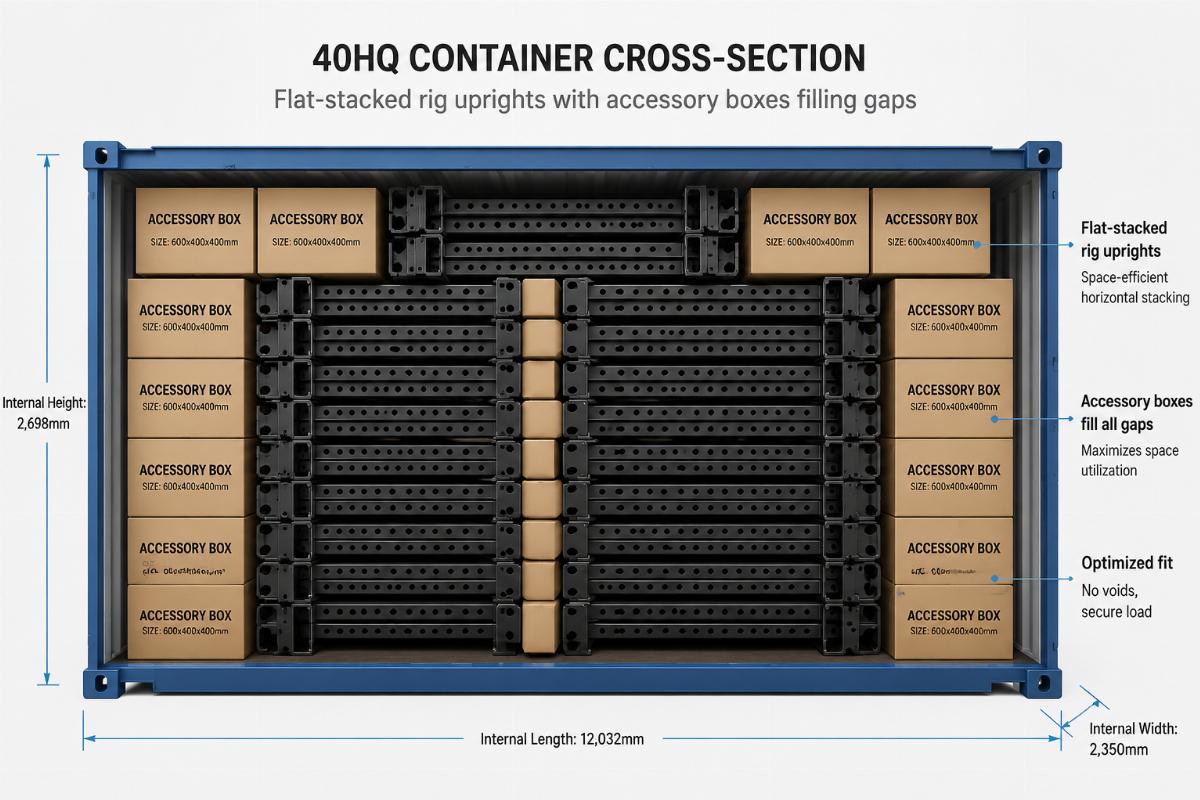
The physical dimensions and packaging method of a leg press machine directly determine how many units fit in a container, and this loading efficiency is a hidden cost factor in any leg press machine wholesale deal.
A commercial plate-loaded leg press is one of the larger items in a strength equipment lineup. The frame is constructed from heavy-gauge steel, the guide rods are long, and the seat assembly adds bulk. Factories typically package these machines in a knocked-down or partially disassembled format to maximize container utilization [NEED_CITE: packaging and loading optimization for commercial strength training equipment]. The seat may be detached, the weight horns removed, and the frame nested where possible. Even with optimized packaging, the number of leg press units per container is limited by weight distribution and volumetric capacity.
For a leg press machine wholesale order, the factory will calculate the loading plan before confirming the order. A standard container may hold a specific range of units depending on the model’s footprint and the packaging configuration. If the buyer wants to mix the leg press with other machines in the same container, the loading plan must account for the dimensional compatibility of each item. A poorly planned mix can leave unused space in the container, meaning the buyer pays for ocean freight on air.
I once reviewed a loading plan where a buyer had ordered a leg press machine wholesale batch alongside a large quantity of adjustable benches. The benches were packaged in flat cartons that could be stacked, but the leg press frames, even partially disassembled, created irregular voids that the bench cartons could not fill. The container was sealed with unused cubic capacity, and the per-unit shipping cost for the leg presses was higher than it needed to be. Rearranging the loading sequence and adjusting the bench packaging orientation recovered enough space to fit additional units on the next shipment.
Loading efficiency factors to discuss with the factory:
- Request a detailed loading plan with unit count per container before confirming the order.
- Ask whether the factory offers nested or knock-down packaging to improve container fill rate.
- Confirm whether mixed-SKU containers are loaded by the factory or by a third-party consolidation warehouse, as this affects loading precision.
- Inquire about the weight limit per container and whether the leg press machines approach the limit before the container is volumetrically full.
Optimizing the loading plan ensures the buyer gets maximum value from every container and avoids paying freight on empty space.
What Payment Terms Are Standard for a Leg Press Machine Wholesale Order?
Payment terms for a leg press machine wholesale order are typically structured in stages tied to production and shipment milestones, not as a single lump sum, and the exact split is negotiable within industry norms.
The most common payment structure for a leg press machine wholesale deal from a Shandong factory is a deposit upon order confirmation, a midpoint payment triggered by a production status update or pre-shipment inspection, and a final balance paid before the container is released or against copy of the bill of lading [NEED_CITE: standard payment milestone structures for commercial fitness equipment exports]. The deposit secures raw material procurement—steel tubing, weight plates, upholstery—and schedules the production slot. The midpoint payment confirms that the order is progressing and gives the factory working capital to continue production without cash flow interruption. The final balance ensures the factory receives full payment before the shipping documents are released to the buyer.
Some buyers attempt to negotiate open-account terms or extended payment windows, especially for repeat orders. Factories may consider this for established buyers with a proven reorder history, but for a first-time leg press machine wholesale order, the staged payment structure is the industry standard and is unlikely to be waived. Letters of credit are occasionally used for very large orders, but the bank charges and documentation requirements add cost and complexity that both parties generally prefer to avoid for orders at the wholesale tier.
A buyer in Central America placed a leg press machine wholesale order and requested that the final balance be paid thirty days after the container arrived at the destination port. The factory declined, as the goods would already be in the buyer’s possession and the factory would have no leverage if a quality dispute arose. The two sides compromised on a structure where the final balance was paid against scanned copies of the shipping documents, giving the buyer visibility into the shipment status before releasing funds while ensuring the factory was paid before the original documents were released.
Payment term elements to agree on before production:
- The exact percentage split for deposit, midpoint, and final payment.
- The trigger event for each payment milestone (order confirmation, production photo, pre-shipment inspection, bill of lading copy).
- The currency of payment and any exchange rate fluctuation provisions.
- Whether the payment method is bank transfer, letter of credit, or another instrument, and who bears the bank fees.
Aligning payment milestones with production and shipment events protects both the buyer’s cash flow and the factory’s working capital.
Conclusion
A leg press machine wholesale order at the MOQ 100 level succeeds when the buyer and factory align on five terms before production begins: the MOQ structure across the product family, the Incoterm and port charge allocation, the OEM branding conditions and reorder commitments, the container loading efficiency plan, and the staged payment milestone schedule. Each of these terms interacts with the others, and a gap in any one area creates friction that delays delivery and erodes margins. Defining them clearly in writing at the outset turns a complex international transaction into a repeatable, predictable process.