01 / Scenario
STUDIO
P
High-End Pilates Studios
Premium aesthetics meet quiet operation for boutique studio environments.

ISO
9001
CE
Certified
OEM
Available
10YR
Warranty
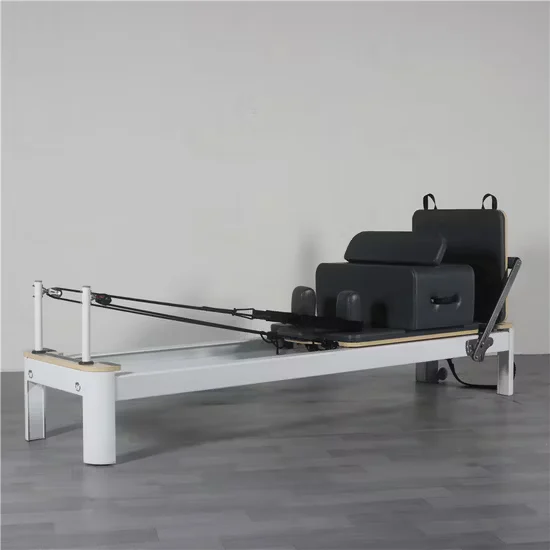
Aluminum Pilates Reformer with Tower, 2390×900×1960mm, 120kg Net Weight — features corrosion-resistant aluminum carriage rail system with sealed bearings for smooth, low-friction movement under daily studio loading, reinforced tower mount distributing spring and bar loads without joint flex, and modular accessory configuration including long box, jump board, and platform for comprehensive programming. Engineered with color-coded spring resistance progression maintaining consistent tension without fatigue over extended commercial use. Backed by 3-year warranty with full OEM customization and mill-certified aluminum alloy traceability for long-term structural integrity.
// Spec Highlights
• Direct from Manufacturer · No Middlemen · Worldwide Shipping
01
// Material
Imported Solid Wood
Premium hardwood frames sourced for density and visual warmth.
02
// Hardware
Medical-Grade Silent
Whisper-quiet pulleys and springs for clinical environments.
03
// Customization
Appearance OEM
Color, upholstery, and branding tailored to your studio.
04
// Service
Layout Design
Free venue planning for studios and rehab institutions.
Every component is selected for longevity, performance, and aesthetic harmony - from imported hardwood frames to silent medical-grade accessories.
// Features
Every Unit Load-Tested — Our commercial aluminum pilates reformer with tower undergoes individual load verification before shipment, ensuring the carriage rail and tower mount perform consistently under repeated studio-level use.
| Parameter | Value |
|---|---|
| Product Type | Pilates Reformer with Tower |
| Model NO. | SRY-12 |
| Frame Construction | Aluminum alloy |
| Specification | 2390×900×1960mm |
| Net Weight | 120kgs |
| Accessory | Long Box / Jump Board / Platform |
| Color | Black (custom options available) |
| Logo | Customized Is Allowed |
| Age / Gender | Adult / Unisex |
| Warranty | 3 Years |
| Production Capacity | 80 Pieces/Month |
| Facility Type | Typical Use |
|---|---|
| Pilates studio | Daily group and private reformer classes |
| Boutique fitness studio | Mixed-format classes combining reformer and tower exercises |
| Rehabilitation and physical therapy center | Controlled resistance protocols for mobility and post-injury recovery |
| Hotel and resort wellness facility | Premium equipment accommodating varied user skill levels |
| Commercial gym functional training zone | Dedicated Pilates and mobility station within a larger strength floor |
Rail tolerance and wheel bearing specification determine whether a reformer survives its first year in a high-traffic studio.
Most reformers sold as commercial grade use carriage wheels with open bearings and rails that are not ground to tight flatness tolerances. Under daily studio scheduling — where a single unit may see eight or more sessions per day — open bearings accumulate chalk dust, sweat residue, and particulate debris, developing lateral play and audible grinding within months [NEED_CITE: bearing sealing requirements for cyclic loading in fitness environments]. Rail flatness deviation causes the carriage to bind during off-center loading, forcing instructors to adjust client positioning around equipment limitations rather than programming intent. A commercial aluminum pilates reformer with tower must address the carriage-to-rail interface first, because this is where structural tolerance determines long-term serviceability.
The Pilates Reformer with Tower covers the full range of supine, prone, seated, and standing movement patterns, targeting core stabilization, hip and shoulder mobility, and controlled eccentric resistance through the spring system. In a studio configuration, it pairs with mat stations and small apparatus for circuit-format classes, while functioning as a standalone unit for private sessions. It accommodates users across a wide range of body sizes within a compact footprint of roughly 2390×900mm, making it suitable for facilities running high-density class schedules where floor space must serve multiple programming formats. The commercial aluminum pilates reformer with tower supports both group instruction and individual rehabilitation protocols without requiring a dedicated machine per client.
Static loading on the carriage during holds, impact loading from jump board sequences, and eccentric loading during controlled spring returns all concentrate stress at the tower mount joint and the carriage wheel contact points. In a studio running six to ten sessions daily, the spring attachment hardware undergoes thousands of tension-release cycles per week, and the tower bars experience repeated bending moments at their mounting points [NEED_CITE: fatigue cycle classification for structural joints in training equipment]. Upholstery contact surfaces face compression and shear from user weight shifts, while the aluminum frame resists torsional stress during asymmetrical exercises. Coatings and finishes must withstand daily exposure to sweat, cleaning agents, and chalk without degradation at high-contact zones.
The aluminum frame construction provides corrosion resistance and dimensional stability under the cyclic loading patterns inherent to studio use, maintaining rail alignment without the progressive deformation that thin-wall painted steel can exhibit over time. The 2390×900×1960mm overall dimension provides a full-length carriage travel path with sufficient tower height for standing spring exercises and overhead bar work. The included long box, jump board, and platform expand the exercise repertoire without requiring separate apparatus purchases, and the 120kg net weight anchors the unit firmly to the floor during dynamic movements. Custom logo application allows studio branding consistency across a fleet of matching units.
Aluminum extrusions with insufficient wall thickness deflect under repeated carriage loading, causing the rail to develop a visible crown that prevents smooth carriage travel. Non-sealed carriage wheel bearings require frequent cleaning and replacement, generating maintenance labor costs that compound across a fleet of reformers. Upholstery bonded with low-grade adhesive delaminates under sweat exposure and daily compression, requiring full reupholstery rather than simple pad replacement. Tower mounts secured with undersized fasteners loosen under spring tension cycling, creating lateral play in the tower bars that compromises exercise precision and creates a perceived equipment failure. When replacement springs, wheels, and upholstery pads are not available through the original supplier, the entire unit becomes disposable once any single component wears out [NEED_CITE: maintenance interval expectations for high-use studio equipment].
The aluminum carriage rail system is specified for continuous commercial studio use rather than light-commercial scheduling, meaning rail flatness and wheel bearing selection are matched to daily multi-session operation. The tower attachment integrates into the main frame structure so that spring and bar loading distributes through the aluminum extrusion rather than concentrating at a single bolt point. Every unit receives individual load verification before shipment, confirming carriage travel smoothness and tower rigidity under tension. The three-year warranty reflects confidence in structural longevity, and OEM customization — including color and logo — supports studio fleet consistency. Floor planning guidance ensures correct reformer spacing for safe instructor circulation and client clearance during movement sequences.
Provide your studio floor dimensions and target class capacity to receive a 2D-3D layout showing optimal reformer placement, instructor sightlines, and client flow paths. Specify your expected daily session volume per unit so structural grade and warranty terms can be confirmed against your scheduling model. Indicate your target user demographic and any accessibility requirements so accessory configuration and adjustment ranges can be verified. Communicate any branding requirements — custom logo placement, frame color, or upholstery selection — to ensure fleet consistency across your order.
Q: How do you distinguish a true commercial Pilates reformer from a light-commercial model in frame and rail construction?
A: Commercial reformers use aluminum extrusions with sufficient wall thickness to resist deflection under daily multi-session loading, paired with sealed carriage bearings rated for continuous use. Light-commercial models often reduce alloy grade and bearing specification, resulting in rail play and noise within months of studio-level scheduling. Verify the frame alloy specification and bearing seal type rather than relying on marketing terminology.
Q: What aluminum alloy specification is required for daily studio use without rail deformation or noise?
A: Studio-grade reformers require aluminum alloy with adequate temper specification and wall thickness to maintain dimensional stability under thousands of carriage travel cycles per week. The rail surface must be finished to a flatness tolerance that prevents binding during off-center loading. Request the material test report confirming alloy grade and temper to verify suitability for your scheduling volume.
Q: How does the tower attachment integrate structurally with the reformer frame?
A: The tower mounts directly into the aluminum frame extrusion, distributing spring tension and bar loading through the main structure rather than relying on surface-mounted brackets. This prevents joint loosening under repeated cyclic loading from spring exercises. Fastener specification and mount geometry determine long-term rigidity, and these should be verified against your expected session frequency.
Q: What maintenance cycle should we expect for carriage wheels, springs, and upholstery in a high-traffic studio?
A: Carriage wheel bearings require inspection intervals based on daily session volume, with sealed bearings extending service intervals compared to open designs. Springs maintain consistent tension over thousands of cycles before fatigue replacement is needed. Upholstery lifespan depends on cleaning protocol adherence and adhesive quality, with commercial-grade materials resisting delamination under daily sweat and compression exposure.
Q: How should we plan studio floor layout with correct reformer spacing for class instruction?
A: Each reformer station requires lateral and rear clearance for instructor access, client movement, and safe egress during dynamic exercises such as jump board sequences. The tower height adds a vertical clearance consideration if overhead bar work is programmed. A detailed floor plan CAD layout should be generated from your actual room dimensions rather than applying generic spacing guidelines.
Premium aesthetics meet quiet operation for boutique studio environments.
Medical-grade silence and precision for sports & postpartum recovery.
Furniture-grade craftsmanship for premium residential installations.
Compact premium setups for one-on-one and small-group training.
Aesthetic Pilates integration for hybrid wellness studio programming.
Multi-unit deployment with instructor-grade reliability for certification programs.
Tell us about your project. Our team will respond within 24 hours with pricing, customization options, and shipping details.
// Sales Director
William
+86 132 2531 1800
// Export Manager
Bella
+86 198 5412 8032
william@bickfit.com