01 / Scenario
STUDIO
P
High-End Pilates Studios
Premium aesthetics meet quiet operation for boutique studio environments.
ISO
9001
CE
Certified
OEM
Available
10YR
Warranty
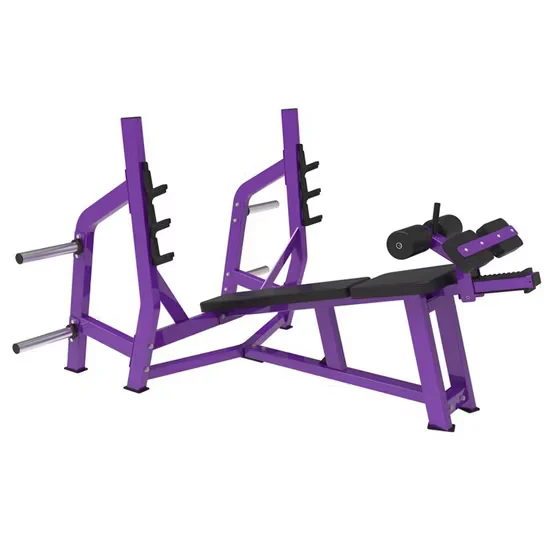
Commercial Decline Bench, 1500×1150×1280mm, 65kg Net Weight, Steel Frame — engineered with 11-gauge steel tubing and robotic MIG continuous welding to eliminate joint fatigue under repeated heavy loading. Frame and cushion colors are fully customizable to align with facility branding without compromising structural or material integrity. Every unit undergoes three-stage QC including individual load testing before shipment, backed by a 10-year frame warranty.
// Spec Highlights
• Direct from Manufacturer · No Middlemen · Worldwide Shipping
01
// Material
Imported Solid Wood
Premium hardwood frames sourced for density and visual warmth.
02
// Hardware
Medical-Grade Silent
Whisper-quiet pulleys and springs for clinical environments.
03
// Customization
Appearance OEM
Color, upholstery, and branding tailored to your studio.
04
// Service
Layout Design
Free venue planning for studios and rehab institutions.
Every component is selected for longevity, performance, and aesthetic harmony - from imported hardwood frames to silent medical-grade accessories.
// Features
Traceable Steel — Every frame tube is traceable to the mill coil certificate before it enters the cutting line.
| Parameter | Value |
|---|---|
| Product Type | Incline Decline Bench |
| Frame Material | Steel |
| Product Dimensions | 1500×1150×1280mm |
| Net Weight | 65kg |
| Assembly State | Unfolded |
| Power Source | Manual |
| Main Frame Color | Available according to customer requirements |
| Cushion Color | Available according to customer requirements |
| Upholstery | Available in standard or high-density options |
| Customization | Available |
| OEM/ODM | Acceptable |
| Certification | ISO 9001, CE |
| Production Capacity | 500 PCS/Month |
| Facility Type | Typical Use |
|---|---|
| Commercial gym strength floor | Free weight zone decline pressing and decline sit-up stations |
| Hotel and resort fitness center | Compact footprint bench for limited-space strength corners |
| University strength and conditioning room | Athlete-specific decline core and pressing work |
| Community fitness center | Durable bench for unsupervised high-rotation environments |
| Rehabilitation and performance center | Controlled-angle decline work for return-to-training protocols |
The joint where the adjustment pin meets the upright tube is where structural failure begins on under-built benches.
A commercial decline bench endures repeated eccentric loading every time a user lowers themselves onto the pad or re-racks a loaded barbell. The upright support tube absorbs this energy, and when the steel gauge is described only as "commercial grade" with no mill documentation, there is no way to verify what the frame can actually sustain over thousands of loading cycles. Spot-welded joints at the adjustment bracket are particularly vulnerable — they pass a visual inspection at the factory but develop hairline cracks once the bench enters a high-traffic rotation where it sees dozens of users per day. [NEED_CITE: EN 957 structural requirements for stationary training equipment]
The consequence is not always catastrophic failure. More often it manifests as progressive wobble that gym staff attribute to loose bolts, when the real cause is fatigue damage accumulating inside the weld zone. By the time the movement becomes noticeable to users, the joint has already lost a significant portion of its load-bearing cross-section.
This bench occupies a specific role in the free weight zone: it provides the fixed-angle decline position needed for decline pressing variations and weighted core work that flat and incline benches cannot replicate. In a fully equipped strength floor, it complements flat benches and adjustable FID stations by covering the negative-angle movement plane without requiring users to improvise with flat benches propped on plates.
For facilities running high member density during peak hours, a dedicated decline station eliminates the bottleneck that occurs when users compete for adjustable benches set to a decline position. The fixed 1500×1150mm footprint allows it to slot between power racks and flat bench stations with adequate clearance for barbell travel and spotter movement, accommodating users across a wide range of body sizes without requiring equipment modification.
Every repetition on a decline bench involves the user lowering their bodyweight plus any external load onto the pad, creating an impact cycle that travels through the cushion into the frame tube beneath. Unlike a leg press where the load path is linear and contained, the decline bench absorbs off-axis forces when users shift position or control their descent unevenly. These lateral components create stress concentrations at the weld junctions where the pad support rails meet the main upright. [NEED_CITE: weld classification and fatigue performance in structural steel]
The powder coating at these junctions faces constant micro-flexing, and if the pre-treatment and coating thickness are inadequate, the first visible sign of structural compromise is chipping at the weld toe — not because the weld failed, but because the coating could not accommodate the frame deflection under load. Upholstery on the contact surface compresses and recovers thousands of times daily, and low-density foam develops permanent compression set that changes how the load transfers into the frame beneath it.
The 11-gauge steel frame specification matters because the wall thickness directly governs how much the upright tube deflects under off-center loading. A thinner tube does not necessarily fail immediately — it flexes beyond its elastic limit over repeated cycles, and each flex event accumulates plastic deformation at the highest-stress cross-section. This is why frame gauge must be paired with mill-certified material documentation rather than a generic "heavy-duty" label.
Continuous robotic MIG welding produces a uniform weld bead along the entire joint length, distributing stress across the full perimeter rather than concentrating it at discrete spot-weld locations. On a decline bench, the critical joints are where the pad support brackets connect to the main frame and where the foot-hold assembly anchors to the base — both locations experience cyclic loading that spot welds cannot sustain indefinitely.
The 200μm powder coating applied over sandblasted steel provides a barrier thickness sufficient to withstand contact abrasion at adjustment points and roller positions. Pre-treatment through sandblasting removes mill scale and creates the surface profile necessary for mechanical adhesion, meaning the coating resists chipping when the adjustment pin is repeatedly inserted and removed.
A decline bench built with thin-wall tubing does not announce its inadequacy on day one. The first symptom is usually a slight rocking that maintenance staff try to correct by tightening hardware, not realizing the frame itself has deformed beyond recovery. Once the upright tube has taken a permanent set, no amount of bolt adjustment restores stability, and the entire frame must be retired — often within a timeframe that makes the "savings" on initial purchase irrelevant against replacement cost and member complaints. [NEED_CITE: structural steel fatigue under cyclic commercial loading]
Non-sealed pivot points at the adjustment mechanism allow dust and moisture ingress that accelerates wear on the pin-and-hole interface, creating play that users feel as looseness before staff notice it visually. Low-density upholstery foam compresses permanently within months of commercial use, leaving a pad that no longer distributes load evenly and concentrates point forces into the frame at specific locations. When replacement upholstery is not available as a stocked spare part, the entire bench becomes disposable once the pad deteriorates.
The 11-gauge frame steel comes with a mill certificate traceable to the coil, so the material specification is verifiable rather than claimed. This matters for a decline bench because the upright tubes carry the full user load plus external weight at an angle, and the margin between elastic behavior and permanent deformation depends entirely on the actual wall thickness of the tube in use.
Robotic MIG welding produces continuous weld lines at every frame junction — the pad support brackets, the foot-hold anchors, the base-to-upright connections — eliminating the spot-weld weak points that fail first under cyclic loading. Every unit undergoes load testing before leaving the factory floor, not sample-based testing on a production batch, which means the specific bench arriving at the facility has been individually verified under load.
The 200μm industrial powder coating over sandblasted steel protects the high-wear adjustment zone where pins and brackets see constant contact. The 10-year frame warranty reflects confidence in the structural specification rather than a marketing number backed by limited coverage. Floor planning support includes 2D and 3D CAD layouts that position the decline bench with correct safety clearances for barbell travel and spotter access within the free weight zone, preventing the layout errors that create unusable gaps or collision risks between adjacent stations.
Provide the total free weight zone area and the intended equipment list so the decline bench can be positioned within a coordinated 2D or 3D floor plan with verified clearances. State the expected daily user volume to confirm the structural grade matches the traffic level the bench will experience.
Identify the user population — general membership, athletic teams, or mixed commercial — so the frame and pad configuration aligns with the body size range the bench must accommodate. Note any customization requirements including frame color, cushion color, and facility branding applied to the upholstery or frame.
Q: How do I verify the steel gauge on a decline bench before purchase?
A: Request the mill certificate that traces the frame steel back to the original coil. This document states the actual gauge, grade, and chemical composition of the material used. Without it, "commercial grade" is an unverifiable claim that provides no structural assurance for equipment subjected to daily cyclic loading in a gym environment.
Q: What is the difference between spot welding and continuous MIG welding on bench frames?
A: Spot welding creates discrete connection points that concentrate stress at each weld location, making them vulnerable to fatigue cracking under repeated loading. Continuous MIG welding produces an unbroken weld bead along the full joint perimeter, distributing forces evenly and significantly extending the fatigue life of structural connections on equipment used in high-traffic commercial facilities.
Q: How does powder coating thickness affect long-term durability at adjustment points?
A: Thicker industrial powder coating resists chipping and abrasion where metal components make repeated contact during position adjustments. A coating applied over proper sandblast pre-treatment adheres mechanically to the surface profile, maintaining its protective barrier against moisture and corrosion at the high-wear zones most prone to coating breakdown over years of daily commercial use.
Q: Why does upholstery density matter for commercial decline benches?
A: High-density foam resists compression set far longer than standard-density alternatives, maintaining even load distribution across the pad surface. When foam compresses permanently, point loads concentrate into the frame beneath, accelerating structural fatigue at specific locations and creating an uncomfortable user experience that leads to member complaints and premature equipment replacement.
Q: What layout clearances are needed around a decline bench in a free weight zone?
A: Adequate space must account for full barbell travel during decline pressing, spotter positioning on both sides, and user entry and exit from the foot-hold end. Providing a 2D or 3D floor plan to your equipment supplier allows them to verify these clearances against the specific bench dimensions and adjacent equipment positions before installation begins.
Premium aesthetics meet quiet operation for boutique studio environments.
Medical-grade silence and precision for sports & postpartum recovery.
Furniture-grade craftsmanship for premium residential installations.
Compact premium setups for one-on-one and small-group training.
Aesthetic Pilates integration for hybrid wellness studio programming.
Multi-unit deployment with instructor-grade reliability for certification programs.
Tell us about your project. Our team will respond within 24 hours with pricing, customization options, and shipping details.
// Sales Director
William
+86 132 2531 1800
// Export Manager
Bella
+86 198 5412 8032
william@bickfit.com