
01 / Scenario
STUDIO
P
High-End Pilates Studios
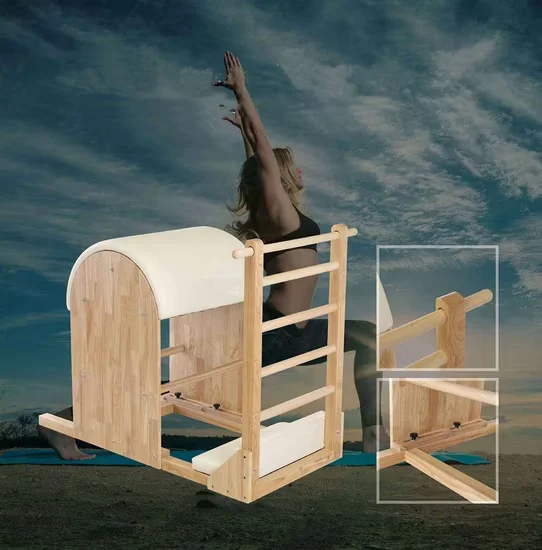
Premium aesthetics meet quiet operation for boutique studio environments.
ISO
9001
CE
Certified
OEM
Available
10YR
Warranty
Pilates Ladder Barrel Trainer, Solid Oak Frame, 1100×770×980mm — engineered with reinforced steel bolt-through hardware for long-term joint integrity under repetitive loaded stretching, paired with high-density upholstery vinyl rated for 6–8 hours of daily studio use. Includes long box, jump board, and platform accessories for full spinal articulation programming. Backed by FSC-certified hardwood sourcing with 8% moisture content control to prevent warping in humid studio environments.
// Spec Highlights
• Direct from Manufacturer · No Middlemen · Worldwide Shipping
01
// Material
Imported Solid Wood
Premium hardwood frames sourced for density and visual warmth.
02
// Hardware
Medical-Grade Silent
Whisper-quiet pulleys and springs for clinical environments.
03
// Customization
Appearance OEM
Color, upholstery, and branding tailored to your studio.
04
// Service
Layout Design
Free venue planning for studios and rehab institutions.
Every component is selected for longevity, performance, and aesthetic harmony - from imported hardwood frames to silent medical-grade accessories.
// Features
Structural Longevity Guaranteed — Solid oak frame paired with reinforced steel hardware withstands years of repetitive spinal articulation in commercial studio environments.
| Parameter | Value |
|---|---|
| Product Type | Pilates Ladder Barrel |
| Product Dimensions | 1100×770×980mm |
| Frame Construction | Solid Oak with Reinforced Steel Hardware |
| Net Weight | 50kgs |
| Upholstery | Standard or High-Density Options Available |
| Color | Solid Color / Custom Options Available |
| Logo | Customization Allowed |
| Accessories | Long Box / Jump Board / Platform |
| Target Demographic | Adult, Unisex |
| Production Capacity | 800 Pieces/Month |
| Warranty | 3 Years |
| Facility Type | Typical Use |
|---|---|
| Commercial Pilates Studio | Daily group classes focusing on spinal articulation and core conditioning |
| Rehabilitation & Physical Therapy Center | Post-injury mobility restoration and posture correction |
| Boutique Fitness & Yoga Facility | Flexibility training and deep stretching sequences |
| Hotel Fitness Center | Premium guest amenities for low-impact recovery sessions |
| University Athletic Department | Athlete mobility maintenance and active recovery protocols |
Solid oak resists humidity-induced warping that compromises barrel curvature and alignment.
Many facilities utilize softwood or laminated plywood barrels to manage initial procurement costs, but these materials degrade rapidly under fluctuating studio humidity and continuous bodyweight loading. [NEED_CITE: wood dimensional stability under cyclic loading conditions] When the internal structure shifts, the barrel’s arc loses its geometric tolerance, leading to uneven resistance curves that frustrate users and compromise the biomechanical intent of the exercises.
This commercial pilates ladder barrel trainer serves as the primary station for extension, flexion, and lateral flexion movements within a comprehensive Pilates curriculum. It complements the Reformer and Cadillac by providing unsupported, bodyweight-driven articulation that challenges deep stabilizers without spring assistance. Ideal for facilities running 6-8 hours of daily classes, the footprint allows for placement in dedicated flexibility zones or high-density circuit layouts, accommodating a wide range of user heights and limb proportions through adjustable ladder spacing.
Unlike dynamic lifting equipment that sees peak forces during concentric phases, this unit endures sustained eccentric tension and static holds as users drape over the apex. [NEED_CITE: fatigue limits of solid wood in cantilevered applications] The primary stress points occur where the steel ladder rungs mount to the oak frame and where the upholstery foam compresses against the wooden substructure. In high-traffic environments, non-reinforced mounting points loosen, creating play and audible creaking that signals structural compromise long before visible failure occurs.
The choice of solid oak over engineered alternatives provides a dense, tight-grain substrate that maintains its shape despite the sweat and humidity inherent in active studios. The steel ladder rung mounting hardware utilizes bolt-through construction rather than surface-mounted screws, ensuring that dynamic pulling forces do not strip the wood threads over time. Upholstery options range from standard to high-density foam; in a commercial setting, higher density foam resists permanent compression set, preserving the smooth arc required for safe spinal rolling. The 200μm industrial powder coating on any exposed steel elements prevents rust from sweat exposure and cleaning chemicals.
When manufacturers reduce costs by using thin-walled steel hardware or low-grade plywood, the immediate savings are quickly negated by maintenance demands. Thin-walled rungs bend under the weight of heavier users, creating misalignment that forces the wood frame into torsion. Low-density foam upholstery bottoms out within months, requiring expensive re-covering services that take the unit out of commission. Furthermore, proprietary hardware without standard sizing means that when a rung bends, the entire side rail often requires replacement rather than a simple swap of the damaged component. [NEED_CITE: lifecycle cost analysis of commercial fitness flooring and equipment]
Our approach extends beyond the unit itself to how it functions within your floor plan. We provide 2D-3D CAD support to ensure the 1100×770×980mm footprint is integrated with proper safety clearance for users extending legs overhead or rolling back. The solid oak construction is backed by a 3-year warranty and full OEM customization capabilities, allowing you to match studio branding on the leatherette or frame finish. Every unit undergoes load testing to verify that the oak frame and steel hardware interface remains rigid under maximum eccentric tension.
Provide your total studio square footage and intended class size to receive a customized 2D-3D floor plan that optimizes traffic flow between the commercial pilates ladder barrel trainer, Reformers, and Cadillacs. Specify your target demographic’s height range to confirm ladder spacing adjustments. Share your branding guidelines for custom logo placement and upholstery color matching to ensure cohesive studio aesthetics.
Q: How can I distinguish commercial-grade Pilates barrels from home-use models?
A: Commercial-grade barrels prioritize structural density and hardware reinforcement. Look for solid wood species like oak rather than MDF or plywood, and ensure the ladder rungs use bolt-through mounting rather than surface screws. Commercial upholstery will feature higher density foam and tear-resistant vinyl designed to withstand daily cleaning and continuous body contact without delaminating.
Q: Why does solid wood outperform engineered wood in a studio environment?
A: Studios experience significant humidity fluctuations from heating, cooling, and respiration during classes. Solid oak has natural dimensional stability and a tight grain structure that resists the warping and delamination common in plywood or MDF when exposed to moisture. This stability ensures the barrel’s curvature remains consistent, which is critical for maintaining proper spinal alignment during exercises.
Q: How does ladder rung spacing affect the exercise range of motion?
A: Adjustable rung spacing allows the equipment to accommodate users of vastly different heights, from petite adults to tall athletes. Proper spacing ensures the user’s hips sit correctly at the apex of the barrel, allowing for full spinal flexion and extension without the feet slipping or the knees locking. Incorrect spacing forces the user to compensate, reducing the effectiveness of the stretch.
Q: What is the expected replacement cycle for upholstery in high-traffic studios?
A: In facilities running multiple classes daily, standard foam may compress permanently within 12 to 18 months. High-density commercial foam extends this cycle significantly, often lasting several years depending on user weight averages. Vinyl covers may show surface wear from friction and cleaning chemicals; selecting tear-resistant, antimicrobial vinyl grades can extend the aesthetic lifespan of the upholstery.
Q: What clearance is required between ladder barrels and other equipment?
A: Safe floor planning requires a minimum buffer zone around the unit to allow users to extend their legs fully overhead or perform side-lying series without contacting adjacent equipment. Generally, a clearance equal to the height of the tallest user plus the length of the barrel is recommended in the primary axis of movement to ensure instructor access and user safety.
Premium aesthetics meet quiet operation for boutique studio environments.
Medical-grade silence and precision for sports & postpartum recovery.
Furniture-grade craftsmanship for premium residential installations.
Compact premium setups for one-on-one and small-group training.
Aesthetic Pilates integration for hybrid wellness studio programming.
Multi-unit deployment with instructor-grade reliability for certification programs.
Tell us about your project. Our team will respond within 24 hours with pricing, customization options, and shipping details.
// Sales Director
William
+86 132 2531 1800
// Export Manager
Bella
+86 198 5412 8032
william@bickfit.com


