01 / Scenario
STUDIO
P
High-End Pilates Studios
Premium aesthetics meet quiet operation for boutique studio environments.

ISO
9001
CE
Certified
OEM
Available
10YR
Warranty
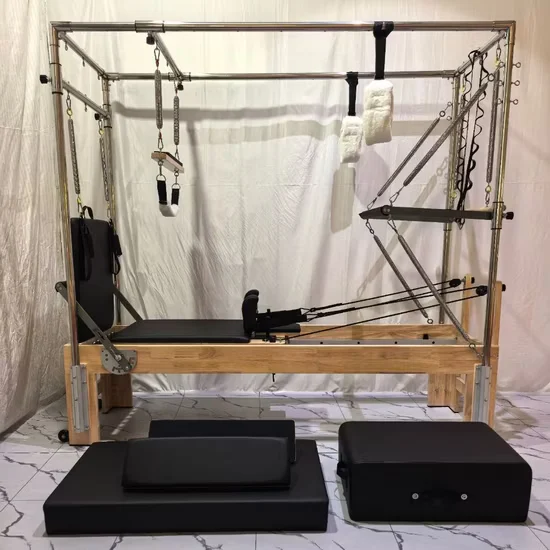
Pilates Reformer with Tower, Solid Wood Frame, 2460×730×1900mm — engineered with integrated tower mount ensuring long-term pulley alignment and spring anchor stability under daily tension cycling. Includes long box, jump board, platform, and half trapeze as standard configuration. Backed by 3-year warranty and 32-point inspection with full load testing before shipment.
// Spec Highlights
• Direct from Manufacturer · No Middlemen · Worldwide Shipping
01
// Material
Imported Solid Wood
Premium hardwood frames sourced for density and visual warmth.
02
// Hardware
Medical-Grade Silent
Whisper-quiet pulleys and springs for clinical environments.
03
// Customization
Appearance OEM
Color, upholstery, and branding tailored to your studio.
04
// Service
Layout Design
Free venue planning for studios and rehab institutions.
Every component is selected for longevity, performance, and aesthetic harmony - from imported hardwood frames to silent medical-grade accessories.
// Features
Frame Integrity First — Solid wood construction with integrated tower mounting resists warping and fastener loosening under repeated spring tension cycling.
| Parameter | Value |
|---|---|
| Product Type | Pilates Reformer with Tower |
| Product Dimensions | 2460×730×1900mm |
| Net Weight | 150kgs |
| Frame Material | Wood |
| Color | Solid Color |
| Accessory | Long Box / Jump Board / Platform |
| Half Trapeze | Included |
| Warranty | 3 Years |
| Production Capacity | 80 Pieces/Month |
| Logo | Customized Is Allowed |
| Facility Type | Typical Use |
|---|---|
| Commercial Pilates studio | Daily group and private reformer sessions with full tower exercise library |
| Boutique fitness studio | High-frequency class rotation combining reformer and tower movement patterns |
| Rehabilitation and physiotherapy center | Controlled resistance progressions for joint mobility and post-injury conditioning |
| Hotel and resort wellness facility | Guest-accessible equipment with low maintenance requirements |
| Private home studio | Comprehensive movement training in a single footprint |
The joint between the reformer bed and tower determines whether pulley cables stay aligned after thousands of use cycles.
Many studios purchase reformers marketed as commercial grade, only to discover that hollow-core wood composites or thin-gauge metal towers develop lateral play at the pulley mount points within months. This misalignment causes cable drag against pulley edges, creating uneven resistance through the movement range and accelerating cable wear. The structural solution lies in how the tower anchors to the bed frame — through-bolted connections with reinforcement plates distribute the cantilevered load across a wider contact surface, preventing the loosening that compromises pulley alignment over time. [NEED_CITE: structural requirements for stationary training equipment frame connections]
A reformer with integrated tower serves as the central equipment piece in a Pilates studio, covering supine, prone, seated, and standing movement patterns across all major muscle chains. This unit complements mat work zones and standalone apparatus like chairs and barrels, allowing instructors to progress clients from stable reformer exercises to more demanding tower-based standing work. The 2460mm length accommodates users across a wide height range, while the tower’s vertical cable routing enables exercises that require overhead and lateral resistance vectors not achievable on the reformer carriage alone. The commercial pilates reformer with tower configuration suits studios running six to ten sessions daily with minimal equipment changeover time between users.
Reformer springs and tower cables experience asymmetric loading during unilateral exercises, creating cyclical fatigue at anchor points where hardware meets the wood frame. Each session generates hundreds of spring stretch-compression cycles, concentrating stress at the eye bolts and attachment points embedded in solid wood. Tower pulley bearings face continuous friction loads as cables change direction under tension, with off-center pulling during standing exercises introducing lateral forces that accelerate bushing wear. The wood frame itself resists compressive forces from jump board impacts and tensile forces from long box exercises where clients pull against spring resistance while positioned on the carriage. [NEED_CITE: fatigue performance requirements for exercise equipment load-bearing connections]
Solid wood frame construction differs fundamentally from plywood or MDF laminate alternatives. Engineered wood composites rely on adhesive bonds between layers, which can delaminate when exposed to the humidity fluctuations and cleaning chemicals common in studio environments. Solid wood maintains fastener thread engagement over repeated adjustment cycles — a critical factor for tower mount bolts that experience vibrational loosening during dynamic exercises. The 150kg net weight indicates substantial mass in the frame and carriage assembly, contributing to stability during standing tower work where lateral forces could shift a lighter unit. Spring configuration determines resistance progression through the range of motion, with multiple springs allowing instructors to match load to client capacity across rehabilitation through advanced conditioning. Pulley bearing type — sealed bearings versus simple bushings — affects smoothness under off-center loading, particularly during tower exercises where the cable pulls at angles rather than straight down.
Engineered wood frames cost less initially but develop fastener loosening as the laminated layers compress and expand at different rates under humidity changes and mechanical loading. When tower mount bolts lose clamping force, pulley alignment shifts, creating cable wear patterns that require premature replacement. Non-sealed pulley bushings develop play within months of daily use, introducing cable vibration that clients feel as resistance inconsistency during slow controlled movements. Thin or poorly applied finishes on wood surfaces chip and wear at contact points where accessories attach and detach, exposing raw material to moisture intrusion. Studios that specify based on price often face higher total cost through replacement parts, instructor complaints about equipment feel, and eventual full-unit replacement when structural degradation reaches a point where repair is no longer viable. [NEED_CITE: maintenance cost analysis for commercial fitness equipment material selection]
The 3-year warranty reflects confidence in the solid wood frame’s ability to maintain structural integrity under sustained commercial use without fastener loosening or material degradation. Solid color finishing allows consistent appearance across multiple units in a studio, with customization available through logo application for brand-aligned facilities. The included half trapeze, long box, jump board, and platform eliminate accessory upsell cycles — studios receive a complete exercise library from initial delivery. Production capacity of 80 units monthly indicates dedicated manufacturing lines rather than intermittent batch production, supporting consistent quality control across orders.
Provide studio floor dimensions and planned equipment count to receive layout recommendations that account for tower exercise clearance requirements and instructor circulation paths. Specify expected daily session volume to confirm that the wood frame and hardware configuration matches your usage intensity. Communicate target client demographics including height range and conditioning levels to verify spring configuration appropriateness. Detail any branding requirements including logo placement and color preferences for multi-unit studio consistency.
Q: How can I verify that a reformer frame uses solid wood rather than engineered composite?
A: Request mill documentation specifying wood species and grade for the frame material. Solid wood shows continuous grain patterns across cut sections, while engineered composites display visible layering or particle structure at edges and joinery points. Inspect fastener locations where hardware embeds into the frame — solid wood maintains thread engagement under repeated adjustment cycles, whereas composites can strip and lose clamping force over time.
Q: What structural factors affect tower stability during standing exercises?
A: Tower stability depends on the mounting method where the tower connects to the reformer bed frame. Through-bolted connections with reinforcement plates distribute cantilevered loads across a larger contact surface, preventing loosening under lateral forces. The frame’s mass and base footprint also contribute — heavier units resist tipping during standing work where clients pull cables at angles away from the equipment centerline.
Q: How should spring configuration match studio client demographics?
A: Studios serving rehabilitation populations need lighter springs with fine resistance increments for early-stage recovery work, while facilities focused on athletic conditioning require heavier springs to challenge trained clients. Multiple springs with varying resistance allow instructors to progress clients across this spectrum without equipment modification. Confirm the included spring set covers your expected client range from post-injury through advanced conditioning levels.
Q: What determines pulley smoothness under off-center loading?
A: Pulley bearing type and cable routing geometry affect smoothness when cables pull at angles rather than straight down. Sealed bearings maintain smooth rotation as contamination accumulates in studio environments, while unsealed bushings develop play that creates resistance inconsistency. Pulley diameter relative to cable thickness also matters — larger pulleys reduce cable bending stress and maintain smoother operation over extended use cycles.
Q: What replacement parts should a studio stock for ongoing maintenance?
A: Springs, cables, and pulley assemblies experience the most wear in daily use and should be stocked as maintenance inventory. Fastener hardware for tower mount points and accessory attachment should also be available, as these components can loosen and require replacement if thread engagement degrades. Confirm parts availability and lead times before purchase to avoid equipment downtime when replacements are needed.
Premium aesthetics meet quiet operation for boutique studio environments.
Medical-grade silence and precision for sports & postpartum recovery.
Furniture-grade craftsmanship for premium residential installations.
Compact premium setups for one-on-one and small-group training.
Aesthetic Pilates integration for hybrid wellness studio programming.
Multi-unit deployment with instructor-grade reliability for certification programs.
Tell us about your project. Our team will respond within 24 hours with pricing, customization options, and shipping details.
// Sales Director
William
+86 132 2531 1800
// Export Manager
Bella
+86 198 5412 8032
william@bickfit.com