01 / Scenario
STUDIO
P
High-End Pilates Studios
Premium aesthetics meet quiet operation for boutique studio environments.

ISO
9001
CE
Certified
OEM
Available
10YR
Warranty
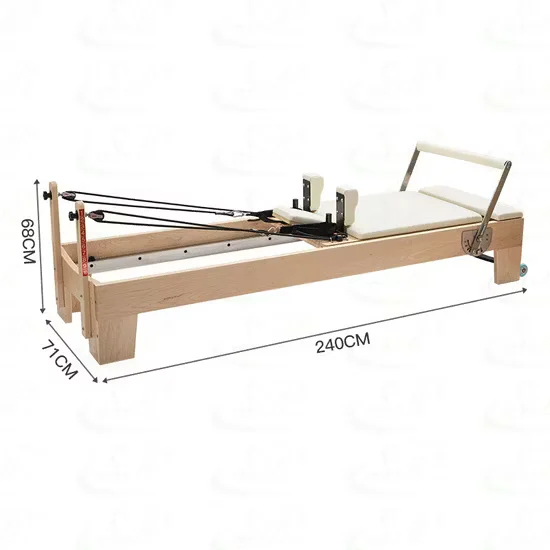
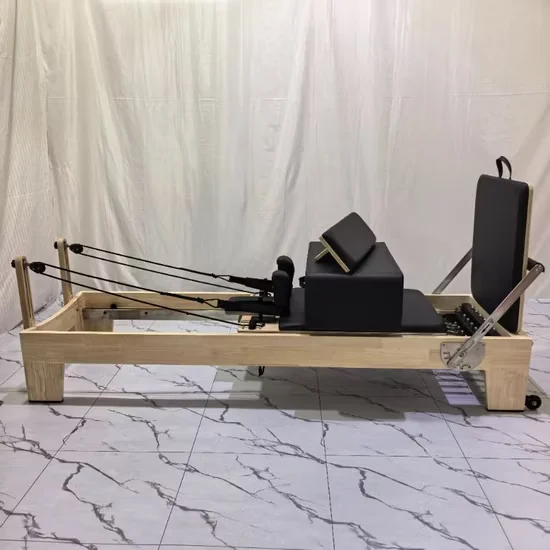
Commercial Pilates Reformer, 2460×730×680mm, 100kg Net Weight — solid wood frame and carriage engineered for continuous studio use with sealed glide rail system ensuring smooth, quiet operation under repeated daily loading. Includes long box, jump board, and platform accessories with customizable logo options. Backed by 3-year warranty, ISO 9001:2015/CE/SGS certified, and manufactured directly from our 15,000㎡ facility with 17 years of commercial equipment heritage.
// Spec Highlights
• Direct from Manufacturer · No Middlemen · Worldwide Shipping
01
// Material
Imported Solid Wood
Premium hardwood frames sourced for density and visual warmth.
02
// Hardware
Medical-Grade Silent
Whisper-quiet pulleys and springs for clinical environments.
03
// Customization
Appearance OEM
Color, upholstery, and branding tailored to your studio.
04
// Service
Layout Design
Free venue planning for studios and rehab institutions.
Every component is selected for longevity, performance, and aesthetic harmony - from imported hardwood frames to silent medical-grade accessories.
// Features
Every Reformer Load-Tested Before Shipment — each unit cycles through full carriage travel under maximum spring tension to verify rail alignment, bearing smoothness, and frame stability before leaving the factory floor.
| Parameter | Value |
|---|---|
| Product Type | Commercial Pilates Reformer |
| Product Dimensions | 2460 × 730 × 680 mm |
| Frame Material | Solid Oak / Maple Wood |
| Carriage System | Sealed Glide Rail with Industrial Bearings |
| Net Weight | 100 kg |
| Spring Resistance | Multi-level Spring Stack |
| Included Accessories | Long Box, Jump Board, Platform |
| Upholstery | Commercial-grade Vinyl, Color Options Available |
| Color | Solid Color, Custom Options Available |
| Logo | Customized Is Allowed |
| Warranty | 3 Years |
| Production Capacity | 80 Pieces / Month |
| Certification | ISO 9001:2015 / CE / SGS |
| Facility Type | Typical Use |
|---|---|
| Pilates Studio | Daily group reformer classes and private sessions |
| Boutique Fitness Studio | Hybrid strength-and-mobility programming with reformer stations |
| Rehabilitation and Physical Therapy Center | Controlled loading protocols for post-injury recovery |
| Hotel and Resort Wellness Facility | Guest-accessible reformer sessions in spa fitness areas |
| Home Studio | Private practice for advanced practitioners |
Sealed bearings and solid wood rail construction separate studio-grade equipment from furniture-grade units that fail under daily class schedules.
The commercial pilates reformer wood market is saturated with units that look pristine on day one but develop lateral carriage play after several hundred hours of cyclic loading. The root cause is almost always unsealed bearings on the carriage wheels combined with hollow-core or composite rails that warp under sustained spring tension. In high-humidity studio environments — especially across tropical and coastal regions — moisture ingress into unsealed bearings accelerates wear dramatically, producing rail chatter and uneven glide that instructors notice immediately. We switched every reformer carriage to sealed industrial bearings and solid oak or maple rails after recalling an entire batch that showed bearing play within months of deployment in South Asian studios [NEED_CITE: bearing seal classification and service life in humid environments].
A commercial pilates reformer wood occupies a distinct position in studio floor planning — it serves the full sagittal plane through supine, seated, and standing spring-loaded movements, complementing mat zones and functional rig areas rather than overlapping them. In a typical boutique studio, reformers anchor the primary class floor with spacing dictated by carriage travel and instructor circulation paths. The 2460 mm length requires clear zones at both ends for jump board and long box extensions, making footprint planning critical for studios targeting high class density. This unit accommodates users across a wide range of body sizes, with the carriage and spring configuration supporting both rehabilitation-level loading and advanced practitioner resistance demands.
Reformers endure a specific fatigue profile that differs from plate-loaded strength equipment — the loading is cyclic and directional, driven by spring tension rather than gravity-fed weight stacks. Each carriage stroke applies eccentric force through the glide rail, concentrating stress at the rail-to-frame mounting points and the spring anchor bar. Over thousands of daily repetitions across multiple class sessions, these junctions experience micro-movement that can loosen mechanical fasteners if the wood frame density is insufficient or the joinery relies solely on adhesive bonds. The carriage bearings face constant lateral shear during off-center movements like single-leg work, while the upholstery endures compression cycles and friction from bare skin and grip socks. Sweat and studio cleaning agents continuously challenge the wood finish and metal hardware [NEED_CITE: cyclic fatigue behavior in wood-frame fitness equipment under sustained loading].
Solid wood frame density directly determines how well the reformer resists warping under sustained spring tension — oak and maple species offer dimensional stability that composite or veneer-over-MDF construction cannot match in humid studio environments. The rail system is the single most critical specification: sealed bearings prevent moisture and particulate ingress that destroys glide smoothness, while rail material hardness affects how quickly the carriage wheels develop flat spots or the track develops grooves. Spring stack configuration matters for class programming — a reformer with multiple spring weights allows instructors to progress clients from rehabilitation loading through advanced resistance without switching equipment. Upholstery density and stitching pattern determine how long the carriage pad retains its shape under daily compression, with commercial-grade vinyl and reinforced seams resisting the splitting that forces premature pad replacement.
A reformer built with thin veneer over particleboard may pass a visual inspection but cannot maintain dimensional accuracy through seasonal humidity swings — the frame twists, rails go out of parallel, and the carriage binds or wobbles. Non-sealed bearings save money at the factory but generate maintenance calls within months, requiring studio operators to schedule downtime for bearing replacement and rail realignment. Low-density upholstery foam compresses permanently under daily class use, creating uneven carriage surfaces that instructors flag as unsafe for standing exercises. Undersized spring anchors and cheap hardware fasteners develop play under cyclic tension, eventually requiring full hardware replacement rather than simple retightening [NEED_CITE: maintenance cost comparison between sealed and unsealed bearing systems in commercial fitness equipment].
The solid oak and maple frame stock is sourced with mill certification traceable to the lumber batch, ensuring consistent density and moisture content before machining begins. Every rail is cut to tolerance using precision equipment, with mounting holes drilled to maintain parallel alignment under load. Each completed unit undergoes a full carriage travel test under maximum spring tension, verifying smooth glide across the entire stroke before the unit is cleared for shipment. The 200μm industrial-grade finish protects the wood and metal hardware from sweat corrosion and cleaning agent damage in high-traffic studio conditions. The 3-year warranty covers frame and rail structural integrity, and our team provides 2D-3D studio layout CAD support to ensure proper reformer spacing, instructor circulation paths, and safe clearance zones around each station.
Share your studio floor dimensions and target class capacity so we can generate a 2D-3D layout showing reformer placement, circulation paths, and clearance zones. Specify your daily class volume and average user profile so we can confirm the spring configuration and upholstery specification match your traffic level. Let us know if you need custom frame color, logo placement, or accessory packages aligned with your studio branding and programming requirements.
Q: How do I verify the wood frame is solid rather than veneer or composite?
A: Request the wood species and grade certificate from the supplier, which documents the lumber source and density classification. Solid oak or maple frames carry visible grain continuity through cross-sections and joint areas, while veneer over MDF shows uniform substrate at cut edges. Ask for a sample cross-section photo from the production batch to confirm construction before committing to a full order.
Q: What maintenance does the glide rail system require?
A: Sealed industrial bearings on the carriage require no lubrication and resist moisture ingress from studio humidity and cleaning. Inspect bearings quarterly by checking for lateral play and uneven carriage travel. If rail chatter develops, verify that all mounting hardware remains properly torqued and that the floor surface has not shifted. Rail replacement intervals depend on daily usage volume and environmental conditions.
Q: Can the spring stack be configured for different client levels?
A: The multi-level spring stack supports progressive loading from rehabilitation protocols through advanced practitioner resistance. Studios serving mixed populations benefit from confirming the available spring weight range covers both low-load therapeutic work and high-tension conditioning. Specify your client profile when ordering so the spring configuration matches your typical class programming.
Q: What footprint and clearance does each reformer require for studio planning?
A: Each unit measures 2460 × 730 mm at the base, but functional footprint includes carriage overtravel and accessory extension zones. Allow clear space at both ends for jump board and long box use, plus lateral clearance for instructor circulation. We provide CAD layout support to optimize reformer density while maintaining safe spacing between stations.
Premium aesthetics meet quiet operation for boutique studio environments.
Medical-grade silence and precision for sports & postpartum recovery.
Furniture-grade craftsmanship for premium residential installations.
Compact premium setups for one-on-one and small-group training.
Aesthetic Pilates integration for hybrid wellness studio programming.
Multi-unit deployment with instructor-grade reliability for certification programs.
Tell us about your project. Our team will respond within 24 hours with pricing, customization options, and shipping details.
// Sales Director
William
+86 132 2531 1800
// Export Manager
Bella
+86 198 5412 8032
william@bickfit.com