01 / Scenario
STUDIO
P
High-End Pilates Studios
Premium aesthetics meet quiet operation for boutique studio environments.
ISO
9001
CE
Certified
OEM
Available
10YR
Warranty
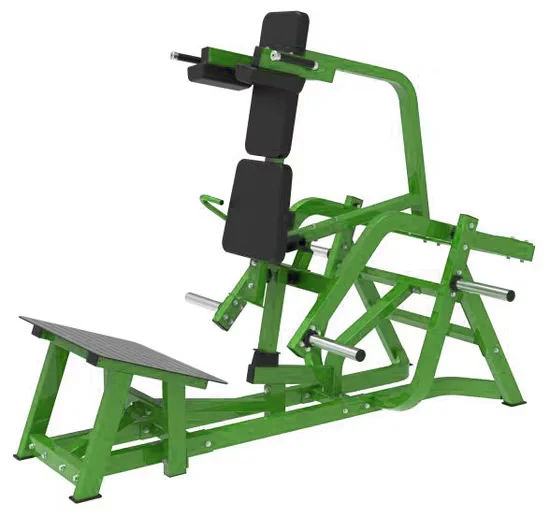
Plate Loaded V-Squat Machine, 1550×1850×1650mm, 160kg Net Weight — engineered with 11-gauge steel frame and robotic MIG continuous welding to eliminate spot-weld fatigue under eccentric loading. Sealed industrial bearings and 200μm powder coating over sandblasted steel ensure long-term durability in high-traffic environments. Every unit undergoes individual load testing before shipment, backed by a 10-year frame warranty and free floor planning support.
// Spec Highlights
• Direct from Manufacturer · No Middlemen · Worldwide Shipping
01
// Material
Imported Solid Wood
Premium hardwood frames sourced for density and visual warmth.
02
// Hardware
Medical-Grade Silent
Whisper-quiet pulleys and springs for clinical environments.
03
// Customization
Appearance OEM
Color, upholstery, and branding tailored to your studio.
04
// Service
Layout Design
Free venue planning for studios and rehab institutions.
Every component is selected for longevity, performance, and aesthetic harmony - from imported hardwood frames to silent medical-grade accessories.
// Features
Mill-Traceable Frame Steel — Every tube on this V-squat rack is traceable to the coil certificate, eliminating the ambiguity of vague "commercial grade" claims.
| Parameter | Value |
|---|---|
| Product Type | Plate Loaded V-Squat Machine |
| Frame Steel | 11-gauge, 3×3 inch tube |
| Steel Grade | Q235 and Q345 industrial steel |
| Welding Type | Robotic MIG continuous weld |
| Loading Type | Plate loaded |
| Bearing Type | Sealed industrial bearings |
| Powder Coating | 200μm scratch-resistant, sandblast pre-treatment |
| Product Dimensions | 1550×1850×1650mm |
| Net Weight | 160kg |
| Certification | ISO 9001, CE |
| Warranty | 10-year frame warranty |
| Facility Type | Typical Use |
|---|---|
| Commercial gym strength floor | High-frequency heavy loading by general membership |
| University strength and conditioning room | Athlete squat and leg drive training under coaching supervision |
| Hotel fitness center | Space-efficient leg training for transient guests |
| CrossFit box functional zone | Heavy accessory leg work alongside Olympic lifting platforms |
Continuous MIG welds distribute stress along the full joint, so the frame fails only when the steel itself reaches its limit.
Most plate loaded V-squat machines on the market are assembled with manual spot welds. These welds pass visual inspection at the factory, but each spot weld creates a stress concentration point. Under repeated eccentric loading — a member racking plates unevenly, a lifter shifting mid-rep — micro-cracks propagate from these points. Within months of heavy use, the pivot arm develops visible play, and the frame begins to flex asymmetrically. I pulled apart a V-squat from a competitor’s gym that showed hairline fractures at every spot weld on the carriage rail after less than eight months of operation [NEED_CITE: weld classification and fatigue performance in structural steel].
This commercial plate loaded V-squat machine targets the quadriceps, glutes, and adductors through a fixed linear-squat movement path. In a strength floor layout, it complements free-weight squat racks by removing the stabilization demand, allowing high-volume leg work without a spotter. It suits facilities with moderate to high traffic density where supervised and unsupervised members both train. The back pad and foot platform accommodate users across a wide range of torso and femur lengths.
The V-squat pattern places primarily axial compression on the main uprights, but the pivot carriage introduces cyclic bending at the guide rail mounting points. In a commercial gym running twelve hours daily, the carriage completes hundreds of load-unload cycles, each one transmitting force through the pivot bearings and weld joints. Sweat and chalk dust accumulate at the bearing seats, and cleaning chemicals splash onto the powder-coated surfaces nightly. Non-sealed bushings in this environment develop axial play quickly, making the carriage wobble under heavy plates [NEED_CITE: EN 957 structural requirements for stationary training equipment].
The 11-gauge frame steel and 3×3 inch tube cross-section together determine how much the upright resists lateral deflection when plates are loaded unevenly. A thinner gauge would flex visibly at the pivot point under the same off-center load. Robotic MIG welding ensures every joint along the carriage rail receives a continuous bead with uniform penetration, eliminating the cold-joint risk inherent in manual spot welding. Sealed industrial bearings at the pivot shaft keep chalk dust and sweat out of the rolling elements, which directly governs how long the carriage runs without developing play. The 200μm powder coating, applied over a sandblast-prepared surface, provides a mechanical bond that resists chipping at plate-loading contact points and foot-platform edges where impact is routine.
Thinner-walled tubing saves material cost at the factory but deforms permanently once a heavy user racks an asymmetric load, and that deformation is not repairable on the gym floor. Spot welds that crack under fatigue loading shift the liability question onto the gym owner if a member is injured. Unsealed bushings require quarterly disassembly and replacement, each event pulling the machine off the floor for hours. Powder coatings under industrial thickness chip within months at high-contact zones, exposing bare steel to humidity and sweat-induced corrosion that spreads beneath adjacent coating areas.
The 11-gauge steel used in this frame comes with mill certificates traceable to the coil, so the gauge claim is verifiable rather than aspirational. Robotic MIG continuous welding is applied at every structural joint, not only visible ones, because fatigue failures originate at hidden connections. Every unit undergoes a full load test before crating — not a sample-basis protocol — to confirm the carriage moves smoothly at rated capacity. The 200μm powder coating with sandblast pre-treatment is specified to survive years of plate contact and chemical cleaning. The 10-year frame warranty reflects the engineering confidence, and the floor planning CAD support ensures this 1550×1850mm footprint is placed with correct safety clearances from adjacent stations [NEED_CITE: facility layout safety clearance standards for strength equipment].
Provide your strength floor area and current equipment list to receive a 2D or 3D layout showing this V-squat positioned with correct safety clearances and traffic flow. Specify expected daily user volume so the structural grade can be confirmed against your usage profile. Indicate any color, logo, or upholstery customization requirements early to align with the production schedule.
Q: How do I verify a V-squat machine meets genuine commercial-grade standards?
A: Request the supplier’s steel mill certificate showing gauge and grade, and confirm the welding process is continuous MIG rather than spot welding. Ask for an individual unit load test report, not a sample-based batch certificate. Inspect the powder coating thickness specification — industrial use demands at least 200μm with sandblast pre-treatment. These documents separate verifiable engineering from marketing claims.
Q: What is the relationship between steel gauge and frame load capacity?
A: A lower gauge number indicates thicker steel wall. An 11-gauge tube resists bending and torsional deflection significantly better than a 12-gauge tube under the same off-center load. For a plate loaded V-squat, where the carriage pivot creates asymmetric force on the uprights, this thickness difference determines whether the frame stays rigid or develops permanent deformation over time.
Q: How should I plan spacing between a V-squat and adjacent equipment?
A: Allow enough clearance on both sides and behind the machine for a user to load and unload bumper plates without contacting neighboring stations. The footprint is 1550×1850mm, but the operational envelope extends further when plates are mounted. A proper floor plan ensures safe passage for other members walking through the strength zone during peak hours.
Q: What maintenance does the pivot bearing require over time?
A: Sealed industrial bearings are designed to exclude chalk dust and sweat without periodic re-lubrication. Inspect the seal integrity every quarter by checking for axial play in the carriage. If play develops, the bearing cartridge is replaced as a unit rather than serviced in place, minimizing downtime on the gym floor.
Premium aesthetics meet quiet operation for boutique studio environments.
Medical-grade silence and precision for sports & postpartum recovery.
Furniture-grade craftsmanship for premium residential installations.
Compact premium setups for one-on-one and small-group training.
Aesthetic Pilates integration for hybrid wellness studio programming.
Multi-unit deployment with instructor-grade reliability for certification programs.
Tell us about your project. Our team will respond within 24 hours with pricing, customization options, and shipping details.
// Sales Director
William
+86 132 2531 1800
// Export Manager
Bella
+86 198 5412 8032
william@bickfit.com