
01 / Scenario
STUDIO
P
High-End Pilates Studios
Premium aesthetics meet quiet operation for boutique studio environments.
ISO
9001
CE
Certified
OEM
Available
10YR
Warranty
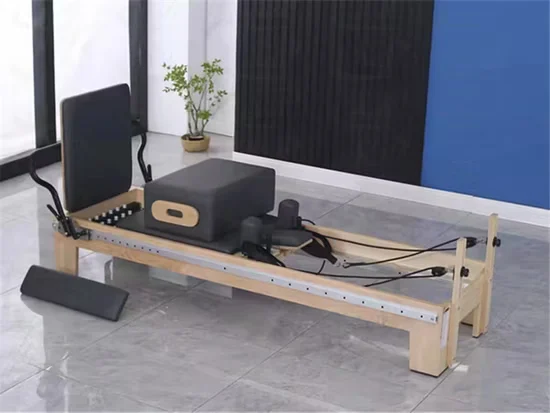
Wood Pilates Reformer, 2460×730×680mm, 100kg Net Weight, Solid Wood Frame — engineered for commercial studio use with sealed bearing carriage wheels ensuring smooth, quiet glide under high-traffic conditions. Includes long box, jump board, and platform for versatile training applications. 3-year frame warranty with factory-direct manufacturing and full OEM customization available.
// Spec Highlights
• Direct from Manufacturer · No Middlemen · Worldwide Shipping
01
// Material
Imported Solid Wood
Premium hardwood frames sourced for density and visual warmth.
02
// Hardware
Medical-Grade Silent
Whisper-quiet pulleys and springs for clinical environments.
03
// Customization
Appearance OEM
Color, upholstery, and branding tailored to your studio.
04
// Service
Layout Design
Free venue planning for studios and rehab institutions.
Every component is selected for longevity, performance, and aesthetic harmony - from imported hardwood frames to silent medical-grade accessories.
// Features
Reinforced Wood Carriage Frame — Solid wood rails with sealed bearing wheels engineered for repeated studio loading without glide degradation.
| Parameter | Value |
|---|---|
| Product Type | Pilates Reformer |
| Model NO. | SRY-19 |
| Product Dimensions | 2460×730×680mm |
| Frame Material | Wood |
| Net Weight | 100kgs |
| Carriage System | Sealed bearing wheels |
| Accessory | Long Box / Jump Board / Platform |
| Color | Solid Color options available |
| Logo | Customized Is Allowed |
| Age | Adult |
| Gender | Unisex |
| Warranty | 3 Years |
| Production Capacity | 80 Pieces/Month |
| Facility Type | Typical Use |
|---|---|
| Commercial Pilates studio | Group reformer classes with daily scheduling |
| Rehabilitation center | Controlled resistance therapy and mobility recovery |
| Boutique fitness studio | Premium small-group functional movement sessions |
| Home fitness room | Dedicated personal Pilates practice space |
The gap between a light-duty home reformer and a commercial wood Pilates reformer shows up first where the carriage meets the rail under repetitive eccentric loading.
Sealed bearing wheels and reinforced rail anchors separate studio-grade equipment from units that bind within months of high-frequency use.
I once had a batch of Wood Pilates Reformers come back from a studio install in Southeast Asia. The carriage guide rail tolerance wasn’t controlled during assembly, and after three months of daily group classes pulling against spring resistance, every unit developed sticking on the return stroke. Worse, the spring anchor welds showed hairline cracks from repeated tension cycling. That batch went back for full rework. Since then I check rail straightness and frame stress nodes on every shipment before it leaves the floor [NEED_CITE: dimensional tolerance standards for linear guide systems in fitness equipment].
Many reformers on the market advertise "studio grade" without naming the wood species, specifying rail straightness tolerance, or identifying the carriage wheel bearing type. The result is warped frames from humidity shifts, carriages that stick mid-stroke, and rail play that worsens with each class cycle.
This commercial wood Pilates reformer covers supine, prone, seated, and standing movement patterns across the full sagittal and frontal planes. It pairs with Pilates chair units and Cadillac towers to round out a studio’s apparatus lineup without overlapping movement demands. The platform footprint fits standard group class spacing when laid out with proper lateral clearance zones. It accommodates a wide range of user heights through adjustable shoulder rest positions and spring resistance progression, making it suitable for mixed-ability class rosters.
The carriage frame endures repeated impact loading every time a user reverses direction against spring tension, concentrating stress at the rail contact surface and the spring anchor mount. In a studio running five to six group classes per day, each unit cycles through hundreds of loaded forward-and-return strokes. The wood rail surface must resist compression wear from the bearing wheels, while the spring anchor joints face continuous tensile cycling that can initiate micro-cracks in undersized fastener points. Upholstery on the carriage pad and shoulder rests also degrades from sweat exposure and repeated compression, requiring replacement scheduling [NEED_CITE: fatigue behavior of wood joints under cyclic tensile loading].
Wood species and frame thickness determine how well the carriage frame resists warping when ambient humidity shifts between seasons. A denser hardwood with controlled moisture content holds its dimensional stability far better than softer timber under continuous studio climate variation. Rail straightness tolerance directly governs how smoothly the carriage glides over years of use — even a minor deviation from true linear alignment causes binding that worsens over time. Sealed bearing wheels outperform bushing-type wheels in this application because they keep dust and sweat contamination out of the rolling surface, maintaining quiet operation and extending the interval between maintenance visits. Spring anchor configuration and the range of resistance progression allow instructors to scale intensity from rehabilitation-level loading up to advanced conditioning without swapping equipment.
Thinner wood sections may look identical on a showroom floor but begin to twist under the asymmetric loading of advanced Pilates movements, throwing the carriage track out of alignment. Undersized spring anchor hardware loosens under daily tension cycling, eventually developing play that transfers impact shock into the wood grain and accelerates splitting. Non-sealed carriage wheels accumulate chalk dust and sweat residue in the bearing race, creating audible grinding and requiring frequent disassembly for cleaning. Low-density carriage pad upholstery compresses permanently within months of commercial scheduling, leaving visible impressions that signal wear to clients. Non-standard fastener sizes mean replacement parts aren’t available when components eventually need servicing [NEED_CITE: hardware standardization and replacement part availability in commercial fitness apparatus].
Our wood sourcing specifies moisture content at the time of milling, so the frame arrives at the studio dimensionally stable rather than warping after the first seasonal humidity shift. Every unit undergoes carriage load testing before packing — not a sample-basis check, but a per-unit verification that the rail runs true under loaded stroke cycles. The 200μm industrial powder coating on all metal hardware resists corrosion from sweat and cleaning agents in high-traffic studio environments. A 3-year warranty on the frame and carriage system gives studio operators predictable replacement budgeting. For floor planning, we provide CAD layouts that specify safe lateral clearance between reformer units so instructors can circulate during group sessions without collision risk. OEM private label options let studio brands carry their own identity on the equipment.
Provide your studio floor dimensions and target class size to receive a 2D or 3D layout showing reformer spacing, instructor walkways, and accessory storage zones. Specify your average daily class frequency so we can confirm the structural grade matches your usage volume. Share your target client demographic and body type range so we can verify the shoulder rest adjustment positions and spring resistance bands cover your programming needs. Let us know any branding requirements including custom logo placement and color selection for the frame finish.
Q: How do I tell a commercial-grade wood reformer from a light-duty home model?
A: Commercial units specify the wood species, frame thickness, rail straightness tolerance, and carriage bearing type. Home models typically list only overall dimensions and weight capacity without structural detail. Look for sealed bearing wheels rather than bushing-type carriage systems, and verify that spring anchors use through-bolted hardware rather than surface-mounted hooks. A minimum two-year frame warranty signals the manufacturer stands behind commercial-cycle durability.
Q: What wood species and frame thickness ensure the reformer holds up in daily studio use?
A: Denser hardwoods with controlled moisture content resist warping and joint loosening better than softer timber species when exposed to seasonal humidity changes inside a studio. Frame rail thickness directly determines how much compression wear the bearing wheels create over thousands of stroke cycles. Request the manufacturer’s wood species certification and moisture content specification at the time of shipment rather than relying on generic "solid wood" descriptions.
Q: Do sealed bearing carriage wheels outlast bushing wheels in a high-traffic Pilates studio?
A: Sealed bearings keep chalk dust, sweat residue, and cleaning solution contamination out of the rolling surface, which preserves smooth carriage glide and quiet operation far longer than open bushing-type wheels. Bushing wheels develop play and audible friction as particulate accumulates in the contact surface, requiring more frequent maintenance disassembly. For studios running multiple group classes per day, sealed bearings meaningfully extend the service interval and reduce total maintenance labor cost.
Q: How should I plan reformer spacing in a group class studio layout?
A: Each commercial wood Pilates reformer needs lateral clearance on both sides so instructors can walk between units during class to cue and correct form. The unit length plus rear clearance for jump board use determines the front-to-back spacing requirement. Request a CAD floor plan from the equipment supplier that accounts for your specific room dimensions, column placements, and target class capacity to avoid unusable gaps or unsafe traffic corridors between stations.
Q: What is the replacement cycle for springs, carriage pads, and shoulder rests under daily use?
A: Springs lose their calibrated resistance progression after extended tension cycling and should be checked quarterly for stretch deformation. Carriage pad upholstery compresses permanently under daily class scheduling, typically showing visible impressions that affect client comfort within a predictable window depending on class volume. Shoulder rest padding follows a similar wear pattern. Confirm with the manufacturer that these consumable components are available as replacement parts with standard lead times.
Premium aesthetics meet quiet operation for boutique studio environments.
Medical-grade silence and precision for sports & postpartum recovery.
Furniture-grade craftsmanship for premium residential installations.
Compact premium setups for one-on-one and small-group training.
Aesthetic Pilates integration for hybrid wellness studio programming.
Multi-unit deployment with instructor-grade reliability for certification programs.
Tell us about your project. Our team will respond within 24 hours with pricing, customization options, and shipping details.
// Sales Director
William
+86 132 2531 1800
// Export Manager
Bella
+86 198 5412 8032
william@bickfit.com


