01 / Scenario
STUDIO
P
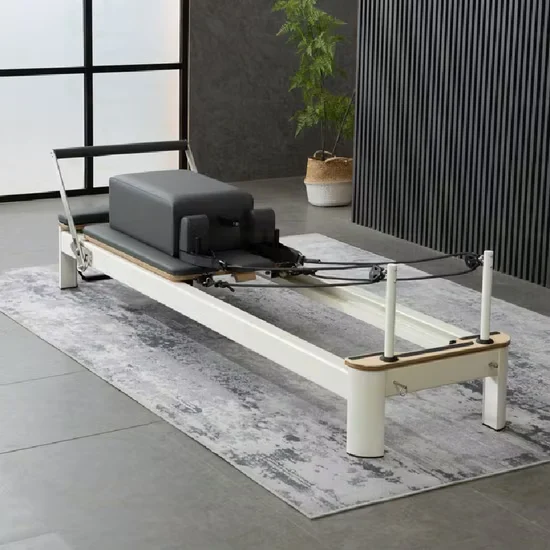
High-End Pilates Studios
Premium aesthetics meet quiet operation for boutique studio environments.
ISO
9001
CE
Certified
OEM
Available
10YR
Warranty
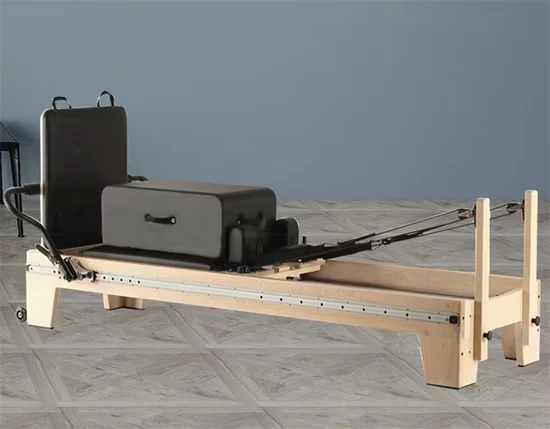
Wood Pilates Reformer, Full Tracking Carriage, 2460×730×680mm — solid wood frame at 100 kg net weight ensures inherent stability without bolt-down anchoring on sprung floors. Full-tracking carriage system maintains rail alignment across the entire travel length, reducing lateral drift and uneven spring wear under repeated studio use. Modular accessory compatibility with long box, jump board, and platform covers classical and contemporary repertoire. Backed by BICKFIT's 17-year manufacturing heritage and three-stage inspection process for every unit shipped.
// Spec Highlights
• Direct from Manufacturer · No Middlemen · Worldwide Shipping
01
// Material
Imported Solid Wood
Premium hardwood frames sourced for density and visual warmth.
02
// Hardware
Medical-Grade Silent
Whisper-quiet pulleys and springs for clinical environments.
03
// Customization
Appearance OEM
Color, upholstery, and branding tailored to your studio.
04
// Service
Layout Design
Free venue planning for studios and rehab institutions.
Every component is selected for longevity, performance, and aesthetic harmony - from imported hardwood frames to silent medical-grade accessories.
// Features
Continuous Weld Integrity — Robotic MIG welding delivers uninterrupted weld lines across the wood-to-carriage mounting points, eliminating the spot-weld failures that plague high-frequency studio equipment.
| Parameter | Value |
|---|---|
| Product Type | Pilates Reformer |
| Frame Material | Solid Wood |
| Carriage System | Full Tracking |
| Product Dimensions | 2460 × 730 × 680 mm |
| Net Weight | 100 kg |
| Included Accessories | Long Box / Jump Board / Platform |
| Finish Options | Solid Color |
| Customization | Logo and finish available upon request |
| Warranty | 3 Years |
| Facility Type | Typical Use |
|---|---|
| Commercial Pilates Studio | Daily group and private classical repertoire sessions |
| Rehabilitation and Physiotherapy Center | Low-impact mobility and post-injury strength recovery |
| Boutique Fitness and Personal Training Facility | One-on-one and small-group reformer programming |
| Hotel and Resort Wellness Floor | Guest-accessible Pilates instruction with minimal supervision |
| University Dance and Movement Department | Supplementary conditioning for performance arts students |
A full-tracking carriage system maintains alignment across the entire rail length, preventing the lateral drift that accelerates wheel and spring wear in undersized designs.
When a studio runs eight or more classes daily, the carriage completes thousands of travel cycles per week. Hollow-core rails and undersized carriages — often marketed as studio grade — develop lateral play within months because the rail-to-carriage engagement surface is too narrow to resist off-axis forces during jump board work or standing exercises. Once drift sets in, wheels wear unevenly, springs fatigue asymmetrically, and the smooth travel that defines reformer work degrades steadily [NEED_CITE: EN 957 structural requirements for stationary training equipment]. The commercial wood pilates reformer with full tracking addresses this failure mode by maximizing the contact surface between carriage and rail, distributing load across a broader engagement zone rather than concentrating stress at narrow guide points.
The reformer occupies the center of any Pilates studio floor plan, covering sagittal and frontal plane movements across the full classical and contemporary repertoire. It pairs with the Cadillac and Wunda Chair to create a complete apparatus circuit, and its 2460 × 730 mm footprint allows efficient spacing in rooms designed for six to twelve units. The long box, jump board, and platform accessories mean a single commercial wood pilates reformer with full tracking handles exercises that would otherwise require separate apparatus, reducing total equipment count in space-constrained studios. It accommodates users across a wide range of body sizes without frame adjustment, which keeps class transitions fast in high-throughput scheduling.
Static loading during holds and isometric positions places sustained compression on the wood frame joints and carriage wheels. Jump board work introduces impact cycles that test the rail-to-carriage interface repeatedly, making full-tracking engagement critical for preventing cumulative drift [NEED_CITE: fatigue performance in cyclic-loaded structural joints]. Eccentric loading occurs during single-leg and single-arm exercises where force is applied off-center to the carriage, creating lateral torque that undersized carriages cannot resist. The 100 kg net weight of the solid wood frame provides inherent vibration damping and floor stability, reducing transmitted vibration to adjacent units during jump board sequences. Strap hardware and spring anchor points experience the highest wear concentration and should be inspected for fatigue cracking at intervals matched to class volume.
Solid wood as a frame material offers mass and rigidity that aluminum extrusions cannot match at comparable price points — the 100 kg net weight anchors the unit on sprung studio floors without bolt-down hardware. The full-tracking carriage design refers to how the carriage wheels or bearings engage the rail along its entire travel path, rather than relying on short guide channels at each end; this distinction separates units that remain smooth after years of daily use from those that require rail realignment within the first year. Wood species and finish treatment directly affect humidity tolerance: a studio in a climate-controlled urban tower faces different dimensional stability demands than a coastal retreat center with seasonal humidity swings [NEED_CITE: dimensional stability of solid wood under cyclic humidity exposure]. The three included accessories — long box, jump board, and platform — should mount to the frame with standardized attachment points so replacement parts remain available as the unit ages. Spring count and resistance progression determine whether the reformer serves both introductory rehabilitation clients and advanced practitioners in the same studio without requiring spring swaps between sessions.
Thin-wall aluminum rails flex under jump board impact and accelerate bearing wear as the carriage fights to stay centered. Undersized carriages with narrow wheel bases introduce lateral play that worsens with every session, eventually requiring rail replacement rather than simple wheel service. Non-sealed bearings in the carriage system accumulate dust, chalk, and sweat residue that creates grinding friction and shortens service intervals dramatically. Low-density upholstery on the carriage and long box compresses within months of commercial use, creating uneven support surfaces that compromise exercise precision and require early reupholstering. Spring sets with inconsistent resistance progression force instructors to manually compensate during classes, degrading the teaching experience and the client outcome.
Every wood frame is checked for grain orientation and joint integrity at load-bearing connection points before assembly proceeds. Carriage-to-rail engagement is measured for lateral tolerance across the full travel distance, not just sampled at mid-rail. Spring resistance is tested across the complete extension range to confirm consistent progression matches the specified curve [NEED_CITE: load testing protocols for tension springs in commercial fitness equipment]. Finish treatment is inspected for complete coverage at recessed joints and hardware mounting points where moisture ingress begins. The 3-year warranty reflects confidence in the structural decisions made during manufacturing, and facility layout support is available when planning multi-unit studio floors to ensure safe clearance between reformers during standing and jump board exercises. OEM customization including logo application and finish color is handled in-house rather than outsourced post-production.
Provide your studio floor dimensions and target unit count to receive a 2D-3D layout showing safe spacing between reformers for all exercise positions. Specify your daily class volume and average client profile so the spring resistance configuration matches your actual use pattern rather than a generic default. Note any branding requirements — custom logo placement and finish color selection are confirmed before production begins. For rehabilitation or physiotherapy applications, flag any low-resistance spring requirements or accessory modifications needed for clinical use cases.
Q: How do I evaluate carriage tracking quality before committing to a bulk order?
A: Request the lateral tolerance measurement across the full rail travel distance, not just a mid-point reading. Ask whether the carriage uses sealed bearings or open bushings — sealed units resist chalk, sweat, and dust accumulation that causes grinding within months. Run the carriage through full extension and return cycles with off-center loading to feel for drift. A unit that tracks true under asymmetrical load will hold alignment far longer in daily studio rotation.
Q: What are the practical differences between solid wood and aluminum reformer frames?
A: Solid wood provides inherent mass — this unit sits at 100 kg — which dampens vibration and prevents walking on sprung floors without bolt-down anchoring. Aluminum frames are lighter and easier to relocate but transmit more vibration and may require floor anchoring in high-traffic studios. Wood also tolerates humidity fluctuation differently; confirm the species and finish treatment match your studio’s climate control profile before ordering.
Q: How should spring resistance be configured for a studio serving mixed experience levels?
A: The spring set should offer a progression range that covers rehabilitation clients at the light end and advanced practitioners at the heavy end. Ask whether springs are interchangeable with standard mounting hardware so you can reconfigure without replacing the entire set. Consistent resistance curve across the extension range matters more than peak load — uneven curves force instructors to compensate manually during class.
Q: What accessory compatibility should I confirm for a high-throughput studio?
A: Confirm that the long box, jump board, and platform mount with standardized attachment points so replacements are available years later without custom fabrication. Ask whether accessories from the same manufacturer fit across different production years — backward compatibility prevents orphaned units. Storage solutions matter too: wall-mounted racks or stacking systems keep accessories accessible without consuming floor space between classes.
Premium aesthetics meet quiet operation for boutique studio environments.
Medical-grade silence and precision for sports & postpartum recovery.
Furniture-grade craftsmanship for premium residential installations.
Compact premium setups for one-on-one and small-group training.
Aesthetic Pilates integration for hybrid wellness studio programming.
Multi-unit deployment with instructor-grade reliability for certification programs.
Tell us about your project. Our team will respond within 24 hours with pricing, customization options, and shipping details.
// Sales Director
William
+86 132 2531 1800
// Export Manager
Bella
+86 198 5412 8032
william@bickfit.com