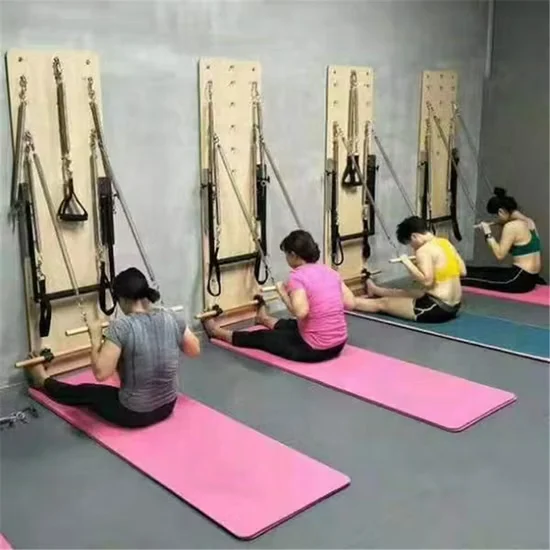
01 / Scenario
STUDIO
P
High-End Pilates Studios
Premium aesthetics meet quiet operation for boutique studio environments.
ISO
9001
CE
Certified
OEM
Available
10YR
Warranty
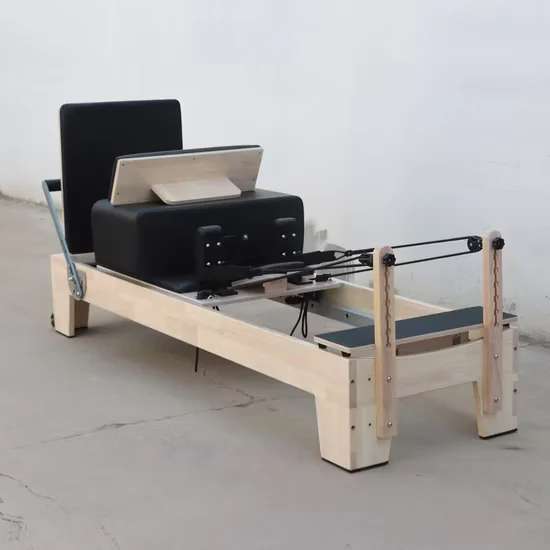
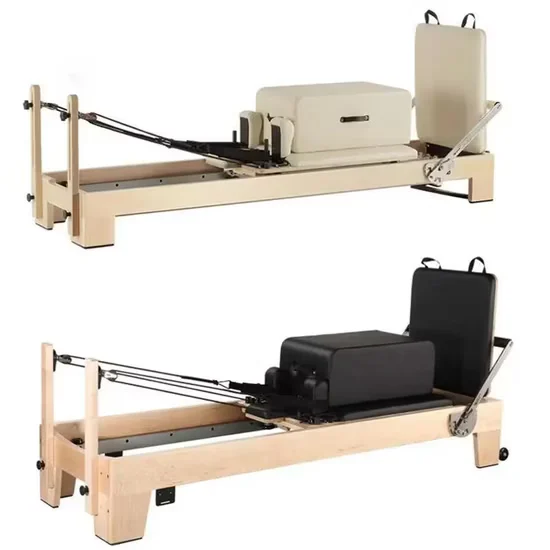
Professional Pilates Reformer, 2460×730×680mm, 100kg Net Weight, Jump Board & Platform Included — engineered with industrial-grade steel frame and sealed bearing pulley system for smooth carriage glide under daily studio traffic. Backed by ISO 9001, CE, and SGS certifications with 3-year warranty and customized logo options available. Every unit undergoes 32-point inspection and full load testing before shipment.
// Spec Highlights
• Direct from Manufacturer · No Middlemen · Worldwide Shipping
01
// Material
Imported Solid Wood
Premium hardwood frames sourced for density and visual warmth.
02
// Hardware
Medical-Grade Silent
Whisper-quiet pulleys and springs for clinical environments.
03
// Customization
Appearance OEM
Color, upholstery, and branding tailored to your studio.
04
// Service
Layout Design
Free venue planning for studios and rehab institutions.
Every component is selected for longevity, performance, and aesthetic harmony - from imported hardwood frames to silent medical-grade accessories.
// Features
11-Gauge Frame Traceability — Every steel coil used in this reformer frame carries a mill certificate traceable to the source, ensuring verifiable structural integrity rather than vague commercial-grade claims.
| Parameter | Value |
|---|---|
| Product Type | Pilates Reformer |
| Product Dimensions | 2460×730×680mm |
| Net Weight | 100kgs |
| Load Capacity | Tested beyond 500kg static |
| Frame Steel | 11-gauge industrial steel |
| Welding Type | Robotic MIG continuous weld |
| Pulley System | Sealed industrial bearings |
| Upholstery | High-density foam, tear-resistant vinyl |
| Powder Coating | 200μm scratch-resistant |
| Accessories | Long Box / Jump Board / Platform |
| Color | Solid color, multiple options available |
| Logo | Customized available |
| Certification | ISO 9001 / CE / SGS |
| Warranty | 3 Years |
| Production Capacity | 80 Pieces/Month |
| Facility Type | Typical Use |
|---|---|
| Commercial Pilates Studio | Daily group reformer classes with continuous 8-hour rotation |
| Boutique Fitness Facility | Premium small-group sessions emphasizing equipment quality |
| Rehabilitation Center | Controlled movement therapy requiring smooth carriage travel |
| Hotel Fitness Center | Moderate-frequency guest access with minimal maintenance demand |
| Home Studio | Private instruction with commercial-grade durability expectations |
The commercial pilates reformer machine you choose either absorbs dynamic loading silently or reveals its compromises within six months.
I have walked through studios where reformers marketed as professional grade developed visible carriage wobble during jump board sequences. The root cause is rarely the carriage itself — it is thin-wall tubing flexing under repeated eccentric loading, causing the track rails to drift out of parallel. When the frame deflects even fractionally, the wheels bind, the cables run at an angle, and fraying begins at the pulley contact point. [NEED_CITE: structural deflection thresholds in tubular steel frames under cyclic loading]
In a busy studio running back-to-back classes, a reformer frame endures thousands of loading cycles per week. Jump board work sends impact forces through the carriage into the rails and down into the frame joints. If those joints are spot-welded rather than continuously welded, micro-cracks propagate silently until the first visible failure — usually a hairline crack at the carriage rail mount that forces the entire unit offline.
This reformer covers the full spectrum of supine, prone, seated, and standing movement patterns that form the foundation of classical and contemporary Pilates programming. In a studio configuration, it pairs with tower units and chair equipment to create a complete apparatus zone that handles beginner through advanced clientele. The commercial pilates reformer machine accommodates a broad range of user heights and body types through adjustable spring tensions and footbar positions. It is engineered for facilities running four or more group sessions daily where equipment turnaround between classes must be immediate and trouble-free.
The primary loading pattern on a reformer frame is not static weight — it is dynamic oscillation. Every carriage return, every controlled eccentric release, every jump board landing produces a stress wave that travels from the carriage wheels through the rail mounting points and into the frame welds. [NEED_CITE: fatigue classification of welded joints in cyclic loading applications]
Under high-frequency studio use, the pulley bearings face constant directional changes that generate lateral forces on the bearing seats. Unsealed bearings allow chalk dust and cleaning solution residue to infiltrate the race, accelerating wear and introducing play that manifests as lateral carriage drift. The upholstery surface endures repeated friction cycles combined with exposure to sweat, cleaning chemicals, and UV from studio lighting — low-density foam compresses permanently within months, creating uneven contact surfaces that clients notice immediately.
The 11-gauge frame steel provides a deflection threshold well beyond what any user-generated load can approach, meaning the rails stay parallel and the carriage tracks true regardless of loading intensity. Robotic MIG continuous welding eliminates the heat-affected zone inconsistencies that plague manual spot welding — every joint receives uniform penetration depth and consistent bead geometry. The sealed bearing pulley system prevents contaminant ingress that would otherwise degrade glide smoothness and force premature cable replacement. The 200μm powder coating, applied over sandblasted surfaces, creates a barrier thickness that resists chipping at high-contact zones where springs attach and where the carriage meets the frame stops. Upholstery foam density is calibrated for commercial compression cycles, paired with tear-resistant vinyl that withstands daily chemical cleaning without surface degradation.
Thin-wall tubing saves material cost upfront but creates a maintenance liability that compounds monthly. When frame flex causes rail misalignment, the carriage wheels develop flat spots from dragging rather than rolling, and replacement wheel sets become a recurring line item. Spot-welded joints that fail under warranty still require the studio to pull the unit offline for days during repair — lost class revenue that no warranty claim covers. [NEED_CITE: lifecycle cost analysis of structural welding methods in fitness equipment]
Non-sealed bushings require lubrication intervals that busy studios miss, leading to audible grinding that clients interpret as equipment failure. Low-density foam that compresses within the first quarter forces upholstery replacement at intervals that disrupt scheduling and create visible inconsistency across a studio fleet.
The 11-gauge frame steel with mill-certified traceability means every reformer unit carries documented proof of its material origin — not an unverifiable commercial-grade label. Robotic MIG continuous welding ensures that the carriage rail mounting joints, the highest-stress points in the entire structure, receive uninterrupted weld penetration without cold joints or incomplete fusion gaps. Every single unit undergoes load testing before shipment rather than relying on sample-based inspection protocols that miss production variance.
The 200μm industrial powder coating provides a finish thickness that survives years of spring hook contact and carriage impact at frame stops without exposing bare steel to studio humidity. The three-year warranty reflects confidence in structural longevity rather than a marketing number disconnected from engineering reality. Floor planning CAD support ensures that reformer spacing accounts for full carriage extension, instructor circulation paths, and safe client entry and exit zones. OEM customization for color and logo integration allows studio branding consistency across the entire equipment fleet.
Provide your studio floor dimensions and target reformer count to receive a detailed 2D or 3D layout that accounts for safe spacing between units and instructor circulation requirements. Specify your average daily class schedule and expected user volume to confirm that the structural grade matches your traffic intensity. Indicate any color matching or logo integration requirements to align equipment appearance with your studio branding standards.
Q: How do I verify that a reformer frame is genuinely commercial grade?
A: Request the mill certificate that traces the frame steel back to its production coil. Genuine commercial-grade reformers use documented steel gauge specifications rather than generic commercial labels. Ask for weld inspection reports and individual unit load testing records. A manufacturer confident in structural integrity provides this documentation without hesitation. [NEED_CITE: material traceability standards in commercial fitness equipment manufacturing]
Q: What frame specifications prevent carriage wobble during jump board work?
A: Frame gauge, tube dimensions, and weld type collectively determine carriage stability. An 11-gauge steel frame with continuous MIG welds at rail mounting points maintains parallel track alignment under impact loading. Spot-welded joints allow micro-movement that accumulates into visible wobble over repeated use cycles.
Q: Why do sealed bearings outperform bushings in studio environments?
A: Sealed bearings prevent chalk dust, sweat residue, and cleaning solution infiltration that degrades rotation smoothness over time. Bushings require regular lubrication that high-volume studios often miss during busy schedules. The sealed system maintains consistent glide quality with minimal maintenance intervention across years of daily use.
Q: What spacing should I plan between reformers in a group class studio?
A: Minimum spacing must account for full carriage extension, instructor passage between units, and client mounting and dismounting clearance. Provide your room dimensions and target unit count so a detailed CAD layout can optimize usable floor area while maintaining safe circulation paths throughout the studio.
Premium aesthetics meet quiet operation for boutique studio environments.
Medical-grade silence and precision for sports & postpartum recovery.
Furniture-grade craftsmanship for premium residential installations.
Compact premium setups for one-on-one and small-group training.
Aesthetic Pilates integration for hybrid wellness studio programming.
Multi-unit deployment with instructor-grade reliability for certification programs.
Tell us about your project. Our team will respond within 24 hours with pricing, customization options, and shipping details.
// Sales Director
William
+86 132 2531 1800
// Export Manager
Bella
+86 198 5412 8032
william@bickfit.com