01 / Scenario
STUDIO
P
High-End Pilates Studios
Premium aesthetics meet quiet operation for boutique studio environments.
ISO
9001
CE
Certified
OEM
Available
10YR
Warranty
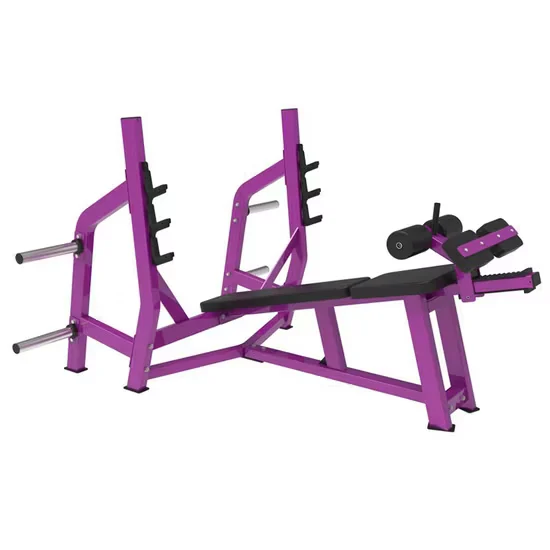
Commercial Decline Bench, 1500×1150×1280mm, 65kg Net Weight — built with industrial steel frame construction for high-traffic commercial gym environments. Fixed decline angle ensures structural stability during heavy chest training, while 200μm powder coating resists chipping at contact points. Every unit undergoes load testing before shipment, backed by a 10-year frame warranty and floor planning support.
// Spec Highlights
• Direct from Manufacturer · No Middlemen · Worldwide Shipping
01
// Material
Imported Solid Wood
Premium hardwood frames sourced for density and visual warmth.
02
// Hardware
Medical-Grade Silent
Whisper-quiet pulleys and springs for clinical environments.
03
// Customization
Appearance OEM
Color, upholstery, and branding tailored to your studio.
04
// Service
Layout Design
Free venue planning for studios and rehab institutions.
Every component is selected for longevity, performance, and aesthetic harmony - from imported hardwood frames to silent medical-grade accessories.
// Features
Traceable 11-Gauge Steel — Every Commercial Decline Bench frame uses Q235 steel with mill certification linked back to the original coil, ensuring structural integrity under repeated heavy chest training loads.
| Parameter | Value |
|---|---|
| Product Type | Commercial Decline Bench |
| Frame Steel | 11-gauge, 3×3 inch tube |
| Steel Grade | Q235 industrial steel, mill-certified |
| Welding Type | Robotic MIG continuous weld |
| Product Dimensions | 1500×1150×1280mm |
| Net Weight | 65kg |
| Exercise Part | Chest |
| Adjustment Type | Fixed decline angle |
| Power Source | Manual |
| Upholstery | Available in standard or high-density options |
| Powder Coating | 200μm scratch-resistant industrial finish |
| Certification | ISO 9001, CE |
| OEM/ODM | Available |
| Transport Package | Plywood case |
| Facility Type | Typical Use |
|---|---|
| Commercial gym strength floor | High-frequency chest training station in dedicated free weight zone |
| Hotel fitness center | Reliable decline pressing option for diverse guest training needs |
| University strength and conditioning room | Withstands athlete-level loads during team training cycles |
| Rehabilitation and performance center | Controlled decline angle for targeted lower chest development |
Continuous robotic MIG welding eliminates the fatigue failure point that plagues spot-welded benches.
Many manufacturers label equipment "commercial grade" without disclosing steel specifications or welding methods. In high-traffic environments, a decline bench endures thousands of loading cycles annually. Spot welds may pass visual inspection but develop micro-cracks under repeated eccentric stress, particularly at the junction where the decline frame meets the base support. Within months, these hidden defects propagate, leading to sudden structural failure during heavy pressing movements. The commercial decline bench uses full-penetration continuous welds along all load-bearing joints, distributing stress evenly across the entire seam rather than concentrating it at discrete points [NEED_CITE: weld classification and fatigue performance in structural steel].
The commercial decline bench occupies a specific niche in the chest training arsenal, targeting the lower pectoral fibers through a fixed-angle pressing path. It complements flat and incline benches in a complete chest training setup, allowing users to address the full muscle architecture. The 1500×1150mm footprint requires adequate clearance on all sides for safe loading and dismounting. This fixed decline configuration suits facilities prioritizing structural simplicity over adjustability, reducing maintenance points while delivering consistent performance across users of varying body dimensions.
A decline bench in a busy commercial gym experiences complex loading patterns: static compression from the user’s body weight, dynamic impact during barbell racking, and eccentric shear forces during the pressing motion itself. The welded joints at the frame-to-base connection bear the highest cyclic stress, particularly when users perform heavy sets near muscular failure. Unsealed bearings or bushings in adjustable models accumulate sweat and chalk dust, accelerating wear and developing play that compromises stability. The 200μm powder coating must resist not only mechanical abrasion from barbell contact but also chemical degradation from daily cleaning with disinfectant solutions [NEED_CITE: coating durability in high-humidity fitness environments].
The 11-gauge, 3×3 inch frame tube provides the critical balance between weight and rigidity. Thinner wall sections deflect visibly under load, creating an unsettling sensation during heavy presses, while excessive thickness adds unnecessary weight without proportional strength gains. The Q235 steel grade offers predictable yield behavior, allowing engineers to calculate safety margins with confidence. Robotic MIG welding ensures consistent penetration depth and eliminates the human variability inherent in manual welding, producing uniform焊缝 quality across every unit. The 200μm powder coating thickness exceeds typical residential equipment standards, providing a durable barrier against the combination of sweat, cleaning chemicals, and mechanical impact that characterizes commercial gym environments.
Thin-wall tubing may reduce material costs initially but deflects perceptibly under heavy loads, undermining user confidence and accelerating fatigue failure at weld joints. Spot welding saves labor time but creates stress concentration points that propagate cracks under cyclic loading, leading to premature frame replacement. Low-density upholstery compresses permanently within months of commercial use, requiring frequent replacement that disrupts equipment availability and increases long-term operating costs. Inadequate powder coating chips at contact points, exposing bare steel to sweat-induced corrosion that spreads beneath the surrounding finish, necessitating complete refinishing or frame replacement [NEED_CITE: corrosion mechanisms in fitness equipment exposed to chloride-containing sweat].
Every commercial decline bench undergoes individual load testing before shipment, verifying structural integrity rather than relying on batch sampling. The 11-gauge steel frame comes with mill certification traceable to the original coil, providing documented proof of material specifications. Robotic continuous welding eliminates the spot-weld failure mode that compromises competitor products. The 200μm industrial powder coating resists chipping and corrosion in high-traffic environments. A 10-year frame warranty reflects confidence in the structural design and manufacturing quality. 2D-3D CAD layout support ensures proper spacing between the decline bench and adjacent equipment, maintaining safe traffic flow and emergency access throughout the strength zone. OEM customization allows color and logo matching to facility branding without compromising structural specifications.
Provide your strength zone dimensions and equipment list to receive a 2D-3D layout plan showing optimal commercial decline bench placement. Specify daily user volume to confirm the structural grade matches your traffic intensity. Indicate target user body size range to verify the fixed decline angle accommodates your population. Detail any customization requirements for frame color, upholstery selection, or facility branding integration.
Q: How do I verify a decline bench is truly commercial-grade rather than light-commercial?
A: Request steel mill certification showing gauge, tube dimensions, and grade. Confirm robotic continuous welding rather than spot welding. Verify individual load testing records for each unit. Check powder coating thickness specifications and warranty terms for the frame structure.
Q: What is the relationship between steel gauge and load capacity?
A: The 11-gauge, 3×3 inch tube provides optimal rigidity for commercial chest training loads. Thinner tubing deflects under heavy weights, creating instability. The specific combination of wall thickness and cross-section dimension determines the frame’s resistance to bending and torsional forces during pressing movements.
Q: How long does upholstery last in commercial environments?
A: High-density upholstery options resist permanent compression significantly longer than standard foam. Replacement intervals depend on daily usage frequency and user weight ranges. Availability of replacement pads ensures minimal equipment downtime when refurbishment becomes necessary.
Q: What spacing is required around the decline bench?
A: Maintain minimum 600mm clearance on all sides for safe operation. This allows adequate space for barbell loading, user entry and exit, and emergency access. The 1500×1150mm footprint plus clearance zones determines the total allocation needed in your strength zone layout.
Q: What is the OEM customization process for this equipment?
A: Frame powder coating color can be matched to facility branding specifications. Upholstery color and logo embroidery are available as options. Customization requirements should be specified during the quotation phase to ensure proper lead time allocation and production scheduling.
Premium aesthetics meet quiet operation for boutique studio environments.
Medical-grade silence and precision for sports & postpartum recovery.
Furniture-grade craftsmanship for premium residential installations.
Compact premium setups for one-on-one and small-group training.
Aesthetic Pilates integration for hybrid wellness studio programming.
Multi-unit deployment with instructor-grade reliability for certification programs.
Tell us about your project. Our team will respond within 24 hours with pricing, customization options, and shipping details.
// Sales Director
William
+86 132 2531 1800
// Export Manager
Bella
+86 198 5412 8032
william@bickfit.com