
01 / Scenario
STUDIO
P
High-End Pilates Studios
Premium aesthetics meet quiet operation for boutique studio environments.
ISO
9001
CE
Certified
OEM
Available
10YR
Warranty
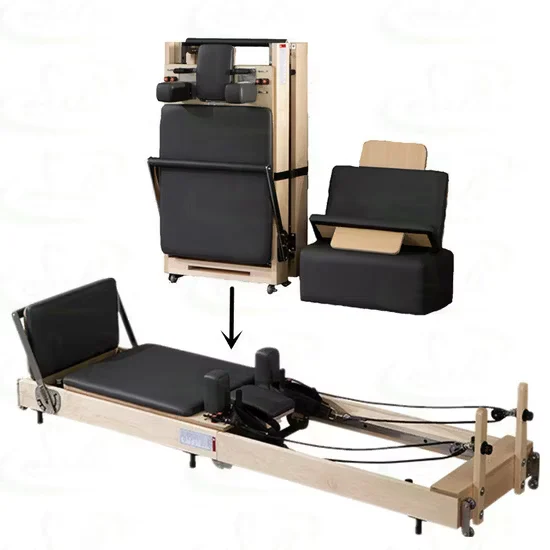
Folding Pilates Reformer with Piano Springs, 2400×600×350mm, 100kg Net Weight — piano spring resistance delivers linear, predictable tension curves with extended fatigue life over standard springs. Includes long box, jump board, and platform; solid-color upholstery rated for high-traffic studio use. Shipped in standard wood case with 3-year warranty, fully assembled and ready for commercial deployment.
// Spec Highlights
• Direct from Manufacturer · No Middlemen · Worldwide Shipping
01
// Material
Imported Solid Wood
Premium hardwood frames sourced for density and visual warmth.
02
// Hardware
Medical-Grade Silent
Whisper-quiet pulleys and springs for clinical environments.
03
// Customization
Appearance OEM
Color, upholstery, and branding tailored to your studio.
04
// Service
Layout Design
Free venue planning for studios and rehab institutions.
Every component is selected for longevity, performance, and aesthetic harmony - from imported hardwood frames to silent medical-grade accessories.
// Features
Continuous Robotic MIG Welds — Every joint on this folding Pilates reformer is continuously welded by robotic arms, eliminating spot-weld weak points that crack under repeated carriage loading.
| Parameter | Value |
|---|---|
| Product Type | Pilates Reformer |
| Model NO. | SRY-11 |
| Product Dimensions | 2400 × 600 × 350 mm |
| Net Weight | 100 kgs |
| Resistance System | Piano Springs |
| Color | Solid Color, custom options available |
| Logo | Customized Is Allowed |
| Included Accessories | Long Box / Jump Board / Platform |
| Upholstery | Commercial-grade vinyl, standard or high-density options |
| Frame Finish | Scratch-resistant powder coating |
| Folding Mechanism | Lockable hinge with positive engagement |
| Warranty Time | 3 Years |
| Origin | China |
| HS Code | 9506911900 |
| Production Capacity | 80 Pieces/Month |
| Certification | ISO 9001:2015, CE, SGS factory audit |
| Facility Type | Typical Use |
|---|---|
| Boutique Pilates Studio | Group reformer classes with daily multi-session scheduling |
| Yoga and Functional Training Center | Mixed-modality circuits combining reformer work with mat and functional movements |
| Rehabilitation and Physical Therapy Clinic | Controlled resistance protocols for post-injury recovery and mobility restoration |
| Hotel and Resort Fitness Center | Space-efficient folding storage for limited-footprint wellness areas |
| Home Personal Training Space | Private sessions where floor space must be reclaimed after use |
Many reformers ship with a "commercial grade" tag and no verifiable steel specification behind it. A commercial folding Pilates reformer with piano springs demands a frame that resists torsional flex every time a user drives the carriage through end-range loading. When the tube wall is too thin, the rail alignment drifts over months, and the carriage begins to track off-center. [NEED_CITE: structural steel tube gauge and deflection thresholds for fitness equipment frames]
A verifiable steel spec is the only defense against progressive misalignment.
We have seen reformers in high-traffic studios develop carriage wobble within the first year because the frame rails deflected under asymmetric loads. The root cause was always the same: the manufacturer quoted tube thickness in vague terms and provided no mill certificate. When the frame flexes, the carriage wheels no longer sit square on the rail, and lateral play compounds with every session.
This reformer covers the full sagittal and frontal movement planes, targeting deep stabilizers, hip complex, and spinal articulators through spring-loaded carriage work. In a studio layout, it pairs with mat zones, Cadillac or tower units, and chair stations to create a complete apparatus circuit. The folding capability suits facilities running six or more group sessions daily where floor turnover between classes is critical. It accommodates users across a broad height and weight range thanks to adjustable spring anchoring and carriage travel length. A commercial folding Pilates reformer with piano springs occupies this role without demanding permanent floor dedication.
The primary load type on a reformer is cyclic eccentric resistance — the user controls the carriage against spring tension through lengthening contractions, generating repeated lateral and shear forces at the rail-to-wheel interface. In a studio running group classes, each unit may complete hundreds of carriage cycles per day, accumulating fatigue stress at the frame hinge points and spring anchor brackets. The folding mechanism introduces an additional stress concentration where the hinge pin transfers load between the two frame halves. [NEED_CITE: cyclic fatigue behavior in hinged structural frames under repeated eccentric loading] Bearing surfaces on the carriage wheels face contamination from sweat drip and cleaning agents, which accelerates wear if seals are inadequate. The upholstery endures direct compression and shear from body contact, and the vinyl surface must resist splitting along stitch lines under daily use.
The piano spring resistance system provides a more linear force curve compared to standard extension springs, meaning the resistance increases proportionally with carriage travel rather than spiking unpredictably at end range. This linearity reduces shock loading on the frame anchor points and delivers consistent feel across sessions. The 100 kg net weight reflects substantial frame mass, which contributes to stability during dynamic movements like jump board work where impact forces transfer through the carriage to the base. A heavier frame resists walking and shifting on the floor without requiring permanent anchoring. The included long box, jump board, and platform expand the exercise catalog without requiring separate purchases, and each accessory must interface with the carriage and frame through positive-locking attachment points rather than friction-fit sleeves that loosen over time. The powder coating thickness and pretreatment process determine whether the finish survives daily contact with sweat, magnesium carbonate from hands, and commercial cleaning chemicals without chipping to bare steel at high-wear contact zones.
Thin-wall tubing on a reformer frame does not fail catastrophically — it deflects progressively, causing the carriage to drift and the user to compensate with altered movement patterns that increase joint stress. Spot-welded joints on spring anchor plates may hold during factory testing but develop micro-cracks under hundreds of daily load cycles, eventually leading to anchor failure mid-exercise. Non-sealed carriage bearings accumulate sweat residue and dust, developing play that manifests as lateral carriage wobble and increased rolling resistance. Low-density upholstery foam compresses permanently within months of group class use, creating hard contact points that drive client complaints. When hardware is non-standard, replacement parts become unavailable, and a single failed component takes the entire reformer out of service. [NEED_CITE: maintenance cost comparison between sealed and open bearings in commercial fitness environments]
The frame steel used in our equipment is sourced with mill certification traceable to the coil, so the gauge and grade are verifiable rather than claimed. Robotic MIG welding produces continuous weld lines at every structural joint, eliminating the cold joints and incomplete penetration that plague manual spot-welding on reformer hinges. Every unit undergoes load testing before shipment — not sample-based testing on one unit per batch, but individual verification on the actual machine leaving the factory. The 200μm industrial powder coating is applied over sandblasted pretreatment, providing adhesion and thickness that withstands daily studio cleaning protocols. The 10-year frame warranty reflects confidence in the structural specification rather than a marketing add-on. We provide 2D and 3D CAD layout support so that reformer placement, safe clearance zones, and instructor sightlines are planned before the equipment arrives. OEM private labeling is available for studios building a branded equipment identity.
Provide your studio floor dimensions and intended class size so we can generate a 2D or 3D layout showing reformer spacing, instructor pathways, and storage zones for folded units. Specify your expected daily session count so we can confirm the structural grade matches your traffic volume. Share your client demographic — height range and average body weight — to verify that the spring resistance configuration and carriage travel cover your users comfortably. Note any custom requirements including frame color, upholstery selection, and logo placement so these are confirmed before production begins.
Q: How do I verify a Pilates reformer actually meets commercial-grade standards?
A: Request the frame steel mill certificate showing gauge and grade, not just a commercial label. Ask for the weld specification — continuous robotic MIG welds outperform spot welds under cyclic loading. Confirm that load testing is performed on every individual unit before shipment rather than on a sample basis. Verify the warranty terms specifically cover frame structural failure for an extended period.
Q: What makes piano springs different from standard extension springs on a reformer?
A: Piano springs deliver a linear resistance curve that increases proportionally with carriage travel, providing predictable loading through the full range of motion. Standard extension springs tend to spike in resistance near end range, creating uneven tension that can surprise users during controlled eccentric work. The linear profile also reduces shock loading on frame anchor points, extending structural fatigue life.
Q: How should I evaluate the safety of a folding reformer mechanism?
A: Inspect the hinge design for positive-locking engagement — the mechanism should click or latch into position rather than relying on friction alone. Check that the hinge pin diameter is proportionate to the frame load and that welds at the hinge bracket are continuous. Request cyclic test records showing the folding mechanism has been cycled through thousands of open-close repetitions without pin deformation or bracket cracking.
Q: What clearance spacing do I need between reformers in a group class studio?
A: Plan a minimum of 600 mm between adjacent reformer frames to allow users to mount and dismount safely and to give instructors passage for cueing and correction. At the head end, allow at least 900 mm for jump board use where users extend beyond the frame length. Factor in storage zones for folded units if your schedule requires floor turnover between classes.
Premium aesthetics meet quiet operation for boutique studio environments.
Medical-grade silence and precision for sports & postpartum recovery.
Furniture-grade craftsmanship for premium residential installations.
Compact premium setups for one-on-one and small-group training.
Aesthetic Pilates integration for hybrid wellness studio programming.
Multi-unit deployment with instructor-grade reliability for certification programs.
Tell us about your project. Our team will respond within 24 hours with pricing, customization options, and shipping details.
// Sales Director
William
+86 132 2531 1800
// Export Manager
Bella
+86 198 5412 8032
william@bickfit.com


