01 / Scenario
STUDIO
P
High-End Pilates Studios
Premium aesthetics meet quiet operation for boutique studio environments.
ISO
9001
CE
Certified
OEM
Available
10YR
Warranty
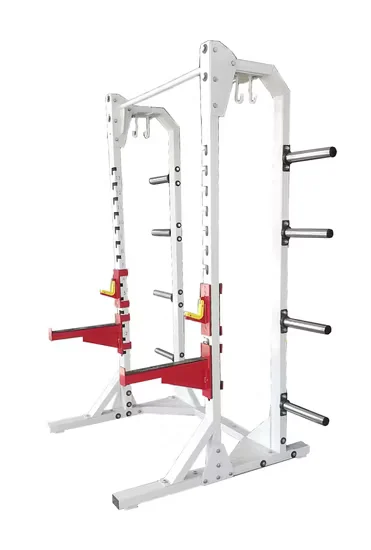
Commercial Half Rack, 152kg Net Weight, Plate Loaded Free Weight System — engineered with industrial steel frame and continuous robotic MIG welding to eliminate fatigue cracks at J-cup and safety catch mounting points under repeated barbell impacts. Backed by mill-certified steel traceable to coil origin, three-stage QC inspection, and load testing on every unit before shipment.
// Spec Highlights
• Direct from Manufacturer · No Middlemen · Worldwide Shipping
01
// Material
Imported Solid Wood
Premium hardwood frames sourced for density and visual warmth.
02
// Hardware
Medical-Grade Silent
Whisper-quiet pulleys and springs for clinical environments.
03
// Customization
Appearance OEM
Color, upholstery, and branding tailored to your studio.
04
// Service
Layout Design
Free venue planning for studios and rehab institutions.
Every component is selected for longevity, performance, and aesthetic harmony - from imported hardwood frames to silent medical-grade accessories.
// Features
Industrial Steel Traceability — Every frame tube is mill-certified Q235 steel traceable to coil origin, verified before cutting begins.
| Parameter | Value |
|---|---|
| Product Type | Half Rack |
| Frame Tube Size | 1434×1675×2296mm |
| Net Weight | 152kg |
| Loading Type | Plate Loaded (Free Weight) |
| Material | Steel (Q235) |
| Welding Type | Robotic MIG Continuous Weld |
| Powder Coating | 200μm Scratch-Resistant |
| Certification | ISO 9001, CE |
| OEM/ODM | Available |
| Production Capacity | 500 PCS/Month |
| Facility Type | Typical Use |
|---|---|
| Commercial Gym Strength Floor | Primary barbell squat and pressing station |
| CrossFit Box Functional Zone | High-rep barbell cycling and accessory work |
| University Strength & Conditioning Room | Team-based athletic development sessions |
| Hotel Fitness Center | Space-efficient free weight training area |
| Rehabilitation & Performance Center | Controlled loading for return-to-sport protocols |
Many half racks quote vague "commercial grade" steel without verifiable gauge or tube specification — and rely on spot welds that crack under repeated barbell impacts at the J-cup and safety catch mounting points.
Continuous robotic MIG welding eliminates fatigue crack initiation at every structural joint.
When a lifter misses a rep and drops a loaded barbell onto safety straps, the impact force travels through the J-cup tabs into the upright. Spot welds create localized heat-affected zones that become brittle over thousands of loading cycles. The crack starts invisible at the weld toe, then propagates until the tab separates — often without warning. Robotic MIG continuous welds distribute that impact stress along the entire joint length, keeping the connection intact well beyond the steel’s own yield point [NEED_CITE: weld classification and fatigue performance in structural steel].
This commercial half rack strength equipment occupies the sagittal plane for squat, press, and pull variations, serving as the anchor point for any free weight zone. It pairs directly with plate-loaded lateral and converging machines, dumbbell storage, and functional rig attachments to create a complete strength circuit. The open front design accommodates lifters across a wide stature range, from sub-160cm to over 190cm, without requiring height-specific adjustments to the frame itself. Facility planners position this unit as the primary barbell station where traffic density demands structural permanence rather than modular flexibility.
Free weight stations experience three distinct stress types: static compression from loaded barbells resting on J-cups, eccentric impact from missed lifts dropping onto safety catches, and lateral shear when lifters rack unevenly. In a high-traffic commercial gym environment, these loading cycles accumulate daily — a single squat station may see 40 to 60 loading events per operating hour during peak periods. The weld toes at J-cup mounting holes and safety strap receivers become stress concentration points where micro-cracks initiate if weld penetration is incomplete. Powder coating at barbell contact zones faces repeated abrasion from knurled steel sleeves, demanding thickness and adhesion that thin decorative finishes cannot sustain [NEED_CITE: powder coating adhesion standards for industrial metal substrates].
The 3×3 inch frame tube dimension determines the moment of inertia — the geometric property that resists bending under off-center barbell loading. A wider tube section places more material farther from the neutral axis, meaning the frame deflects less under the same eccentric load compared to narrower alternatives. The 11-gauge wall thickness provides the material cross-section that prevents local buckling at connection points where bolts pass through the tube wall. Robotic MIG continuous welding maintains consistent penetration depth along every joint, eliminating the cold laps and incomplete fusion defects that manual spot welding produces under production pressure. The 200μm powder coating, applied after sandblast pre-treatment, creates a mechanical interlock with the steel surface that resists chipping at high-contact areas where barbells and plates repeatedly strike the frame [NEED_CITE: structural tube dimension and moment of inertia in steel frame design].
Thin-wall tubing flexes visibly under heavy squat loads, creating a perception of instability that undermines user confidence — even if the frame never permanently deforms. Spot-welded J-cup tabs that crack after months of service create liability exposure: a failed tab during a maximal attempt means the barbell falls without arrest. Non-sealed bearing systems in any adjustable components develop play quickly in environments where chalk dust, sweat, and cleaning chemicals penetrate the bearing race. Low-density upholstery on any attached bench splits under daily commercial use, requiring replacement within months rather than years. Powder coating that chips at contact points exposes bare steel to moisture and sweat corrosion, creating rust streaks that spread beneath adjacent coating and accelerate structural degradation [NEED_CITE: corrosion progression under compromised powder coating in humid environments].
Every frame tube traces back to mill-certified Q235 coil stock, providing material verification that generic "commercial grade" claims cannot match. Robotic MIG welding produces continuous bead lines on every joint — no spot welds to inspect, no cold joints to miss. Each unit undergoes load testing before shipment, not sample-based auditing that leaves production variance undetected. The 200μm industrial powder coating survives the abrasion and chemical exposure that thinner finishes cannot withstand. A 10-year frame warranty backs the structural engineering with long-term accountability. For facility planning, 2D-3D CAD layout support ensures this commercial half rack strength equipment fits within proper safety clearance zones, maintaining accessible traffic flow around the barbell path. OEM private label and color customization options align the unit with your facility’s visual identity.
Provide your strength zone floor plan dimensions and target equipment list to receive a 2D-3D CAD layout showing safety clearance compliance and traffic flow optimization. Specify your estimated daily user volume so the structural grade recommendation matches actual loading frequency. Indicate the user stature range your facility serves to confirm J-cup and safety strap positioning covers all lifters. Share any private label branding, color matching, or upholstery specification requirements for OEM configuration.
Q: How do I verify a half rack uses genuine commercial-grade steel rather than vague marketing claims?
A: Request mill certification documentation that traces the steel grade and tube dimensions back to the original coil stock. Legitimate manufacturers provide test reports showing chemical composition and mechanical properties. The frame tube size and wall gauge should appear in technical specifications with verifiable measurements, not generic descriptors like "heavy-duty" or "commercial strength."
Q: What frame tube gauge and steel grade are necessary for safe heavy barbell loading?
A: The 11-gauge wall thickness on a 3×3 inch tube provides sufficient cross-section to resist local buckling at bolt holes and bending under eccentric loads. Q235 steel offers adequate yield strength for free weight applications when the tube geometry maintains structural rigidity. The combination of wall thickness and tube dimension determines the moment of inertia that governs deflection behavior.
Q: How should I plan half rack footprint and safety clearance in a commercial gym layout?
A: Maintain minimum 900mm clearance on all sides to accommodate barbell path during lifts and plate loading access. Position the unit so the open front faces a traffic corridor, not a wall, allowing spotters and passing members to maintain safe distance. Account for barbell sleeve overhang when calculating total width requirements during plate loading.
Q: What is the expected replacement cycle for J-cups, safety straps, and upright liners under daily commercial use?
A: Replacement frequency depends on loading volume and maintenance practices. High-traffic facilities typically inspect J-cups quarterly for deformation at the mounting hole. Safety straps showing fraying or elongation should be replaced immediately. Upright contact liners that develop deep gouges from barbell knurling need replacement to prevent coating damage exposure.
Q: Can this half rack be customized with private label branding and color options?
A: OEM private label configuration is available, including custom powder coating colors to match facility branding. Logo application options and upholstery color selection can be specified during order configuration. Contact the sales team with your branding requirements and target quantity to receive a customization specification sheet.
Premium aesthetics meet quiet operation for boutique studio environments.
Medical-grade silence and precision for sports & postpartum recovery.
Furniture-grade craftsmanship for premium residential installations.
Compact premium setups for one-on-one and small-group training.
Aesthetic Pilates integration for hybrid wellness studio programming.
Multi-unit deployment with instructor-grade reliability for certification programs.
Tell us about your project. Our team will respond within 24 hours with pricing, customization options, and shipping details.
// Sales Director
William
+86 132 2531 1800
// Export Manager
Bella
+86 198 5412 8032
william@bickfit.com