01 / Scenario
STUDIO
P
High-End Pilates Studios
Premium aesthetics meet quiet operation for boutique studio environments.
ISO
9001
CE
Certified
OEM
Available
10YR
Warranty
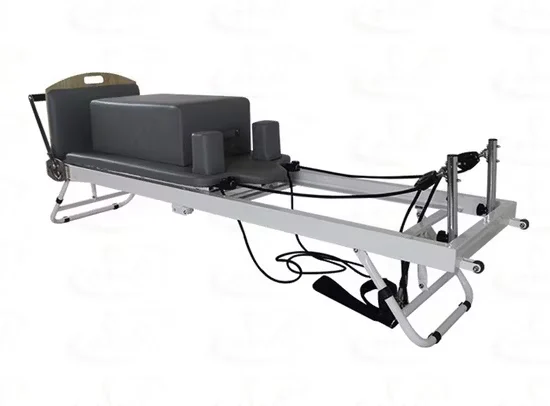
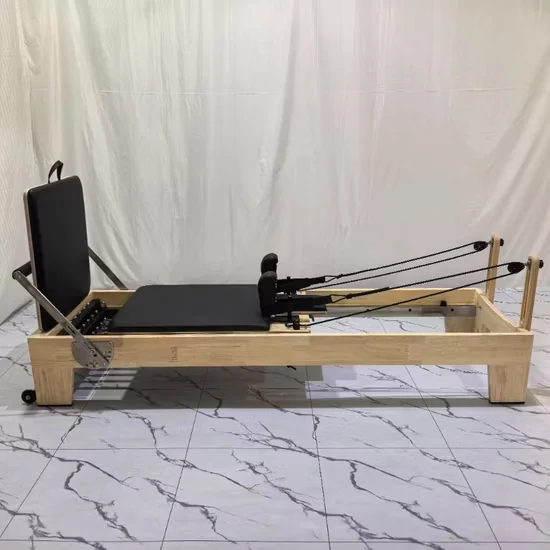
Pilates Reformer, 2460×730×680mm, 100kg Net Weight — solid oak maple frame with long box, jump board, and platform for full-body training. Includes 3-year warranty and customized logo options for studio branding. Engineered with 32-point inspection and 100% load testing before shipment.
// Spec Highlights
• Direct from Manufacturer · No Middlemen · Worldwide Shipping
01
// Material
Imported Solid Wood
Premium hardwood frames sourced for density and visual warmth.
02
// Hardware
Medical-Grade Silent
Whisper-quiet pulleys and springs for clinical environments.
03
// Customization
Appearance OEM
Color, upholstery, and branding tailored to your studio.
04
// Service
Layout Design
Free venue planning for studios and rehab institutions.
Every component is selected for longevity, performance, and aesthetic harmony - from imported hardwood frames to silent medical-grade accessories.
// Features
Solid Oak Maple Core — solid hardwood frame with verified grain orientation resists warping under cyclic spring loading, built for daily studio use with long box, jump board, and platform included.
| Parameter | Value |
|---|---|
| Product Type | Pilates Reformer |
| Product Dimensions | 2460×730×680mm |
| Net Weight | 100kg |
| Frame Material | Solid Oak Maple Wood |
| Included Accessories | Long Box / Jump Board / Platform |
| Color Options | Solid Color |
| Logo Customization | Customized Is Allowed |
| Warranty | 3 Years |
| Target User | Adult / Unisex |
| Transport Package | Standard Wood Case |
| Facility Type | Typical Use |
|---|---|
| Commercial Pilates Studio | High-traffic group reformer classes and private sessions |
| Home Gym | Full-body Pilates training in dedicated personal fitness spaces |
| Rehabilitation and Physical Therapy Center | Controlled resistance exercises for injury recovery programs |
| Boutique Fitness Studio | Small-group reformer workouts with premium equipment presentation |
Solid hardwood grain structure distributes cyclic spring tension across the full cross-section instead of concentrating stress at adhesive layers.
Many reformers labeled as wood construction use thin veneer over particle board or plywood laminate. Under repeated spring tension cycles, these composite cores develop delamination at joint points and along the carriage track mounting surface. The oak maple wood Pilates reformer eliminates this failure mode through solid core construction. [NEED_CITE: EN 957 structural requirements for stationary training equipment] The difference shows up within the first year of commercial daily use, where laminated frames begin exhibiting joint loosening and track misalignment.
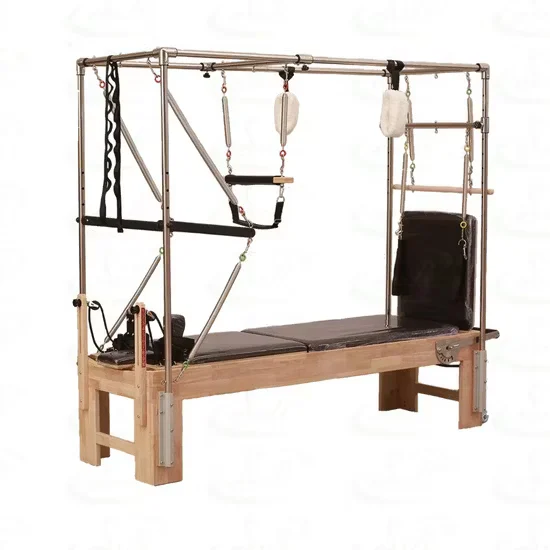
The commercial oak maple wood Pilates reformer anchors the reformer training zone, covering supine, prone, seated, and standing movement planes across full-body muscle groups. It pairs with Cadillac, chair, and barrel equipment to form a complete Pilates apparatus configuration. Suitable for studios running four to six daily class cycles and home installations with dedicated floor space. The carriage and spring system accommodates users across a wide anthropometric range, from shorter rehabilitation clients to taller athletic populations.
Each spring contraction and release creates tension spikes at the end-stop anchors and track mounting points. In a commercial studio running back-to-back classes, the frame endures hundreds of load cycles per day. The foot bar hinge, spring hooks, and carriage pulley mounts concentrate stress into small joint areas. Solid oak maple distributes these forces through continuous wood grain rather than adhesive bonds. [NEED_CITE: fatigue performance in cyclically loaded wood structures] Vinyl upholstery on the carriage and platform faces compression cycles combined with cleaning chemical exposure, requiring material that resists both compression set and surface cracking.
Frame density and grain orientation determine whether the carriage track remains flat and parallel after months of spring loading. Solid oak maple maintains dimensional stability because its grain runs continuously through joint intersections. The carriage wheel and track system depends on this flatness, where deviations of even small fractions create audible drag and uneven glide. Spring configuration, wire gauge, and hook placement define the resistance progression curve and how adaptively the unit serves beginners through advanced practitioners. Upholstery foam density must resist compression set under daily body-weight loading without becoming too firm for comfort. Powder-coated hardware and stainless steel springs resist corrosion from sweat and cleaning solutions that accumulate around mounting points.
Thin-wall composite cores reduce material cost but shift maintenance burden to the studio operator. Delaminating frames require carriage track re-shimming or complete frame replacement. Non-sealed carriage wheels accumulate dust and hair in the bearing race, creating drag and requiring frequent teardowns. Low-density foam upholstery compresses permanently within months of daily use, forcing reupholstery costs. Underspecified springs lose their calibrated resistance profile faster, confusing clients who notice the movement feel has changed. [NEED_CITE: lifecycle cost comparison of commercial fitness equipment materials]
The solid oak maple frame is sourced with core material verification to confirm solid hardwood rather than veneer-laminated composite. Every frame undergoes inspection for grain continuity at stress-concentration joints before assembly. Each unit is load-tested under spring tension cycles before crating, not pulled from a batch sample. The 200μm hardware coating resists corrosion from studio humidity and cleaning protocols. A 3-year warranty covers structural defects, reflecting the expected service life under commercial use patterns. Floor planning CAD support helps studios position reformers with proper clearance for safe carriage operation and instructor circulation paths between units.
Provide your studio floor dimensions and planned reformer count to receive 2D-3D layout planning with proper clearance mapping. Specify expected daily class volume to confirm the structural grade matches your usage pattern. Share your target client demographic to verify the carriage range and spring configuration suit the anthropometric range. Detail customization needs including frame color, logo placement, and upholstery selection for brand consistency across your facility.
Q: How can I verify a Pilates reformer uses solid wood rather than laminated plywood?
A: Request the core material certification showing solid hardwood construction, not veneer over composite. Examine the end-grain at frame joints where solid wood shows continuous grain patterns through the cross-section. Laminated frames display visible ply layers at cut edges. Ask for the frame weight specification, as solid oak maple is measurably heavier than particle board alternatives of the same dimensions.
Q: What spring configuration works for different experience levels in a studio?
A: Beginner clients typically start with lighter springs to learn control through the full range of motion. Intermediate and advanced practitioners require heavier spring combinations for adequate resistance during compound movements. A reformer with multiple spring hooks and graduated wire gauges lets instructors adjust the load curve session by session, accommodating mixed-level classes without swapping hardware.
Q: How often should carriage wheels and tracks be maintained in a commercial studio?
A: Under daily class schedules, inspect carriage wheels every 90 days for dust accumulation and bearing play. Clean the oak maple track surface with a dry lint-free cloth to remove chalk residue and body oil buildup. Wheels showing flat spots or wobble should be replaced before they create track wear. Sealed bearings extend service intervals compared to open bearing designs.
Q: What replacement parts should a studio keep in stock for reformer maintenance?
A: Keep spare springs in each wire gauge your studio uses, as springs gradually lose calibrated resistance. Stock replacement straps, rope loops, and upholstery repair patches for high-wear contact points. Carriage wheels and replacement foot bar pads prevent extended downtime when components wear out. Confirm parts availability and lead times with your supplier before purchasing equipment.
Premium aesthetics meet quiet operation for boutique studio environments.
Medical-grade silence and precision for sports & postpartum recovery.
Furniture-grade craftsmanship for premium residential installations.
Compact premium setups for one-on-one and small-group training.
Aesthetic Pilates integration for hybrid wellness studio programming.
Multi-unit deployment with instructor-grade reliability for certification programs.
Tell us about your project. Our team will respond within 24 hours with pricing, customization options, and shipping details.
// Sales Director
William
+86 132 2531 1800
// Export Manager
Bella
+86 198 5412 8032
william@bickfit.com