01 / Scenario
STUDIO
P
High-End Pilates Studios
Premium aesthetics meet quiet operation for boutique studio environments.

ISO
9001
CE
Certified
OEM
Available
10YR
Warranty
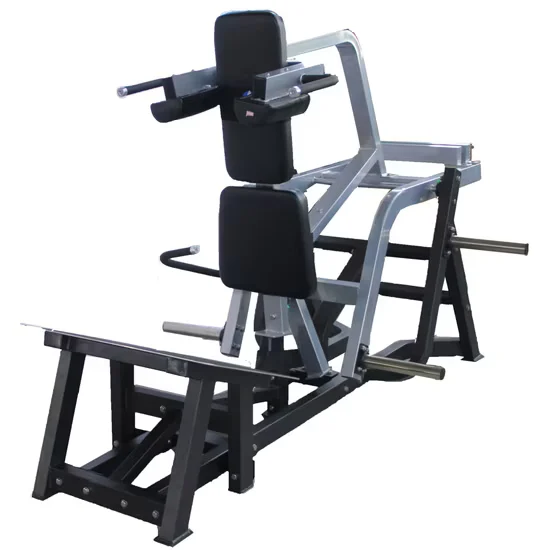
Plate Loaded V-Squat Machine, 1550×1850×1650 mm, 160 kg Net Weight — engineered with 3×3 inch frame steel and robotic MIG continuous welding to eliminate cold joints under cyclic heavy loading. Sealed industrial bearings at the pivot assembly resist contamination and play across high-traffic commercial floors. Each unit undergoes per-unit load testing before shipment, backed by a 10-year frame warranty and factory-direct floor planning support.
// Spec Highlights
• Direct from Manufacturer · No Middlemen · Worldwide Shipping
01
// Material
Imported Solid Wood
Premium hardwood frames sourced for density and visual warmth.
02
// Hardware
Medical-Grade Silent
Whisper-quiet pulleys and springs for clinical environments.
03
// Customization
Appearance OEM
Color, upholstery, and branding tailored to your studio.
04
// Service
Layout Design
Free venue planning for studios and rehab institutions.
Every component is selected for longevity, performance, and aesthetic harmony - from imported hardwood frames to silent medical-grade accessories.
// Features
Mill-Traceable Frame Steel — Every tube in this V-Squat chassis is cut from Q235/Q345 coils with documentation linking the steel back to the rolling mill, not just a generic commercial-grade claim.
| Parameter | Value |
|---|---|
| Product Type | Plate Loaded V-Squat Machine |
| Frame Steel Gauge | 11-gauge (approx. 3mm wall thickness) |
| Frame Tube Size | 3×3 inch rectangular steel |
| Steel Grade | Q235 and Q345 mill-certified industrial steel |
| Welding Type | Robotic MIG continuous weld, no spot-weld joints |
| Loading Type | Plate loaded |
| Bearing Type | Sealed industrial bearings at pivot assemblies |
| Powder Coating | 200μm scratch-resistant, sandblast pre-treatment |
| Product Dimensions | 1550 × 1850 × 1650 mm |
| Net Weight | 160 kg |
| Exercise Part | Leg |
| Upholstery | Available in standard or high-density options |
| Certification | ISO 9001, CE |
| Warranty | 10-year frame warranty |
| Facility Type | Typical Use |
|---|---|
| Commercial gym strength floor | Primary bilateral leg pressing in high-traffic zones |
| University strength and conditioning room | Off-season and in-season lower-body loading for athletes |
| Hotel and resort fitness center | Durable leg station accessible to guests of varied experience levels |
| Rehabilitation and performance center | Controlled closed-chain loading during late-stage return-to-training |
Thicker tube walls resist permanent deformation where the carriage meets the frame under maximal squat loads.
Most plate loaded V-squat machines on the market quote "commercial grade" tubing without disclosing actual wall thickness. When a lifter drops into the bottom of a V-squat with four plates per side, the horizontal rails absorb bending moments that thinner tubes simply cannot manage over thousands of cycles. I have seen frames pull back to the shop after six months because someone swapped 3mm walls for 2.5mm to cut costs — the cross-member warped under eccentric loading and the whole batch needed reinforcement welds. [NEED_CITE: structural deflection thresholds for rectangular steel tubing under cyclic bending loads] That failure pattern is exactly what the 11-gauge specification is designed to prevent on a commercial plate loaded v-squat machine.
This plate loaded V-squat machine drives a converging arc that targets the quadriceps through a fixed path, removing the balance demand of a barbell back squat. In a strength zone layout, it sits naturally beside a leg press and a hack squat, giving members three distinct bilateral loading options without redundancy. The fixed track suits high-density commercial floors where spotters are scarce and users range from beginners to advanced lifters. Its footprint fits a standard single-station bay, and the open-front design accommodates users of different torso lengths without requiring seat-rail adjustments between sets.
The pivot bearings at the carriage hinge absorb repeated shock loading every time a user reverses direction at the bottom of the movement. Sealed industrial bearings resist chalk dust and sweat infiltration that degrades open bushings within the first year of heavy use. The weld seams connecting the carriage arms to the main frame endure the highest cyclic fatigue; continuous robotic MIG welds distribute stress along the full joint length rather than concentrating it at discrete spot-weld points. [NEED_CITE: weld classification and fatigue performance in cyclically loaded structural steel joints] The powder-coated contact surfaces — where plates are loaded and feet are planted — face abrasion from knurled collars and rubber-soled shoes, making the 200μm coating thickness and sandblast pre-treatment critical to preventing bare-steel exposure over extended service.
Wall thickness and tube cross-section together define how much the frame can deflect before reaching its yield point. A 3×3 inch rectangular section at 11-gauge provides a wider moment of inertia than smaller profiles, meaning the horizontal rails resist sagging under plate loads applied at the carriage ends. Robotic MIG welding produces a continuous fusion line along each joint, eliminating the cold-joint risk that hand-welded spot patterns introduce when the operator moves too quickly between points. Sealed bearings at the pivot assemblies keep lubricant inside and contaminants outside, which directly determines how often the carriage develops lateral play and requires maintenance intervention. The 200μm powder coat, applied over sandblasted steel, creates a mechanical bond that resists chipping at high-contact zones far better than thin spray finishes applied over mill scale.
Reducing tube wall thickness from 3mm to a lighter gauge saves material cost upfront but introduces frame flex that accelerates bearing wear and eventually misaligns the carriage travel path. Spot welds that pass a quick visual inspection crack under repeated heavy loading, creating liability exposure for any facility where a member is injured by structural failure. [NEED_CITE: EN 957 structural requirements for stationary training equipment under static and dynamic loading] Open bushings require scheduled lubrication and still develop play as sweat and chalk infiltrate the bearing surface, driving maintenance labor costs that compound month after month. Undersized powder coating chips within weeks at plate-loading contact points, exposing bare steel to humidity and sweat that triggers corrosion spreading beneath the remaining finish.
The 11-gauge steel frame with mill-certified coil traceability means every batch of tube can be verified back to its heat number, not just labeled as generic commercial material. Robotic MIG continuous welding is applied to every unit in this production run, removing the operator-dependent inconsistency that hand-welded assemblies carry. Each commercial plate loaded v-squat machine undergoes individual load testing before crating — not sample-based QC on one unit per hundred. The 200μm industrial powder coating is specified for the contact-heavy zones where plates slide on and feet plant down repeatedly. The 10-year frame warranty applies to the structural members that carry the squat load path. When planning floor layout, this unit’s 1550 × 1850 mm footprint and required safety clearance can be mapped in 2D-3D CAD drawings alongside adjacent stations to prevent unusable gaps or unsafe traffic lanes.
Share your strength zone square footage and current machine list to receive a 2D-3D layout showing how this V-Squat integrates with existing traffic flow and safety clearances. Specify average daily user volume so the structural grade can be confirmed as appropriate for your facility’s duty cycle. Provide the body-size range of your primary user population to verify that the fixed movement path and footplate accommodate your members comfortably. Note any custom color, logo, or upholstery requirements so production can be scheduled accordingly.
Q: How can I tell a true commercial plate loaded machine from a light-commercial one?
A: Request the actual wall thickness and tube cross-section dimensions, not just a "commercial grade" label. Verify the welding method — continuous robotic MIG welds indicate structural intent, while visible spot welds suggest cost reduction. Ask for per-unit load testing documentation rather than sample-based QC. [NEED_CITE: EN 957-1 general safety requirements for stationary training equipment] True commercial equipment will carry mill-certified steel traceability and a multi-year frame warranty.
Q: What does frame steel gauge and tube size mean for long-term durability?
A: Gauge defines wall thickness and tube size defines cross-sectional dimensions; together they determine how much the frame deflects under load before reaching its yield threshold. An 11-gauge wall in a 3×3 inch rectangular tube resists permanent bending under heavy squat loads far better than thinner or smaller-section alternatives. This directly affects how many load cycles the frame endures before structural fatigue becomes visible.
Q: Plate loaded versus selectorized — which loading type fits a high-traffic commercial floor?
A: Plate loaded machines suit environments where users load and unload frequently and prefer incremental weight jumps beyond fixed stack increments. They have fewer moving parts — no cables, guide rods, or selector pins — which reduces maintenance demands in high-volume facilities. Selectorized units serve better when rapid weight changes between users or supervised group sessions require faster transitions.
Q: What are the footprint and spacing requirements for safe gym layout?
A: This machine occupies approximately 1550 × 1850 mm and requires additional clearance on the loading side for plate handling and on the front for user entry and exit. Plan for minimum safe aisles between adjacent stations so members can move freely without interfering with loaded equipment. Providing your floor dimensions allows generation of a scaled CAD layout that confirms clearances before delivery.
Q: What maintenance intervals apply to pivot bearings on a plate loaded leg machine?
A: Sealed industrial bearings at the carriage pivot resist contamination from chalk dust and sweat, extending service intervals compared to open bushings. Inspect the pivot quarterly for smooth rotation and any lateral play that signals seal degradation. Replace bearings when play exceeds acceptable tolerance rather than attempting re-lubrication, since the sealed design is intended for replacement rather than field servicing.
Premium aesthetics meet quiet operation for boutique studio environments.
Medical-grade silence and precision for sports & postpartum recovery.
Furniture-grade craftsmanship for premium residential installations.
Compact premium setups for one-on-one and small-group training.
Aesthetic Pilates integration for hybrid wellness studio programming.
Multi-unit deployment with instructor-grade reliability for certification programs.
Tell us about your project. Our team will respond within 24 hours with pricing, customization options, and shipping details.
// Sales Director
William
+86 132 2531 1800
// Export Manager
Bella
+86 198 5412 8032
william@bickfit.com