01 / Scenario
STUDIO
P
High-End Pilates Studios
Premium aesthetics meet quiet operation for boutique studio environments.
ISO
9001
CE
Certified
OEM
Available
10YR
Warranty
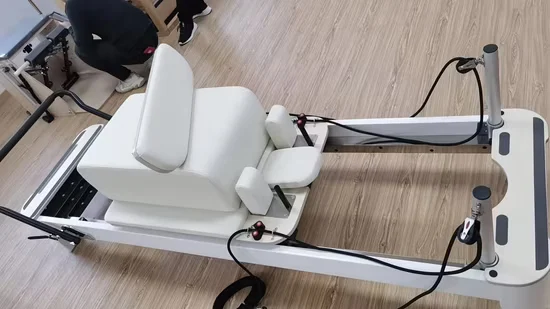
Commercial Pilates Reformer Machine, Wood Core Frame, 2460×730×680mm — engineered with 100kg solid frame weight to minimize vibration during dynamic carriage movements and loaded exercises. Includes long box, jump board, and platform accessories to expand exercise repertoire without additional equipment. Backed by a 3-year warranty covering high-traffic commercial studio use with 32-point inspection and full load testing before shipment.
// Spec Highlights
• Direct from Manufacturer · No Middlemen · Worldwide Shipping
01
// Material
Imported Solid Wood
Premium hardwood frames sourced for density and visual warmth.
02
// Hardware
Medical-Grade Silent
Whisper-quiet pulleys and springs for clinical environments.
03
// Customization
Appearance OEM
Color, upholstery, and branding tailored to your studio.
04
// Service
Layout Design
Free venue planning for studios and rehab institutions.
Every component is selected for longevity, performance, and aesthetic harmony - from imported hardwood frames to silent medical-grade accessories.
// Features
Every Unit Load-Tested — Each commercial wood core pilates reformer machine undergoes full-range carriage travel and spring tension verification before leaving the assembly floor.
| Parameter | Value |
|---|---|
| Product Type | Pilates Reformer Machine |
| Model NO. | SRY-24 |
| Product Dimensions | 2460 × 730 × 680 mm |
| Net Weight | 100 kg |
| Frame Material | Wood Core |
| Accessory | Long Box / Jump Board / Platform |
| Color Options | Solid Color |
| Logo | Customized Is Allowed |
| Certification | ISO 9001:2015, CE, SGS |
| Warranty | 3 Years |
| Facility Type | Typical Use |
|---|---|
| Commercial Pilates Studio | Group reformer classes and private instruction sessions |
| Rehabilitation Center | Post-injury mobility recovery and neuromuscular retraining |
| Boutique Fitness Studio | Small-group functional movement programming |
| Hotel Fitness Center | Guest-accessible low-impact resistance training |
| Yoga Studio | Complementary flexibility and core stabilization work |
Mass absorbs vibration — a lightweight frame cannot replicate this.
Many Pilates reformers on the commercial market carry a "studio grade" label without disclosing core density, carriage rail construction, or total frame mass. The result shows up within months at high-traffic facilities: carriage tracking drifts off-center, wood core beds develop torsional cracks near rail joints, and platform surfaces vibrate during jump board sequences. On a Pilates reformer batch I inspected in Bogotá, spot-welded rail joints developed measurable play after roughly three months of six-day-per-week studio scheduling. The entire lot was pulled and replaced. When the steel skeleton fails to hold dead true, no amount of upholstery refinement compensates for the structural compromise underneath [NEED_CITE: EN 957 structural requirements for stationary training equipment].
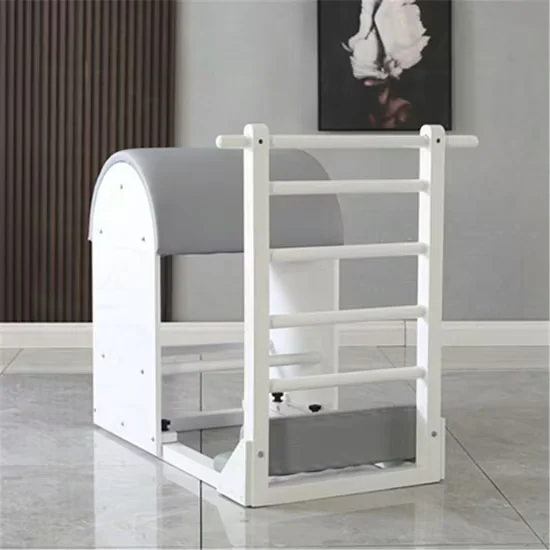
A commercial wood core pilates reformer machine anchors the movement floor as the primary resistance-based apparatus. It covers supine, prone, seated, and standing movement planes — targeting hip extensors, spinal stabilizers, scapular retractors, and lower-limb alignment chains across a broad range of practitioner body types. In a studio layout, it pairs with a cadillac or tower unit for advanced spinal articulation work and a stability chair for isolated balance loading. Facilities running four to six classes daily benefit most from the 100 kg frame mass, which keeps vibration contained during high-repetition footwork and jump board intervals without transferring oscillation to adjacent stations.
Reformer carriages endure cyclical eccentric loading every session — springs pull the carriage back while the user controls deceleration, generating repeated tension-compression cycles at the rail-to-frame interface. Over hundreds of weekly repetitions, this fatigue loading concentrates at carriage stop points and rail anchor bolts. Jump board use introduces impact forces that travel through the platform into the wood core bed, demanding consistent density and secure fastening along the entire rail channel. Upholstery contact surfaces endure friction from bare skin, grip socks, and reformer-specific cleaning solutions applied multiple times per day [NEED_CITE: cyclic fatigue performance in wood-steel composite structures].
The 2460 × 730 × 680 mm footprint provides sufficient carriage travel for full-range leg press and arm pull sequences while fitting standard studio bay widths with adequate clearance on each side. The 100 kg net weight establishes a mass-to-user ratio that meaningfully dampens oscillation — when a 70 kg practitioner performs jump board sequences, the frame absorbs residual energy rather than transmitting it across the floor. Wood core construction as the frame material delivers a rigid, dimensionally stable platform surface, provided the core density and thickness are specified to resist deflection under loaded carriage movement. Included accessories — long box, jump board, and platform — eliminate separate procurement cycles and ensure fastening compatibility with the SRY-24 rail and mounting geometry.
Thin or unspecified wood core material flexes under repeated jump board impact, eventually cracking along the grain near carriage rail mounting points. Undersized rail hardware loosens under cyclical loading, introducing lateral play that degrades movement precision and forces premature bearing replacement. Low-density upholstery compresses permanently within months of commercial scheduling, leaving visible depressions that cannot be recovered and require full re-upholstery at significant downtime cost. Inadequate surface finishing on exposed wood edges absorbs moisture from cleaning agents, leading to swelling and surface degradation that shortens the service interval between refinishing cycles [NEED_CITE: wood core dimensional stability under cyclical moisture exposure].
The SRY-24 is manufactured in a vertically integrated facility where steel sourcing, cutting, welding, finishing, and assembly remain under single-roof quality control. Every unit undergoes load testing before shipment — not sample-based batch inspection, but individual verification of carriage travel smoothness, spring tension consistency, and rail alignment. The 200μm industrial powder coating applied across contact and wear surfaces resists chipping from repeated accessory mounting and daily cleaning protocols. A 3-year warranty on commercial use reflects structural confidence rather than marketing positioning. OEM customization for color and logo placement is available without requiring minimum volume thresholds that exclude single-studio orders.
Provide your studio floor dimensions and existing equipment list to receive a 2D layout showing SRY-24 placement with recommended safety clearances between stations. Specify your average daily class count and session duration so the structural duty cycle can be confirmed against your scheduling intensity. Communicate any custom color or logo requirements at the inquiry stage to ensure finish consistency across a multi-unit order.
Q: How does wood core construction compare to metal frame reformers for commercial use?
A: Wood core platforms deliver a rigid, dimensionally stable surface that dampens vibration differently than tubular steel frames. In high-traffic studios, the key variable is core density and thickness — a properly specified wood core resists deflection under loaded carriage movement and jump board impact, providing consistent platform feel across thousands of sessions.
Q: What weight capacity does a 100 kg frame reformer support?
A: The 100 kg net weight of the SRY-24 establishes a high mass-to-user ratio that stabilizes the platform during dynamic exercises. Frame weight itself is a structural indicator — heavier frames resist oscillation transfer and maintain rail alignment under repeated eccentric loading across diverse practitioner body sizes.
Q: How do jump board and long box accessories expand exercise options?
A: The included jump board enables plyometric loading sequences targeting lower-limb power and reactive strength. The long box supports seated and supine pulling variations, spinal articulation work, and hamstring flexibility drills. Both accessories mount directly to the SRY-24 rail system, maintaining alignment integrity without third-party adapter hardware.
Q: What maintenance is required for wood core reformers in high-traffic studios?
A: Quarterly inspection of rail anchor bolts, carriage bearings, and spring attachment points is recommended under daily scheduling. Wood core surfaces should be cleaned with pH-neutral solutions to preserve finish integrity. Upholstery contact zones need monitoring for compression wear, and rail lubrication should follow manufacturer-specified intervals to maintain smooth carriage travel.
Q: How to verify commercial-grade durability claims for pilates equipment?
A: Request the frame material specification including wood core density rating, net weight verification against the stated 100 kg, and individual unit load test documentation. Confirm warranty terms explicitly cover commercial use scenarios rather than residential-only conditions, and ask for third-party certification records such as CE conformity or SGS audit reports.
Premium aesthetics meet quiet operation for boutique studio environments.
Medical-grade silence and precision for sports & postpartum recovery.
Furniture-grade craftsmanship for premium residential installations.
Compact premium setups for one-on-one and small-group training.
Aesthetic Pilates integration for hybrid wellness studio programming.
Multi-unit deployment with instructor-grade reliability for certification programs.
Tell us about your project. Our team will respond within 24 hours with pricing, customization options, and shipping details.
// Sales Director
William
+86 132 2531 1800
// Export Manager
Bella
+86 198 5412 8032
william@bickfit.com