01 / Scenario
STUDIO
P
High-End Pilates Studios
Premium aesthetics meet quiet operation for boutique studio environments.
ISO
9001
CE
Certified
OEM
Available
10YR
Warranty
Every unit undergoes 32-point inspection and 100% load testing before shipment.
// Spec Highlights
• Direct from Manufacturer · No Middlemen · Worldwide Shipping
01
// Material
Imported Solid Wood
Premium hardwood frames sourced for density and visual warmth.
02
// Hardware
Medical-Grade Silent
Whisper-quiet pulleys and springs for clinical environments.
03
// Customization
Appearance OEM
Color, upholstery, and branding tailored to your studio.
04
// Service
Layout Design
Free venue planning for studios and rehab institutions.
Every component is selected for longevity, performance, and aesthetic harmony - from imported hardwood frames to silent medical-grade accessories.
// Features
Solid Wood Frame Integrity — Solid wood species selection and reinforced joinery ensure long-term dimensional stability under continuous studio use and humidity fluctuations.
| Parameter | Value |
|---|---|
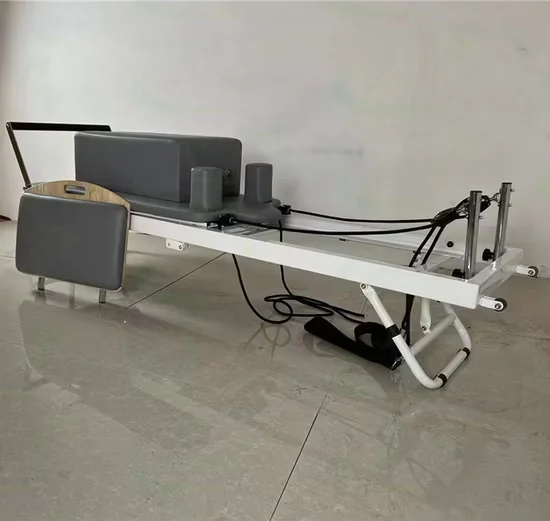
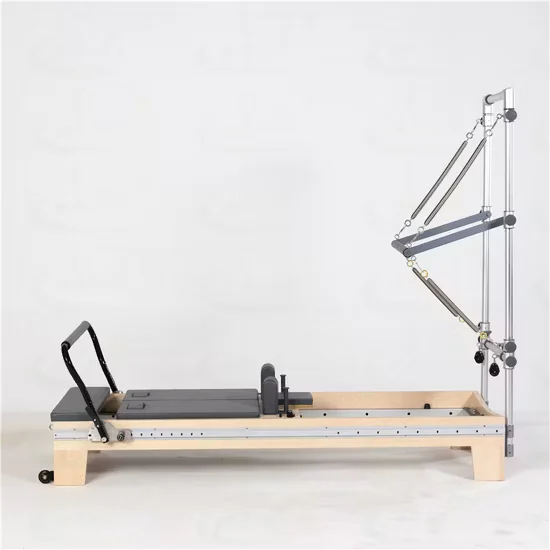
| Product Type | Wood Reformer Pilates Equipment |
| Model NO. | SRY-06A |
| Product Dimensions | 2460 × 730 × 1900 mm |
| Net Weight | 150 kg |
| Frame Material | Solid Wood |
| Carriage System | Two-Way Sliding Ladder |
| Accessory | Long Box / Jump Board / Platform |
| Color | Solid Color |
| Logo | Customized Is Allowed |
| Age | Adult |
| Gender | Unisex |
| Warranty | 3 Years |
| Origin | China |
| Certification | CE |
| Facility Type | Typical Use |
|---|---|
| Commercial Pilates Studio | Daily group reformer classes with back-to-back scheduling |
| Boutique Fitness Studio | Semi-private sessions combining reformer with mat work |
| Rehabilitation and Conditioning Center | Post-injury mobility and core stabilization programs |
| Hotel Fitness Facility | Guest-access wellness programming with instructor-led classes |
Precision-machined rails with sealed bearings eliminate the play and squeak that plague high-repetition studio environments.
When I first built a Wood Reformer Pilates unit for a Middle East client years ago, the decision to cut cost on the sliding rail seemed minor — swap sealed bearings for standard bushings and save on the bill. Within months of daily studio scheduling, the carriage developed lateral play, the rail surface showed uneven wear tracks, and instructors reported audible friction during footwork sequences. That failure reshaped how I evaluate every two-way sliding ladder system that crosses our workshop floor. Commercial wood reformer pilates equipment lives or dies by what happens between the carriage and the rail — the joint where repetitive loading, sweat exposure, and humidity fluctuation converge. [NEED_CITE: bearing load rating and maintenance intervals for linear motion systems in fitness equipment]
The reformer addresses sagittal and frontal plane work through supine, prone, and seated positions, targeting core stabilization, hip mobility, and spinal articulation. In a studio layout, it anchors the equipment zone alongside cadillacs and chair stations, allowing instructors to rotate clients through circuits without bottlenecking. The two-way sliding ladder expands exercise variety by introducing vertical pulling and climbing patterns that complement traditional spring-loaded carriage work. For studios running four to six reformer stations per room, the 2460 mm length requires adequate clearance at both head and foot ends for jump board extensions and long box slides. The SRY-06A fits operators who program for mixed-body-type clientele, given the carriage travel range accommodates varying limb lengths across adult users. Commercial wood reformer pilates equipment in this configuration serves studios prioritizing movement diversity without adding separate tower units.
The carriage rail absorbs cyclical impact loading every time a client performs jump board repetitions or controlled eccentric returns against spring tension — easily hundreds of cycles per day in a fully booked studio. Sweat and cleaning solutions pool at rail contact points, accelerating corrosion on unsealed bearing surfaces and degrading lubrication over time. The solid wood frame experiences shear stress at joinery points where the rail mounts to the base, particularly if humidity swings cause the timber to expand and contract seasonally. Upholstery on the carriage platform endures compression from body weight in every session, with foam density determining how quickly the surface loses its support profile. Pulley cables running through the two-way sliding ladder system face abrasion at each sheave, and undersized sheave diameters concentrate wear on fewer cable strands. [NEED_CITE: cyclic fatigue performance of wood-to-metal fastened joints in humid environments]
Solid wood species matters because hardwoods like maple or beech maintain dimensional stability across humidity ranges that would cause softwood or laminated veneer to warp and delaminate. The frame thickness at stress junctions — where rail brackets bolt to the base — determines whether the structure resists racking forces or gradually loosens at the fasteners. A two-way sliding ladder with sealed bearings keeps dust, chalk, and sweat out of the rolling elements, whereas open bushings require scheduled relubrication and develop lateral play as particulate contaminates the contact surface. Pulley sheave diameter relative to cable thickness controls how many bending cycles the cable survives before strand fracture; larger sheaves distribute the bending stress across more cable length per revolution. Upholstery foam density rated for commercial compression cycles maintains its rebound profile across years of daily use, while residential-grade foam collapses into permanent depressions within a season of studio scheduling.
Thinner frame stock saves material cost upfront but allows the base to flex under off-center loading, transferring that deflection into the rail alignment and causing the carriage to bind. Open bushings reduce the bill of materials but demand maintenance downtime that pulls reformers off the booking schedule every few weeks. Low-density upholstery foam compresses permanently within months, forcing studios to either run classes on degraded surfaces or pay for reupholstery work that takes the unit offline again. Undersized pulley cables snap mid-session under the dynamic loads of jump board work, creating both a safety incident and a liability conversation. Non-standard fastener hardware means replacement parts are unavailable locally, turning a simple bearing swap into a weeks-long wait for shipped components. [NEED_CITE: total cost of ownership comparison between sealed bearing and bushing carriage systems]
We trace solid wood sourcing back to species certification rather than accepting generic hardwood claims — because studio operators need to know the frame will hold its geometry through seasonal humidity swings. Robotic MIG welding applies to the metal sub-assemblies where brackets meet rail mounts, producing continuous weld lines without the cold joints that manual spot-welding leaves at stress concentrations. Every SRY-06A unit undergoes load testing on the carriage before shipment, verifying that the two-way sliding ladder tracks true under off-center weight distribution. The 200μm industrial powder coating on all metal contact surfaces resists the cleaning chemicals and sweat acids that strip thinner finishes down to bare steel within a year. Our ten-year frame warranty reflects confidence in the joinery and steel reinforcement, not a prorated schedule that depreciates coverage annually. Studio operators receive 2D and 3D CAD layout support showing reformer station spacing with safe clearance zones for jump board extensions and instructor circulation paths. OEM branding on frame color and logo placement allows boutique studios to align equipment aesthetics with their interior design without ordering from a middleman.
Provide your studio floor dimensions and planned station count so we can generate 2D and 3D layout files showing optimal reformer spacing with safe clearance zones. Specify your average daily class volume to confirm the carriage system matches your usage intensity. Share your target client demographics so we can verify the carriage travel range accommodates the full body-type spectrum in your membership base. Outline any branding requirements — frame color, logo placement, upholstery selection — to receive a production-ready specification package. Commercial wood reformer pilates equipment procurement starts with matching the structural grade to your operational reality, not just comparing line-item pricing.
Q: How do you distinguish commercial-grade wood reformers from home-use models?
A: Commercial units use solid hardwood frames with reinforced joinery at stress points, sealed bearing carriage systems rated for thousands of daily cycles, and upholstery foam density specified for continuous compression recovery. Home models often use laminated veneer, open bushings, and thinner foam that degrades within months of studio-level scheduling. Request wood species certification and bearing specification documentation to verify the build grade before committing to a fleet purchase.
Q: What wood species and frame construction ensure long-term stability?
A: Hardwoods like maple and beech maintain dimensional stability across humidity fluctuations common in studio environments where HVAC systems cycle on and off throughout operating hours. Solid timber construction with doweled or mortise-and-tenon joinery at rail-mount junctions resists the racking forces that cause simpler butt-joint frames to loosen over time. Avoid frames built from laminated veneer or softwood cores, as these warp and delaminate when exposed to seasonal moisture changes.
Q: Sealed bearing versus bushing carriage systems — what is the practical difference?
A: Sealed bearings keep particulate contamination out of the rolling elements, maintaining smooth carriage travel with minimal scheduled maintenance across years of studio operation. Bushing systems rely on surface lubrication that degrades as chalk dust, sweat, and cleaning solution penetrate the contact zone, requiring relubrication and eventual replacement. Studios running back-to-back classes experience noticeably different maintenance intervals and noise profiles between the two approaches.
Q: What studio floor planning considerations apply to reformer stations?
A: Each station requires clearance beyond the 2460 mm frame length at both ends for jump board extension and instructor circulation during class. Lateral spacing between adjacent reformers must allow clients to move through standing and side-lying exercises without contact. Factor in storage wall or shelf footprint for accessories like long boxes, jump boards, and resistance accessories that rotate through class programming.
Q: How does upholstery replacement work when the time comes?
A: Commercial-grade upholstery attaches with standardized fastener patterns so replacement pads swap without damaging the underlying carriage platform. Specify upholstery density and cover material at procurement to match your studio’s daily session volume and cleaning protocol. Ordering replacement pads from the original manufacturer ensures the foam profile and mounting geometry match the carriage dimensions precisely.
Premium aesthetics meet quiet operation for boutique studio environments.
Medical-grade silence and precision for sports & postpartum recovery.
Furniture-grade craftsmanship for premium residential installations.
Compact premium setups for one-on-one and small-group training.
Aesthetic Pilates integration for hybrid wellness studio programming.
Multi-unit deployment with instructor-grade reliability for certification programs.
Tell us about your project. Our team will respond within 24 hours with pricing, customization options, and shipping details.
// Sales Director
William
+86 132 2531 1800
// Export Manager
Bella
+86 198 5412 8032
william@bickfit.com