
01 / Scenario
STUDIO
P
High-End Pilates Studios
Premium aesthetics meet quiet operation for boutique studio environments.
ISO
9001
CE
Certified
OEM
Available
10YR
Warranty
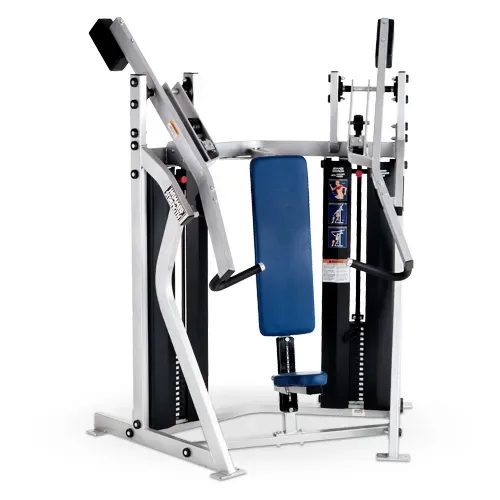
MTS-8015 Selectorized ISO-Lateral Squat Press, Dual 80kg Stacks, 399kg Machine Weight — engineered with 3×3 inch frame steel and robotic MIG continuous welding to eliminate spot-weld fatigue under heavy commercial loading. Sealed industrial bearings and precision guide rods ensure smooth pin-select operation across high-traffic environments. Every unit undergoes full load testing before shipment, backed by a 10-year frame warranty and custom floor planning support.
// Spec Highlights
• Direct from Manufacturer · No Middlemen · Worldwide Shipping
01
// Material
Imported Solid Wood
Premium hardwood frames sourced for density and visual warmth.
02
// Hardware
Medical-Grade Silent
Whisper-quiet pulleys and springs for clinical environments.
03
// Customization
Appearance OEM
Color, upholstery, and branding tailored to your studio.
04
// Service
Layout Design
Free venue planning for studios and rehab institutions.
Every component is selected for longevity, performance, and aesthetic harmony - from imported hardwood frames to silent medical-grade accessories.
// Features
Continuous MIG Weld Lines — Every MTS-8015 frame joint is robotically welded with continuous beads, eliminating the spot-weld fatigue points that crack under repeated heavy squat press loading.
| Parameter | Value |
|---|---|
| Designation | MTS-8015 |
| Product Type | Selectorized ISO-Lateral Squat Press Machine |
| Frame Steel | 11-gauge industrial steel, mill-certified Q235/Q345 |
| Frame Tube Size | 3×3 inch |
| Welding Type | Robotic MIG, continuous weld lines |
| Weight Stack | 80 kg × 2 independent stacks (expandable) |
| Loading Type | Pin-select |
| Bearing Type | Sealed industrial bearings |
| Pulley System | Aircraft-cable with precision-machined pulleys |
| Powder Coating | 200μm scratch-resistant, sandblast pre-treatment |
| Product Dimensions (L×W×H) | 140 cm × 150 cm × 147 cm |
| Net Weight | 399 kg |
| Machine Grade | Commercial use |
| Certification | CE / ISO 9001 / SGS / RoHS |
| Color Options | Customizable frame and upholstery colors |
| Warranty | 10-year frame |
| Facility Type | Typical Use |
|---|---|
| Commercial gym strength floor | Primary lower-body pressing station in selectorized zones |
| University strength and conditioning room | Athlete lower-body power development under supervised loading |
| Hotel and resort fitness center | Heavy-duty station for high-turnover guest use |
| Strength-focused distributor showroom | Demonstration unit showcasing iso-lateral movement and build quality |
Thicker tube walls keep the MTS-8015 frame from deflecting when users push near-maximum loads through the iso-lateral pressing arms.
Many selectorized machines labeled "commercial grade" never disclose actual wall thickness. When a 150kg user drives through the concentric phase of a squat press, the frame absorbs significant lateral and vertical force. Thin-wall tubing flexes under that stress, and over hundreds of loading cycles, micro-cracks propagate at welded joints. [NEED_CITE: weld classification and fatigue performance in structural steel] The MTS-8015 is built on 11-gauge steel with a 3×3 inch cross-section, providing the structural mass that keeps deflection within acceptable tolerances throughout years of daily commercial use.
The MTS-8015 commercial selectorized iso-lateral squat press machine occupies a specific role: it targets the quadriceps, glutes, and hamstrings through a converging arc that mimics natural leg-drive mechanics while reducing axial spinal loading compared to barbell squats. In a well-configured strength floor, it complements leg press platforms and hack squat stations by offering iso-lateral independent leg movement without requiring spotters. This machine suits high-density commercial environments where daily user turnover demands equipment that withstands continuous loading, and its adjustable range accommodates users across a broad spectrum of body sizes.
A squat press endures a distinct loading profile — the eccentric phase generates controlled deceleration forces while the concentric phase delivers peak compressive loads through the pressing arms and into the frame base. [NEED_CITE: EN 957 structural requirements for stationary training equipment] Over thousands of daily repetitions across multiple users, stress concentrates at the junction points where the pressing arm pivots meet the main uprights. Sealed industrial bearings at these pivot points prevent the play and wobble that develop in unsealed bushings after months of sweat and chalk exposure. The aircraft-cable pulley system distributes load evenly across the dual 80kg stacks, and the 200μm powder coating protects high-contact areas from the corrosive effects of cleaning chemicals and perspiration that accumulate on commercial gym floors.
The 399kg net weight of the MTS-8015 is not arbitrary — that mass reflects the volume of steel required to anchor the machine against lateral displacement during aggressive pressing. The 11-gauge frame wall thickness paired with a 3×3 inch tube section creates a moment of inertia sufficient to resist bending at the base uprights, which bear the highest combined load from the weight stacks and user force. Robotic MIG welding produces continuous weld beads rather than intermittent spot welds, distributing stress along the full joint length instead of concentrating it at discrete points. The dual 80kg pin-select stacks ride on guide rods where precise machining clearance determines whether the stack glides or binds under off-center loading — a tolerance issue that becomes visible only after months of commercial use. Sandblast pre-treatment before powder coating ensures the 200μm finish adheres to bare steel rather than sitting on mill scale, preventing the chip-and-rust cycle that degrades appearance in the first year.
When manufacturers cut frame tube gauge to save material costs, the resulting flex under load accelerates fatigue at every welded connection — a problem that surfaces as hairline cracks within the first year of heavy commercial use. [NEED_CITE: structural steel fatigue under cyclic loading in fitness equipment] Spot welds may pass initial visual inspection, but they create discrete stress risers that fail progressively under the repeated impact loading of a squat press. Non-sealed bearings in the pivot system allow sweat and chalk dust to infiltrate, generating play that degrades movement smoothness and requires increasingly frequent maintenance visits. Low-density upholstery compresses permanently under daily use, forcing premature re-upholstery contracts. Insufficient powder coating thickness at contact points chips down to bare steel, initiating corrosion that spreads beneath adjacent coating.
The MTS-8015 frame uses 11-gauge Q235 or Q345 steel with mill certification traceable to the original coil, so material provenance is verifiable rather than claimed. Every joint is robotically MIG welded with continuous beads — the same process used in structural steelwork, adapted for gym equipment geometry. Each unit undergoes individual load testing before shipment, not sample-based batch testing, ensuring the specific machine arriving at your facility has been verified under stress. The 200μm industrial powder coating applied over sandblasted surfaces protects the frame through years of commercial cleaning protocols. A 10-year frame warranty backs the structural investment, and our team provides 2D and 3D CAD floor planning support to position the MTS-8015 with proper safety clearances and traffic flow within your strength zone. OEM customization including frame color, upholstery material, and private labeling is available for chain operators and distributors.
Provide your strength zone square footage and existing equipment list so we can generate a 2D or 3D CAD layout positioning the MTS-8015 with correct spacing and traffic flow. Specify your expected daily user volume to confirm the structural grade matches your traffic density. Share your target user demographic and body-size range to verify the adjustment positions cover your membership. Detail any custom requirements including frame color, upholstery selection, or private label branding for distributor and chain operator programs.
Q: How to verify commercial-grade versus light-commercial selectorized machines?
A: Request the actual frame steel gauge and tube dimensions with mill certification, not just a "commercial grade" label. Verify the welding method — continuous robotic MIG welds handle cyclic loading far better than spot welds. Check the net weight; machines under 300 kg typically lack the structural mass for sustained heavy use. Confirm that sealed industrial bearings are specified rather than simple bushings, and ask for individual unit load test records rather than sample-based reports.
Q: What frame steel gauge and tube size are required for heavy-load squat pressing?
A: For a dual-stack selectorized squat press handling loads exceeding 160 kg total, 11-gauge steel with a minimum 3×3 inch tube section provides adequate resistance to frame deflection. Thinner gauges allow visible flex during the concentric pressing phase, which transfers cyclic stress to welded joints. The tube cross-section and wall thickness together determine the bending resistance at the upright-to-base connections where stress concentration is highest.
Q: How does weight stack guide rod precision affect maintenance frequency?
A: Guide rods machined to tight tolerances with properly matched bore clearance allow the stack to travel without binding, even when users load asymmetrically or drop the stack. Excessive clearance causes lateral wobble that accelerates wear on guide bushings, while insufficient clearance creates friction that degrades the smooth pin-select feel. Precision-machined rods paired with sealed bearings in the selector mechanism reduce maintenance interventions significantly in high-traffic environments.
Q: What is the recommended equipment spacing for commercial gym floor planning?
A: Allow a minimum of 60 cm lateral clearance on each side of the machine for user passage and emergency access, plus 90 cm behind for weight stack maintenance access. Front clearance should accommodate the full range of pressing arm extension plus user entry space. These distances ensure safe traffic flow in busy strength zones and allow maintenance technicians to reach pulleys and cables without moving adjacent equipment.
Premium aesthetics meet quiet operation for boutique studio environments.
Medical-grade silence and precision for sports & postpartum recovery.
Furniture-grade craftsmanship for premium residential installations.
Compact premium setups for one-on-one and small-group training.
Aesthetic Pilates integration for hybrid wellness studio programming.
Multi-unit deployment with instructor-grade reliability for certification programs.
Tell us about your project. Our team will respond within 24 hours with pricing, customization options, and shipping details.
// Sales Director
William
+86 132 2531 1800
// Export Manager
Bella
+86 198 5412 8032
william@bickfit.com


