01 / Scenario
STUDIO
P
High-End Pilates Studios
Premium aesthetics meet quiet operation for boutique studio environments.

ISO
9001
CE
Certified
OEM
Available
10YR
Warranty
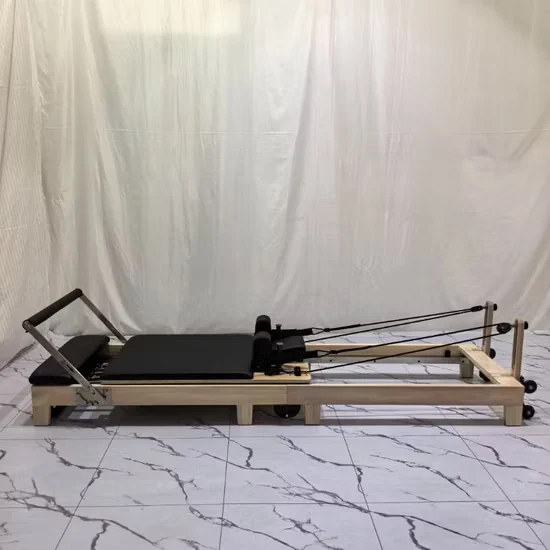
Foldable Pilates Reformer, Aluminum Alloy Bed, 2570×730×270mm — engineered with a reinforced folding hinge to maintain carriage rigidity and rail alignment after repeated spring-loaded cycles. Includes long box, jump board, and platform for full-spectrum programming on a 90kg net-weight frame. Backed by a 3-year warranty covering the folding mechanism, springs, and upholstery.
// Spec Highlights
• Direct from Manufacturer · No Middlemen · Worldwide Shipping
01
// Material
Imported Solid Wood
Premium hardwood frames sourced for density and visual warmth.
02
// Hardware
Medical-Grade Silent
Whisper-quiet pulleys and springs for clinical environments.
03
// Customization
Appearance OEM
Color, upholstery, and branding tailored to your studio.
04
// Service
Layout Design
Free venue planning for studios and rehab institutions.
Every component is selected for longevity, performance, and aesthetic harmony - from imported hardwood frames to silent medical-grade accessories.
// Features
Foldable Precision Engineering — every hinge and rail section is load-tested under full spring tension to eliminate the wobble that plagues most collapsible reformers within months of studio use.
| Parameter | Value |
|---|---|
| Product Type | Foldable Pilates Reformer |
| Model NO. | SRY-12A |
| Frame Material | Aluminum Alloy Bed |
| Assembly State | Foldable |
| Product Dimensions | 2570 × 730 × 270 mm |
| Net Weight | 90 kg |
| Color Options | White (custom colors available) |
| Included Accessories | Long Box / Jump Board / Platform |
| Logo | Customized Is Allowed |
| Target User | Adult, Unisex |
| Certification | ISO 9001 |
| Warranty | 3 Years |
| Facility Type | Typical Use |
|---|---|
| Home studio | Space-saving storage between sessions, full accessory coverage for solo practice |
| Boutique Pilates studio | Stowable units for multi-class scheduling and floor reconfiguration |
| Rehabilitation and physical therapy center | Portable reformer moved between treatment rooms as patient volume shifts |
| Hotel and resort wellness facility | Deployable on demand for guest programming without dedicated studio footprint |
The hinge is the first structural casualty, not the aluminum carriage.
Most foldable Pilates reformers treat the folding joint as a convenience feature rather than a load-bearing component. Under repeated spring-loaded tension, the pivot point accumulates micro-play that compounds into visible carriage wobble and misaligned rail tracking. I have seen aluminum extrusion beds with wall thickness around 1.2 mm develop hinge slop within a single quarter of daily studio scheduling, turning a supposedly space-saving foldable Pilates reformer aluminum alloy bed into a maintenance liability. The failure is not sudden — it creeps in as carriage drift, then binding, then member complaints about uneven resistance through the stroke [NEED_CITE: structural fatigue at pivot points in folding fitness equipment].
This reformer addresses the sagittal plane through the full spectrum of supine, prone, and seated spring-work, complementing mat-based programming and Cadillac or tower units in a mixed-equipment Pilates studio. The long box enables spinal articulation and seated rowing progressions; the jump board introduces plyometric loading for lower-body conditioning. In a boutique studio running six to eight classes per day, this foldable Pilates reformer aluminum alloy bed stores vertically between sessions, recovering floor area for mat classes or functional circuits without requiring a separate equipment room.
The primary stress vector on any foldable reformer is not the static load of the user but the cyclic tension from springs pulling the carriage against the stop during explosive movements like jump board repetitions. Each fold-unfold cycle introduces a secondary stress path through the hinge pin and surrounding aluminum extrusion. Over hundreds of daily repetitions, the wheel-to-rail interface must maintain alignment despite the folding seam crossing the carriage travel path. Sealed bearings and precision-ground rail surfaces reduce the accumulation of particulate debris that accelerates tracking deviation under this combined loading regime [NEED_CITE: bearing degradation under cyclic folding loads in exercise equipment].
The 90 kg net weight of this unit signals a bed structure substantial enough to resist flex under off-center loading, where lighter reformers transmit user movement into frame deflection rather than spring resistance. The aluminum alloy bed surface provides dimensional stability across humidity ranges encountered in coastal resort environments or basement studios — unlike wooden carriages that warp and require seasonal planing to maintain rail contact. The included accessory suite eliminates the interface compatibility problem that arises when long boxes and jump boards are sourced separately, each with slightly different mounting tolerances that degrade connection rigidity over repeated swaps.
Budget folding reformers cut cost at the hinge by using standard hardware-store pivot pins and un-reinforced aluminum profiles. The result is a carriage that tracks true when new but develops lateral drift as the hinge bore elongates under spring tension. Non-sealed wheels collect chalk dust and skin debris, turning the rail into an abrasive surface that scores the aluminum finish. Low-density foam upholstery on the bed compresses within months of commercial scheduling, exposing the carriage plate beneath and creating pressure points that drive members to competitor studios. These are not warranty claims — they are operational attrition that erodes class revenue [NEED_CITE: commercial equipment depreciation from deferred structural specification].
The aluminum alloy bed is sourced with mill-certified material documentation, ensuring the extrusion profile and wall thickness match the engineering specification rather than a generic commercial grade label. Robotic MIG welding at the hinge sub-assembly produces continuous weld lines that distribute cyclic stress across the joint rather than concentrating it at spot-weld points. Every unit undergoes load testing before shipment — not sample-based batch testing — confirming carriage tracking integrity under maximum spring tension through the full fold cycle. The 200 μm powder coating on structural contact points resists chipping from accessory swaps and carriage impacts. Layout support includes CAD-based floor planning that accounts for the folded storage footprint, safe clearance around the unit during use, and accessory staging zones for high-turnover class environments.
Provide your studio floor dimensions and class schedule density to receive a 2D-3D layout showing folded storage positions, active-use clearances, and accessory staging areas. Specify expected daily user volume and body-weight range to confirm spring resistance configuration and carriage load rating. Detail any branding requirements including custom color, logo placement, or upholstery selection to align with studio identity.
Q: How does the folding mechanism affect long-term rigidity compared to fixed-frame reformers?
A: A well-engineered folding joint with reinforced pivot hardware and precision bore tolerances can approach fixed-frame stability for typical studio loading cycles. The critical difference lies in maintenance intervals — folding units require periodic hinge inspection and pin replacement scheduling that fixed frames do not. Under light home use, the gap in perceived rigidity narrows considerably.
Q: What determines carriage smoothness on this reformer?
A: Carriage smoothness depends on the combined system of wheel material hardness, rail surface finish, and bearing sealing. Harder wheel compounds resist flat-spotting under sustained load, while sealed bearings prevent particulate ingress that degrades tracking over time. Rail straightness tolerance ensures the wheel maintains full contact through the entire stroke.
Q: How do you evaluate spring resistance progression and replacement timing?
A: Spring resistance should increase linearly with carriage displacement. Noticeable dead spots or inconsistent pull through the stroke indicate spring fatigue. Replacement intervals depend on session volume and the proportion of high-tension exercises in your programming, but inspect spring hooks and coil spacing quarterly under commercial use.
Q: Can the aluminum alloy bed accommodate different user heights?
A: The 2570 mm bed length provides adequate carriage travel for users across the standard adult height range. The adjustable stop positions and spring anchor points allow programming modification for limb-length variation. Confirm shoulder rest and foot bar adjustment range against your specific member demographic during specification.
Premium aesthetics meet quiet operation for boutique studio environments.
Medical-grade silence and precision for sports & postpartum recovery.
Furniture-grade craftsmanship for premium residential installations.
Compact premium setups for one-on-one and small-group training.
Aesthetic Pilates integration for hybrid wellness studio programming.
Multi-unit deployment with instructor-grade reliability for certification programs.
Tell us about your project. Our team will respond within 24 hours with pricing, customization options, and shipping details.
// Sales Director
William
+86 132 2531 1800
// Export Manager
Bella
+86 198 5412 8032
william@bickfit.com