01 / Scenario
STUDIO
P
High-End Pilates Studios
Premium aesthetics meet quiet operation for boutique studio environments.
ISO
9001
CE
Certified
OEM
Available
10YR
Warranty
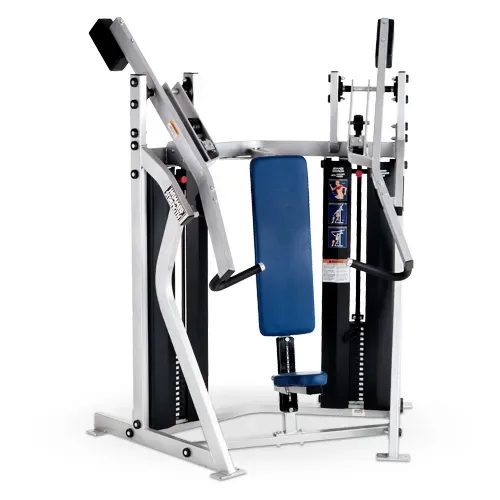
MTS-8002 Selectorized Iso-Lateral Decline Chest Press, Dual 90kg Stacks, 3×3 inch Frame — pin-select loading with iso-lateral converging path, engineered on 11-gauge steel frame with robotic MIG continuous welding and sealed industrial bearings at pivot points to maintain zero-play rotation under continuous commercial use. Every unit undergoes per-shipment load testing with 10-year frame warranty and CAD floor planning support for proper clearance around dual-stack stations.
// Spec Highlights
• Direct from Manufacturer · No Middlemen · Worldwide Shipping
01
// Material
Imported Solid Wood
Premium hardwood frames sourced for density and visual warmth.
02
// Hardware
Medical-Grade Silent
Whisper-quiet pulleys and springs for clinical environments.
03
// Customization
Appearance OEM
Color, upholstery, and branding tailored to your studio.
04
// Service
Layout Design
Free venue planning for studios and rehab institutions.
Every component is selected for longevity, performance, and aesthetic harmony - from imported hardwood frames to silent medical-grade accessories.
// Features
Traceable Steel — MTS-8002 frames use Q235 and Q345 industrial steel with mill certification traceable to the coil origin.
| Parameter | Value |
|---|---|
| Designation | MTS-8002 |
| Product Type | Selectorized Iso-Lateral Decline Chest Press |
| Frame Tube Size | 3×3 inch |
| Frame Steel Grade | Q235 / Q345 industrial steel, mill-certified |
| Welding Type | Robotic MIG continuous weld |
| Weight Stack | 90 kg × 2 Stacks |
| Loading Type | Pin Select |
| Bearing Type | Sealed industrial bearings at iso-lateral pivots |
| Pulley System | Aircraft-cable pulley system |
| Upholstery | Standard or high-density options available |
| Powder Coating | 200μm scratch-resistant, sandblast pre-treatment |
| Product Dimensions | 99 cm × 163 cm × 168 cm |
| Net Weight | 342 kg |
| Adjustment Positions | Iso-lateral converging movement pattern |
| Certification | CE, ISO 9001, SGS |
| Warranty | 10-year frame warranty |
| Facility Type | Typical Use |
|---|---|
| Commercial gym strength floor | High-traffic selectorized chest training station |
| Hotel and resort fitness center | Accessible decline press for diverse guest strength levels |
| University strength and conditioning room | Controlled iso-lateral pressing for athletic development |
| Rehabilitation and performance center | Independent arm movement for unilateral strength assessment |
Precision-machined guide rods and aligned pulleys keep dual 90kg stacks gliding without off-center friction under repeated commercial loading.
Selectorized machines in busy gym environments cycle hundreds of times daily. When guide rods are undersized or pulleys misaligned, the weight stack catches on every rep, and users feel the drag immediately. On a dual-stack commercial selectorized decline chest press, asymmetrical loading is the norm — one arm pressing heavier than the other — which multiplies the lateral force on each guide rail [NEED_CITE: EN 957 structural requirements for stationary training equipment]. Machines that skip precision alignment develop binding within months, not years, and the resistance curve becomes unpredictable right when lifters need it most.
The MTS-8002 targets the sternal and lower pectoral fibers through a decline pressing angle with converging iso-lateral arms. In a commercial strength floor layout, this unit complements flat and incline press stations to complete the full pressing plane. It fits medium-to-high density facilities where members expect independent arm control without loading plates. The seat and pad geometry accommodates a wide range of torso lengths, making it suitable for mixed-population gym floors.
Every decline press rep pushes load through the iso-lateral arm pivot, down the frame column, and into the base tube junction. In a high-traffic commercial selectorized decline chest press environment, these junctions face thousands of cyclic load reversals weekly. Static loading alone does not reveal weak points — it is the repeated eccentric return phase, where weight stacks drop and re-engage, that fatigues weld seams and bearing seats over time [NEED_CITE: weld classification and fatigue performance in structural steel]. Sealed bearings at each pivot must resist dust and sweat ingress, while powder coating on contact surfaces must withstand cleaning chemicals and perspiration without degrading.
The 3×3 inch frame tube in 11-gauge steel provides a deflection threshold that holds steady even when both 90kg stacks are fully pinned. Thinner-walled tubing may appear identical in product photos, but under sustained heavy loading, the pivot mounts begin to shift, altering the pressing path and introducing lateral play. Robotic MIG continuous welding eliminates the cold joints and incomplete fusion zones that spot welding leaves at T-junctions. The 200μm powder coating, applied after sandblast pre-treatment, resists chipping at the seat rail contact points where metal-on-metal wear concentrates. Aircraft-cable pulleys matched to proper sheave diameter prevent cable fraying under the repeated directional changes of dual-stack routing.
A thinner frame tube saves material cost on day one, but when pivot mounts deform under repeated heavy pressing, the entire movement path drifts and the machine feels unstable. Spot welds that pass initial visual inspection develop hairline cracks at stress concentrations, eventually requiring full section re-weld or frame replacement. Non-sealed bearings at the iso-lateral arm pivots accumulate gym dust and sweat, developing wobble that users feel as uneven resistance. Low-density upholstery compresses within months of daily use, exposing foam to tearing and forcing early re-covering. Each of these failures compounds downtime and maintenance cost across a facility [NEED_CITE: commercial fitness equipment lifecycle and maintenance frequency benchmarks].
The MTS-8002 frame is built from Q235 and Q345 steel with full mill traceability, so you know exactly what is under the powder coat. Every weld seam is robotic MIG continuous, inspected across a three-stage QC process that includes per-unit load testing before shipment. The 99 cm × 163 cm footprint requires proper safety clearance on the pressing side and weight stack access side — our CAD layout support plans spacing for this station alongside adjacent selectorized and plate-loaded units. OEM private label options cover custom color, logo, and upholstery to match facility branding. The 10-year frame warranty reflects confidence in the structural system, not just a marketing line.
Share your strength zone dimensions and current equipment list so we can generate a 2D or 3D layout placing the MTS-8002 with proper safety clearances. Specify your expected daily traffic volume so we can confirm the structural grade matches your usage intensity. Note your target member population to verify the seat and pad adjustment range covers their body types. Mention any custom requirements — frame color, logo placement, or upholstery material — and we will include those in the specification sheet.
Q: How can I verify the actual frame steel specification versus generic commercial-grade claims?
A: Request a mill certificate that traces the steel to its coil origin, showing grade designation such as Q235 or Q345. Generic claims of commercial grade often lack verifiable documentation. We provide full mill traceability on every MTS-8002 frame so buyers can confirm the exact steel specification and gauge used in production.
Q: Is selectorized or plate-loaded equipment better for a high-traffic commercial gym?
A: Selectorized machines reduce member onboarding friction and speed up equipment turnover since weight changes happen via pin selection. Plate-loaded units serve experienced lifters who prefer incremental loading. Most high-traffic commercial floors benefit from both, with selectorized stations handling the majority of general membership traffic.
Q: What weight stack capacity is appropriate for a commercial decline chest press?
A: Dual 90kg stacks provide sufficient resistance for the vast majority of commercial gym members performing decline pressing movements. Facilities serving elite strength athletes may supplement with plate-loaded options. The dual independent stacks on the MTS-8002 also allow unilateral training and accommodate strength imbalances between arms.
Q: What spacing and clearance does this selectorized press need in a strength zone layout?
A: Beyond the 99 cm × 163 cm machine footprint, you need clearance on the pressing side for full arm extension and on the stack side for maintenance access. Proper spacing prevents member congestion and ensures safe movement between stations. We provide CAD layout support to plan these clearances within your specific floor plan.
Q: How durable is the upholstery under daily commercial use, and are replacement parts available?
A: Standard and high-density upholstery options are available, with high-density foam resisting compression longer under continuous use. Replacement pads and covers are stocked as spare parts for the MTS-8002, so worn upholstery can be swapped without replacing the entire seat assembly.
Premium aesthetics meet quiet operation for boutique studio environments.
Medical-grade silence and precision for sports & postpartum recovery.
Furniture-grade craftsmanship for premium residential installations.
Compact premium setups for one-on-one and small-group training.
Aesthetic Pilates integration for hybrid wellness studio programming.
Multi-unit deployment with instructor-grade reliability for certification programs.
Tell us about your project. Our team will respond within 24 hours with pricing, customization options, and shipping details.
// Sales Director
William
+86 132 2531 1800
// Export Manager
Bella
+86 198 5412 8032
william@bickfit.com