01 / Scenario
STUDIO
P
High-End Pilates Studios
Premium aesthetics meet quiet operation for boutique studio environments.

ISO
9001
CE
Certified
OEM
Available
10YR
Warranty
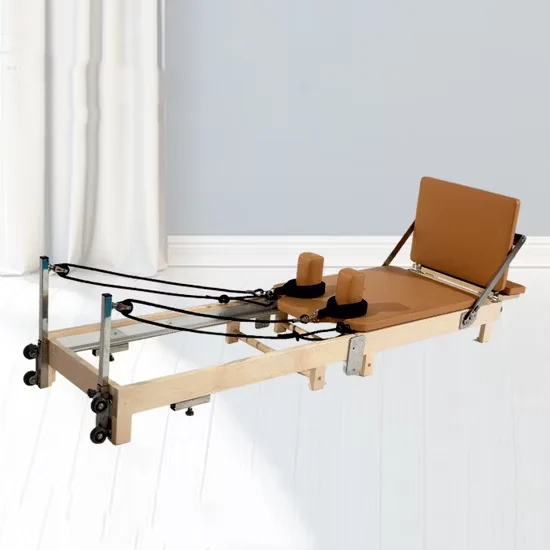
White Aluminum Pilates Reformer, 2570×730×270mm, 90kg Net Weight — engineered with a rigid aluminum frame and sealed bearing carriage system to eliminate rail play during high-frequency studio use. Includes long box, jump board, and platform accessory set for full-range training. Backed by a 3-year warranty and customized logo options for studio branding.
// Spec Highlights
• Direct from Manufacturer · No Middlemen · Worldwide Shipping
01
// Material
Imported Solid Wood
Premium hardwood frames sourced for density and visual warmth.
02
// Hardware
Medical-Grade Silent
Whisper-quiet pulleys and springs for clinical environments.
03
// Customization
Appearance OEM
Color, upholstery, and branding tailored to your studio.
04
// Service
Layout Design
Free venue planning for studios and rehab institutions.
Every component is selected for longevity, performance, and aesthetic harmony - from imported hardwood frames to silent medical-grade accessories.
// Features
Precision-Machined Rail Tolerance — Every aluminum extrusion is milled to eliminate lateral carriage drift under hundreds of daily studio cycles.
| Parameter | Value |
|---|---|
| Product Type | Pilates Reformer |
| Model NO. | SRY-12 |
| Frame Material | Aluminum |
| Color | White (customizable) |
| Product Dimensions | 2570 × 730 × 270 mm |
| Net Weight | 90 kg |
| Accessories Included | Long Box, Jump Board, Platform |
| Warranty | 3 Years |
| Logo | Customized |
| Facility Type | Typical Use |
|---|---|
| Boutique Pilates Studio | Daily group class rotation requiring consistent carriage tracking across back-to-back sessions |
| Hotel and Resort Wellness Center | Low-maintenance guest equipment with minimal on-site technician oversight |
| Home Studio Installation | Compact footprint for serious practitioners needing commercial-grade durability in a residential setting |
| Rehabilitation and Physiotherapy Center | Controlled resistance environment for guided recovery and mobility work |
A rigid aluminum frame only performs as well as the tolerances machined into its rail groove. Carriage drift is a machining problem, not a material problem. Many studio-grade reformers cut costs on rail finishing, leaving microscopic unevenness that accelerates wheel wear and introduces lateral wobble within the first season of heavy class rotation [NEED_CITE: rail tolerance standards for linear motion systems in fitness equipment]. When the carriage develops play, the entire movement feel degrades — practitioners feel the catch, instructors lose confidence in the equipment, and studio owners face premature replacement decisions.
The 2.5-meter bed length accommodates full-range spinal articulation for adult users across varying heights, making this commercial aluminum pilates reformer suitable for studios that serve a broad client demographic. In a multi-station studio configuration, it pairs logically with Cadillac towers and chair units to cover the complete Pilates apparatus system. The low-profile aluminum frame keeps visual weight minimal in boutique environments where aesthetics influence client retention, while the 730 mm width provides adequate clearance for instructor access during hands-on cueing.
Every reformer session generates hundreds of carriage cycles under variable spring tension, creating repetitive lateral forces on the rail interface. The primary wear path concentrates where carriage wheels contact the rail groove — an area exposed to sweat, studio humidity, and cleaning chemicals [NEED_CITE: fatigue loading patterns in linear bearing systems]. Sealed bearings prevent contaminant ingress that would otherwise accelerate wheel degradation and increase rolling resistance. The aluminum frame itself resists corrosion in humid studio environments far better than powder-coated steel alternatives, maintaining dimensional stability across seasonal humidity shifts without surface treatment maintenance.
The aluminum frame delivers a favorable weight-to-rigidity ratio that matters when studios need to reconfigure layouts or relocate equipment between rooms. A 90 kg net weight indicates substantial structural mass in the carriage and rail assembly — necessary for dampening vibration during dynamic movements like jump board sequences. The inclusion of a long box, jump board, and platform expands the movement repertoire without requiring separate apparatus purchases. Three-year warranty coverage on a studio-frequency unit signals confidence in the carriage bearing specification and rail machining precision, as these components typically fail first under commercial use conditions.
Light-commercial reformers often use thinner aluminum extrusions that deflect slightly under heavy spring loads, creating a flex pattern that accelerates carriage wheel wear unevenly. This deflection may be imperceptible during initial demonstrations but compounds across thousands of cycles until the carriage no longer tracks true [NEED_CITE: structural deflection thresholds in aluminum extrusion profiles]. Studios replacing carriage assemblies annually face cumulative maintenance costs that eclipse the initial savings on equipment procurement. Open bushings in budget units require frequent lubrication and still develop play faster than sealed bearing systems, adding technician hours to an already strained operational schedule.
Every aluminum extrusion used in this commercial aluminum pilates reformer is sourced with mill certification traceable to the production batch, ensuring material consistency across orders. Robotic welding is not applicable to aluminum extrusion assembly, so frame joints are precision-bolted with torque-verified hardware rather than spot-welded, eliminating the hidden failure points that plague welded aluminum structures. Each unit undergoes load testing before shipment — the carriage is cycled under maximum spring tension to verify tracking accuracy and bearing smoothness. The 200 μm industrial powder coating on contact surfaces resists chipping from metal accessories and cleaning chemicals. Our team provides 2D and 3D CAD layout support to confirm reformer spacing meets instructor access requirements and emergency egress standards for your specific studio footprint.
Provide your studio floor dimensions and target reformer count to receive a 2D-3D layout plan that confirms instructor circulation paths and ADA-compliant spacing. Specify your expected daily class volume so we can confirm the carriage bearing specification matches your usage intensity. Share your client demographic height range to verify the bed length and spring configuration accommodates your user base. Communicate any branding requirements including frame color, logo placement, and upholstery options early in the procurement timeline to align production scheduling.
Q: How do I distinguish a commercial-grade reformer from a light-commercial unit?
A: Inspect the carriage wheel bearing specification — sealed industrial bearings indicate commercial intent, while open bushings signal light-commercial cost reduction. Check rail machining documentation for tolerance specifications rather than accepting generic claims. Frame joint construction also reveals intent: precision-bolted joints with verified torque values outperform spot-welded connections under cyclic studio loading. Request load test records specific to the unit you are evaluating, not sample-based testing from a different production batch.
Q: Why choose an aluminum frame over steel for a studio environment?
A: Aluminum resists corrosion from the humidity and sweat exposure inherent in studio environments without relying on surface coating integrity. The material maintains dimensional stability across seasonal humidity variations that cause steel frames to expand and contract subtly, affecting rail alignment over time. Aluminum also reduces equipment weight for studios that reconfigure layouts regularly, while still providing adequate structural rigidity when extrusion profiles are properly engineered for the specific load patterns of reformer use.
Q: What maintenance intervals should high-traffic studios expect for carriage components?
A: Quarterly bearing inspection is the baseline for studios running four or more classes daily, checking for lateral play and rolling resistance changes. Rail surfaces require daily wiping with pH-neutral cleaner to prevent sweat acid etching the aluminum contact surface. Spring resistance calibration should be verified monthly rather than on a fixed replacement schedule, as spring fatigue varies with actual usage intensity and tension settings selected by instructors across different class formats.
Q: How should I plan spacing between reformers in a studio layout?
A: Minimum lateral clearance of 900 mm on each side allows instructor access for hands-on cueing and safe client entry and exit without disrupting adjacent stations. Factor in long box and platform extension beyond the base footprint when calculating total floor area per station. Front and rear clearance must accommodate full carriage travel plus instructor standing space during footwork sequences at the head end of the reformer.
Premium aesthetics meet quiet operation for boutique studio environments.
Medical-grade silence and precision for sports & postpartum recovery.
Furniture-grade craftsmanship for premium residential installations.
Compact premium setups for one-on-one and small-group training.
Aesthetic Pilates integration for hybrid wellness studio programming.
Multi-unit deployment with instructor-grade reliability for certification programs.
Tell us about your project. Our team will respond within 24 hours with pricing, customization options, and shipping details.
// Sales Director
William
+86 132 2531 1800
// Export Manager
Bella
+86 198 5412 8032
william@bickfit.com