01 / Scenario
STUDIO
P
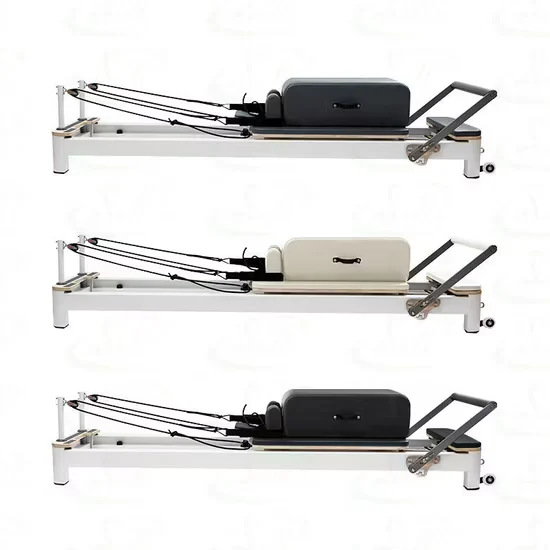
High-End Pilates Studios
Premium aesthetics meet quiet operation for boutique studio environments.

ISO
9001
CE
Certified
OEM
Available
10YR
Warranty
Pilates Ladder Barrel, Solid White Maple Wood, 1100×770×980mm, 50kg — engineered with high-density maple selected for grain consistency, ensuring rigidity under repetitive spinal articulation without joint loosening or rung flex over thousands of cycles. Custom logo and color options available with 3-year warranty for commercial studio environments. Every unit undergoes 32-point inspection and 100% load testing before shipment.
// Spec Highlights
• Direct from Manufacturer · No Middlemen · Worldwide Shipping
01
// Material
Imported Solid Wood
Premium hardwood frames sourced for density and visual warmth.
02
// Hardware
Medical-Grade Silent
Whisper-quiet pulleys and springs for clinical environments.
03
// Customization
Appearance OEM
Color, upholstery, and branding tailored to your studio.
04
// Service
Layout Design
Free venue planning for studios and rehab institutions.
Every component is selected for longevity, performance, and aesthetic harmony - from imported hardwood frames to silent medical-grade accessories.
// Features
Maple Wood Integrity — Solid white maple lumber mill-sourced for density and grain consistency, eliminating the delamination failures common in laminated barrel alternatives.
| Parameter | Value |
|---|---|
| Product Type | Pilates Ladder Barrel |
| Frame Material | Solid White Maple Wood |
| Product Dimensions | 1100×770×980mm |
| Net Weight | 50kgs |
| Color | Solid Color |
| Finish | Sweat-resistant surface treatment |
| Logo | Customized Is Allowed |
| Age Group | Adult |
| Gender | Unisex |
| Warranty | 3 Years |
| Production Capacity | 800 Pieces/Month |
| Origin | China |
| Facility Type | Typical Use |
|---|---|
| Pilates studio | Spinal articulation, loaded stretching, and core conditioning sequences |
| Yoga studio | Assisted backbends, hip flexor release, and balance-supported poses |
| Rehabilitation and conditioning center | Post-injury mobility work and supervised corrective exercise |
| Boutique fitness facility | Small-group Pilates classes and private movement sessions |
Solid maple eliminates the structural unpredictability of laminated plywood in daily studio use.
Most ladder barrels sold to commercial studios use plywood cores or softwood laminates dressed up with veneer. Under repeated loaded stretching and bodyweight support, these layered constructions begin to separate at the glue lines — rungs develop lateral play, the barrel curve gradually flattens, and the entire unit shifts from a precision tool to a liability. [NEED_CITE: EN 957 structural requirements for stationary training equipment] When a studio replaces its commercial maple wood ladder barrel Pilates equipment within eighteen months, the root cause is almost always material selection, not usage volume. I have seen laminated barrels crack cleanly along a rung joint during a routine private session, and the failure mode is always the same: the adhesive bond surrenders before the wood itself ever reaches its limit.
This piece addresses spinal flexion, extension, and lateral bending in a single station — movements that reformers and cadillacs only partially replicate. In a commercial Pilates layout, it pairs naturally with a reformer wall and a spine corrector station, creating a three-point circuit that keeps clients moving without floor congestion. The 1100×770mm footprint fits against a wall or in a dedicated stretching alcove without consuming primary apparatus space. It accommodates adult users across a wide height range, and the fixed barrel geometry suits studios serving general fitness populations rather than exclusively clinical clients. Studios running commercial maple wood ladder barrel Pilates equipment in group class rotations find it handles back-to-back sessions without the cool-down or reset time that electronic apparatus requires.
The barrel curve bears sustained compressive load every time a client drapes their torso over the apex for extension work — this is a static hold, not an impact event, and the stress accumulates through creep rather than fracture. [NEED_CITE: long-term creep behavior in hardwood structural members under sustained load] The rungs experience a different force profile: lateral shear each time a user grips and pulls, combined with vertical compression when feet are hooked for inverted positions. Sweat and cleaning agents concentrate at the rung-to-frame joints, making surface finish integrity critical for preventing moisture ingress into end grain. The base feet carry the entire assembly load plus dynamic user weight, and any unevenness in the floor transfers torsional stress up through the uprights.
White maple’s density — substantially higher than softwood alternatives — gives the barrel curve resistance to the gradual flattening that plagues lighter-spec units. Grain orientation matters: quartersawn boards resist the cupping and twist that plainsawn stock develops under asymmetric humidity exposure. The rung-to-frame connection is the single highest-stress joint on the apparatus; traditional mortise-and-tenon joinery distributes load across a large glue surface and mechanical interlock, outperforming dowel or screw-only methods over thousands of loading cycles. Surface treatment must seal end grain without creating a plastic film that cracks and traps moisture underneath — a penetrating oil or conversion varnish designed for high-contact environments performs differently than standard furniture lacquer. Padding density on the barrel crown determines whether the foam compresses permanently under daily use or retains its profile across years of studio traffic.
Substituting solid maple with plywood laminate reduces the purchase price visibly but shifts the expense forward: glue-line failures require complete rung replacement or full unit retirement, and these failures cluster in the second year of commercial use. [NEED_CITE: comparative failure rates of solid hardwood versus laminated wood in commercial fitness applications] Softwood frames dent at contact points where clients grip and hook their feet, creating splinter hazards that demand early sanding and refinishing. Non-replaceable padding bonded directly to a soft substrate compresses and hardens, leaving the studio to choose between an uncomfortable apparatus and a costly reupholstery. Finish systems not designed for sweat exposure cloud and peel, turning a premium-looking wood surface into a maintenance burden within months.
Share your studio floor plan and current apparatus list so we can confirm clearance and integration with your existing Pilates layout. Specify your average daily session count and whether the unit will serve group rotation or private-only use so we can align padding density and finish grade accordingly. Indicate any custom branding, color matching, or dimensional adjustment requirements early in the inquiry to confirm feasibility and production lead time.
Q: How can I verify that a ladder barrel uses solid maple rather than plywood or laminate?
A: Inspect the end grain on any exposed cut surface — solid maple shows continuous grain lines running through the full thickness, while plywood reveals stacked veneer layers and laminate shows a thin decorative sheet over particle core. Request a wood species certificate from the supplier naming the exact hardwood used, not a generic "solid wood" claim. Cross-check the unit weight against published specifications; genuine solid maple barrels carry noticeably more mass than composite alternatives.
Q: What joinery methods indicate a ladder barrel built for commercial daily use?
A: Mortise-and-tenon joints at the rung-to-frame connection provide both mechanical interlock and broad glue surface, outperforming dowel-only or screw-only assemblies under repeated lateral loading. Ask the manufacturer to describe their joinery method specifically and whether load testing data covers cyclic lateral force, not just static vertical weight. Visible screw heads at rung joints generally signal a lighter-duty construction approach unsuitable for high-traffic studio rotation.
Q: How should I specify padding density for different studio client populations?
A: Studios serving primarily rehabilitation and older adult clients benefit from medium-density foam that offers supportive contouring without excessive firmness. High-volume commercial studios running back-to-back group sessions need higher-density foam that resists permanent compression across thousands of use cycles. Confirm with the supplier whether replacement covers and foam inserts are available as spare parts, since padding is the first wear component on any barrel apparatus.
Q: What maintenance protocol keeps wood surfaces in condition under heavy studio traffic?
A: Wipe the frame with a pH-neutral, non-ammonia cleaner between sessions to remove sweat residue that degrades finishes over time. Avoid abrasive scrubbing pads on sealed maple; use a soft microfiber cloth to prevent micro-scratches that accumulate into visible surface dulling. Schedule a quarterly inspection of the finish integrity, particularly at high-contact points where hands and feet repeatedly grip, and plan for a professional refinish when the seal coat shows wear-through.
Premium aesthetics meet quiet operation for boutique studio environments.
Medical-grade silence and precision for sports & postpartum recovery.
Furniture-grade craftsmanship for premium residential installations.
Compact premium setups for one-on-one and small-group training.
Aesthetic Pilates integration for hybrid wellness studio programming.
Multi-unit deployment with instructor-grade reliability for certification programs.
Tell us about your project. Our team will respond within 24 hours with pricing, customization options, and shipping details.
// Sales Director
William
+86 132 2531 1800
// Export Manager
Bella
+86 198 5412 8032
william@bickfit.com