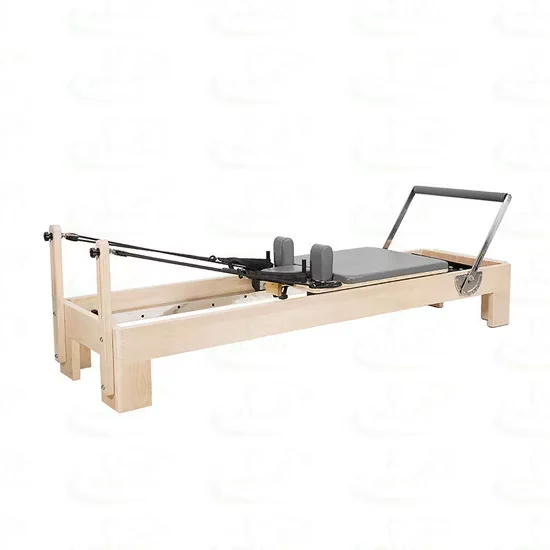
01 / Scenario
STUDIO
P
High-End Pilates Studios
Premium aesthetics meet quiet operation for boutique studio environments.

ISO
9001
CE
Certified
OEM
Available
10YR
Warranty
PVC Pilates Yoga Ball, 65cm / 75cm, Anti-Burst PVC Construction — engineered for high-traffic commercial studios with reinforced wall thickness and slow-deflate safety structure. Surface texture optimized for grip during intense sessions; sealed air valve minimizes maintenance cycles. Custom logo printing available from 2-piece MOQ. Every unit undergoes static pressure and load testing before dispatch.
// Spec Highlights
• Direct from Manufacturer · No Middlemen · Worldwide Shipping
01
// Material
Imported Solid Wood
Premium hardwood frames sourced for density and visual warmth.
02
// Hardware
Medical-Grade Silent
Whisper-quiet pulleys and springs for clinical environments.
03
// Customization
Appearance OEM
Color, upholstery, and branding tailored to your studio.
04
// Service
Layout Design
Free venue planning for studios and rehab institutions.
Every component is selected for longevity, performance, and aesthetic harmony - from imported hardwood frames to silent medical-grade accessories.
// Features
Burst-Rated PVC Shell — static load tested beyond typical user weight with anti-burst failure mode, engineered for commercial studio abuse.
| Parameter | Value |
|---|---|
| Product Type | Yoga Ball |
| Material | PVC |
| Specification | 65cm |
| Color | Red (additional colors available) |
| Net Weight | — |
| Customization | Size and logo available |
| Logo | Customized is allowed |
| MOQ | 2 PCS |
| Target User | Adult |
| Standards | — |
| Facility Type | Typical Use |
|---|---|
| Commercial gym group exercise floor | Core stability circuits and Pilates mat classes |
| Pilates and barre studio | Spinal articulation drills and balance challenges |
| Rehabilitation and performance center | Post-injury core reactivation and pelvic stability work |
| Hotel fitness center | Compact, storable functional accessory for diverse guest use |
| University strength and conditioning room | Dynamic warm-up and active recovery stations |
Most studio balls fail not from punctures, but from slow material creep and seam fatigue.
When a facility buys yoga balls labeled "commercial grade" with no documented burst rating or wall thickness, they typically see deformation within months. The PVC softens under repeated loading cycles, the ball loses its spherical geometry, and users compensate with unstable posture. In high-traffic Pilates studios running back-to-back classes, a ball that slowly deflates mid-session is not an inconvenience — it is a liability event waiting to happen [NEED_CITE: material fatigue standards for inflatable fitness accessories]. The commercial PVC yoga ball 65cm listed here addresses this with a specified burst-rated shell and a valve system designed for slow, controlled deflation if compromised, rather than sudden failure.
A yoga ball does not replace any fixed station on the strength floor — it fills the gap between mat work and loaded movement. It pairs with TRX anchor points for unstable push-up progressions, sits beside half racks for Swiss ball hamstring curl variations, and anchors the center of a group exercise room for Pilates reformer-adjacent core work. The commercial PVC yoga ball 65cm is sized for users roughly between 155cm and 175cm tall, making it the default choice for mixed-gender studio classes. Facilities running dedicated athletic populations typically add the 75cm variant to cover taller users.
Inflatable fitness accessories experience cyclic fatigue unlike any steel-frame machine. Each class session subjects the PVC shell to point loads from elbows, knees, and heels, plus sustained compression when a user sits or lies supine. The stress concentrates at the equator seam and around the valve insertion point. A ball used in three classes per day accumulates hundreds of compression cycles weekly. Cheaper PVC compounds develop micro-creep at these stress points, leading to gradual shape distortion long before any visible puncture occurs [NEED_CITE: cyclic loading effects on PVC inflatable structures]. The anti-burst PVC formulation used here is selected to resist this creep, maintaining roundness through sustained commercial use.
Wall thickness is the single most important spec for a commercial yoga ball, yet it is rarely published. Thicker PVC resists deformation under point loads and delays the onset of material creep. The anti-burst rating indicates failure mode: if punctured, the ball should deflate gradually rather than explode. Surface texture determines grip when users are sweating — a smooth ball becomes a slip hazard in a heated studio. The valve mechanism controls air retention; a poorly seated valve leaks incrementally, requiring staff to top off inflation between classes. The 65cm diameter targets the most common adult height range, while the 75cm option covers taller athletes. Custom logo printing uses a process verified for abrasion resistance so branding survives repeated contact with mats and floors.
A facility that sources yoga balls based on unit price alone typically replaces them two to three times within the lifespan of one properly specified ball. Thin PVC deforms under static load, so a ball left under a heavy user between classes gradually flattens at the contact patch. Once the shell loses true spherical geometry, it rolls unpredictably and becomes a balance hazard rather than a training tool. Valve failures on low-cost balls cause slow leaks that staff discover only when a participant complains mid-class. The cumulative cost of replacements, plus the injury risk from degraded equipment, far exceeds the initial savings [NEED_CITE: total cost of ownership for high-wear studio accessories].
A company that builds plate-loaded machines and functional rigs approaches a yoga ball differently than a general sporting goods trader. We specify PVC compounds using the same structural logic we apply to steel gauge selection: verify material properties, test under worst-case load, and document failure modes. The commercial PVC yoga ball 65cm and 75cm variants ship from the same facility producing our HD-700 and FR-300 lines, meaning quality records, shipping logistics, and OEM branding are consolidated. For facilities doing a full floor-out, we include this accessory in 2D-3D CAD layouts so storage racks, clearances, and class capacity are planned before the first ball ships.
Provide your group exercise room dimensions and class capacity to receive a storage and layout plan that accounts for ball count, rack footprint, and safe clearance. Specify expected daily user volume so we confirm the burst rating and PVC compound match your throughput. Indicate whether you need mixed 65cm and 75cm sizing based on your member demographics. Submit logo artwork and brand color codes for print proofing before production begins.
Q: How do I tell a commercial-grade yoga ball from a consumer one?
A: Consumer balls rely on thinner PVC with no documented burst rating or wall thickness. Commercial-grade balls specify anti-burst construction, meaning a puncture causes slow deflation rather than sudden failure. Check for published material test reports covering static load capacity and cyclic fatigue resistance. A commercial ball should also maintain its spherical shape after months of daily class use without developing flat spots.
Q: What is the relationship between PVC thickness and burst resistance?
A: Thicker PVC walls resist point loads from knees and heels without stretching permanently. They also delay material creep, the slow deformation that causes a ball to lose roundness over time. Burst resistance depends on both wall thickness and compound formulation — a thick but brittle PVC can still fail catastrophically. Request the manufacturer’s burst test documentation to confirm the failure mode is controlled deflation.
Q: How do I choose between 65cm and 75cm for my studio?
A: The 65cm diameter fits users approximately 155cm to 175cm tall, which covers most mixed-gender group exercise participants. The 75cm variant accommodates users above 175cm, common in athletic and university settings. If your studio runs specialized populations, measure your tallest regular participants and stock accordingly. Many commercial facilities carry both sizes and assign them by class type.
Q: How often should commercial yoga balls be reinflated?
A: In a high-traffic studio, check inflation weekly. Even well-sealed valves lose small amounts of air over time, and underinflated balls deform under load, accelerating PVC fatigue. Train staff to measure diameter with a tape rather than estimating visually. If a ball requires inflation more than twice a week, inspect the valve for seal degradation and replace if needed.
Premium aesthetics meet quiet operation for boutique studio environments.
Medical-grade silence and precision for sports & postpartum recovery.
Furniture-grade craftsmanship for premium residential installations.
Compact premium setups for one-on-one and small-group training.
Aesthetic Pilates integration for hybrid wellness studio programming.
Multi-unit deployment with instructor-grade reliability for certification programs.
Tell us about your project. Our team will respond within 24 hours with pricing, customization options, and shipping details.
// Sales Director
William
+86 132 2531 1800
// Export Manager
Bella
+86 198 5412 8032
william@bickfit.com