01 / Scenario
STUDIO
P
High-End Pilates Studios
Premium aesthetics meet quiet operation for boutique studio environments.

ISO
9001
CE
Certified
OEM
Available
10YR
Warranty
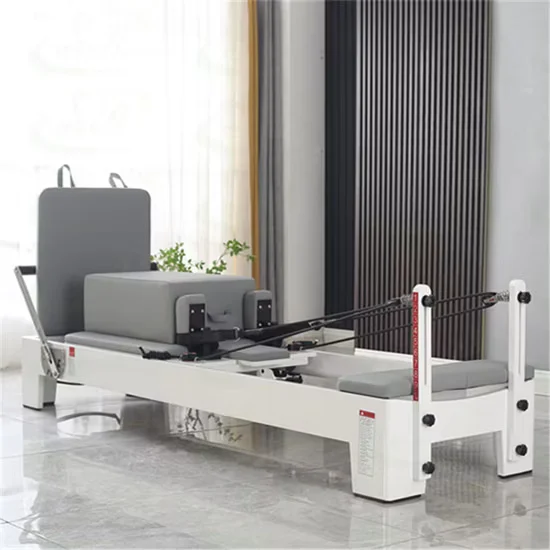
Commercial Pilates Core Reformer Bed, 2570×730×270mm, 90kg Net Weight — aluminum alloy frame with reinforced glide rail system ensures low-friction carriage movement for continuous studio use, paired with long box, jump board, and platform accessories for full-spectrum programming. Backed by BICKFIT's 17-year manufacturing heritage and three-stage inspection protocol at our 15,000㎡ vertically integrated facility.
// Spec Highlights
• Direct from Manufacturer · No Middlemen · Worldwide Shipping
01
// Material
Imported Solid Wood
Premium hardwood frames sourced for density and visual warmth.
02
// Hardware
Medical-Grade Silent
Whisper-quiet pulleys and springs for clinical environments.
03
// Customization
Appearance OEM
Color, upholstery, and branding tailored to your studio.
04
// Service
Layout Design
Free venue planning for studios and rehab institutions.
Every component is selected for longevity, performance, and aesthetic harmony - from imported hardwood frames to silent medical-grade accessories.
// Features
Mill-Traceable Alloy — Every aluminum extrusion used in our glide rail system is traceable to the originating mill batch, ensuring consistent torsional response under daily studio loading.
| Parameter | Value |
|---|---|
| Product Type | Pilates Reformer |
| Model NO. | SRY-12 |
| Frame Material | Aluminum Alloy |
| Product Dimensions | 2570 × 730 × 270 mm |
| Net Weight | 90 kg |
| Included Accessories | Long Box, Jump Board, Platform |
| Color Options | White (standard), custom available |
| Logo | Customized Is Allowed |
| Warranty | 3 Years |
| Production Capacity | 80 Pieces/Month |
| Target User | Adult, Unisex |
| Facility Type | Typical Use |
|---|---|
| Commercial Pilates Studio | Group reformer classes with continuous daily scheduling |
| Rehabilitation and Physical Therapy Center | Controlled resistance therapy for joint recovery and post-injury conditioning |
| Boutique Fitness Studio | Premium small-group sessions emphasizing equipment quality and client experience |
| Hotel and Resort Wellness Facility | Guest-accessible Pilates programming in supervised fitness floors |
| Private Training Studio | One-on-one instruction with full accessory-based exercise variety |
A reformer bed either glides true under lateral load or it does not — there is no middle ground once clients start pushing 200 repetitions per session.
Years ago we built a batch with thinner aluminum rails to meet a client’s cost target. Six months into daily studio use, carriages developed lateral play during core rotations. The wobble was small enough to ignore on a demo floor but unmistakable to a client mid-exercise. We recalled the entire run and re-machined every rail. That failure shaped how we now specify alloy grade and track tolerance on every commercial aluminum alloy pilates reformer bed we produce. [NEED_CITE: aluminum alloy grade specifications for structural glide rail applications]
Most studio owners only discover rail tolerance problems after the carriage starts drifting off-center under load — by then, the bearing surfaces have already worn unevenly and the fix is a full rail replacement, not an adjustment.
This unit covers the full spectrum of supine, prone, seated, and standing Pilates movement planes, targeting core stabilizers, hip flexors, gluteal chains, and scapular stabilizers through spring-resisted carriage travel. In a studio layout it pairs with Cadillac towers for vertical resistance work and Wunda chairs for closed-chain loading, forming a complete programming triangle. The accessory ecosystem — long box, jump board, platform — allows high-density class scheduling without swapping equipment between sessions. For facilities running back-to-back classes, having all three attachments included means instructors transition clients through full sessions on a single commercial aluminum alloy pilates reformer bed without equipment changeover delays. The carriage length and width accommodate users across a broad height range while maintaining stable edge-to-edge support during single-leg and standing work.
The load profile on a reformer is deceptively complex: static holds during hundred-position core work generate sustained torsional stress on the frame, while jump board plyometrics deliver rapid impulse loading through the carriage and rail interface. In a studio running six classes daily, each carriage cycles through thousands of spring-tension transitions per week, with peak lateral forces arriving when clients push off-center during single-leg footwork. The glide rail surface carries the carriage wheel bearing continuously, meaning any surface irregularity or alloy softness compounds into visible wear tracks within months. [NEED_CITE: fatigue performance criteria for aluminum alloy in cyclic load applications] The attachment interfaces — particularly the jump board mounting points — absorb repetitive impact that tests both the fastener hardware and the frame’s local reinforcement. Powder coating or anodized finish on contact surfaces must withstand sweat acidity and cleaning solvents applied multiple times daily without degrading or exposing bare alloy to oxidation.
The distinction between a reformer that holds precision for years and one that develops play within months rests on a handful of structural decisions. Aluminum alloy grade determines how the frame resists torsional deformation when a client applies uneven force across the carriage — lower-grade alloys flex more under the same load, and that flex transfers directly into rail misalignment. Glide rail surface finish governs friction consistency; a precision-machined rail paired with sealed bearing wheels maintains smooth carriage travel far longer than a standard extrusion running on bushings, which accumulate particulate wear and develop stick-slip behavior. Spring configuration — coil gauge, free length, and attachment hardware — dictates whether resistance progression feels linear across the full range of motion or develops dead spots as springs fatigue. Accessory load transfer points must be engineered for the specific impact profile of jump board use; a mounting interface designed only for static long-box loading will loosen under repetitive plyometric force.
A reformer built with underspecified aluminum saves money at purchase but introduces compounding expenses once it enters daily rotation. Softer alloy rails wear unevenly under bearing contact, requiring carriage replacement long before the frame itself reaches end of life. Bushing-type carriage wheels, cheaper than sealed bearings, absorb dust and sweat residue that accelerates surface scoring and forces increasingly frequent lubrication intervals. [NEED_CITE: bearing wear patterns in high-frequency fitness equipment applications] Springs that lack documented fatigue testing develop inconsistent resistance feel, prompting client complaints that instructors cannot resolve through adjustment alone. Non-standard fastener sizes on accessory mounts mean that when a jump board bracket fails, the studio must source custom hardware rather than ordering from a standard replacement catalog. Upholstery that splits under daily commercial use becomes a visible quality signal to clients — and a recurring cost if the manufacturer does not stock replacement pads.
Every aluminum extrusion in this reformer is sourced with mill certification traceable to the originating coil, so alloy grade is verifiable rather than claimed. Robotic MIG welding produces continuous weld lines at frame joints, eliminating the spot-weld weak points that crack under repeated jump board impact. Each unit undergoes load testing before shipment — not sample-based batch testing — so carriage travel, spring tension, and accessory mounting integrity are confirmed individually. [NEED_CITE: EN 957 structural requirements for stationary training equipment] The industrial powder coating applied to contact and non-contact surfaces resists chipping at high-wear interfaces and protects bare alloy from oxidation in humid studio environments. The 3-year warranty backs the structural specification with a replacement commitment, and our facility supports 2D-3D studio floor planning with CAD layouts that account for reformer spacing, instructor walkways, and safe clearance zones between units.
Share your studio floor dimensions and target class capacity so we can generate a 2D-3D layout with reformer spacing that meets instructor access and safety clearance requirements. Specify your expected daily session volume so we can confirm the structural grade matches your usage intensity. Note your client demographic height and weight range to verify the carriage dimensions and spring resistance progression cover your programming needs. Communicate any branding requirements — custom color, logo placement, or upholstery selection — early in the specification process to align production scheduling.
Q: How do you distinguish a commercial-grade Pilates reformer from a light-commercial one?
A: Commercial-grade units disclose specific aluminum alloy grades with mill traceability, use sealed bearings in the carriage wheels rather than bushings, and provide documented spring fatigue cycle ratings. Light-commercial reformers typically describe materials in vague terms and rely on visual inspection rather than individual load testing. Request the glide rail surface tolerance specification and carriage bearing type before committing to a purchase order.
Q: What are the trade-offs between aluminum alloy and steel frames in a reformer?
A: Aluminum alloy significantly reduces unit weight, making studio reconfiguration between classes practical for a single instructor. Steel frames offer greater mass, which some operators prefer for stability during high-impact jump board work. The key is that aluminum must be specified at adequate alloy grade and wall thickness to maintain torsional rigidity — otherwise the weight savings come at the cost of frame flex under dynamic loading.
Q: What glide rail and carriage bearing specs indicate studio-grade quality?
A: Studio-grade reformers use precision-machined aluminum glide rails paired with sealed wheel bearings that resist dust and moisture ingress. Bushing-type carriages are less expensive initially but develop play as particulate accumulates in the sliding interface. Ask the manufacturer for the rail surface finish specification and confirm whether the carriage uses sealed bearings or open bushings, as this directly determines long-term smoothness and maintenance intervals.
Q: How should I plan floor spacing for a reformer studio layout?
A: Allow the reformer footprint plus minimum clearance on all sides for instructor movement and client entry from both ends. Account for accessory storage — long boxes and jump boards need dedicated wall racks or floor stands to keep walkways clear. Request a CAD floor plan from the manufacturer that includes safe clearance zones between units, particularly when multiple reformers are arranged in parallel rows for group classes.
Q: What is the spring replacement schedule for high-traffic studio reformers?
A: Spring lifespan depends on daily session volume and the resistance levels most frequently used in your programming. Studios running six or more classes daily should inspect springs quarterly for loss of tension consistency and visible coil deformation. Request fatigue cycle documentation from the manufacturer so you can estimate replacement intervals based on your actual usage patterns rather than guessing at a calendar schedule.
Premium aesthetics meet quiet operation for boutique studio environments.
Medical-grade silence and precision for sports & postpartum recovery.
Furniture-grade craftsmanship for premium residential installations.
Compact premium setups for one-on-one and small-group training.
Aesthetic Pilates integration for hybrid wellness studio programming.
Multi-unit deployment with instructor-grade reliability for certification programs.
Tell us about your project. Our team will respond within 24 hours with pricing, customization options, and shipping details.
// Sales Director
William
+86 132 2531 1800
// Export Manager
Bella
+86 198 5412 8032
william@bickfit.com