Adjustable Bench for CrossFit Boxes in Ethiopia – Wholesale Supplier
Cheaper benches cost more in Africa — every time.
Sourcing an adjustable bench for CrossFit boxes in Ethiopia requires commercial-grade steel framing, multi-angle backrest adjustment, and pre-verified customs documentation — because port delays at Djibouti and inland transit to Addis Ababa can double your landed cost if paperwork or build quality falls short.
I still remember a container that sat at the Modjo dry port for weeks because a single line item — a bag of M8 bolts for the seat slider — was missing its sequence number on the packing list. The Ethiopian Customs Commission system flagged the entire shipment. The client was running a new CrossFit box in Bole, and every day without those benches meant cancelled classes and angry members. That kind of headache doesn’t come from the product itself; it comes from treating Africa like an afterthought in the shipping department. [NEED_CITE: Ethiopian Customs Commission documentary requirements for fitness equipment imports]
When you’re outfitting a CrossFit box in Addis Ababa, Dire Dawa, or Hawassa, the adjustable bench is one of the hardest-working pieces in the room. It handles thrusters, seated presses, step-ups, and dumbbell rows — often back-to-back with zero rest between classes. A bench that wobbles at full incline or cracks a weld after a few months isn’t just an inconvenience; it’s a liability in a market where replacement parts don’t arrive overnight.

Let me walk you through what actually matters when you’re buying an adjustable bench for CrossFit boxes in Ethiopia — from the steel on the floor to the stamp on the bill of lading.
Why CrossFit Boxes in Ethiopia Need Commercial-Grade Adjustable Benches?
CrossFit programming puts adjustable benches under forces that ordinary gym benches were never designed to handle.
In a typical commercial gym, a bench might see thirty to forty users a day doing controlled dumbbell presses. In a CrossFit box, that same bench gets slammed with barbells during floor-to-overhead movements, used as a plyo surface for step-ups, and dragged across rubber flooring between workout stations. The African fitness market has been growing steadily, and East Africa is no exception — more boxes are opening, and owners are realizing that residential-grade equipment simply doesn’t survive the volume. [NEED_CITE: growth trends of functional fitness facilities in East Africa]
A CrossFit box owner I worked with in Addis opened with a mix of imported residential benches and one set of commercial-grade adjustable benches. Within months, the residential units developed play in the backrest hinge and the vinyl started splitting along the stitch lines. The commercial units? Still tight, still clean, still in daily rotation. The difference wasn’t price — it was gauge thickness on the frame tube and the type of bearing used in the adjustment mechanism.
Here’s what CrossFit-specific use demands from an adjustable bench for CrossFit boxes in Ethiopia:
- Frame stability under dynamic loads — thrusters and seated push presses generate lateral force, not just vertical compression. The frame must resist flex.
- Backrest adjustment range — from flat to full incline, with secure locking at every angle. Athletes need to transition fast between movements.
- Seat slide mechanism durability — the seat must glide and lock without wobble, even after thousands of adjustments.
- Upholstery resistance — high-density foam with commercial-grade vinyl that withstands sweat, humidity, and repeated cleaning.
The Ethiopian climate adds another layer. Addis Ababa sits at over two thousand meters — dry and moderate — but coastal logistics routes through Djibouti mean equipment passes through extreme heat and humidity before it ever reaches the gym floor. Materials that handle that transit without warping or corrosion are non-negotiable. [NEED_CITE: material degradation factors for fitness equipment in tropical transit corridors]

What Specs Matter When Sourcing Adjustable Benches for African Gyms?
Three parameters separate a bench that lasts years from one that fails in months: frame steel thickness, adjustment mechanism type, and upholstery density.
When I review spec sheets for an adjustable bench for CrossFit boxes in Ethiopia, I look at the numbers that manufacturers sometimes bury in the footnotes. Here’s a breakdown of what to compare:
| Parameter | Commercial-Grade | Mid-Range | Residential-Grade |
|---|---|---|---|
| Frame steel wall thickness | Heavy-duty gauge | Standard gauge | Thin-wall tubing |
| Backrest adjustment positions | Multiple locked angles across full range | Limited angle options | Two or three fixed positions |
| Seat slide mechanism | Steel-on-steel with pin lock | Basic slider | No seat adjustment |
| Upholstery foam density | High-density, commercial rating | Medium density | Low-density consumer foam |
| Weld quality | Continuous, ground-smooth welds | Spot welds visible | Inconsistent bead |
| Load rating | Full commercial use verified | Moderate use rated | Light use only |
[NEED_CITE: commercial fitness equipment structural standards for adjustable benches]
A distributor in East Africa once received a batch of benches where the backrest adjustment used a ladder-style pin system — decent in theory, but the pin holes were drilled slightly off-center. After a few hundred reps, the pin started binding. Small issue on paper, massive issue when your coach is trying to switch from flat bench press to incline dumbbell work mid-class.
The Bick adjustable bench, for example, uses a backrest system with a wide angle range and a seat slider that locks with a positive pin mechanism — the kind of detail that matters when you’re sourcing an adjustable bench for CrossFit boxes in Ethiopia and can’t afford to send it back for warranty work. The frame is built from heavy-gauge steel with continuous welds, and the upholstery uses high-density foam wrapped in commercial vinyl rated for high-traffic environments.
One thing buyers often overlook: the gap between the backrest and the seat when the bench is flat. A wide gap means athletes’ shoulders catch during pressing movements. A well-designed bench minimizes that gap without creating a pinch point. It’s an ergonomic detail that separates thoughtful engineering from cost-cutting.

How to Pack and Ship Adjustable Benches to Ethiopia Cost-Effectively?
Container loading efficiency and accessory pre-packaging directly determine whether your shipment clears customs smoothly or sits at the port bleeding storage fees.
Shipping an adjustable bench for CrossFit boxes in Ethiopia isn’t just about getting the product on a vessel — it’s about how you pack it. Most CrossFit box owners in Ethiopia are ordering a full gym setup: racks, barbells, plates, benches, and functional accessories. That means consolidation matters.
Here’s how a well-planned loading strategy works:
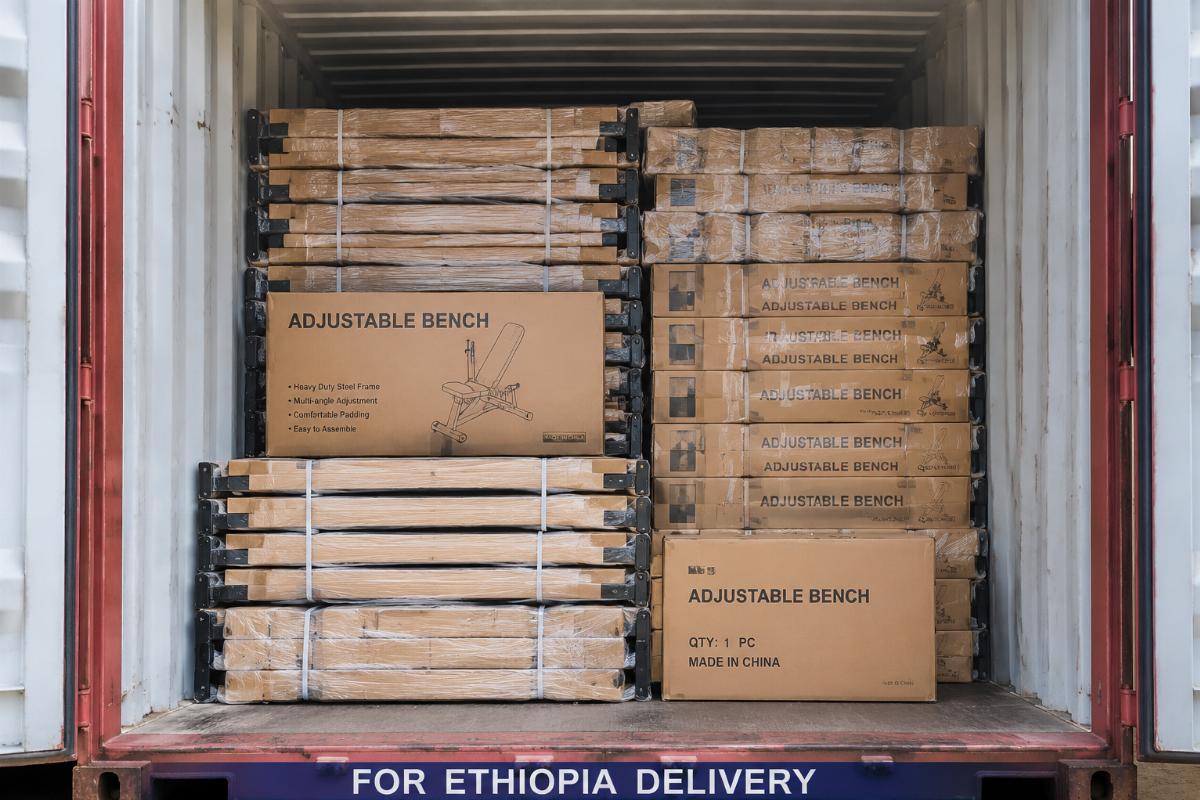
- Flat-pack vs. assembled — Benches shipped knocked-down take up substantially less container space. A standard container can hold a significantly higher unit count when benches are flat-packed with hardware bags pre-labeled and sealed.
- Accessory pre-bundling — Every bolt, washer, and adjustment pin should be in a labeled bag taped to the corresponding component. Loose hardware in a carton is a customs red flag.
- Mixed-container loading — Benches can be nested with plate trees, dumbbell racks, and rig components to maximize cubic utilization. The key is weight distribution — steel benches are dense, and overloading one section of a container can cause damage during the Djibouti-to-Addis transit on the Ethio-Djibouti railway.
[NEED_CITE: container loading optimization for mixed fitness equipment shipments to landlocked East African markets]
I’ve seen a full container of benches and racks get held up because three accessory bags were loose inside the cartons instead of being taped to the frame. The customs officer at Modjo opened one box, found unlisted loose parts, and flagged the entire container for a full item-by-item inspection. That inspection added weeks to the timeline and cost the client a significant amount in demurrage.
When we prepare a shipment of an adjustable bench for CrossFit boxes in Ethiopia, every carton gets a detailed packing list that matches the commercial invoice line-by-line. The hardware bags are numbered and cross-referenced. It sounds obsessive — until you’ve watched a container clear customs in days instead of weeks.
What Customs Documents Are Critical for Clearing Fitness Equipment in Ethiopia?
A missing sequence number on a packing list can freeze an entire container at the Ethiopian port — documentation precision is as important as product quality.
Ethiopia’s import clearance process is one of the most document-intensive in the region. The Ethiopian Single Window (eSW) system requires that every item in a container be individually declared with matching descriptions across the commercial invoice, packing list, and bill of lading. For an adjustable bench for CrossFit boxes in Ethiopia, this means:
- Commercial invoice — must list every SKU with unit price, total value, HS code, and country of origin. Descriptions must match the packing list exactly.
- Packing list — must detail carton count, gross weight, net weight, and dimensions for every package. Accessories must be listed as individual line items or explicitly noted as included with the main unit.
- Bill of lading — must align with invoice and packing list in terms of shipper, consignee, and cargo description.
- Certificate of origin — required for preferential tariff treatment where applicable.
- Pre-shipment inspection certificate — depending on the product category and value, Ethiopia may require a conformity assessment before shipment.
[NEED_CITE: Ethiopian eSW single window system documentary requirements for imported fitness equipment]
The most common mistake I see? Treating the packing list as an afterthought. A buyer in Dire Dawa ordered a batch of benches and racks in one container. The commercial invoice listed "adjustable bench — complete set" for each unit. The packing list said the same. But inside each carton, there were separate bags for the frame, the backrest pad, the seat pad, and the hardware kit. Customs opened the first box, counted four distinct components, and asked why the packing list didn’t break them out. The result was a full container hold while the documentation was amended — and amended documents had to go through the buyer’s bank and the issuing authority, adding more weeks.
The lesson: list every component. If a bench ships with a separate seat cushion, list it. If the hardware kit is in its own bag, list it. The Ethiopian customs system rewards granularity and punishes ambiguity.
When Bick prepares export documentation for an adjustable bench for CrossFit boxes in Ethiopia, our team reviews every document against the physical packing layout before the container is sealed. We’ve built this habit from hard experience — and it’s saved our clients from the kind of delays that turn a profitable deal into a loss.

How to Choose a Reliable Supplier from China for the Ethiopian Market?
A supplier with proven Africa export experience and full documentation support will save you more money than any unit price discount ever could.
Finding the right source for an adjustable bench for CrossFit boxes in Ethiopia comes down to a few practical filters:
- Africa shipping track record — Ask the supplier how many containers they’ve sent to Djibouti in the past few years. A factory that regularly ships to East Africa understands the documentation requirements, the transit realities, and the packaging standards needed for the inland haul.
- Documentation discipline — Can the supplier provide a packing list that matches your invoice line-by-line? Do they pre-verify HS codes? Will they support pre-shipment inspection if required? If the answer is vague, move on.
- Product range for consolidation — A CrossFit box needs more than benches. Racks, barbells, plates, functional rigs, flooring — sourcing from one manufacturer that can consolidate everything into shared containers reduces per-unit freight cost dramatically.
- After-sales reality — In Ethiopia, you can’t return a defective bench to China. You need a supplier who ships spare parts — replacement pins, vinyl patches, extra hardware kits — with the initial order or makes them available on short notice.
[NEED_CITE: best practices for selecting Chinese fitness equipment suppliers for African import markets]
Bick operates from Shandong Province with a product line that covers the full spectrum of commercial and functional fitness equipment — from adjustable benches and power racks to cable crossovers and plate-loaded machines. We regularly ship consolidated containers to East Africa and understand the specific demands of the Ethiopian market. Our adjustable benches are built to commercial standards with heavy-gauge frames, multi-position backrest systems, and durable upholstery — and they ship with documentation that’s been pre-audited against Ethiopian customs requirements.
We don’t just sell benches. We help CrossFit box owners in Ethiopia build a complete, functional training space — with equipment that arrives intact, clears customs cleanly, and performs under real-world use.

Conclusion
The right adjustable bench for CrossFit boxes in Ethiopia is a combination of commercial-grade construction, smart packaging, and bulletproof documentation. Product quality gets you through the first year. Documentation discipline gets your container out of the port. And a supplier who understands the African market keeps your gym running long after the first order. Choose based on total landed performance — not just the invoice price.