
Buy Commercial Fitness Equipment with CE Certificate | OEM Wholesale Supplier
A CE certificate on a quotation sheet does not guarantee your container will clear customs.
CE compliance for fitness equipment is a system-level validation covering mechanical safety, low voltage, and electromagnetic compatibility—not a single sticker. Buyers must verify certificate scope against the actual bill of materials before placing bulk orders, because partial model coverage, substituted components, and missing SKUs in annexes are the three most frequent causes of port rejection.
I used to handle procurement for a gym chain operating across several Southeast Asian capitals. We ordered full container loads of plate-loaded strength machines and commercial treadmills from a single source. The first shipment arrived at the main port, and within days the gym manager called: treadmill running decks were visibly narrower than the contract specified, and the flywheels on the ellipticals felt light under load. We measured on site—the width deviation was noticeable, and the flywheel mass had dropped materially. Members complained about instability within the first week. That shipment sat in the warehouse for weeks while we renegotiated. It was only after I moved to the supplier side that I understood how OEM quotations can look identical on paper yet diverge sharply in steel gauge, motor origin, and bearing grade. Now, when I walk buyers through a specification package, I start by laying the CE file and the full BOM side by side. [NEED_CITE: CE marking requirements for gym equipment under EU Machinery Directive 2006/42/EC]

Let me walk you through what actually matters when you buy fitness equipment with CE certificate documentation, and how to protect your shipment before it leaves the factory floor.
What Does CE Certificate Actually Cover for Fitness Equipment?
CE marking on commercial gym machines is not a quality seal—it is a minimum safety compliance baseline spanning three separate EU directives.
Many buyers assume that seeing a CE logo on a product photo means the machine is durable, high-performing, and ready for heavy commercial use. That assumption is wrong. CE is a legal declaration that the manufacturer has addressed specific safety risks defined by European law. For motorized cardio equipment and electrically powered strength machines, three directives apply simultaneously:
| Directive | Scope | What It Verifies |
|---|---|---|
| Machinery Directive (MD) | Mechanical hazards, guarding, stability | Frame integrity, pinch-point protection, emergency stop function |
| Low Voltage Directive (LVD) | Electrical safety for equipment within specific voltage ranges | Insulation, grounding, terminal protection, wiring gauge |
| Electromagnetic Compatibility (EMC) | Emission and immunity of electronic circuits | Motor controller noise, display interference, power supply stability |
A certificate that only references the Machinery Directive tells you nothing about whether the treadmill inverter will pass EMC testing at your destination port. [NEED_CITE: EN 957 series standards for stationary training equipment safety requirements]
I once reviewed a CE file for a Middle East importer who had received a single certificate covering only a manual spin bike. The same certificate was being used to clear a container that included motorized treadmills and a cable crossover with an electronic console. The customs broker flagged it immediately. The certificate annex listed exactly one SKU. The rest of the container had no valid coverage.
This is the first thing to check: the certificate annex must list every model in your order. If your container holds twelve different SKUs and the annex shows four, you have a problem that no amount of negotiation at the port will fix quickly.
How to Verify CE Certificate Before Placing Bulk Order?
Certificate verification is a three-step process: confirm the issuing body, cross-check the annex against your order list, and validate the BOM against the tested configuration.
Start with the notified body. If the CE certificate claims involvement of a notified body for the relevant directive, the body’s identification number must appear on the certificate and be verifiable in the official European Commission database. [NEED_CITE: NANDO database for notified bodies under EU New Approach directives]
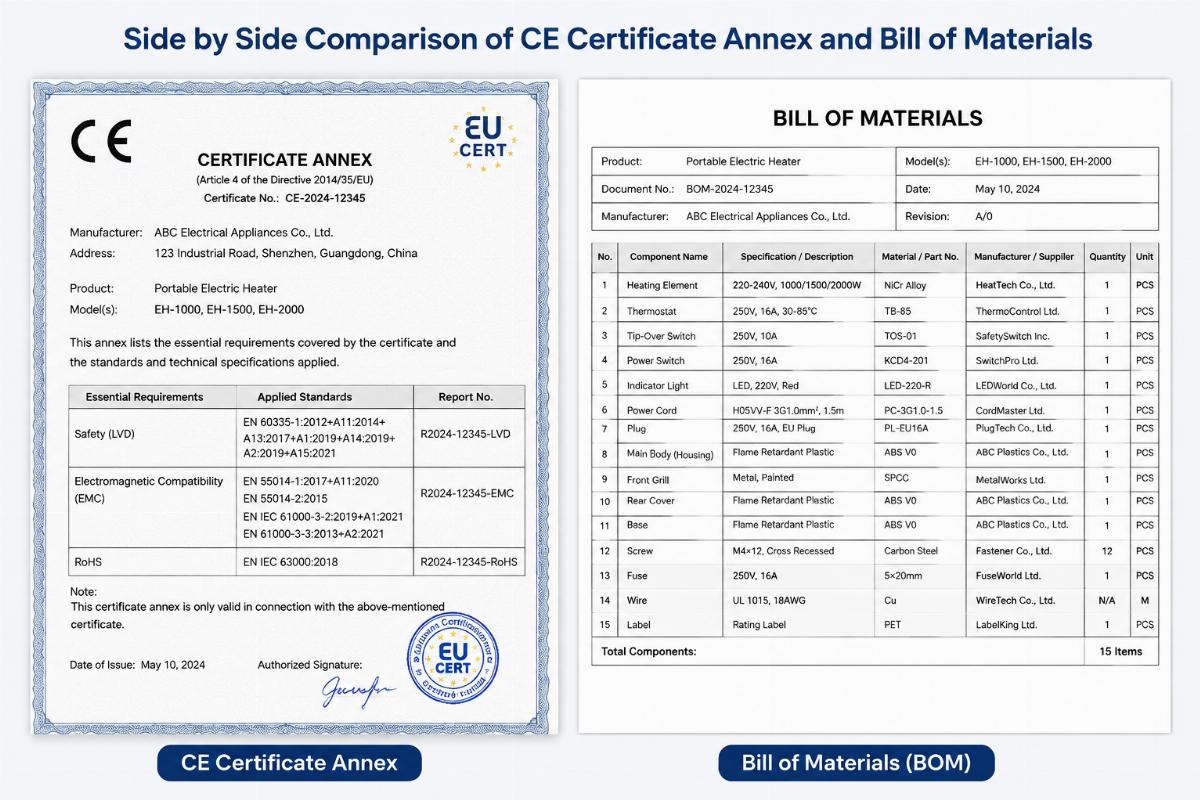
Next, request the full certificate annex—not just the cover page. The annex is the section that lists every model number, variant, and configuration covered. I have seen cases where the cover page looked clean, but the annex was two years old and referenced a product line that had since been redesigned. The tested BOM no longer matched the current production BOM.
Then comes the critical step: BOM reconciliation. Ask the supplier to provide the bill of materials for the exact model you are ordering, and compare it line by line against what was submitted for CE testing. The parameters that matter most for fitness equipment include:
| BOM Parameter | Why It Matters | Typical Substitution Risk |
|---|---|---|
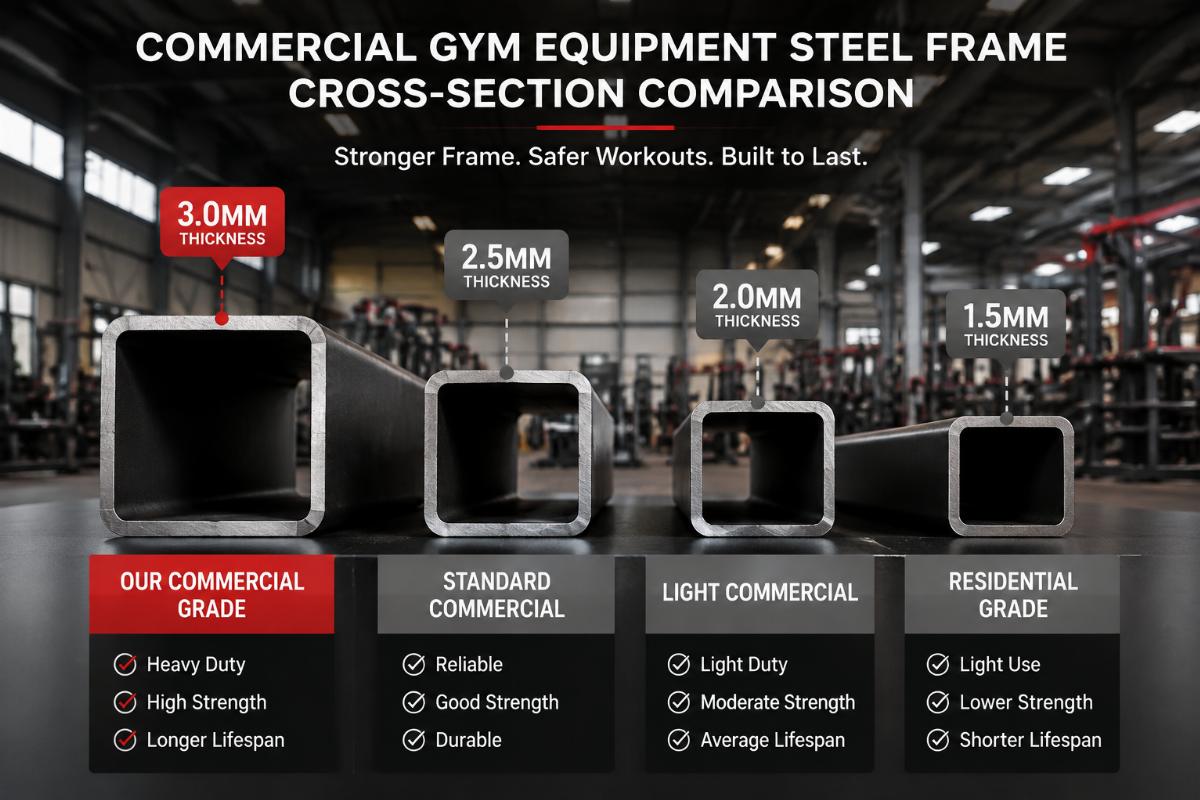
| Steel tube wall thickness | Structural rigidity, load capacity, weld integrity | Thinner gauge reduces cost but compromises safety margin |
| Motor brand and rated power | Drive performance, thermal endurance, EMC profile | Unbranded or under-rated motors fail EMC under load |
| Running deck thickness and material | Wear life, shock absorption, user safety | Thinner decks wear faster and increase impact stress |
| Bearing specification | Smooth operation, service life, maintenance interval | Downgraded bearings increase noise and failure rate |
| Welding process and post-treatment | Joint strength, corrosion resistance | Manual welding without stress relief increases crack risk |
A European hotel developer once shared a procurement file with me. The supplier’s CE certificate was issued by a recognized body, and the cover page matched the product photos. But when I asked for the BOM, the motor listed was a different brand from what appeared in the test report submitted for EMC compliance. The supplier had swapped the motor during production to cut cost. The new motor had not been tested. The certificate, technically, no longer covered the machine as shipped. [NEED_CITE: EU Commission guidance on CE marking and post-certification BOM changes]
What Parameters Should You Compare Across Suppliers?
When two suppliers both hold CE certificates and quote different prices, the real difference lives in the BOM—not in the certificate.
Buyers often assume that comparable CE certificates mean comparable machines. They are not. The CE test confirms that a specific configuration meets minimum safety thresholds. It does not rate durability, comfort, or commercial-grade longevity. Two treadmills can both pass CE testing—one with a heavy-duty frame and a branded inverter, the other with the thinnest steel that still clears the mechanical test and an unbranded controller that barely passes EMC. Both get the CE mark. Their real-world performance will diverge sharply after a few thousand hours of gym use.
Here is the parameter matrix I use when comparing quotations from multiple factories:
| Parameter | Entry-Level Spec | Commercial-Grade Spec | What to Ask the Supplier |
|---|---|---|---|
| Frame steel gauge | Light-duty, minimal wall thickness | Heavy-duty, reinforced wall thickness | Request mill certificate for steel batch |
| Motor origin | Unbranded or regional brand | Recognized industrial motor brand | Require motor nameplate photo per unit |
| Running belt layers | Single-ply or minimal ply | Multi-ply with reinforced weave | Ask for belt cross-section photo |
| Guide rod and bearing material | Standard carbon steel | Hardened steel with sealed bearing | Confirm bearing brand and seal type |
| Surface treatment | Basic powder coat | Multi-stage pretreatment with industrial coating | Request coating thickness test report |
| Weld quality | Spot welds at stress points | Continuous weld with stress relief | Ask for weld inspection photos |
A distributor in West Africa once ordered a full container of selectorized machines from two different factories to compare quality. Both had CE certificates. Both looked similar in product photos. When the containers arrived, the difference was immediate: one set had smooth plate movement, solid welds, and finishes that withstood humidity. The other set had rough weld seams, thin powder coating that chipped within weeks, and guide rods that developed play after minimal use. The certificates had both been valid. The machines were not comparable.
The lesson: CE is the floor, not the ceiling. Your specification sheet must define the parameters that determine real commercial lifespan. [NEED_CITE: IHRSA facility equipment procurement guidelines for durability benchmarking]
What Are Common Pitfalls When Buying CE-Certified Equipment?
The three most frequent problems are partial certificate coverage, post-certification BOM substitution, and missing model annexes at customs.
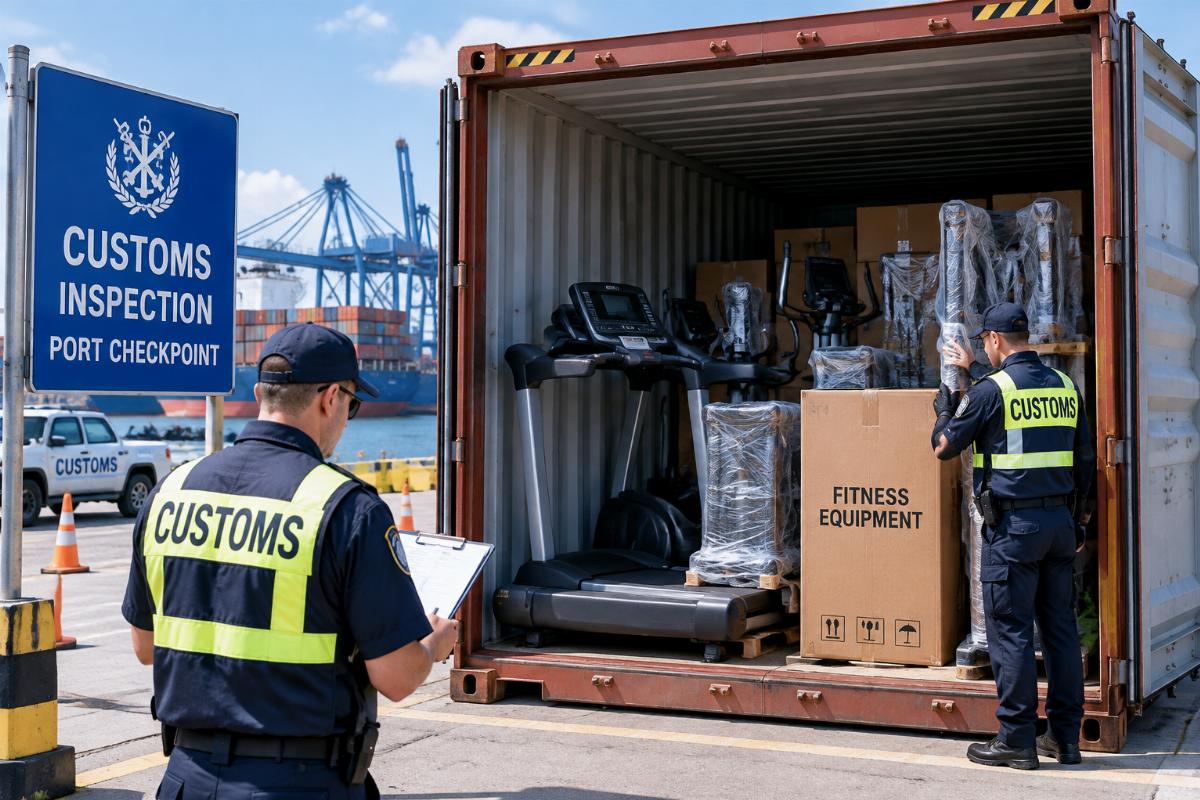
Partial coverage is the most common issue I encounter. A supplier holds a CE certificate for their best-selling treadmill model. The buyer then orders a full gym package from the same supplier—treadmills, ellipticals, rowers, Smith machines, cable stations—assuming the same certificate covers everything. It does not. Each model, or at minimum each product family with a consistent BOM and safety configuration, needs its own coverage or must be explicitly listed in the annex. When customs at the destination port opens the container and finds models not on the certificate, the entire shipment can be held.
BOM substitution after certification is harder to detect but equally damaging. The supplier passes CE testing with a specific motor, a specific steel grade, and a specific controller. After certification, they switch one or more components to reduce cost. The machine still looks the same. The CE mark is still on the nameplate. But the tested configuration no longer matches the shipped product. If an EMC inspector at the port tests the machine and the motor controller emits interference outside the certified range, the certificate does not protect the buyer. [NEED_CITE: EU market surveillance regulations on post-manufacturing compliance verification]
Annex omission is the simplest mistake and the easiest to prevent. The buyer receives the CE certificate cover page, sees the supplier’s company name and the product category, and assumes coverage is complete. They never request the annex. At customs, the officer checks the annex against the packing list. If models are missing, the shipment is flagged.
I worked with a hospitality group outfitting fitness centers across multiple properties in the Gulf region. Their first order was a mixed container of cardio and strength equipment. The supplier provided a CE certificate that looked comprehensive. The buyer did not check the annex. At the port, six out of the fifteen SKUs in the container were not listed. The remaining nine cleared, but the six were held for weeks. The supplier eventually provided updated documentation, but the project timeline had already slipped.
How to Structure Your Procurement Process to Avoid These Pitfalls
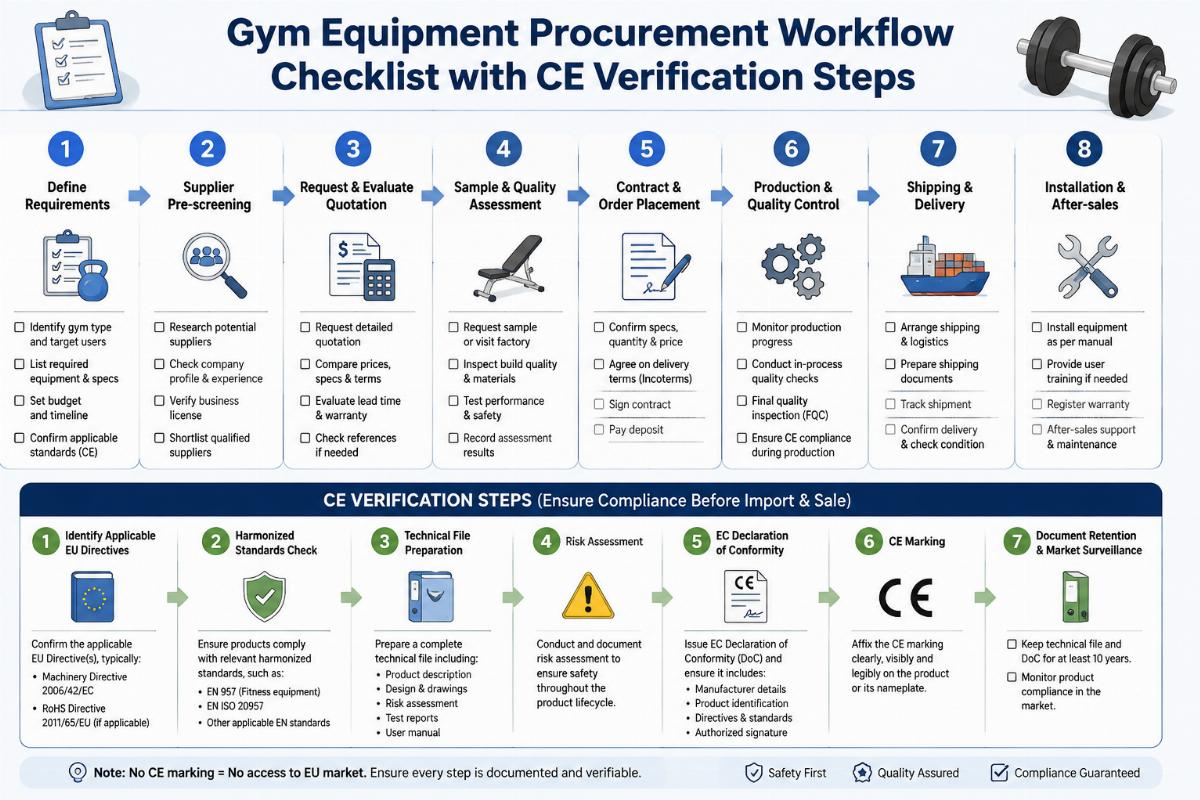
Build CE verification and BOM reconciliation into your purchase order workflow, not as an afterthought but as a mandatory pre-shipment gate.
Before you sign a purchase order, request three documents from the supplier: the CE certificate cover page, the full annex listing all covered models, and the detailed BOM for each model in your order. Cross-check the annex against your order list. Any model not listed must be added to the certificate scope or covered by a separate certificate before production begins.
Next, specify in your purchase order that the BOM submitted for CE testing must match the production BOM exactly. Any component change—motor, steel supplier, bearing brand, controller—must be disclosed and re-validated before shipment. This is not a formality. It is the difference between a container that clears customs smoothly and one that sits at the port while your project timeline collapses.
Finally, require pre-shipment inspection with BOM spot-checks. A third-party inspector can verify that the motors installed match the motor brand and rating on the BOM, that the steel gauge matches the specification, and that the weld quality meets the standard. This step catches substitution before the container is sealed.
When I prepare a quotation for a gym package, I include the full CE documentation set and the BOM breakdown in the initial proposal. The buyer can see exactly which models are covered, what components are specified, and where the cost differences lie between specification tiers. There is no guessing at the port.
Conclusion
CE certification is a safety compliance system, not a quality guarantee, and protecting your investment requires verifying certificate scope, reconciling the BOM, and locking specifications before production.
Buy fitness equipment with CE certificate documentation only after confirming that every model in your order is listed in the certificate annex, that the tested BOM matches the production BOM, and that your purchase order explicitly prohibits unapproved component substitution. The difference between a smooth delivery and a port rejection is not the certificate itself—it is the discipline of checking what the certificate actually covers.


