Cable Crossover for Multi-Site Functional Training Studios Wholesale Supplier
Ordering the same cable crossover spec across every studio location is the single most expensive shortcut multi-site buyers take.
The short answer: multi-site functional training studios need cable crossovers configured per venue—ceiling height, pulley ratio, weight stack weight, and cable return speed must be matched to each location’s training focus, not standardized across the chain. [NEED_CITE: facility design variables affecting cable crossover specification per IHRSA benchmarking]
I started out on the factory floor in Qingdao, watching welds go onto frames and checking powder coat thickness before anything left the line. Later I moved to the trade side, talking directly with buyers. A Middle Eastern client running a chain of boutique functional training studios once placed a single bulk order of cable crossovers across six locations—same weight stack, same frame height, same pulley setup. Two of those studios had ceilings under three meters. The standard frames hit the ceiling, and the high-pulley angle for lat work became useless. Meanwhile, the HIIT-focused locations complained the weight stacks returned too slowly between reps, creating queues during peak class hours. The retrofit alone—shortening frames on some units, swapping springs and cables on others—added a mid-five-figure cost on top of the original order. Since then, the first document I ask for on any multi-site order is the floor plan and ceiling measurement for each venue.

Getting the specs right before the order goes into production is what separates a smooth rollout from an expensive lesson. Here is what matters when sourcing a cable crossover wholesale supplier for a multi-location project.
Why One-Spec-Fits-All Fails for Multi-Studio Cable Crossover Rollouts?
Ceiling height, training modality, and traffic volume vary from venue to venue—even within the same brand—and a uniform cable crossover spec ignores all three.
Functional training studio chains tend to standardize procurement to simplify logistics. The logic seems sound: one SKU, one purchase order, one container load. But functional training spaces are rarely identical. A studio in a converted warehouse may have five-meter ceilings, while a ground-floor urban location in the same city might be limited to just over three meters. A cable crossover frame designed for a high-ceiling environment will physically not fit in the shorter venue, and cutting the frame down after delivery compromises structural integrity and voids warranty coverage. [NEED_CITE: structural modification risks on commercial fitness equipment frames per EN ISO 20957]
Training focus creates a second layer of mismatch. A studio chain might operate HIIT-focused boxes, hypertrophy-oriented strength studios, and recovery or rehabilitation spaces—all under the same brand name. The cable crossover requirements for each are fundamentally different. HIIT zones demand lighter weight stacks with fast cable return to keep class tempo up. Strength zones need heavier stacks and a direct pulley ratio for maximal resistance. Rehab zones require smooth, low-load progression with minimal friction. Ordering the same cable crossover for all three means at least one category of user will have a substandard experience.
I have seen a European functional training brand roll out identical cable crossovers across eight locations. Three of those locations were positioned as strength-focused, and the other five leaned heavily into metabolic conditioning. The uniform weight stack felt right in the strength studios but created unnecessary drag and slow return in the HIIT studios. Members noticed. Trainers noticed. The brand ended up retrofitting half the fleet within a year—swapping springs, re-cabling, and in some cases replacing entire weight stack assemblies.
The cost of per-venue customization during the quoting phase is marginal compared to the cost of post-delivery modification. A cable crossover wholesale supplier who asks for individual site plans is protecting your budget, not complicating your order.

What Specs Matter Most When Sourcing Cable Crossovers Wholesale?
Frame height, pulley ratio, weight stack range, and cable return speed are the four variables that determine whether a cable crossover performs or frustrates in a functional training environment.
Frame height is the most visible constraint. The general rule is that the frame must leave a minimum overhead clearance gap between the top of the frame and the ceiling to accommodate the pulley mechanism and cable routing. [NEED_CITE: minimum overhead clearance requirements for commercial cable crossover installation] If the ceiling is low, the frame must be shortened—ideally at the manufacturing stage, not after delivery. A cable crossover wholesale supplier operating from a factory with in-house fabrication can adjust frame height to order. Suppliers who only stock standard sizes will force you into compromises.
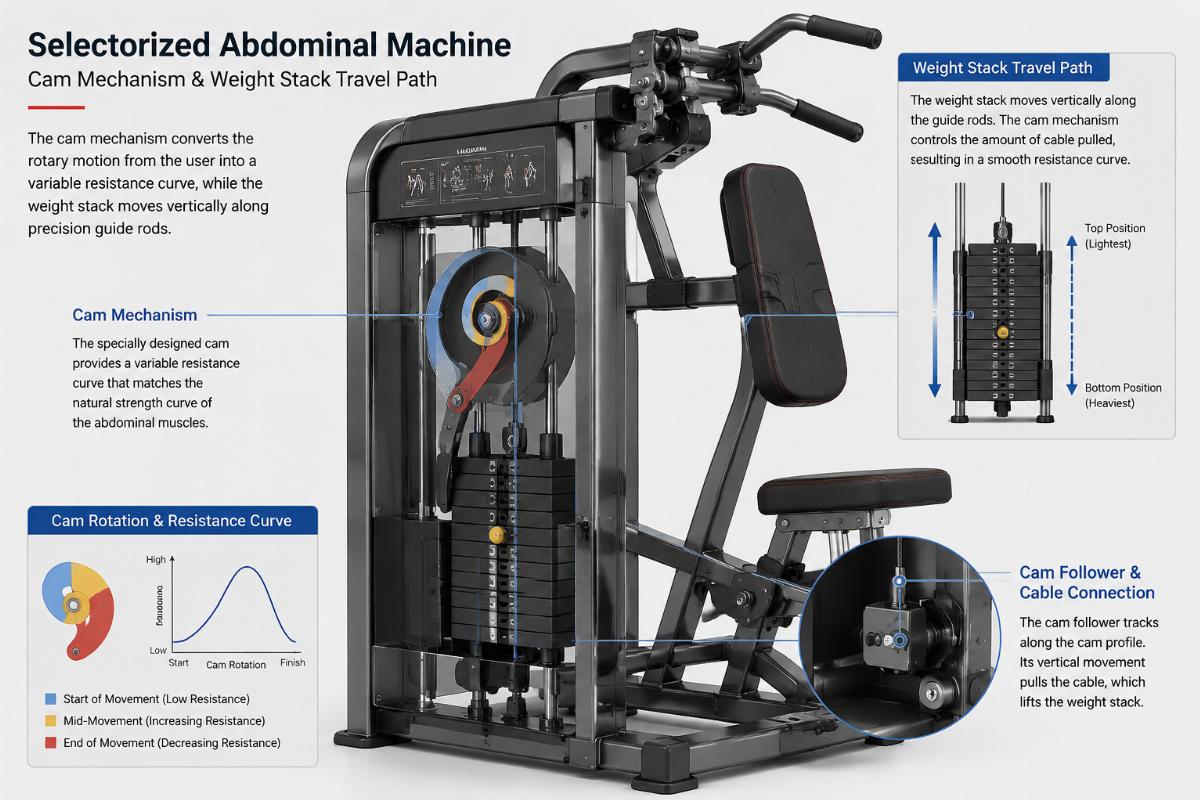
Pulley ratio determines how resistance feels to the user. A direct ratio delivers the full weight stack load to the cable, which is what serious lifters want for isolation work. A compounded ratio effectively halves the perceived load, allowing faster, more dynamic movements suited to functional and metabolic training. Most commercial cable crossovers offer one or the other; some higher-end models allow switching. For a multi-site order, the ratio should be specified per location based on the dominant training style.
Weight stack range needs to match the user demographic. A studio catering to general fitness members and group class participants will need a lighter starting weight and a moderate maximum. A strength-focused box serving experienced athletes will need a significantly heavier stack. The progression increment between plates also matters—smaller increments allow finer loading, which matters in rehab and hypertrophy contexts but is irrelevant for high-intensity metabolic work.
Cable return speed is the spec most buyers overlook. It is controlled by the spring tension and the cable routing geometry. In a HIIT environment where members rotate through stations quickly, a slow-returning cable creates bottlenecks. In a strength environment where users rest between sets, return speed is largely irrelevant. This is a spec that should be discussed explicitly with your cable crossover wholesale supplier, not assumed.

How to Match Cable Crossover Config to Different Training Zones?
HIIT zones, strength zones, and recovery zones each demand a distinct cable crossover configuration—getting this right at the sourcing stage prevents expensive post-installation swaps.
Functional training studios increasingly divide their floor space into zones, each serving a different training modality. The cable crossover is one of the few pieces of equipment that spans multiple zones, which is exactly why its configuration matters so much.
In HIIT and metabolic conditioning zones, the priority is tempo. Members move quickly between exercises, and any friction in the equipment disrupts the class flow. The ideal cable crossover for this zone uses a lighter weight stack—enough to provide meaningful resistance for high-rep movements like cable chops, face pulls, and resisted sprints, but not so heavy that the stack becomes a limiting factor. The pulley ratio should be compounded, allowing faster cable movement with less perceived load. Cable return speed must be fast, so the next user is not waiting for the stack to drop back into place. [NEED_CITE: cable return mechanism design impact on functional training equipment throughput]
In strength and hypertrophy zones, the priorities shift entirely. Users want maximum resistance, direct feel, and precise loading increments. The weight stack should be heavy enough for advanced lifters to reach failure on isolation movements like cable crossovers for chest, tricep pushdowns, and lateral raises. The pulley ratio should be direct, delivering full stack weight to the handle. Return speed is secondary—users rest between sets anyway.
In recovery and rehabilitation zones, the cable crossover serves a different purpose entirely: controlled, low-load movement through full range of motion. The weight stack should start very light, with small increments between plates. The pulley system should feel smooth, with minimal friction or sticking. A compounded ratio helps here as well, allowing fine-grained resistance at the low end.
A cable crossover wholesale supplier who understands these distinctions will ask what training zones you are equipping before quoting specs. A supplier who just sends you a single spec sheet for the entire chain is not thinking about your end users.

What Should Buyers Prepare Before Placing a Multi-Site Order?
Floor plans, ceiling height measurements, and training zone layouts for each venue are the minimum documentation needed to get an accurate cable crossover quote and avoid costly post-delivery modifications.
The most common mistake multi-site buyers make is sending a single specification sheet and expecting it to apply everywhere. The second most common mistake is not sending any site-specific documentation at all, leaving the supplier to guess.
Before requesting a quote from a cable crossover wholesale supplier, each venue should have a basic floor plan showing the intended equipment layout, including the exact position where the cable crossover will be installed. This allows the supplier to check clearances—not just ceiling height, but also side clearances for adjustable pulley columns and rear clearance for weight stack access during maintenance.
Ceiling height must be measured at the exact installation point, not just taken from the building’s general specification. Many commercial spaces have HVAC ducts, lighting rigs, or structural beams that reduce effective ceiling height at specific points. A difference of even a few centimeters can determine whether a standard frame fits or a custom short frame is needed.
Training zone layout should be communicated clearly. If a studio has a dedicated HIIT area and a separate strength area, the cable crossover spec for each should be noted. If the studio is a single open-plan space serving mixed use, the supplier needs to know which training modality dominates so the default configuration can be optimized accordingly.
I have found that buyers who provide this documentation upfront get faster quotes, fewer revision rounds, and zero surprise costs after delivery. The suppliers who ask for it are the ones who have been burned by retrofit projects before—and they are trying to protect both parties.

Conclusion
Multi-site cable crossover procurement is not a volume exercise—it is a site-by-site specification exercise. Ceiling height, training focus, and user profile vary across locations, and a single spec applied uniformly will underperform in at least some of those locations. Providing floor plans, ceiling measurements, and zone layouts to your cable crossover wholesale supplier before the order goes into production is the single most effective step to avoid retrofit costs and member complaints. The suppliers who ask for this information are the ones worth working with.