Chin-Up Station Issues Troubleshooting for Commercial Gyms
Most pulley noise on chin-up stations has nothing to do with defective bearings. The root cause is almost always bracket misalignment from improper bolt torque during installation.
Chin-up station troubleshooting in commercial gyms typically traces back to three fixable issues: installation torque deviation on pulley brackets, insufficient lubrication cycles in humid climates, and incorrect floor shim selection under anchor bolts. Field diagnosis should begin with a torque check on all pulley mounting hardware, followed by wire rope groove inspection and frame level verification, before any component is replaced.
I still remember the call from a chain gym operator in Jakarta. The place had been open for less than three months, and the assisted chin-up module was making a sound like grinding metal every time a client did a rep. The wire rope had also jumped off the pulley groove twice in one week. I flew out, pulled the shrouds, and found the pulley bracket bolts had never been torqued to spec. The entire bracket was cocked by a fraction of a millimeter—enough to make the rope track sideways and chew through the outer strands. In a tropical climate with humidity sitting above eighty percent most days, the rope had also dried out fast because nobody had set a lubrication schedule. From that job onward, I started carrying a torque wrench on every installation visit and taping a lubrication cycle card to the back of every assisted chin-up frame we shipped to Southeast Asia. [NEED_CITE: root cause distribution of pulley noise in cable-based strength equipment per field service reports]
What follows is a field-tested breakdown of the most common chin-up station failures we see across commercial gyms, and the step-by-step fixes that actually hold up under daily use.
Why Does My Chin-Up Station Pulley Squeak or Squeal?
The squeak is almost never the bearing itself—it is the bracket holding the bearing being pulled out of alignment by uneven bolt tension. When the bracket twists even slightly, the pulley sits at an angle to the wire rope. The rope then rubs against the side of the groove instead of seating in the bottom, and that friction is what you hear as a high-pitched squeal during loaded reps. [NEED_CITE: effect of pulley misalignment on wire rope wear pattern per ISO 4309]
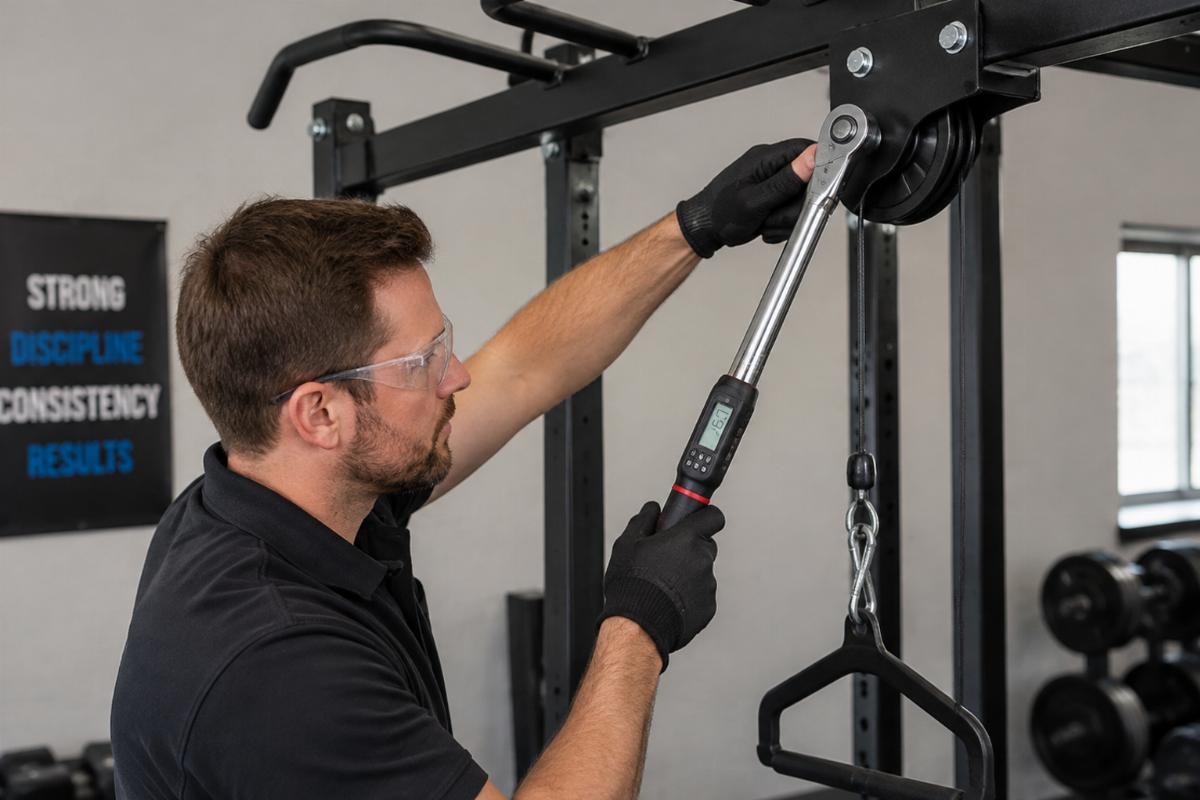
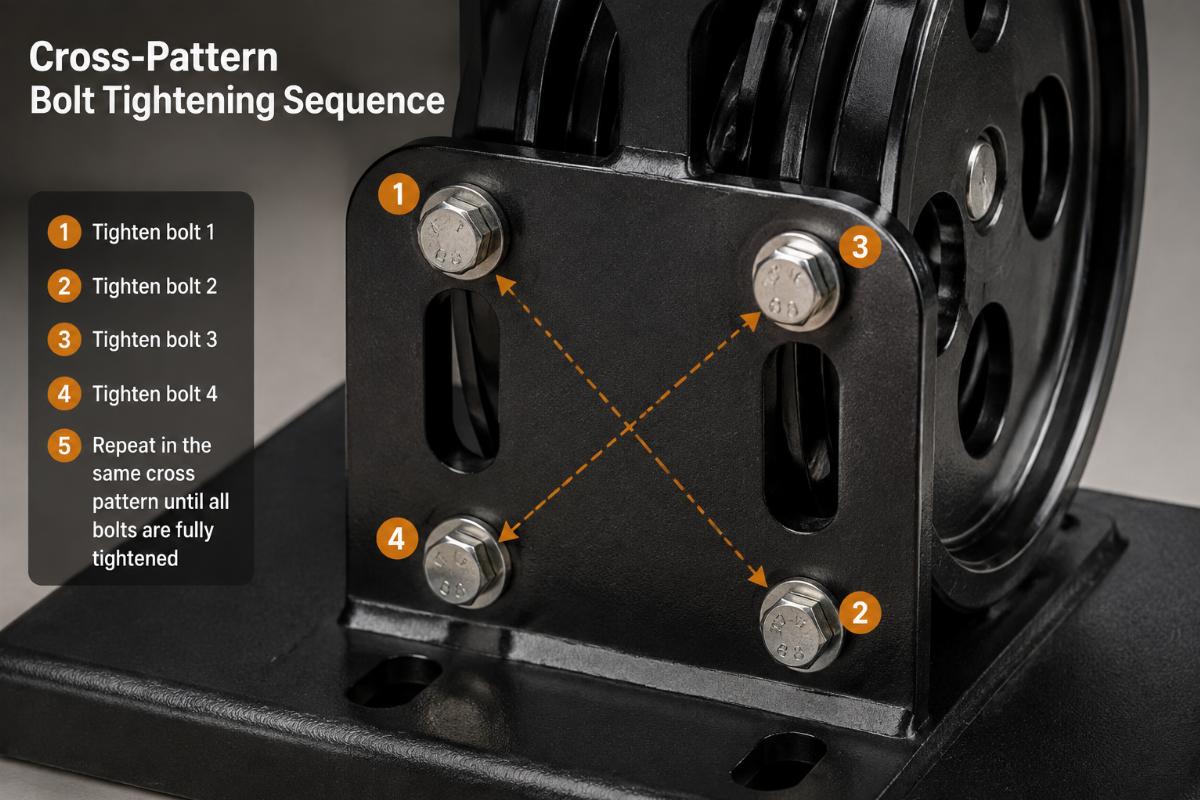
The fix starts with a full torque audit. You need a calibrated click-type torque wrench, not an impact driver. Every bolt on the pulley bracket must be loosened, the bracket re-seated so the pulley face is square to the rope path, and then the bolts tightened in a cross pattern to the manufacturer’s specified value. On most commercial chin-up stations, this means tightening in two or three progressive passes rather than cranking one bolt down fully before moving to the next. Skipping this sequence is what causes the bracket to twist in the first place.
After torquing, spin the pulley by hand with the rope removed. It should rotate freely with no lateral play and no grating sensation through the axle. If it still feels rough after the bracket is confirmed square, then—and only then—do you suspect a sealed bearing failure. In my experience across dozens of gym installations in the region, genuine bearing failures at this stage are rare. The overwhelming majority of noise complaints disappear once the bracket is re-torqued and the rope is re-seated in the groove.
One Southeast Asian distributor we work with started requiring every installer to photograph the torque wrench reading on each pulley bracket bolt and submit the photos before the machine is handed over to the gym. Their warranty claim rate on pulley noise dropped noticeably within a single quarter. [NEED_CITE: preventive maintenance impact on cable station warranty claims per equipment service data]
How to Diagnose Cable Derailment on Assisted Chin-Up Stations?
Wire rope derailment on assisted chin-up modules is a secondary symptom. The primary causes are pulley groove wear from prolonged misalignment and lubrication breakdown that lets the rope stiffen and ride up out of the groove.
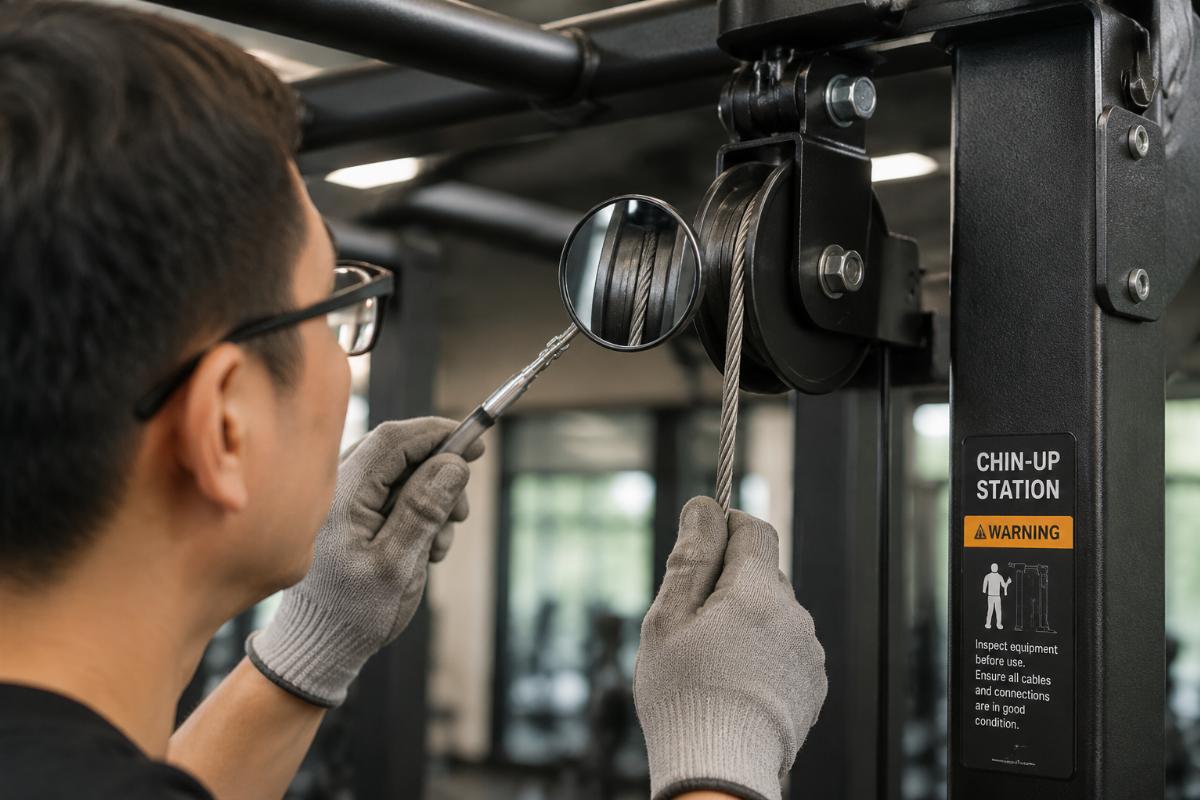
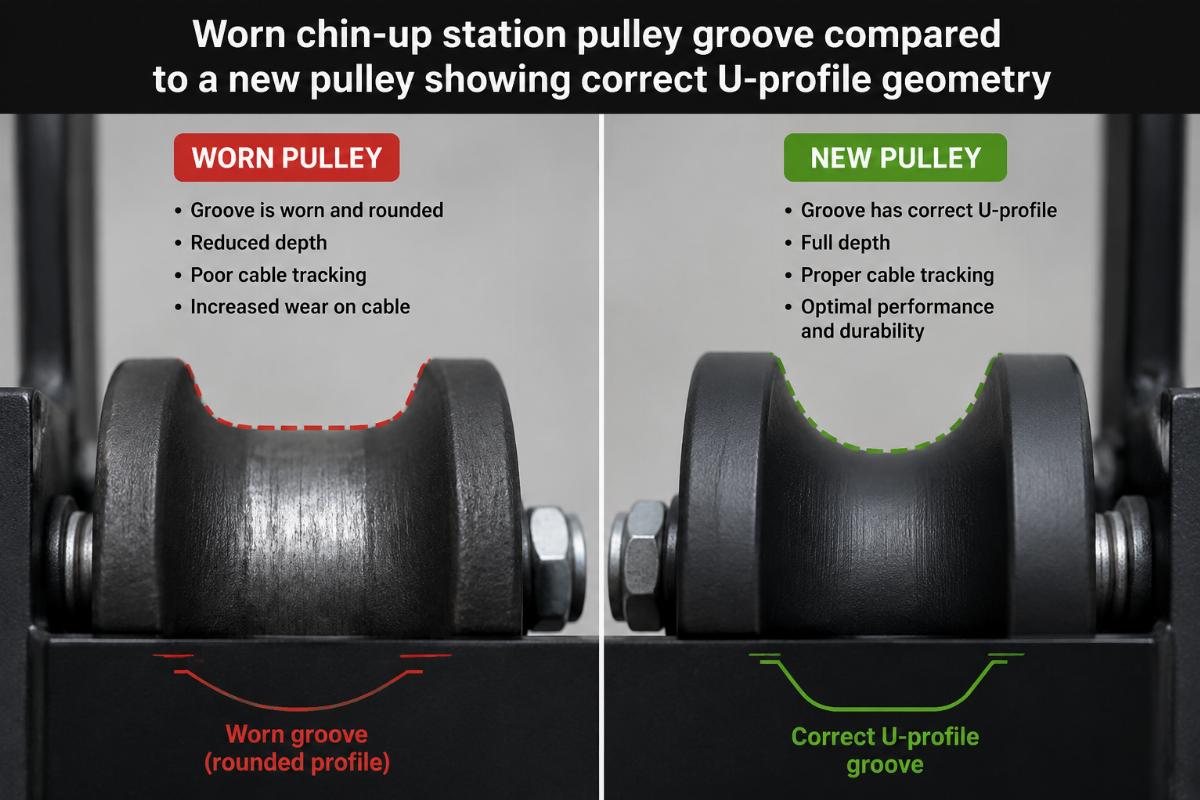
Diagnosis must follow a fixed order. First, inspect the pulley groove with a bright light and a small mirror. A healthy groove shows a polished U-shape with no visible flat spots or hook-shaped wear at the edges. If you see a flattened bottom or sharp edges, the pulley has been running with the rope misaligned for long enough to cut into the metal. At that point, torquing the bracket correctly will stop further damage, but the pulley itself must be replaced because the groove geometry can no longer guide the rope reliably. [NEED_CITE: wire rope pulley groove wear inspection criteria per ISO 4309]
Second, check the rope itself. Run a clean cloth along its full length. If the cloth comes away with black grease residue, the internal lubrication is still present. If the cloth is dry or the rope feels stiff when you flex it between your fingers, the core is starved. In tropical and coastal gym environments, the standard lubrication interval recommended for temperate climates is not enough. The salt-laden moisture accelerates the breakdown of the factory-applied grease, and the rope begins to lose flexibility well before the next scheduled service visit.
The corrective action is two-track. Re-seat or replace the worn pulley, re-torque the bracket in cross pattern, and then establish a lubrication cycle based on the local climate rather than the default schedule in the manual. For gyms in high-humidity zones, the interval between rope lubrication should be shortened substantially compared to the baseline recommendation. A light machine oil applied with a lint-free cloth, worked into the rope strands by flexing the rope through the pulleys under no load, restores flexibility and helps the rope track true.
A boutique studio in Bangkok went through three wire ropes in under a year on their assisted chin-up before we reviewed their maintenance log. They had been following the standard twelve-month lubrication cycle from the manual. After switching to a climate-adjusted schedule, the same rope ran for substantially longer before showing any signs of strand wear. [NEED_CITE: wire rope service life comparison across climate zones per gym maintenance field data]
What Causes Frame Wobble and How to Stabilize It?
Frame wobble on a floor-mounted chin-up station is rarely a welding defect. It is almost always a shimming problem at the anchor bolts combined with an uneven floor surface.
Commercial gym floors are rarely perfectly level. When the installer drops the frame onto the anchor bolts without checking level in both axes, some feet carry the full load while others hang slightly above the floor. Over weeks of use, the loaded feet work into the floor surface and the unloaded feet start to shift under dynamic loads—especially during kipping pull-ups or muscle-ups where the frame sees lateral force. The result is a perceptible rock that users immediately interpret as a structural defect.
The stabilization procedure is straightforward but often skipped. Place a machinist’s level on the main uprights in both the front-to-back and side-to-side directions. Identify which feet are high and which are low. Insert stainless steel shims of the correct thickness under the low feet until the frame reads level on both axes. Then torque the anchor bolts to spec with the shims in place, and re-check level. If the floor is severely uneven, a self-leveling epoxy pad poured under the frame footprint before installation is a more durable solution than stacking multiple shims.
The shim material matters. Using mild steel shims in a humid gym environment guarantees rust jacking within months, which pushes the frame out of level again. Stainless steel or engineered polymer shims resist corrosion and hold their thickness under load. [NEED_CITE: anchor bolt shimming material recommendations for fitness equipment per installation guidelines]
A mid-size gym chain in the Middle East had to recall technicians to six sites within the first year because of wobble complaints on their chin-up stations. The root cause on every single site was mild steel shims that had corroded and expanded, lifting the frame unevenly. After switching to stainless shims across the chain, the wobble callbacks stopped entirely.

How to Build a Preventive Maintenance Schedule for Tropical Climates?
A maintenance schedule written for a temperate warehouse will fail in a tropical gym. Humidity and salt air compress the service life of every wearing component on a chin-up station, and the schedule must be tightened accordingly.
The starting point is the manufacturer’s baseline maintenance table, which typically assumes an indoor environment with controlled humidity and moderate daily use. For gyms in coastal Southeast Asia, the Gulf, or similar climates, every lubrication interval on that table should be compressed. Pulley bearings that are sealed and rated for extended service in dry conditions still see moisture ingress through the seal lips over time in high-humidity air. Wire ropes that hold their factory lubrication for a standard cycle in a European gym lose that lubrication noticeably faster when the air is constantly saturated.
A practical field approach is to divide the year into inspection windows tied to the wet and dry seasons rather than fixed calendar months. Before each wet season begins, every chin-up station should have its pulley grooves inspected, its wire ropes flex-tested for stiffness, and its bracket bolts re-torqued. During the wet season itself, a mid-cycle spot check on rope condition catches problems before they become derailments or noise complaints.
The same logic applies to the selection weight stack guide rods and selectorized pin holes on assisted chin-up modules. In dry climates, a light film of oil on the guide rods is sufficient for the full service interval. In tropical gyms, that film breaks down and the pins begin to stick or drag, which users interpret as a machine fault rather than a maintenance gap. Wiping and re-lubricating the guide rods at the same wet-season checkpoint keeps the weight selection smooth.
We now include a climate-zone lubrication cycle card with every chin-up station shipped to high-humidity markets. The card lists the shortened intervals in plain language and is laminated for mounting on the frame. Gyms that post it visibly see noticeably better compliance from their maintenance staff. [NEED_CITE: preventive maintenance frequency adjustment factors for fitness equipment in tropical climates per industry guidelines]

When Should You Replace vs. Repair Chin-Up Station Components?
The decision to replace rather than repair should be driven by wear thresholds, not by visible damage alone. A component that looks acceptable to the eye may already be outside safe operating geometry.
For pulleys, the threshold is groove profile. Once a flat spot is visible at the bottom of the groove, or the groove edges show a hooked profile, the pulley must be replaced. Continuing to run a rope on a worn groove accelerates rope destruction and raises the risk of sudden derailment under load. [NEED_CITE: wire rope pulley replacement criteria per ISO 4309]
For wire ropes, the threshold is a combination of visible broken wires and loss of diameter. A rope with more than a small number of randomly distributed broken wires in one lay length, or any concentrated breaks at a single point, is past its service limit. Similarly, if the rope diameter has reduced noticeably compared to its nominal size due to core failure or outer strand wear, replacement is required regardless of how clean the surface looks.
For bracket hardware, the threshold is thread damage or elongation. Bolts that have been over-torqued or re-used after yielding show stretched threads or rounded hex heads. These bolts cannot be re-torqued to spec reliably and must be replaced with the same grade fastener specified by the manufacturer. Substituting a lower-grade bolt from a local hardware store is a common field shortcut that reintroduces the misalignment problem the torque spec was designed to prevent.
A clear wear-threshold list, posted in the maintenance room alongside the climate-adjusted schedule, removes guesswork for the technician on duty. It also gives gym owners a defensible basis for budgeting spare parts rather than reacting to breakdowns.
Conclusion
Chin-up station downtime in commercial gyms is overwhelmingly a maintenance and installation quality issue, not a manufacturing defect. Torque verification on pulley brackets, climate-adjusted lubrication cycles, and correct floor shimming at anchor points resolve the vast majority of noise, derailment, and wobble complaints before they escalate into component failure. Building these checks into a visible, posted schedule is what separates gyms that keep their functional training zones running from those that cycle through warranty claims and service callbacks.