
China Chin-Up Station vs Cybex Eagle: Wholesale Supplier Price & Value Comparison
The 40% price gap between a China chin-up station and the Cybex Eagle has almost nothing to do with steel quality — it comes from distribution layers, trade show overhead, and brand positioning. When weld penetration, tube wall thickness, and static load capacity are verified to the same commercial-grade spec, a China chin-up station performs structurally on par with premium US-branded alternatives in high-repetition gym environments.
I still remember a European gym chain buyer walking past our booth at a Munich trade show, Cybex Eagle spec sheet in hand, tapping the paper against our chin-up station frame and asking: "Where exactly are you cutting corners to hit this price?" I didn’t reach for a brochure. I asked him whether his previous supplier had ever provided ultrasonic weld inspection reports. He paused. That single question changed the entire conversation — because the real divide between a China chin-up station and a Cybex Eagle isn’t visible from the outside. It lives inside the weld joint, in the steel yield certificate, and in the fatigue test log that most buyers never ask to see. [NEED_CITE: weld penetration depth as primary failure mode in commercial strength equipment per ASTM F2216 field data]

Let me walk you through what actually separates these two options — and where the money really goes.
What Are the Key Structural Differences Between a China Chin-Up Station and the Cybex Eagle?
Tube specification, welding process, and load-bearing design form the structural comparison core — brand identity does not equal structural difference. A China chin-up station built to commercial export spec uses the same cold-rolled steel family and the same rectangular tube profile architecture as its premium American counterpart. The divergence appears in execution consistency, not in design concept.
| Comparison Dimension | China Chin-Up Station (Export-Grade) | Cybex Eagle (OEM Spec) |
|---|---|---|
| Main frame tube wall thickness | Commercial standard range, verifiable via mill certificate | Commercial standard range, brand-controlled spec |
| Weld type | CO₂ gas shielded / argon-arc hybrid | Proprietary robotic welding cell |
| Weld inspection coverage | Batch-level ultrasonic or sample-level destructively | Full batch-level per internal QA protocol |
| Static load test standard | Aligned with EN 957-1 / ASTM F2216 | Aligned with EN 957-1 / ASTM F2216 |
| Surface treatment | Epoxy-polyester hybrid powder coating | Multi-stage phosphate + powder coating |
| Documentation provided | Mill cert + weld report + load test video on request | Brand-controlled, not shared with end buyer |
[NEED_CITE: EN 957-1 stationary training equipment safety requirements for structural load]
The table above shows something most buyers miss: both platforms target the same international safety standards. The difference lies in whether the manufacturer is willing to show you the paperwork. A reputable China chin-up station supplier will provide third-party weld inspection reports and load test footage before you place a container order — because the factory has nothing to hide. [NEED_CITE: ASTM F2216 standard specification for strength equipment structural integrity testing]
A Middle East distributor once told me he switched from a premium US brand to a Shandong-sourced China chin-up station after running a side-by-side weld cross-section test. The macro-etch results showed penetration depth within the same acceptable band. His only regret? Not asking for the weld reports two years earlier.

How Do Weld Quality and Steel Gauge Actually Affect Long-Term Durability?
Insufficient weld penetration and wall thickness reduction are the two root causes of premature field failure in commercial chin-up stations. In a high-traffic gym where the station sees continuous pull-ups, muscle-ups, and kipping movements, the joint between the upright and the base frame absorbs cyclic bending stress with every repetition. A weld that looks smooth on the outside but lacks internal fusion will develop a fatigue crack — often invisible until the joint suddenly gives way under load.
This is where a China chin-up station from a disciplined manufacturer separates itself from the low-end market. The critical checkpoints include:
- Weld penetration depth: Must reach a defined percentage of the base metal thickness. Shallow penetration creates a stress concentration point that accelerates crack initiation. [NEED_CITE: relationship between weld penetration ratio and fatigue life in structural steel joints]
- Steel yield strength consistency: Commercial-grade frames require certified cold-rolled steel with documented yield values. Substituting lower-grade strip steel saves cost per ton but collapses fatigue life under dynamic loading.
- Tube wall uniformity: Cheap suppliers use ERW tube with inconsistent seam weld quality. A China chin-up station built from DOM (drawn-over-mandrel) or certified seamless-equivalent tube eliminates this weak point.
- Powder coating adhesion: A two-stage phosphate pretreatment followed by epoxy-polyester hybrid coating prevents substrate corrosion that would otherwise undermine weld integrity over time.
A South American functional training facility learned this the hard way. They sourced a low-cost chin-up station without requesting any weld documentation. Within a short operational window, multiple units developed visible cracking at the gusset joints — right where the vertical upright meets the horizontal stabilizer. The replacement cost, including shipping and member downtime, ended up dwarfing the original purchase savings.

Where Does the 40% Price Gap Really Come From?
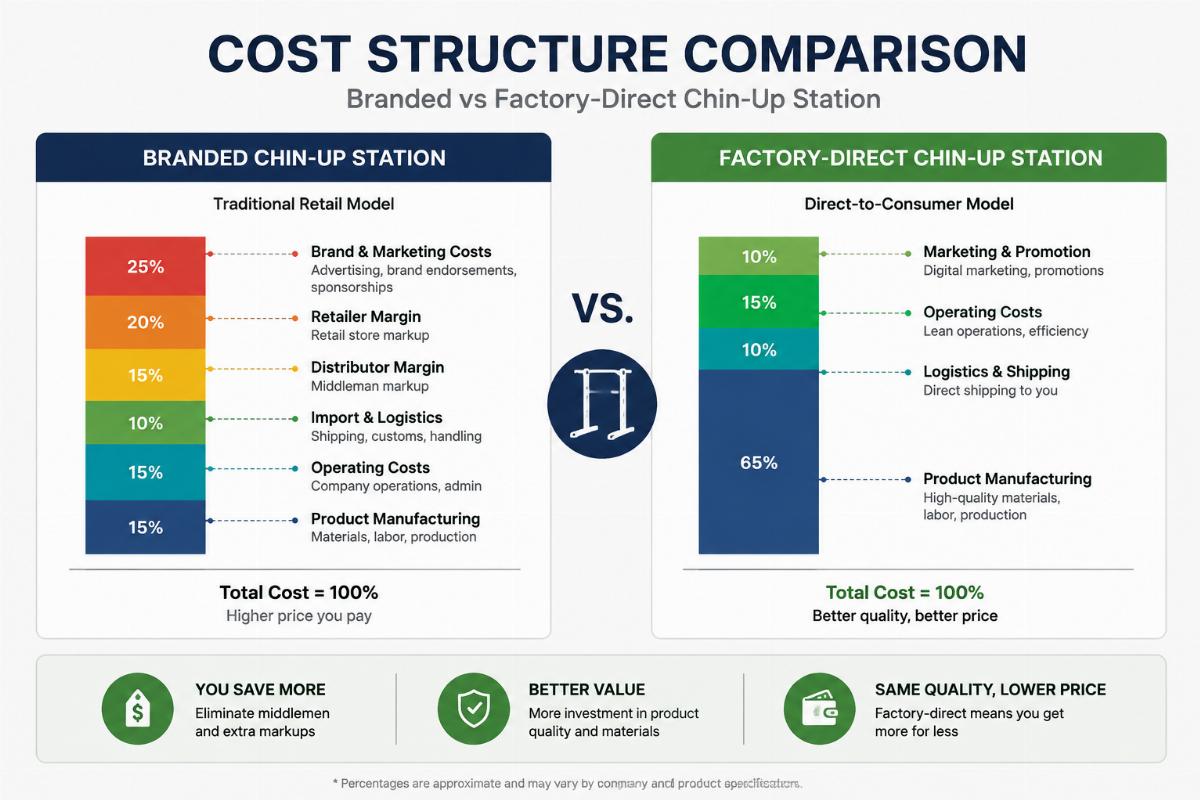
The price difference between a China chin-up station and a Cybex Eagle reflects supply chain structure and brand positioning — not manufacturing cost disparity. When you buy a Cybex Eagle through an authorized dealer, you are paying for the brand name, the regional distributor margin, the local warehouse operation, the sales representative commission, and the trade show presence that keeps the brand visible. The actual metal-to-metal fabrication cost is a fraction of the landed price.
A China chin-up station sourced directly from a Shandong-based manufacturer bypasses most of these layers. The Shandong region hosts one of the world’s densest clusters of commercial fitness equipment production — steel suppliers, powder coating lines, welding fixture shops, and logistics forwarders all operate within a compact industrial radius. This clustering effect drives down unit cost without requiring any compromise on material spec.
Here is where the cost structure actually breaks down:
- Raw material: Steel tube pricing is globally indexed. A China chin-up station factory pays the same market rate for certified cold-rolled coil as any international buyer — the advantage comes from local mill proximity and consolidated purchasing volume.
- Fabrication labor: While labor cost differentials exist, automated welding cells and CNC tube bending have reduced the direct labor share to a modest portion of total unit cost.
- Surface treatment: Powder coating lines in the Shandong cluster run at high utilization across multiple fitness equipment clients, spreading fixed cost across large batch volumes.
- Logistics: A full-container shipment of a China chin-up station directly from the factory to an overseas port eliminates domestic US warehousing, dealer markup, and last-mile distribution fees.
- Brand premium: This is the single largest invisible component. A recognized US brand name carries marketing amortization, sponsorship obligations, and channel protection costs that a direct-source China chin-up station simply does not have.
What Specs Should Buyers Verify Before Placing an Order?
Buyers must require weld inspection reports, static and dynamic load test data, and steel material certificates before committing to any China chin-up station order. These documents are not optional extras — they are the only objective evidence that the unit will survive commercial-grade daily use without premature structural failure.
The verification checklist should cover the following areas:
Weld quality documentation
Request ultrasonic testing (UT) reports covering the critical load-bearing joints — specifically the upright-to-base connection, the pull-up bar mounting bracket, and any diagonal gusset welds. A trustworthy China chin-up station manufacturer will provide batch-level UT coverage or, at minimum, destructive cross-section samples from the same production run. [NEED_CITE: ultrasonic testing acceptance criteria for structural welds in fitness equipment per ISO 5817]
Static and dynamic load test records
The station should be tested to a static load substantially exceeding the maximum rated user weight, held for a defined duration without permanent deformation. Dynamic fatigue testing — simulating hundreds of thousands of load cycles — confirms long-term joint integrity. Ask for video evidence of the test, not just a certificate number.
Steel material certificate
A mill-issued certificate confirming the steel grade, yield strength, and chemical composition of the tube used in the frame. This is the only way to verify that the manufacturer has not substituted lower-grade material.
Surface treatment specification
Confirm the pretreatment process (phosphate or zirconium-based conversion coating) and the powder coating type and film thickness. A China chin-up station coated with a proper epoxy-polyester hybrid system will resist chipping and corrosion far better than a single-layer polyester job.

When Does Cybex Eagle Still Make Sense Over a Chinese Alternative?
The Cybex Eagle remains the rational choice when brand recognition, dealer-level service infrastructure, and institutional procurement requirements outweigh direct cost considerations. A five-star hotel chain that markets its fitness facility as a premium member amenity may find that the Cybex name on the equipment supports its brand positioning in ways a China chin-up station cannot — regardless of structural equivalence. Similarly, a large institutional buyer with rigid procurement policies requiring a domestic service network, next-day parts availability, and a single point of warranty accountability will benefit from the established Cybex dealer ecosystem.
However, for the vast majority of commercial gym operators, CrossFit affiliates, and regional fitness distributors, a China chin-up station that meets verified export-grade specifications delivers the same structural performance at a fraction of the total ownership cost. The savings can be redirected toward additional equipment variety, facility expansion, or member experience improvements — investments that generate visible returns rather than disappearing into brand premium.
The key is verification. A China chin-up station sourced from a manufacturer willing to provide transparent documentation, third-party test reports, and factory audit access gives the buyer the same confidence level as a premium brand purchase — with the added advantage of direct factory communication, flexible customization, and consolidated container shipping.

Conclusion
Structural performance depends on verified specifications — not on brand labels or price tags. A China chin-up station built to documented commercial standards, backed by weld inspection reports and load test evidence, delivers equivalent field durability to premium alternatives at a fundamentally different cost structure. The buyer’s responsibility is to ask for the right documents before placing the order — and to choose a manufacturer whose transparency proves the product speaks for itself.


