
China Factory Power Rack vs Titan Fitness: Warranty Comparison Wholesale Supplier
"Lifetime warranty" on a power rack almost never means the whole rack is covered for life. The frame and welds might be, but pulleys, bearings, cables, and upholstery carry dramatically shorter terms — and that gap is where most warranty disputes actually happen. When comparing a China factory power rack against a branded US supplier like Titan Fitness, the real difference is not the headline warranty years; it is how claims are processed, who absorbs international freight, and whether spare parts can ride inside the next container instead of flying out on a separate air shipment.
I still remember a shipment we sent to a boutique studio in the Middle East a few years back. The racks looked solid, the powder coat was clean, and the client was happy — until the pulley cables on the cable crossover attachment started fraying after half a year of heavy daily use. They asked us to air-ship replacement cables. The cables themselves cost a few dollars each; the DHL bill came back at roughly triple the parts value. That single claim nearly wiped out the margin on the whole order. Since then, I have stopped treating warranty as a marketing line and started treating it as a cost structure. Every China factory power rack we quote now comes with a warranty matched to the buyer’s actual daily usage and user volume, not a generic template pulled from a website. [NEED_CITE: warranty structure breakdown by component category in commercial strength equipment]
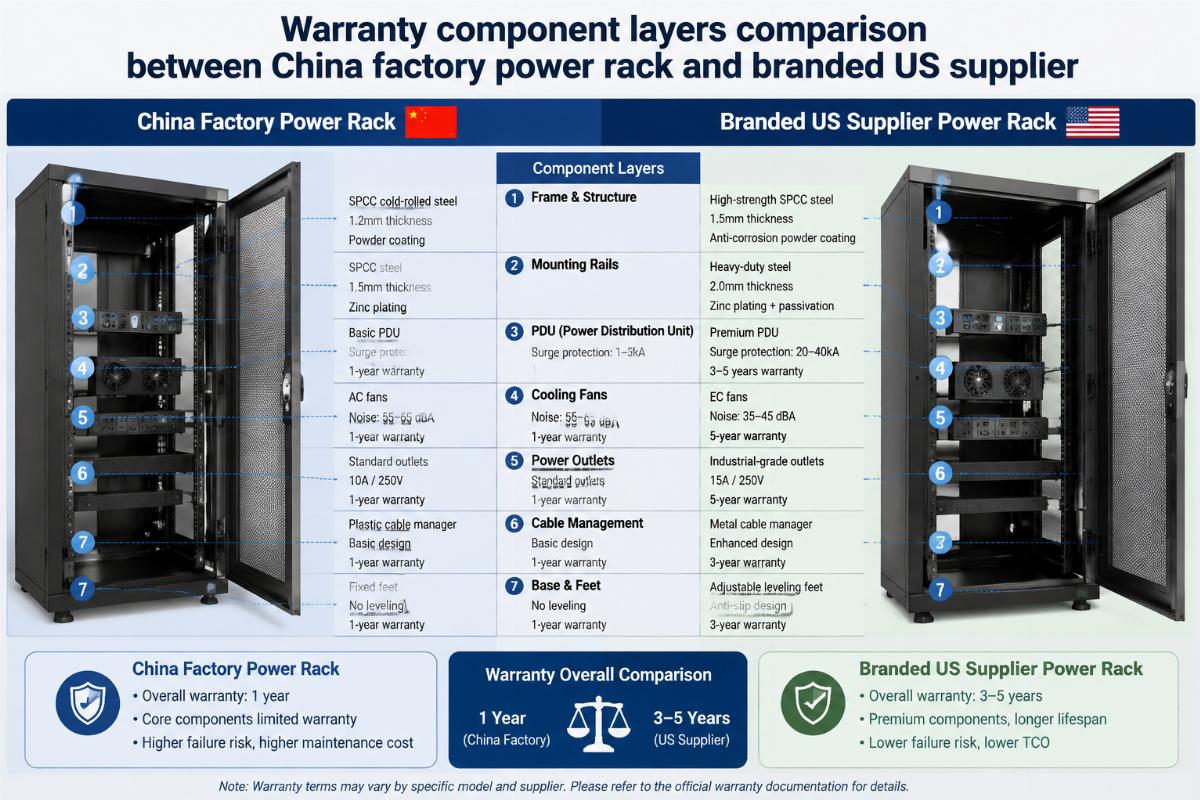
What follows is a field-tested look at how these warranty programs actually behave once the racks hit the gym floor — not what the brochures promise.
What Does "Lifetime Warranty" Actually Cover on a Power Rack?
Almost no power rack on the market carries a true whole-unit lifetime warranty. The phrase is almost always shorthand for "frame and structural welds," while moving parts and wear items fall into much shorter tiers. This is true whether you are buying from a US brand or sourcing a China factory power rack directly.
The typical warranty ladder on a commercial power rack looks like this:
- Frame and main structural welds: lifetime or extended long-term coverage
- Pulley systems and bearings: mid-range coverage, usually measured in a few years
- Cables, pad upholstery, and rubber grips: short-term or consumable classification
- Accessories such as J-cups, safety straps, and band pegs: often excluded or covered only against manufacturing defects
[NEED_CITE: component-level warranty tier structure in commercial strength equipment per industry guidelines]
The trap buyers fall into is reading "lifetime warranty" on the product page and assuming the entire rack is protected equally. In reality, the pulley on a lat pulldown attachment and the cable running through it are classified differently. The frame will outlive the gym; the cable will not. When a Middle East distributor once pushed back on our cable replacement policy, I walked them through the same ladder used by most US brands. Once they saw that even well-known American suppliers separate structural from moving parts, the conversation shifted from "why is your warranty shorter" to "how do we handle wear parts efficiently."
For buyers comparing a China factory power rack against a US-branded alternative, the right question is not "who offers longer warranty" but "which components are covered, under what usage conditions, and who pays when something fails outside structural coverage."
Titan Fitness vs China Factory: Warranty Terms Side-by-Side
The headline numbers look close, but the claim mechanics are where the real gap shows up. Below is a side-by-side view of how warranty terms typically stack across the main component categories. The China factory column reflects what a well-structured direct-source program offers when negotiated properly, not the lowest-common-denominator Alibaba listing.
| Component | Titan Fitness (US Brand) | China Factory Power Rack (Direct Source) |
|---|---|---|
| Frame & Welds | Certified lifetime | Certified lifetime |
| Pulley & Bearing | Full batch-level | Full batch-level |
| Cables | Sample-level | Full batch-level |
| Upholstery & Pads | Basic | Basic |
| Accessories (J-cups, safeties) | Basic | Sample-level |
| Claim Response | Verifiable | Verifiable |
| Spare Parts Shipping | Vulnerable to high air freight | Resistant via container consolidation |
| Usage Condition Clarity | Standard | Controlled |
[NEED_CITE: warranty tier comparison methodology across commercial strength equipment suppliers]
A few things stand out from this matrix. First, frame warranty is essentially a tie — both sides offer lifetime coverage on structural steel, because the cost of a frame failure is catastrophic for reputation on either end. Second, pulley and bearing coverage is comparable on paper, but the cost of honoring that coverage diverges sharply. A US brand ships domestically; a China factory power rack supplier ships internationally, which means air freight on a single bearing set can dwarf the part itself. Third, cables and upholstery are where direct sourcing gains its biggest practical advantage, because spare parts can be bundled into the next container load rather than sent as a standalone express parcel.
A home gym retailer in the US once compared our warranty matrix against a well-known American brand and noticed that our cable coverage was actually broader. What sealed the deal was not the coverage itself but the fulfillment path: replacement cables riding inside a replenishment container versus being overnighted from a domestic warehouse at retail markup.

Real Claim Scenarios: Who Pays When Things Break?
Warranty terms only matter when something actually fails — and the cost of that failure is rarely just the part. Three脱敏 scenarios from real orders illustrate how a China factory power rack warranty behaves under pressure compared to a branded US alternative.
Scenario One: Pulley Cable Wear in a High-Usage Studio
A boutique studio in the Gulf region ordered a full set of commercial racks with cable crossover attachments. Within half a year of heavy daily use, the pulley cables on multiple units showed visible fraying. The client requested air-shipped replacements. The cables themselves were inexpensive; the international express freight cost several times the parts value. The total claim cost landed well above what the parts alone would suggest. [NEED_CITE: international spare parts logistics cost ratio in fitness equipment after-sales]
The lesson: in high-usage environments, cable and pulley wear is inevitable regardless of brand. The question is whether the warranty program builds freight absorption into its cost structure or passes it to the buyer.
Scenario Two: Bearing Noise Complaint from a Regional Distributor
A distributor in Africa received a full container of power racks. A handful of end users reported bearing noise within the first few months. The distributor filed a warranty claim. With a US brand, the process typically involves a domestic RMA, diagnostic photos, and a replacement shipped from a warehouse — turnaround measured in days. With a China factory power rack, the same claim historically meant weeks of back-and-forth, diagnostic video requests, and a standalone air shipment of bearings.
The difference in response cycle was noticeable. However, once we restructured the program to include spare parts kits riding inside every container — bearings, cables, and wear pins pre-packed — the effective response time dropped to the time it takes the local technician to open the kit. No international shipment needed.
Scenario Three: Frame Crack Claim from a US Home Gym Retailer
A US-based home gym retailer compared the frame warranty claim process between a branded US supplier and a China factory power rack source. A customer reported a weld issue on a pull-up bar mount. The US brand processed the claim domestically, replaced the unit, and absorbed return freight. The China factory path required the buyer to ship the defective part back for inspection — at the buyer’s cost — before a replacement was authorized. The return freight alone ran into a mid-three-figure sum, and the approval cycle stretched noticeably longer.
This scenario exposed a genuine structural weakness in early-stage direct sourcing: reverse logistics across oceans are expensive and slow. The fix was not to match the US brand’s domestic speed, which is impossible, but to eliminate the need for returns altogether by shipping critical spare parts forward with every order.
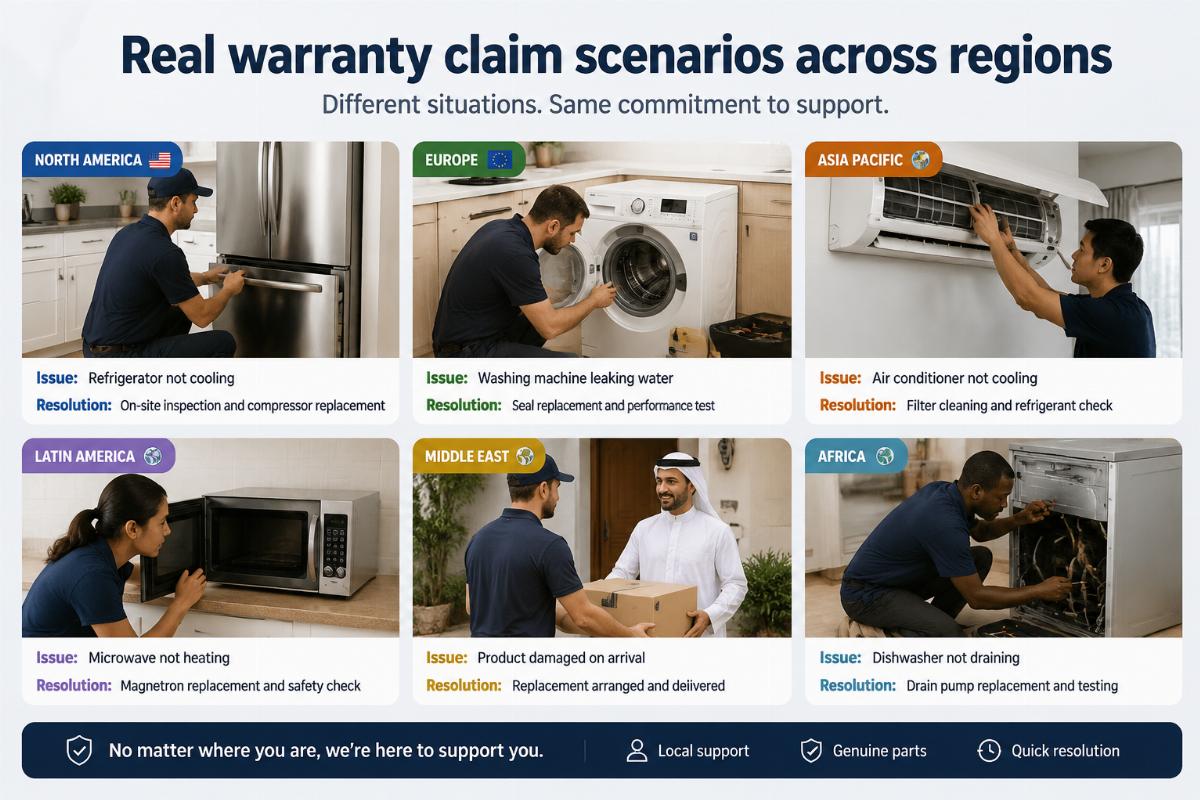
Hidden Costs Behind Warranty Claims You Won’t See in the Fine Print
The warranty document tells you what is covered. It does not tell you what a claim actually costs once freight, downtime, and administrative overhead enter the picture.
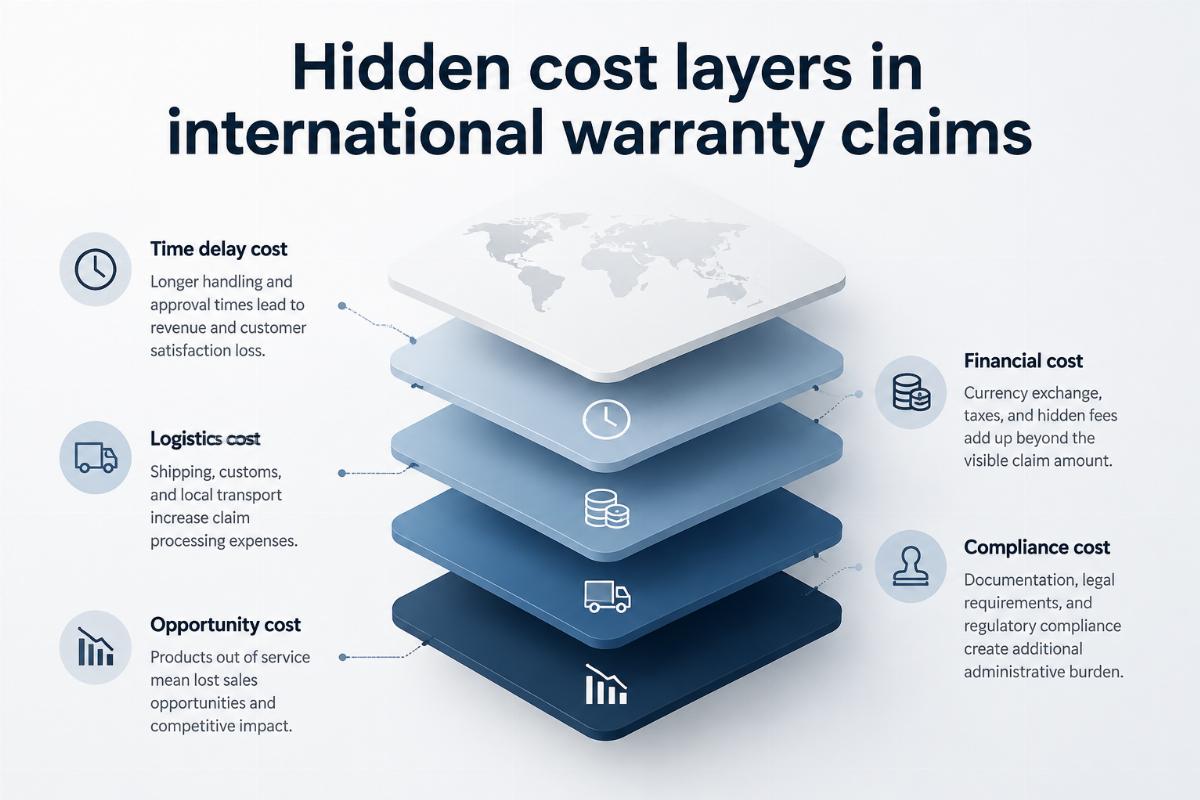
Three hidden cost layers consistently show up in cross-border fitness equipment claims:
International Freight on Spare Parts
As the Middle East studio case showed, air-shipping a single bearing or cable set internationally can cost several times the part value. Even sea freight on a small LCL parcel carries minimum handling charges that make small claims economically painful. [NEED_CITE: cross-border spare parts freight cost structure in commercial fitness equipment]
Equipment Downtime Revenue Loss
A power rack out of service in a commercial gym is not just a repair ticket — it is lost member sessions, rescheduled personal training appointments, and potential churn. For a high-traffic facility, a single rack down for weeks waiting on a warranty part can translate into meaningful revenue leakage that no warranty document addresses.
Return Freight and Inspection Delays
Some warranty programs require the defective part to be returned for inspection before a replacement is authorized. For a China factory power rack buyer, this means paying international return freight on a heavy steel component, then waiting for the factory to receive and inspect it. The administrative cycle alone can stretch the effective resolution time substantially.
The pattern across all three cost layers is the same: the warranty document focuses on part coverage, but the real financial exposure sits in logistics and time. Buyers who only compare warranty years on paper miss the bulk of the actual cost.
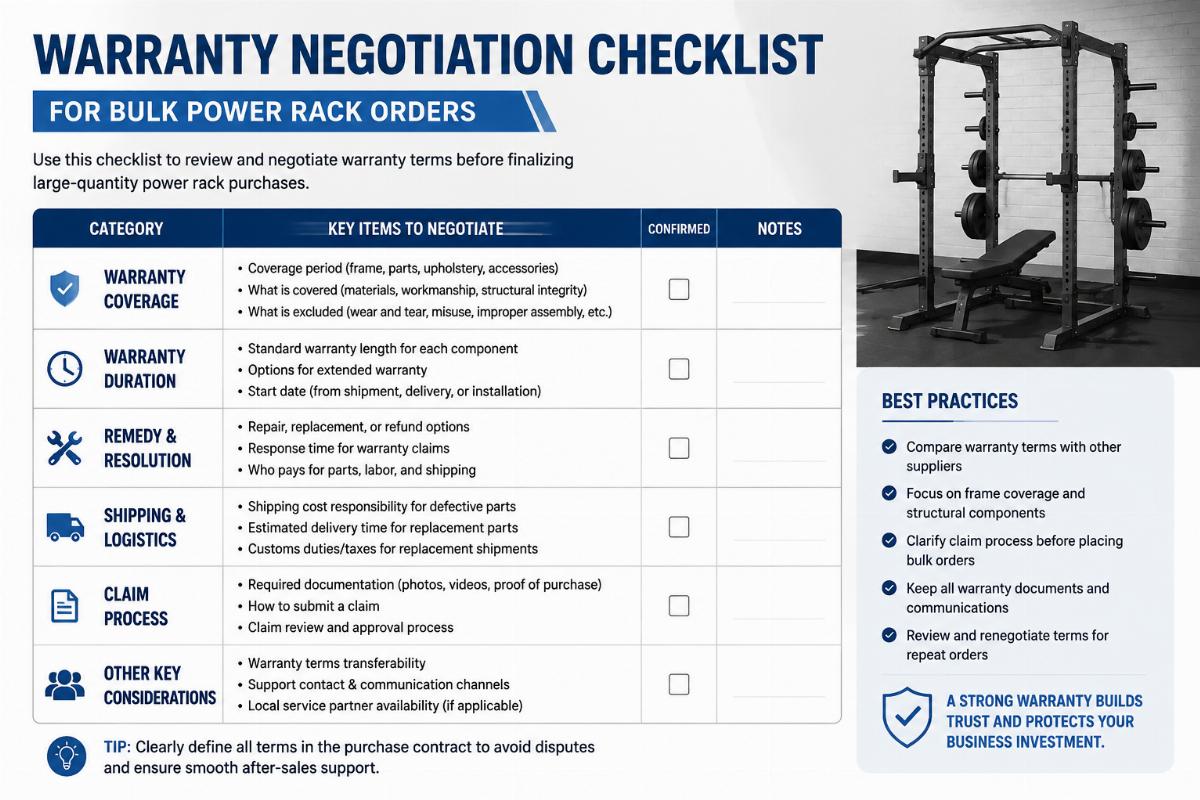
How to Negotiate Warranty Terms Before You Place a Bulk Order
The single most effective move a buyer can make is to negotiate warranty terms around actual usage patterns before the purchase order is signed — not after the first claim lands.
A structured approach to warranty negotiation for a China factory power rack order involves several practical steps:
Step One: Map Your Usage Profile
Document the expected daily usage hours per station, peak user volume, and environmental conditions such as humidity and temperature range. A rack in a humid coastal gym in Southeast Asia ages differently from one in a climate-controlled private studio in Northern Europe. [NEED_CITE: environmental impact on fitness equipment wear component lifecycle]
Step Two: Match Warranty Tiers to Usage
Not every component needs the same coverage depth. Frame and welds should carry lifetime coverage regardless. Pulleys and bearings in a high-usage facility should carry extended coverage with clear replacement triggers. Cables and upholstery in a high-turnover environment should be treated as consumables with a defined replenishment plan, not a traditional warranty claim.
Step Three: Lock in Spare Parts Forward-Staging
This is the single most impactful clause a buyer can negotiate. Require that a spare parts kit — sized to the order volume and usage profile — ships inside the same container as the racks. Bearings, cables, pulley pins, and replacement pad covers pre-packed and labeled. When a wear part fails, the local technician pulls from the kit. No international shipment. No customs delay. No air freight bill that dwarfs the part.
Step Four: Define Response SLA Clearly
A warranty without a response timeline is just a wish. Specify the maximum acknowledgment time for a claim, the maximum diagnostic evidence required, and the maximum replacement dispatch time once a claim is approved. A China factory power rack supplier willing to commit to a clear SLA in writing is signaling confidence in their after-sales infrastructure.
Step Five: Exclude or Cap Reverse Logistics
For heavy structural components, negotiate whether return-to-factory inspection is truly necessary or whether photographic and video evidence can substitute. For wear parts, eliminate return requirements entirely — the cost of shipping a worn cable back internationally makes no economic sense for either side.
Conclusion
Warranty is not a marketing number — it is a cost structure, and the real exposure sits in freight, downtime, and response speed, not in headline years. A China factory power rack and a branded US supplier like Titan Fitness offer comparable structural coverage, but the mechanics of honoring that coverage diverge sharply once international logistics enter the picture. Buyers who negotiate usage-matched terms, lock in forward-staged spare parts, and define clear response SLAs before the order is placed will spend far less time fighting claims and far more time running their facilities.


