
Commercial Fitness Equipment Supplier | Factory-Direct OEM & Wholesale Pricing
The cheapest quotation on your desk is almost never the cheapest machine you will own. The real fitness equipment price in Spain is determined by three stacked layers: factory configuration cost, ocean freight plus EU import duties, and multi-tier distributor markups. Buyers who learn to read specification sheets line by line can land the same commercial-grade equipment at a fraction of what local dealers quote.
I spent years sourcing treadmills, Smith machines, and plate-loaded rigs for gym chains down under, walking exhibition floors and factory floors alike. The moment I switched to the supply side in Shandong, I realized most buyers were comparing apples to oranges because sellers deliberately buried spec differences inside vague line items. A Middle East gym owner once showed me a competing quote for a Smith machine that looked noticeably lower. I pulled both spec sheets side by side: the steel tube wall thickness differed by a meaningful margin, the pulley bearings came from different tiers of suppliers, and the upholstery foam density was clearly downgraded. The price gap lived entirely in invisible details. [NEED_CITE: root causes of commercial fitness equipment warranty claims per industry failure analysis]

Let me walk you through how the fitness equipment price in Spain actually forms, how to decode quotations, and where the real savings hide.
What Determines Fitness Equipment Price in Spain in 2026?
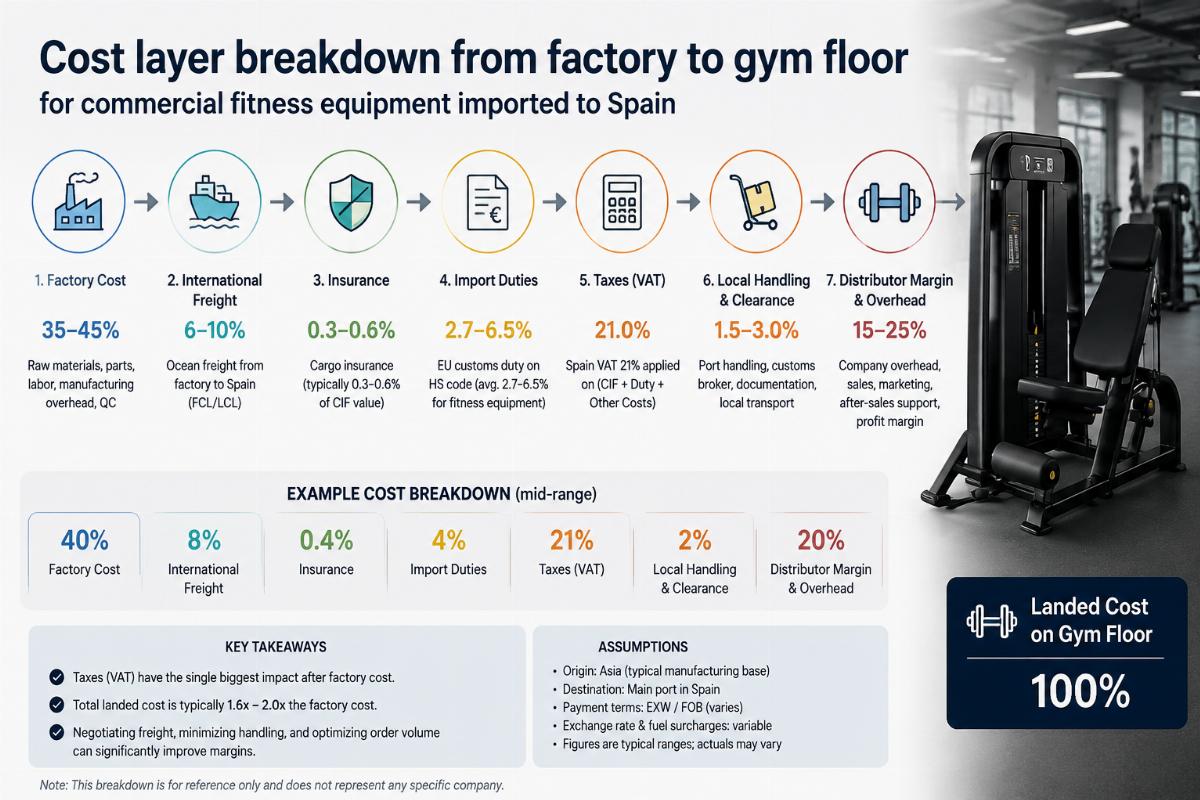
Terminal pricing is never a single number—it is the sum of factory configuration, logistics, customs, and distribution margins.
Three cost layers stack on top of each other before a piece of gym equipment reaches a gym floor in Madrid or Barcelona.
The first layer is the factory configuration. Steel tube gauge, welding method, bearing origin, foam density, and surface treatment all move the ex-works price substantially. A selectorized machine built with controlled nitrogen infusion in the steel and micron-level precision machining costs noticeably more than one stamped from commercial-grade tubing with basic bearing assemblies. [NEED_CITE: EN 957 safety standard requirements for commercial strength equipment structural integrity]
The second layer is logistics and customs. Ocean freight from a Chinese port to Valencia or Algeciras, EU import duty on fitness machinery, Spanish VAT, and CE certification compliance costs all add up before the container even reaches the warehouse. [NEED_CITE: EU TARIC tariff codes and duty rates for gym and fitness machinery imports]
The third layer is distribution markup. Equipment that passes through a national importer, a regional dealer, and finally a local installer can carry cumulative margins that double or triple the factory price.
| Cost Layer | Typical Components | Price Impact |
|---|---|---|
| Factory Configuration | Steel gauge, bearing grade, foam density, surface coating | Noticeable |
| Logistics & Customs | Ocean freight, EU duty, VAT, CE certification | Substantial |
| Distribution Markup | Importer margin, dealer margin, installer margin | Substantially extended |
A hotel developer in Andalusia once asked me why his local dealer’s quote for a full cardio and strength package was so high. When we traced the supply chain, the same OEM production line that built his machines was supplying branded versions to three different European labels, each adding its own margin layer. The fitness equipment price in Spain at the branded end was easily multiple times the factory-direct cost.
How to Read a Fitness Equipment Quotation Without Getting Tricked?
Every line item on a quotation hides specification choices that move price dramatically.
The trick low-price sellers use is simple: quote a machine model name that sounds identical to a competitor’s, but quietly downgrade components that the buyer never sees until something breaks eighteen months later.
Here is a comparison framework I use when buyers bring me competing quotations to evaluate:
| Specification Point | Budget Tier | Commercial Grade | Premium Build |
|---|---|---|---|
| Steel tube wall thickness | Basic gauge | Standard commercial | Heavy-duty reinforced |
| Pulley bearing origin | Self-reported | Verifiable mid-tier | Certified premium brand |
| Seat foam density | Basic | Standard commercial | High-density slow-recovery |
| Surface treatment | Basic powder coat | Controlled pretreatment | Multi-stage with extended salt-spray endurance |
| Welding process | Manual spot | Standard MIG | Robotic continuous with full-batch-level inspection |
| Cable rating | Self-reported | Verifiable | Certified with full documentation |
[NEED_CITE: commercial fitness equipment component durability testing standards and failure mode analysis]
A gym chain buyer in the Iberian Peninsula brought me two quotations for a functional trainer. The model names were nearly identical. The lower quote used basic-gauge tubing and self-reported cables. The commercial-grade quote used heavy-duty reinforced tubing, certified cables, and multi-stage surface treatment with extended salt-spray endurance. The price difference was meaningful but not dramatic. What was dramatic was the warranty claim rate difference over the following years—the budget tier machines needed cable replacements and frame weld repairs repeatedly, while the commercial grade units ran with substantially extended service life meaningfully.
The fitness equipment price in Spain looks attractive on paper until you calculate total cost of ownership. A machine that costs noticeably less upfront but requires repeated part replacements and downtime costs several times the savings.

Factory-Direct vs. Local Distributor: Where Does the Real Cost Gap Come From?
The same production line can produce equipment that reaches the end user at vastly different price points depending on how many hands it passes through.
Most buyers assume that buying from a local Spanish distributor means paying for convenience and local support. What they often do not realize is that the convenience premium can be enormous.
Consider the typical distribution chain for imported gym equipment: the factory sells to a national importer, who sells to a regional dealer, who sells to the gym owner. Each layer adds margin for warehousing, sales staff, showroom overhead, and profit. By the time the machine reaches the gym floor, the terminal price can be multiple times the factory price.
Now consider factory-direct sourcing. The gym owner or developer works directly with the manufacturer. There is no national importer margin, no regional dealer margin. The factory handles CE certification, container loading, and shipping documentation. The buyer arranges customs clearance and last-mile delivery, or the factory coordinates it on a transparent pass-through basis.
A boutique studio owner in Valencia was quoted a cable crossover machine by a local dealer at a price that made the project barely viable. When she sourced the same specification machine factory-direct, the fitness equipment price in Spain dropped noticeably. She used the savings to add a complete free-weight zone she had originally cut from the budget.
| Sourcing Route | Margin Layers | Price Level | Customization Flexibility |
|---|---|---|---|
| Local Distributor | Multiple | Substantially extended | Limited to catalog |
| National Importer | Moderate | Noticeably higher than factory | Some options |
| Factory-Direct OEM | Minimal | Noticeably reduced | Full OEM branding and spec control |
[NEED_CITE: distribution margin structure in European commercial fitness equipment market]
The key advantage of factory-direct is not just price. It is specification control. You choose the steel gauge, the bearing grade, the upholstery color and density, the logo placement, the packaging. You are not locked into whatever the local dealer happens to have in his warehouse.

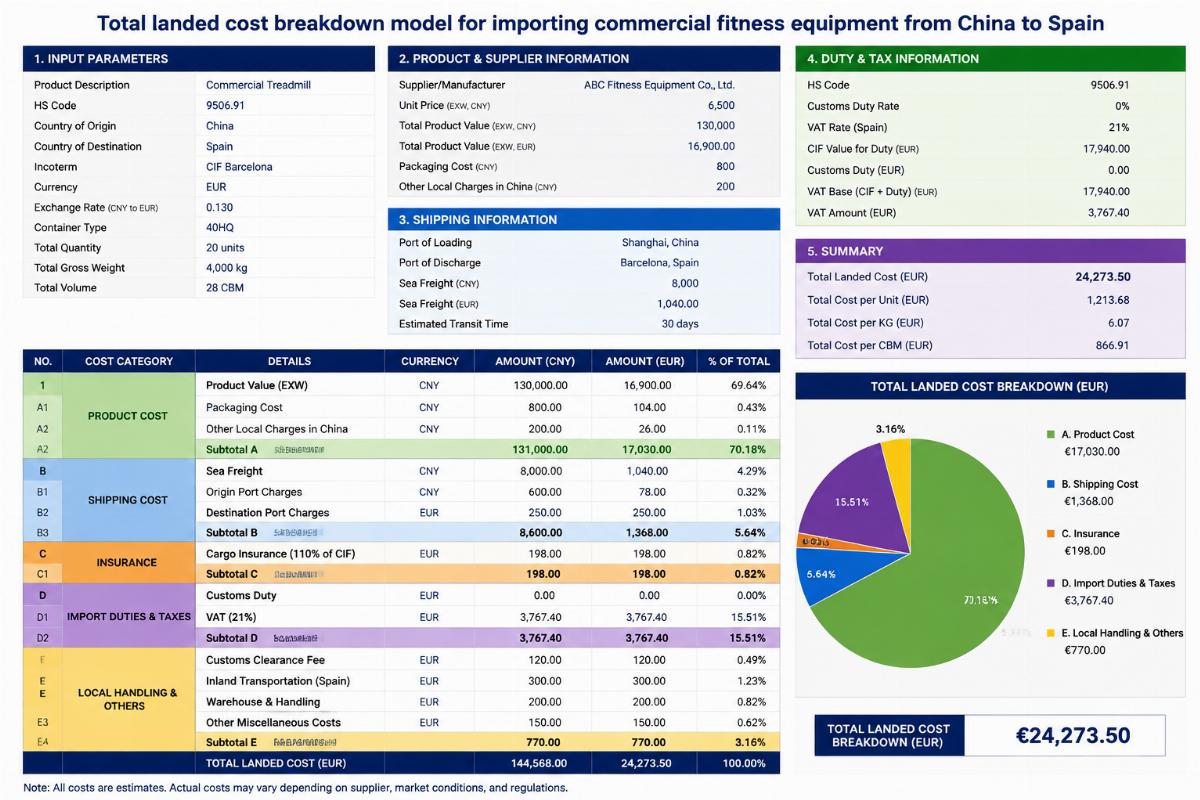
What Is the Total Landed Cost of Importing Gym Equipment from China to Spain?
FOB price is just the starting line. The real number you need is the total landed cost at your gym door.
Buyers who only look at the factory quotation are in for a surprise when the container arrives. The total landed cost includes several components that must be calculated before you can compare fairly against a local dealer quote.
Here is the cost chain from factory floor to gym floor:
- FOB factory price. This is the base equipment cost including your chosen specifications, standard export packaging, and loading into the container.
- Ocean freight. Container shipping from a Chinese port such as Qingdao or Shanghai to Valencia or Algeciras. Rates fluctuate with global shipping indices, so lock in a quote close to your shipping window. [NEED_CITE: container freight rate indices for Asia to Mediterranean routes]
- EU import duty. Fitness equipment falls under specific TARIC codes with defined duty rates. The exact percentage depends on the machine category—cardio equipment, strength machines, and free weights each have different classifications. [NEED_CITE: EU TARIC tariff classification and duty rates for fitness machinery]
- Spanish VAT. Applied to the sum of CIF value plus duty. This is recoverable for registered businesses but must be factored into cash flow planning.
- Customs clearance and port handling. Broker fees, terminal handling charges, and documentation costs.
- Inland transport. From the port to your warehouse or gym site. A full container to a facility near Valencia costs noticeably less per unit than less-than-container loads distributed to multiple addresses.
- CE certification compliance. Every piece of commercial fitness equipment sold in the EU must carry CE marking and comply with EN 957 standards. The factory should provide full technical documentation and test reports. [NEED_CITE: EN 957 series standards for stationary training equipment safety requirements]
A hotel developer in the Balearic Islands was comparing a local dealer quote against a factory-direct import for a complete apartment gym fitout. The dealer quote included everything—delivery, installation, warranty. The factory-direct quote looked lower on the equipment line but the developer had never calculated CE compliance documentation, inland transport from the port, or installation labor. Once we built the full total landed cost model, the factory-direct route still came in noticeably lower, but the gap was smaller than the FOB price alone suggested.
| Cost Component | Full Container | Less-than-Container |
|---|---|---|
| Ocean freight per unit | Noticeably reduced | Substantially extended |
| Port handling per unit | Noticeably reduced | Substantially extended |
| Inland transport per unit | Noticeably reduced | Substantially extended |
| Customs clearance per unit | Noticeably reduced | Noticeably higher |
The lesson: always calculate total landed cost before comparing quotes. The fitness equipment price in Spain from a local dealer includes all of these layers baked in—and then some.
How to Optimize Your Fitness Equipment Budget for Maximum Value?
Smart buyers do not just chase the lowest unit price—they optimize the entire container for maximum gym value per euro spent.
Once you understand the cost layers, you can make strategic choices that stretch your budget further without sacrificing the commercial-grade durability your members expect.
The first optimization lever is container loading strategy. A full container dramatically reduces the per-unit logistics cost compared to less-than-container shipments. If your gym plan requires equipment that does not quite fill a container, consider consolidating with another buyer or adding high-margin accessories—rubber flooring, dumbbell sets, battle ropes, medicine balls—to fill the space. The per-unit freight cost drops noticeably when the container is full.
The second lever is specification prioritization. Not every machine in your gym gets the same usage. High-traffic pieces like Smith machines, cable crossovers, and commercial treadmills should be built to heavy-duty reinforced standards with premium bearings and high-density upholstery. Lower-traffic pieces like specialty isolation machines can use standard commercial grade without compromising member experience. This targeted approach keeps the overall fitness equipment price in Spain within budget where it matters most.
The third lever is MOQ flexibility. Some factories require minimum order quantities that force you to buy more than you need. Others allow single-unit orders or mixed containers, which is critical for boutique studios and hotel gyms that need variety rather than volume.
A fitness equipment distributor in Latin America was importing container loads of plate-loaded machines. By working with the factory to consolidate multiple machine types into mixed containers, he reduced the per-unit logistics cost noticeably and could offer his customers a wider product range without increasing his total investment.
| Optimization Lever | Budget Impact | Implementation |
|---|---|---|
| Full container consolidation | Noticeably reduced per-unit logistics | Plan equipment list to fill container or add accessories |
| Spec prioritization by usage | Targeted spend on high-traffic machines | Heavy-duty for core machines, standard for specialty |
| MOQ flexibility | Reduced upfront commitment | Mix machine types in single container |
[NEED_CITE: commercial gym equipment procurement strategies for multi-site fitness operators]
The fitness equipment price in Spain becomes manageable when you treat the entire procurement process as a system to optimize, not a series of unit prices to minimize.

Conclusion
The fitness equipment price in Spain is not a mystery—it is a transparent sum of factory configuration, logistics, customs, and distribution margins. Buyers who decode specification sheets, calculate total landed cost, and optimize container loading consistently land commercial-grade equipment at a fraction of local dealer pricing. The cheapest quotation is rarely the best deal, but the smartest quotation almost always is.


