
Commercial Fitness Equipment Supplier for Egypt: China Factory Direct OEM
Most buyers think the lowest factory quote wins the deal. The real cost trap is port-side clearance failure caused by spec mismatches that never got caught before loading.
Sourcing commercial fitness equipment from China for the Egyptian market delivers a price advantage of roughly forty to fifty percent versus international brands, but the entire shipment clears customs smoothly only when weight-stack bore diameters, voltage-frequency ratings, and Arabic-language nameplates are locked down at the pre-production sample stage.
I still remember the first full-container order I helped ship to Alexandria. The containers arrived on schedule, the crates looked clean, and the paperwork was stamped—yet the selectorized machines sat in bonded storage for weeks because the weight-stack pin diameter we machined did not match the bore standard the client’s local technician expected. Every day of demurrage ate into margin until the profit line went negative. We ended up air-freighting replacement pin assemblies and re-labeling every nameplate by hand inside a dusty warehouse near the port. That mid-six-figure lesson reshaped how every fitness equipment supplier for Egypt should approach pre-shipment verification. [NEED_CITE: Egyptian Customs Authority import compliance requirements for electro-mechanical equipment]

A fitness equipment supplier for Egypt that skips the pre-production sample stage is essentially gambling with container-load capital. Let’s break down exactly which specs must align before the first crate is sealed.
What Specs Must Match Before Shipping Fitness Equipment to Egypt?
Weight-stack bore diameter, voltage-frequency rating, and Arabic nameplate language are the three non-negotiable parameters that must be confirmed in a signed pre-production sample.
Egypt’s electrical grid operates at a specific voltage and frequency combination that differs from the default settings on many Chinese factory test benches. If a commercial treadmill’s motor controller is wired for the wrong frequency, the belt speed drifts, the incline motor overheats, and the end user blames the gym operator—not the fitness equipment supplier for Egypt. Similarly, selectorized machines use weight stacks held by a selector pin that passes through a bore in each plate. Egyptian maintenance technicians are accustomed to a particular bore diameter range; if the factory defaults to a different standard, the pin either rattles loose or will not insert at all. [NEED_CITE: Egyptian standard voltage and frequency for commercial electrical equipment]
| Parameter | Factory Default (Typical) | Egypt Market Requirement | Verification Method |
|---|---|---|---|
| Weight-stack pin bore | Metric round | Local standard bore range | Pin insertion test on pre-production unit |
| Motor voltage-frequency | Default test-bench setting | Egypt grid specification | Multimeter reading + nameplate engraving |
| Nameplate language | English only | Arabic + English bilingual | Visual inspection + photo archive |
| Upholstery stitch pattern | Factory standard | Client-approved swatch | Physical swatch sign-off |
| Power cord plug type | Chinese standard | Compatible with Egypt socket | Physical fit test |
A distributor in Cairo once received a batch of cable crossover machines where the upholstery color looked correct under warehouse fluorescent light but shifted noticeably under the warm LED lighting the gym had installed. The root cause was that no physical swatch had been approved before bulk production. The fitness equipment supplier for Egypt involved had to re-upholster every unit at the destination, a cost that ran several times the original upholstery line item. [NEED_CITE: commercial gym equipment color fastness and UV resistance standards]

Locking these specs requires a physical pre-production sample that travels to the buyer’s facility, not just a PDF spec sheet. The sample must be tested with the actual accessories the end user will pair it with—Olympic bars, local-standard plates, replacement cables sourced in-country. Only then can the fitness equipment supplier for Egypt guarantee that the machine performs as intended once it leaves the crate.
How to Compare China Factory Direct vs. Branded Pricing for Egypt Gyms?
Factory-direct pricing from a Shandong-based manufacturer typically runs forty to fifty percent below comparable international brand configurations, but the real comparison must include steel wall thickness, welding process, and bearing grade—not just the sticker price.
When an Egyptian gym chain owner opens a quotation spreadsheet side by side with a legacy brand catalog, the headline number looks almost too good to be true. The price gap is real, and it exists because Chinese commercial fitness equipment factories eliminate the licensing fees, regional distributor margins, and brand-premium markups that inflate international brand pricing. However, a fitness equipment supplier for Egypt that competes purely on price without demonstrating construction quality will lose the deal the moment the buyer’s technical advisor inspects the weld seams. [NEED_CITE: commercial fitness equipment steel frame construction quality benchmarks]
| Construction Factor | Factory Direct (Verified) | International Brand | Low-Cost Unverified |
|---|---|---|---|
| Frame steel wall thickness | Commercial-grade heavy-duty | Commercial-grade heavy-duty | Noticeably thinner |
| Welding process | Full continuous weld, ground smooth | Full continuous weld, ground smooth | Intermittent tack weld |
| Guide rod surface treatment | Controlled corrosion resistance | Controlled corrosion resistance | Uncontrolled or basic |
| Bearing grade in pulleys | Verified commercial grade | Verified commercial grade | Not provided |
| Cable tensile rating | Full batch-level tested | Full batch-level tested | Sample-level or self-reported |
The critical insight is that not every Chinese factory operates at the same construction tier. A fitness equipment supplier for Egypt that can provide third-party inspection reports on frame weld integrity, cable tensile strength, and pulley bearing durability gives the buyer a verifiable basis for comparison. Without those reports, the buyer is comparing an unverified low quote against a branded quote and has no way to know whether the savings come from genuine manufacturing efficiency or from hidden corners where steel was thinned or welding was skipped. [NEED_CITE: third-party inspection standards for commercial fitness equipment structural integrity]
A hotel developer in Alexandria was comparing a factory-direct package against a European brand for a rooftop fitness center. The European brand’s quote included a five-year structural warranty. The factory-direct quote from a Shandong manufacturer matched the warranty terms and provided weld inspection certificates for every frame in the package. The developer chose the factory-direct option, saved substantially, and the equipment has performed without structural issue through extended daily use in a high-humidity coastal environment. The deciding factor was not price alone—it was the verifiable construction documentation the fitness equipment supplier for Egypt provided alongside the quote.
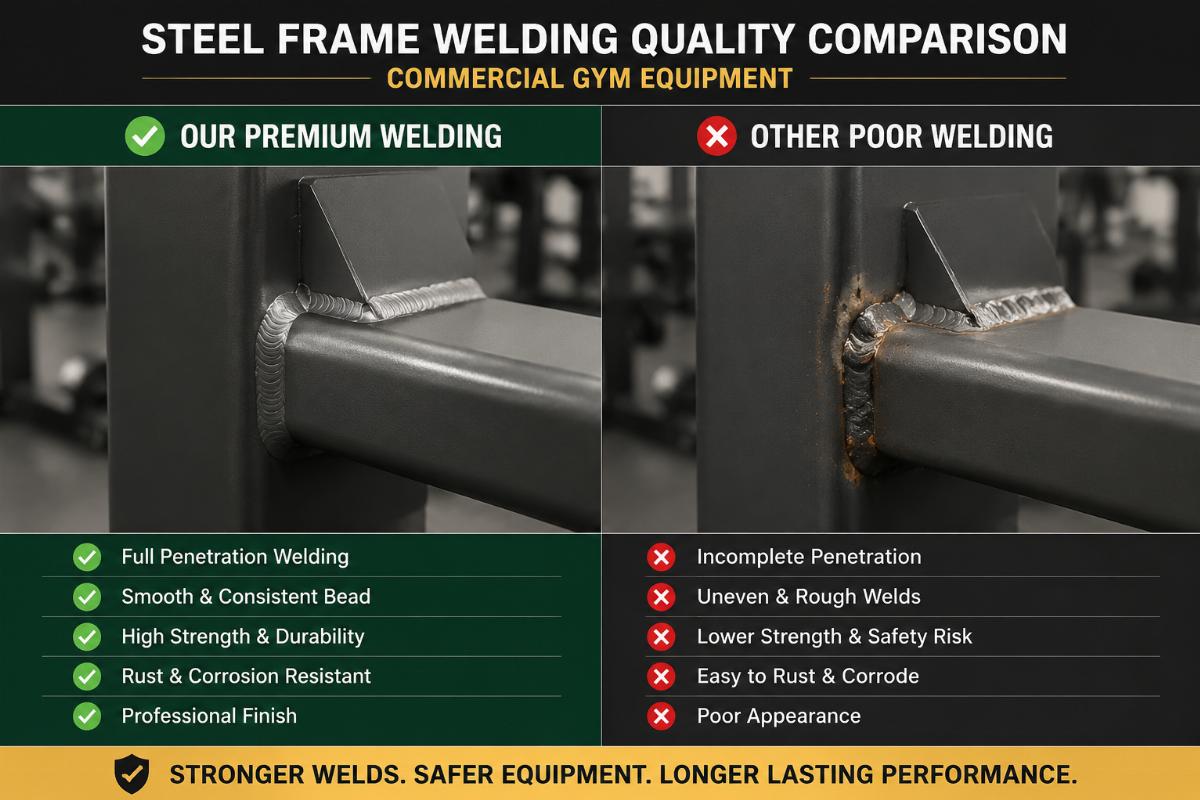
Price comparison without construction verification is just a guessing game. A fitness equipment supplier for Egypt that welcomes third-party inspection and shares weld, cable, and bearing test data transparently earns the buyer’s confidence far more effectively than any discount claim.
How to Build a Turnkey Gym Package with Container Consolidation?
A well-planned turnkey gym package combining cardio, strength, and free-weight equipment can fill a single container to cover the core equipment needs of a mid-size commercial facility, provided the品类 mix is calculated by usable floor area rather than by piece count.
Container consolidation is where many first-time importers miscalculate. They fill the container with as many pieces as physically fit, only to discover that the mix is heavily skewed toward one category—too many plate-loaded machines and not enough free-weight infrastructure, or too much cardio and no functional training zone. A fitness equipment supplier for Egypt that approaches container loading as a space-planning exercise rather than a volume-packing exercise delivers a gym that opens faster and operates more efficiently from day one. [NEED_CITE: commercial gym space planning ratios for cardio, strength, and free-weight zones]
The process works in three stages. First, the buyer provides the total usable floor area and the intended member capacity. Second, the fitness equipment supplier for Egypt maps the equipment categories to zone ratios—cardio typically occupies a defined percentage of the footprint, selectorized and plate-loaded strength another, free weight and functional training the remainder. Third, the loading plan is built backward from the zone plan: each piece of equipment is assigned a stowage position in the container based on its footprint, stackability, and fragility, ensuring that the heaviest items anchor the floor and the lighter items fill vertical gaps.
| Gym Zone | Typical Equipment Types | Container Loading Priority |
|---|---|---|
| Cardio | Treadmills, ellipticals, exercise bikes | High—bulky, limited stackability |
| Selectorized Strength | Cable crossovers, lat pulldowns, leg press | Medium—moderate stackability |
| Plate-Loaded Strength | Smith machines, hack squats, chest press | Medium—heavy, partial disassembly |
| Free Weight | Racks, benches, dumbbells, barbells, plates | High—dense, excellent stackability |
| Functional Training | Functional trainers, battle ropes, plyo boxes | Low—compact, fills gaps |
A fitness chain owner in the Middle East was outfitting a new branch and needed a complete cardio-plus-strength-plus-free-weight package within a single container budget. The fitness equipment supplier for Egypt worked backward from the floor plan, prioritized the free-weight zone for dense loading, partially disassembled the plate-loaded frames to reduce their container footprint, and nested the dumbbells and plates inside the rack uprights. The result was a full-order equipment package that covered the entire gym floor without requiring a second container or a less-than-container-load supplement. [NEED_CITE: container loading optimization methods for mixed commercial fitness equipment]

A turnkey gym package only works if the fitness equipment supplier for Egypt treats container consolidation as a design discipline, not an afterthought. The buyer should expect a loading diagram before production begins, not a surprise at the warehouse door.
What OEM/ODM Verification Steps Prevent Bulk Order Failures?
A signed pre-production sample, a parameter-by-parameter photo archive, and an independent third-party inspection form a three-step verification chain that prevents bulk-order failures—skipping any one of the three leaves the buyer exposed.
OEM branding is a standard request from distributors importing fitness equipment into Egypt. The distributor wants their logo on the frame, their color scheme on the upholstery, and their language on the nameplate. What the distributor often does not anticipate is how many small details can drift between the sample they approved and the mass-production units that arrive months later. A fitness equipment supplier for Egypt that institutionalizes a formal verification chain protects both parties from the kind of disputes that destroy long-term supply relationships. [NEED_CITE: OEM quality verification protocols for commercial fitness equipment export]
The first step is the pre-production sample. This is not a catalog photo or a render—it is a physical unit built on the same production line, with the same materials, that will be used for mass production. The buyer must test the sample with their own accessories, verify every dimension, and sign off in writing. The second step is the photo archive. Every critical parameter—weight-stack bore diameter measured with calipers, voltage rating engraved on the nameplate, upholstery color under standardized lighting, weld seam quality on every frame joint—must be photographed and timestamped. These photos become the reference baseline against which the mass-production units are judged. The third step is the third-party inspection. An independent inspector visits the factory during production, pulls random units from the line, and verifies them against the signed sample and the photo archive. [NEED_CITE: pre-production sample approval and third-party inspection standards for fitness equipment OEM]
| Verification Step | What It Covers | Who Performs It | Deliverable |
|---|---|---|---|
| Pre-production sample | Full unit build, all parameters | Factory, reviewed by buyer | Signed approval document |
| Photo archive | Every critical parameter, timestamped | Factory quality team | Digital archive shared with buyer |
| Third-party inspection | Random unit sampling against baseline | Independent inspection agency | Formal inspection report |
A distributor in North Africa had previously worked with a factory that skipped the third-party inspection step. The first few containers arrived without issue. Then a production-line shift change introduced a subtle change in the powder-coating process, and the frames began showing surface rust within months of installation in a humid coastal gym. The distributor had no photo baseline to prove the coating specification had changed, and the factory disputed the claim. The fitness equipment supplier for Egypt that now serves that distributor insists on all three verification steps for every OEM order, regardless of order size. The cost of the third-party inspection is a small fraction of the cost of a reputation-damaging quality failure. [NEED_CITE: powder coating quality standards for commercial fitness equipment in humid environments]

OEM verification is not bureaucracy—it is insurance. A fitness equipment supplier for Egypt that treats the three-step chain as non-negotiable demonstrates that it respects the buyer’s brand reputation as much as its own factory output.
Conclusion
Spec alignment before shipping, construction verification beyond price, space-driven container planning, and formal OEM inspection chains are the four pillars that separate a successful Egypt fitness equipment import from an expensive lesson.
A fitness equipment supplier for Egypt that masters these four disciplines delivers more than machines—it delivers a gym that opens on schedule, clears customs without demurrage, and performs reliably under heavy daily use. The price advantage of factory-direct sourcing is real, but it only becomes a genuine competitive advantage for the buyer when every detail from bore diameter to nameplate language has been locked down before the first crate is sealed.


