
Commercial Gym Equipment Supplier Peru | Factory Direct 2026 Buyer Guide
The FOB price tag on a commercial treadmill means almost nothing until you calculate what it actually costs to plug it in and run it in Lima.
The real landing cost of gym equipment in Peru is shaped by four factors working together: the factory FOB price, ocean freight to Callao port, import duties stacked with IGV value-added tax, and voltage adaptation for local electrical grids. Buyers who only compare supplier quotations end up underbudgeting by a significant margin, while those who model the full chain can negotiate smarter and avoid costly field surprises.
I still think about a container of cardio machines we shipped to a hotel project near Arequipa a few years back. The purchase order looked clean, the FOB pricing was locked, and everyone assumed the electrical specs were standard. When the containers opened on site, the facility manager discovered the building ran on a three-phase industrial supply that didn’t match the single-phase configuration we’d defaulted to. The machines worked, but the motor stress was noticeable within weeks. We ended up flying a technician out, swapping drive boards across the entire batch, and absorbing a mid-five-figure hit. That job taught me to treat electrical compatibility as a line item in the quotation, not an afterthought. When you evaluate a gym equipment price in Peru quote, the electrical question has to come up before the proforma invoice is signed [NEED_CITE: Peru residential and commercial voltage standards per IEC and local grid codes].

Once you accept that the sticker price is only the starting point, the rest of this guide breaks down each cost layer so you can build a realistic budget and compare suppliers on equal footing.
How Much Does Commercial Gym Equipment Cost in Peru by Category?
Pricing varies sharply across cardio, plate-loaded strength, and free weight categories, and the gap between entry-level commercial and premium commercial tiers is wider than most first-time importers expect.
When I put together comparison matrices for buyers, I separate the equipment into three functional groups because each group behaves differently in terms of per-unit cost, floor space efficiency, and container loading density. A full commercial gym package typically blends all three, and the ratio you choose drives the overall gym equipment price in Peru more than any single machine choice.
| Category | Typical FOB Tier | Space per Unit | Container Loading Density | Per-Unit Cost Position |
|---|---|---|---|---|
| Commercial Cardio (treadmills, ellipticals) | Mid to High | High footprint | Low density, bulky framing | Highest per-unit cost |
| Selectorized & Plate-Loaded Strength | Mid | Moderate footprint | Moderate density, stackable components | Moderate per-unit cost |
| Free Weights & Functional Gear | Low to Mid | Compact | High density, heavy mass loading | Lowest per-unit cost |
A commercial gym owner in Lima once asked me why his strength zone budget was nearly double what a distributor had quoted him for free weights alone. The answer is simple: a single commercial cable crossover occupies meaningful floor space, ships partially assembled to protect the guide rods, and carries a mid-range FOB cost that reflects its welded frame complexity. Compare that to a set of rubber-coated dumbbells, which stack tightly, ship at near-maximum container weight, and carry a low per-piece cost. The gym equipment price in Peru for a complete facility is therefore a blended average, not a single number [NEED_CITE: typical commercial gym equipment category cost distribution across global sourcing markets].
For hotel fitness centers, the calculation shifts again. Space is premium, so compact dual-function cardio units and compact selectorized stacks outperform bulky plate-loaded machines on a revenue-per-square-meter basis. I’ve seen hotel projects in Trujillo where the developer chose a reduced cardio count but upgraded each treadmill to a commercial-grade AC motor model, because guest satisfaction scores correlate directly with machine reliability. The per-unit price rose, but the total project cost stayed within budget because fewer machines were needed.

The practical takeaway: request a category-level breakdown from any gym equipment price in Peru quotation, not just a grand total. That breakdown reveals where the supplier is padding margins and where real value sits.
What Import Duties and Taxes Apply to Fitness Equipment in Peru?
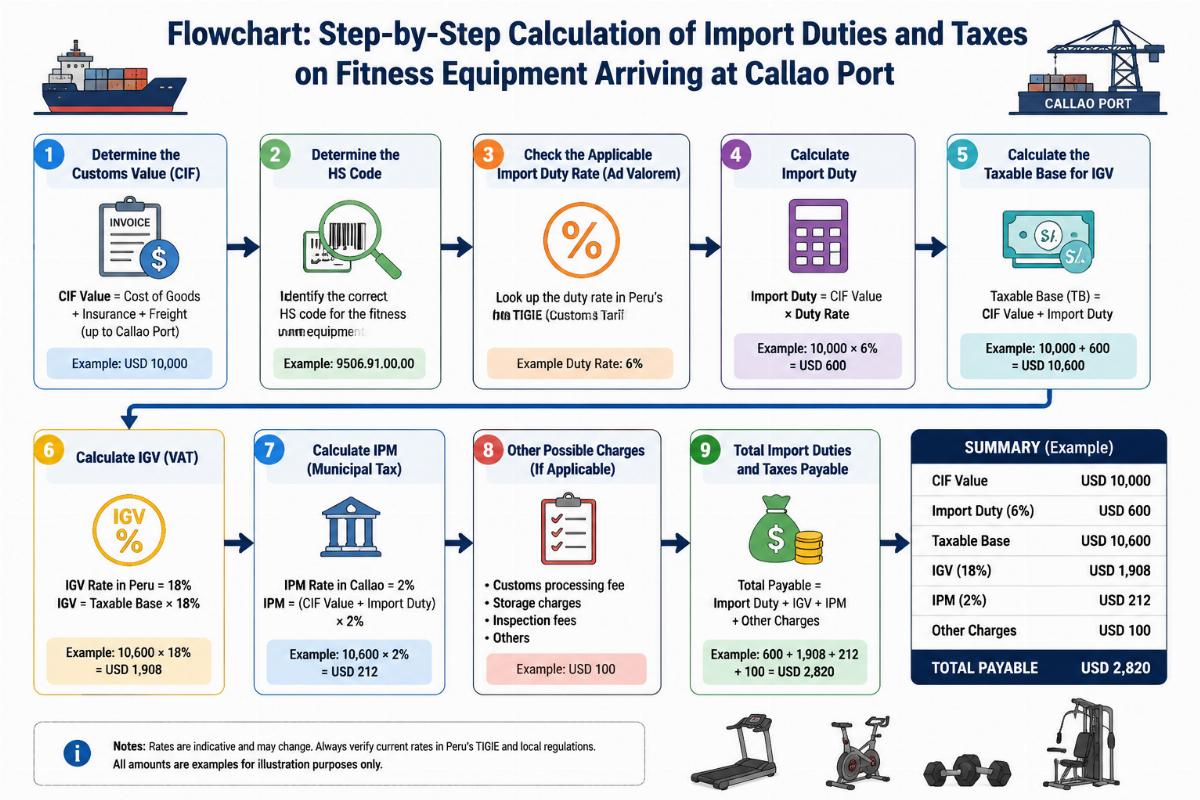
Peru’s import tax structure stacks a customs duty on top of an IGV value-added tax, and the combined burden routinely adds a substantial percentage to the CIF value before a single dumbbell reaches the gym floor.
This is the single most misunderstood part of the gym equipment price in Peru for overseas buyers. Many assume the duty is a flat small percentage and move on. In reality, the calculation compounds. The customs duty applies to the CIF value (cost, insurance, freight), and then the IGV applies to the CIF value plus the duty amount. The result is an effective tax rate noticeably higher than the nominal duty rate alone [NEED_CITE: Peru import tariff schedule for fitness and gym equipment under SUNAT classification].
| Tax Component | Applied To | Nature |
|---|---|---|
| Ad Valorem Customs Duty | CIF value | Variable by HS code |
| IGV (Impuesto General a las Ventas) | CIF value + duty | Standard VAT rate |
| Municipal Promotion Tax | IGV amount | Small supplementary percentage |
| Customs brokerage & documentation | Per shipment | Fixed service fees |
I worked with a distributor in Lima who was evaluating a new supplier for a full container of plate-loaded machines. The first quotation he received looked attractive on FOB terms. But when we ran the full landed cost model, the duty and IGV stack pushed the per-unit landing price into a range where his retail margin disappeared. He switched to a supplier offering a more competitive FOB price with transparent HS code classification, and the landed cost dropped enough to restore his target margin. The machines were functionally equivalent; the difference was purely in how the tax chain was modeled [NEED_CITE: Peru SUNAT customs valuation methodology for imported goods].
One detail that catches buyers off guard: the HS code classification matters enormously. Fitness equipment can fall under slightly different headings depending on whether it’s classified as a general gym machine, a specific rehabilitation device, or a children’s playground item. A misclassification can shift the duty rate by a meaningful margin. Always confirm the HS code your supplier is using and cross-check it against the current Peruvian tariff schedule before committing to a purchase order.
Another point: if you’re importing under a DDP (Delivered Duty Paid) arrangement, the supplier bundles the tax into their price. This simplifies your cash flow but usually costs more than handling customs yourself through a local broker. For first-time importers, CIF plus local broker clearance is typically the most transparent and cost-controlled approach.
How Do Voltage and Electrical Standards Affect Equipment Pricing?
Commercial treadmills and ellipticals shipped to Peru must match the local three-phase industrial supply or the single-phase commercial supply, and the wrong configuration turns a routine installation into an expensive retrofit.
This is where my Arequipa hotel story from the opening becomes relevant. Peru’s electrical grid supplies a mix of voltages depending on the connection type and location. Residential and small commercial outlets commonly run at single-phase 220V, while larger commercial and industrial connections use three-phase 380V. Most heavy-duty commercial cardio equipment, particularly treadmills with AC induction motors above a certain power threshold, is designed for three-phase input to deliver consistent belt speed under load [NEED_CITE: IEC standard voltage classifications for commercial electrical equipment and regional grid variations in South America].
| Electrical Configuration | Typical Application | Motor Drive Requirement | Customization Impact on Price |
|---|---|---|---|
| Single-phase 220V | Small studios, boutique gyms | Requires phase converter or VFD | Noticeable cost addition |
| Three-phase 220V | Some older commercial installations | Standard VFD compatible | Minimal adjustment |
| Three-phase 380V | Modern commercial buildings, hotels | Standard industrial VFD | Baseline configuration for heavy equipment |
When a buyer requests a quotation, the voltage question should be answered before the motor spec is finalized. A treadmill configured for three-phase 380V at the factory ships with a matched drive board and motor winding. If that same machine arrives at a site with only single-phase 220V available, the options are installing a rotary phase converter (bulky, maintenance-prone), adding a static VFD (adds cost and requires electrical panel space), or swapping the motor and drive board entirely (the most expensive path).
I’ve seen buyers try to save a small amount on the unit price by accepting a "universal voltage" claim from a supplier. In practice, universal voltage on heavy commercial cardio is a marketing phrase, not an engineering reality. The motor windings, drive board capacitors, and cooling fans are all spec’d for a particular input. Asking the supplier to confirm the exact voltage configuration in writing, tied to the serial number range of your order, eliminates nearly all field risk.
For buyers sourcing from a gym equipment price in Peru quotation, the electrical adaptation cost should appear as a separate line item, not buried in the unit price. That transparency lets you compare whether the factory customization charge is reasonable versus sourcing a local phase converter. In most cases, factory-configured voltage matching is both cheaper and more reliable than field retrofitting.

What’s the Most Cost-Effective Shipping Method to Peru?
The choice between full container load and less-than-container load hinges on order volume, and the cost crossover point is lower than most buyers assume.
Ocean freight to Callao port is the dominant shipping route for gym equipment entering Peru. Transit times from major Chinese ports are measured in weeks, and the freight rate differential between a full twenty-foot container and a shared less-than-container load slot is significant on a per-cubic-meter basis. However, the decision isn’t purely about freight rate per unit of volume. It’s about total project timing, inventory risk, and product mix flexibility [NEED_CITE: typical ocean freight transit times and container shipping rate structures from East Asia to South American west coast ports].
| Shipping Method | Best Suited For | Cost per Unit Position | Lead Time Flexibility |
|---|---|---|---|
| Full Container Load (FCL) | Established gyms, distributors with warehouse space | Lowest per-unit freight | Requires full order commitment upfront |
| Less-than-Container Load (LCL) | First orders, boutique studios, hotel pilot projects | Higher per-unit freight | Allows mixed small-batch orders |
| Breakbulk / Open Top | Oversized single items (e.g., large functional rigs) | Highest per-unit freight | Specialized handling required |
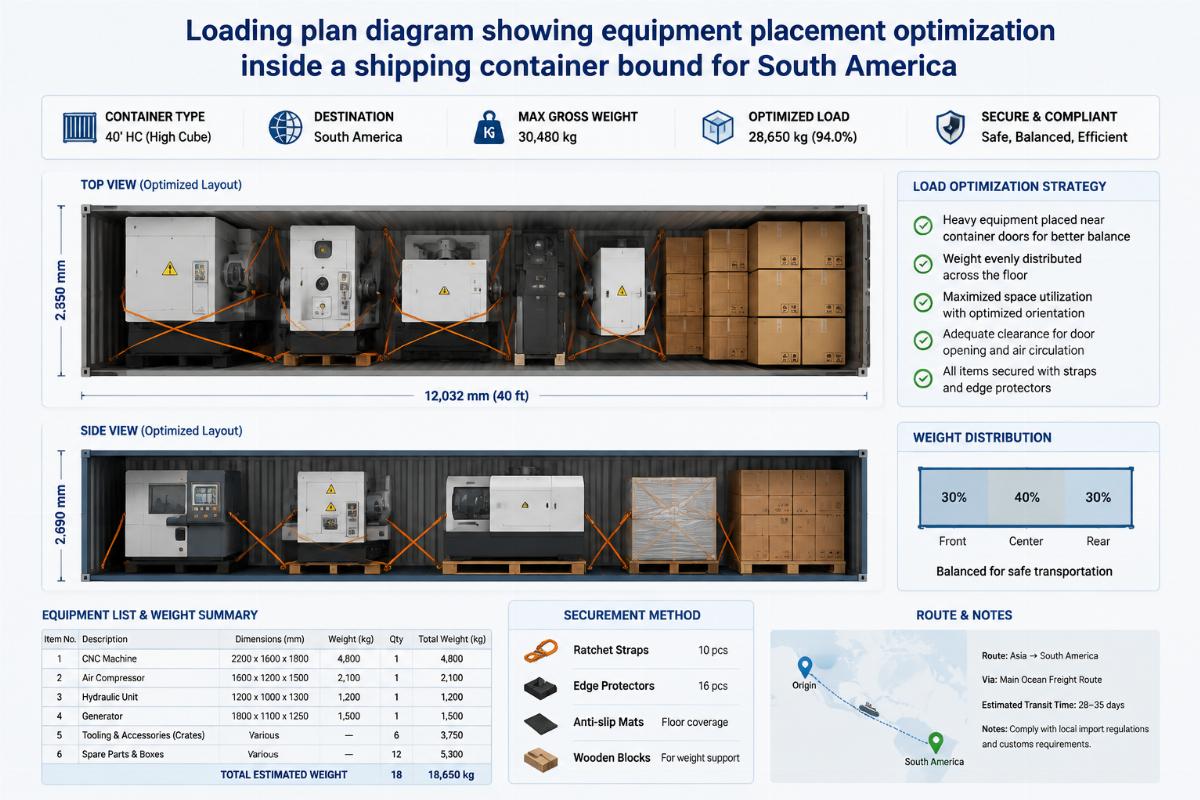
A distributor I worked with in Lima initially planned to order a full forty-foot high-cube container of mixed cardio and strength equipment. When we reviewed the floor plans of his end customers, it became clear that several boutique studio clients only needed a handful of units each. Consolidating everything into one container meant he’d have excess inventory sitting in a warehouse, tying up capital and exposing rubber-coated free weights to humidity damage over time. We restructured the order: a full container for his largest gym client, and an LCL shipment combining the smaller studio orders. The per-unit freight on the LCL was higher, but his total working capital requirement dropped noticeably, and the risk of inventory obsolescence was reduced.
For buyers evaluating the gym equipment price in Peru, the shipping method choice directly affects the per-unit landed cost. A full container of treadmills, which are volumetrically heavy but not weight-heavy, loads efficiently and drives the per-unit freight down. A container packed primarily with iron plates and dumbbells hits the weight limit long before it fills the volume, meaning you pay for weight, not space. Understanding the weight-to-volume ratio of your product mix helps you choose the right container size and avoid paying for unused cubic capacity.
Port congestion at Callao can occasionally extend clearance times, so building a buffer into your project timeline is prudent. I recommend confirming the current port status with your freight forwarder before finalizing shipment dates, especially during peak seasons.
Conclusion
The true gym equipment price in Peru is a composite figure built from factory cost, freight, tax, and electrical adaptation, and treating any single component in isolation leads to budget shortfalls.
Buyers who model all four layers before signing a purchase order consistently land projects within budget, while those who focus only on the FOB quotation discover the gaps only after the container arrives at Callao. Request category-level pricing breakdowns, confirm HS code classifications, lock in voltage specifications in writing, and choose your shipping method based on actual order volume rather than assumed container economics.


