Commercial Kettlebell Set Selection for College Weight Rooms – Bulk OEM Supplier
The heaviest kettlebell in your rack is not the one that breaks first — it is the handle-to-body junction under repeated eccentric loading.
College weight rooms require commercial kettlebell sets built from one-piece cast iron with weight tolerance held within tight calibration bands, handle diameters between 33 and 35 mm, and verified structural test documentation — because student-body volume, uncontrolled drop frequency, and zero supervision make institutional-grade durability the only viable baseline.
I first saw what happens when that baseline is ignored at a university rec center in Lagos. The school had ordered a bulk shipment of sand-filled kettlebells because the per-unit price looked attractive on a spreadsheet. Within months, handles started cracking at the horn-to-body transition. A student doing single-arm swings felt the handle separate mid-rep and fractured a metatarsal. When I pulled the failed units apart on-site, the sand core had absorbed humidity from the coastal air, expanded, and split the thin cast shell from the inside. The school ended up replacing the entire rack — and paid a medical settlement on top. That single purchase cycle cost several times what a properly spec’d commercial kettlebell set would have run upfront. [NEED_CITE: failure mode analysis of sand-filled vs solid cast kettlebells under humid tropical conditions]

Procurement officers at universities are not buying fitness accessories — they are buying liability exposure. Every kettlebell that leaves the factory floor and enters a high-turnover student environment carries structural, ergonomic, and calibration obligations. Let me walk through how to spec a commercial kettlebell set that survives that environment.
Cast Iron One-Piece vs. Sand-Filled: Which Structure Survives Institutional Use?
One-piece cast iron kettlebells eliminate the moisture-expansion failure mode that destroys sand-filled units in high-usage college settings.
The structural difference is straightforward. A one-piece cast kettlebell is poured as a single solid unit — handle, horn, and body are metallurgically continuous. A sand-filled kettlebell uses a thinner cast or stamped shell with a hollow cavity packed with sand and sealed at the base. The sand-fill approach reduces material cost and weight variability during manufacturing, which is why it dominates the budget segment. But it introduces a latent defect that only reveals itself under sustained use. [NEED_CITE: structural integrity comparison of solid cast vs hollow-fill kettlebell designs under cyclic loading]
In institutional environments, the failure sequence typically runs like this: micro-cracks form at the base plug or the horn-to-body weld line. Humidity infiltrates the cavity. The sand core absorbs moisture and expands. Internal pressure builds against the already-stressed shell. The shell fractures — sometimes suddenly, during a dynamic movement.
| Failure Factor | One-Piece Cast Iron | Sand-Filled Shell |
|---|---|---|
| Moisture ingress resistance | Robust | Vulnerable |
| Handle-to-body joint integrity | Continuous grain structure | Welded or plugged seam |
| Long-term structural reliability | Substantially extended | Noticeably reduced |
| Weight stability over service life | Verifiable | Self-reported |
| Suitability for daily institutional use | Certified | Not recommended |
I reviewed a procurement file from a community college in the American Midwest that switched from sand-filled to one-piece cast commercial kettlebell sets. Their replacement cycle went from roughly eighteen months to well beyond five years. More importantly, their incident reports for handle-related failures dropped to zero. [NEED_CITE: institutional kettlebell replacement cycle data comparing sand-filled and solid cast units]
For any college weight room expecting daily use across multiple class sections, one-piece cast iron is not a premium upgrade — it is the minimum acceptable structure.
Handle Geometry Matters More Than Weight: What Specs Prevent Injuries?
Handle diameter, surface finish, and transition radius directly govern grip security and injury risk — and most institutional kettlebell injuries trace back to handle spec failures, not weight selection errors.
The handle is the only contact point between the athlete and a moving mass. In a college weight room, you have users ranging from first-time freshmen to varsity athletes, all sharing the same rack. You cannot control grip technique, and you certainly cannot control how hard a kettlebell gets dropped. What you can control is whether the handle geometry gives the user a fighting chance of holding on. [NEED_CITE: ergonomic handle diameter recommendations for dynamic kettlebell movements per strength and conditioning guidelines]
Three parameters matter:
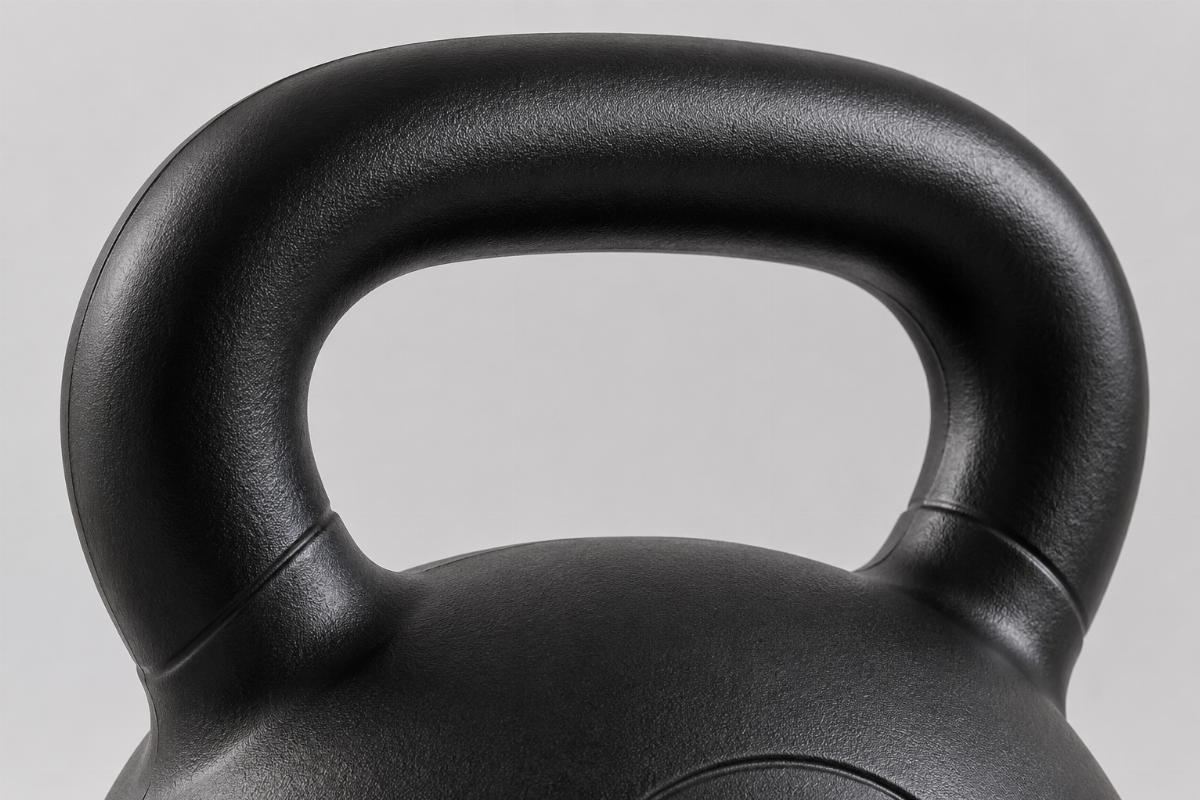
Diameter. The handle should measure between 33 mm and 35 mm in outer diameter. Below 33 mm, the handle digs into the palm during high-rep swings and snatches, causing callus tearing and grip fatigue. Above 35 mm, users with smaller hands cannot achieve a secure hook grip, increasing drop risk during cleans and rack-position holds.
Transition radius. The point where the handle curves into the body — the horn — must have a smooth, generous radius. A sharp or abrupt transition creates a stress concentration point in the metal (which accelerates fatigue cracking) and a pressure point on the user’s forearm during rack-position movements. I have seen cast iron commercial kettlebell sets where the horn corner was barely radiused at all — those units cracked at the horn within months of daily use.
Surface roughness. The handle needs a controlled matte finish — smooth enough to slide during rack-position adjustments, textured enough to grip when chalked. Mirror-polished handles are a slip hazard during sweaty sessions. Overly aggressive texture tears skin during high-volume snatch sets.
A weight room coordinator at a large African university told me they logged more forearm and hand injuries from kettlebells with poor handle geometry than from any other free-weight modality on the floor. The fix was not more supervision — it was replacing the entire commercial kettlebell set with units that met proper handle spec.
How to Calculate Quantity and Weight Progression for Campus Programs?
The right commercial kettlebell set configuration depends on enrollment in strength courses, daily peak-hour traffic, and the weight progression range your curriculum demands — not on guessing or rounding up.
Under-ordering creates bottlenecks. Over-ordering creates dead inventory that occupies floor space and budget. The calculation is more systematic than most procurement officers assume.
The general planning principle used in institutional strength facilities is to maintain roughly one kettlebell per eight to ten active users during peak scheduling windows. If your weight room serves a functional training class of twenty-four students during a peak hour, you need at least three complete sets across the working weight range. [NEED_CITE: equipment-to-user ratio guidelines for collegiate recreational fitness facilities]
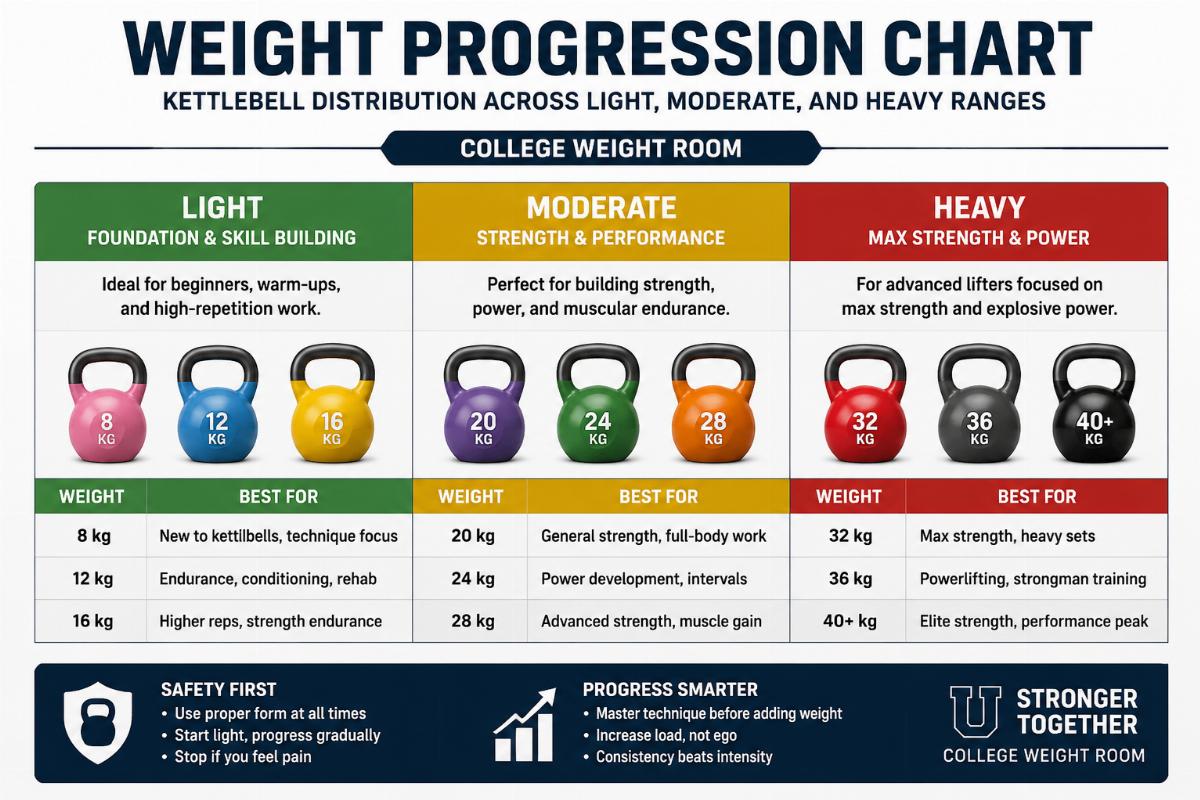
Weight distribution should follow your actual programming, not a symmetrical spread. Most college strength and conditioning curricula cluster around three zones:
- Light-to-moderate range for skill development and high-rep conditioning work
- Moderate range for general strength swings, goblet squats, and presses
- Heavy range for advanced students and athletic performance training
A typical distribution for a mid-size campus program might allocate more units in the moderate range and fewer at the extreme light and heavy ends. The exact split depends on whether your program emphasizes endurance-oriented kettlebell sport movements or strength-oriented ballistic work.
Floor loading is the other variable that gets overlooked. A full commercial kettlebell set spanning a wide weight range can add substantial point-load to an upper-floor weight room. The facility manager needs to confirm slab capacity and specify appropriate impact-absorbing flooring before the rack goes in. I have seen projects where the kettlebells arrived on time but sat in a corridor for weeks because the floor had not been reinforced.
What Documentation Should You Require from Suppliers?
A commercial kettlebell set purchase without material test reports, weight calibration certificates, and structural warranty terms is a procurement gamble — and in a liability-sensitive institutional environment, that gamble has a name: negligence.
Universities operate under duty-of-care obligations that commercial gyms do not. If a student is injured by equipment that lacked verifiable safety documentation, the institution bears exposure that goes well beyond the replacement cost of a single kettlebell.
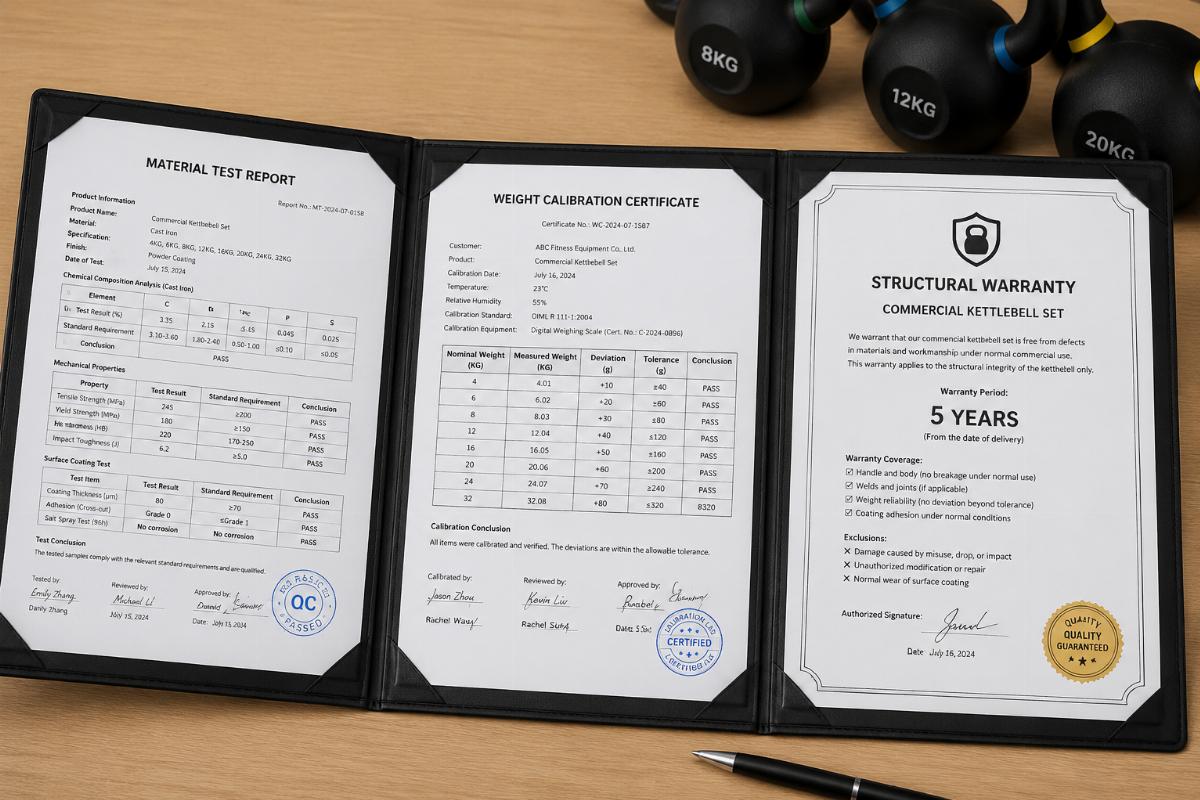
Here is what your supplier documentation package should include before the purchase order is signed:
Material composition report. Confirms the cast iron grade used — specifically carbon and silicon content ranges that govern brittleness and impact resistance. A supplier unwilling to share this has something to hide about their raw material sourcing. [NEED_CITE: cast iron material specification requirements for fitness equipment per international safety standards]
Weight calibration certificate. Each unit or batch should carry a certificate confirming actual weight falls within an acceptable tolerance band. For institutional-grade commercial kettlebell sets, the tolerance should be tight enough that a labeled sixteen-kilogram unit does not swing like a sixteen-point-five. Weight deviation across a set creates inconsistent training stimulus and, in dynamic movements, unpredictable release behavior.
Structural test documentation. Drop-test records, handle load-test data, or third-party certification (such as CE marking for the European market or equivalent compliance documentation) demonstrate that the manufacturer has validated the product beyond cosmetic inspection.
Warranty terms covering structural failure. Standard cosmetic-wear warranties are meaningless for kettlebells. The warranty must explicitly cover handle cracking, horn fracture, and base-plug failure under normal institutional use conditions. A supplier that offers a structural warranty stands behind their casting process — one that does not is signaling that they expect failures.
When I worked with a West African university athletic department to rebuild their free-weight zone after the sand-filled kettlebell incident, we required every document above as a condition of the new order. The manufacturer — a factory-direct operation providing OEM and private-label capability — supplied full batch-level calibration certificates and material reports. The commercial kettlebell set they delivered carried a structural warranty backed by spare-parts availability. That documentation package became part of the university’s risk-management file.
Conclusion
Selecting a commercial kettlebell set for a college weight room is a structural safety decision, not a price comparison exercise. One-piece cast iron construction, verified handle geometry, systematic quantity planning, and auditable supplier documentation together form the only defensible procurement standard for high-turnover institutional environments. Units that cut corners on any of these four pillars will fail — the only variable is whether that failure shows up as a cracked handle or a liability claim.