
Commercial Leg Curl Machine | Factory Direct Wholesale Supplier
Most buyers think thicker steel walls automatically mean a better commercial leg curl machine. The truth is, tube geometry and rib reinforcement matter far more than wall thickness alone for torsional resistance.
When sourcing a commercial leg curl machine, the real differences lie in frame steel yield strength, bearing specifications, weight stack precision, and seat adjustment range. Commercial-grade units use industrial bearings, heavy-duty tubing with strategic reinforcement, and precision-machined weight stacks—while home-grade machines cut corners on these four specs to hit lower price points.
I still remember a container that got held up at Jebel Ali. A Middle East buyer had his inspector reject an entire shipment of leg curl units because the bearings seized during load testing. The root cause was not the steel thickness—it was the bearing specification. We had quoted a standard deep-groove bearing, but the buyer’s spec sheet called for a higher load-rated unit. The滞港 fees alone wiped out a significant chunk of that order’s margin. Since that day, I cross-check every bearing spec against the intended usage environment before confirming a single production run. [NEED_CITE: bearing load rating and L10 life calculation methods per ISO 281]

That single container taught me more about spec verification than any trade show ever could. Let me walk you through what actually separates a reliable commercial leg curl machine from a costly mistake.
Commercial vs. Home Grade: What’s the Real Difference in Leg Curl Machines?
Commercial-grade construction means industrial bearings, reinforced frame geometry, and rigorous quality control—not just bigger dimensions.
The most common mistake importers make is assuming that a heavier machine automatically qualifies as commercial grade. Weight can be inflated with cheap cast iron plates or unnecessary structural bulk. The real distinction lies in component specification and engineering intent.
| Specification | Commercial Grade | Home Grade |
|---|---|---|
| Frame Steel | Heavy-duty with reinforced joints | Standard thickness, minimal reinforcement |
| Bearing Type | Industrial sealed bearings | Basic bushings or low-grade bearings |
| Weight Stack | Precision-machined, guided pins | Cast plates, loose tolerance |
| Seat Adjustment | Multi-position, tool-free | Fixed or limited manual adjustment |
| Cable System | Aircraft-grade, high cycle rating | Standard grade, shorter lifespan |
| Upholstery | Commercial vinyl, high density | Basic vinyl, lower durability |
When a gym in Southeast Asia ordered what they thought was a commercial leg curl machine, they received units with basic bushings instead of sealed bearings. Within months, the pivot points developed play, and the movement became jerky under load. The supplier had technically delivered a "leg curl machine"—just not one built for commercial throughput. [NEED_CITE: commercial fitness equipment durability standards and testing protocols]
A genuine commercial leg curl machine is engineered for continuous daily use across multiple shifts. The frame uses shaped tubing with strategic gussets at stress points, not just thick-walled round tube. Bearings are selected based on calculated load and expected cycle life, not just cost. The weight stack moves smoothly because the guide rods are precision-ground and the plates are machined to tight tolerances.
If you are outfitting a hotel fitness center or a high-traffic commercial gym, these differences translate directly into maintenance costs and member satisfaction. A home-grade unit might save you money upfront, but the downtime and replacement parts will cost far more over its lifespan.
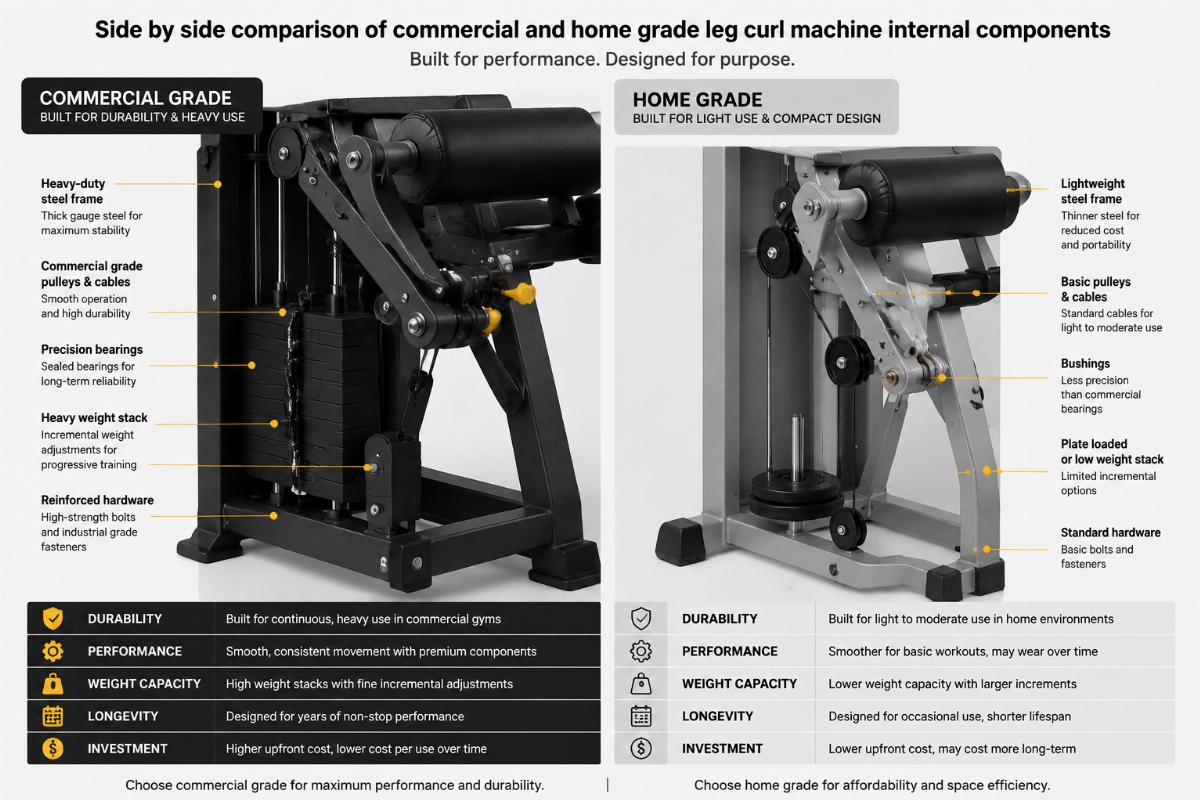
Plate-Loaded vs. Selectorized: Which Leg Curl Machine Fits Your Gym?
Plate-loaded machines offer superior value and simpler maintenance; selectorized units deliver premium user experience ideal for high-end commercial facilities.
This decision shapes your entire procurement strategy. Both configurations have legitimate use cases, and the wrong choice can lead to either overspending or member complaints.
| Factor | Plate-Loaded | Selectorized |
|---|---|---|
| Initial Cost | Noticeably lower | Substantially higher |
| Maintenance Complexity | Minimal | Moderate to high |
| User Experience | Manual plate loading | Quick pin selection |
| Weight Increment | Standard plates | Fixed increments |
| Space Efficiency | Comparable | Comparable |
| Ideal Environment | Budget-conscious gyms, cross-training | Premium clubs, hotel fitness centers |
A fitness chain operator in Latin America faced this exact decision when expanding to multiple locations. For their flagship urban clubs, they specified selectorized commercial leg curl machines to match the premium positioning. For their suburban value-oriented locations, they chose plate-loaded units to keep capital expenditure manageable while still delivering commercial durability. [NEED_CITE: gym equipment selection criteria based on facility positioning and member demographics]
The plate-loaded commercial leg curl machine accepts standard Olympic plates, which gives gym owners flexibility in weight progression and eliminates dependency on proprietary weight stacks. The maintenance is straightforward—essentially just pivot point lubrication and occasional cable inspection. For facilities where staff handles equipment upkeep, this simplicity is a major advantage.
Selectorized units, on the other hand, offer the convenience of pin-selected weight increments. Members can adjust resistance in seconds without handling plates. This matters in high-traffic environments where equipment turnover speed affects member satisfaction. The trade-off is higher initial cost and more complex maintenance when the weight stack or selector mechanism needs service.

5 Critical Specs to Check Before Buying a Leg Curl Machine
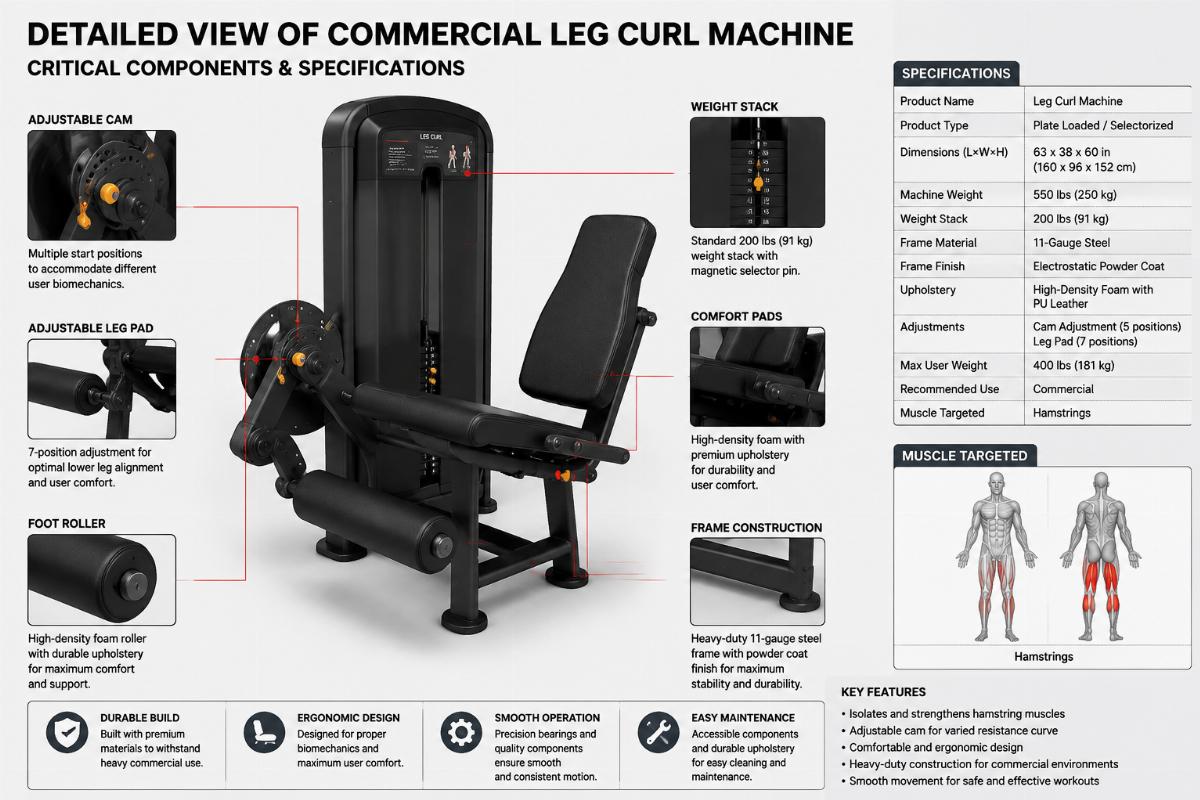
Focus on frame steel thickness, bearing specifications, weight stack precision, seat adjustment range, and cable diameter—these five parameters determine long-term reliability.
I have seen too many buyers get distracted by cosmetic features while missing the specs that actually determine whether a commercial leg curl machine will survive its first year of heavy use. Here is what you need to verify before placing an order.
Frame Steel and Joint Reinforcement
Do not just ask for wall thickness. Ask for the tube shape and whether gussets or internal reinforcements are used at stress points. A D-shaped tube with proper gusseting resists torsional forces far better than a thicker round tube. Request material certificates showing steel grade and yield strength. [NEED_CITE: structural steel grade specifications for fitness equipment frames]
Bearing Specifications
This is where most cost-cutting happens. Sealed deep-groove ball bearings rated for the expected load and cycle life are non-negotiable for commercial use. Ask for the specific bearing model and load rating. If the supplier cannot provide this information, walk away.
Weight Stack Precision
For selectorized units, the weight stack should move smoothly without binding. This requires precision-ground guide rods and plates machined to consistent tolerances. The selector pin should engage cleanly without excessive play. Request a video of the weight stack in operation if you cannot inspect in person.
Seat Adjustment Range
A commercial leg curl machine must accommodate users of different heights. The seat adjustment mechanism should offer multiple positions with secure locking. Tool-free adjustment is strongly preferred for commercial environments where users change between sets.
Cable and Pulley System
Aircraft-grade cables with appropriate diameter for the load rating. Pulleys should be sized to minimize cable wear and provide smooth resistance throughout the range of motion. Check the cable attachment points for reinforcement.
I once reviewed a quotation where the supplier listed "heavy-duty bearings" without any specification. When pressed, they admitted they used the lowest-cost option available. That single component choice would have determined whether those machines lasted two years or ten.
How to Source Leg Curl Machines from China: MOQ, OEM, and Shipping
Flexible MOQ supports single-unit testing through full container orders; OEM customization meets branding requirements; professional consolidation reduces per-unit shipping costs.
Sourcing a commercial leg curl machine from China offers significant cost advantages, but the process requires attention to detail to avoid costly mistakes. The key is finding a manufacturer who understands commercial-grade requirements and can support your specific business model.
MOQ Flexibility
Reputable manufacturers understand that buyers need to test products before committing to large orders. Single-unit samples should be available, though at a premium over bulk pricing. For full container loads, consolidation services allow you to mix different equipment types—combining leg curl machines with other strength equipment, cardio units, or free weights—to optimize shipping costs. [NEED_CITE: fitness equipment container loading optimization and consolidation practices]
OEM and Branding
If you are building a brand or supplying under your own label, OEM capability is essential. This includes custom color schemes, logo placement, packaging design, and documentation in your language. The manufacturer should have experience with international branding requirements and be able to provide reference samples.
Shipping and Logistics
A full container of commercial leg curl machines represents a significant investment. Professional packing, proper container loading plans, and experience with export documentation are critical. The manufacturer should provide detailed loading plans showing how many units fit per container type, along with weight distribution considerations.

When I work with buyers on container orders, we always start with a detailed specification sheet covering every component. This protects both parties and ensures the final product matches expectations. We also provide pre-shipment inspection access so buyers can verify quality before the container is sealed.
Certifications matter for market access. CE marking is required for European markets, and other regions have their own compliance requirements. The manufacturer should be able to provide valid certification documents, not just claim compliance. [NEED_CITE: international fitness equipment safety certification requirements by region]
Conclusion
Commercial-grade leg curl machines are defined by engineering precision, not marketing claims.
The difference between a machine that serves your gym reliably for years and one that becomes a maintenance nightmare lies in bearing specifications, frame geometry, weight stack precision, and component quality. Verify these specs before ordering, choose the configuration that matches your facility’s positioning, and work with a manufacturer who treats commercial-grade as a measurable standard rather than a buzzword.


