
Commercial Treadmill Price in Philippines: 2026 Wholesale Buyer Guide
The real commercial treadmill price in Philippines is never the FOB number you see on a quote — it is the landed cost plus the failure cost over three to five years of operation.
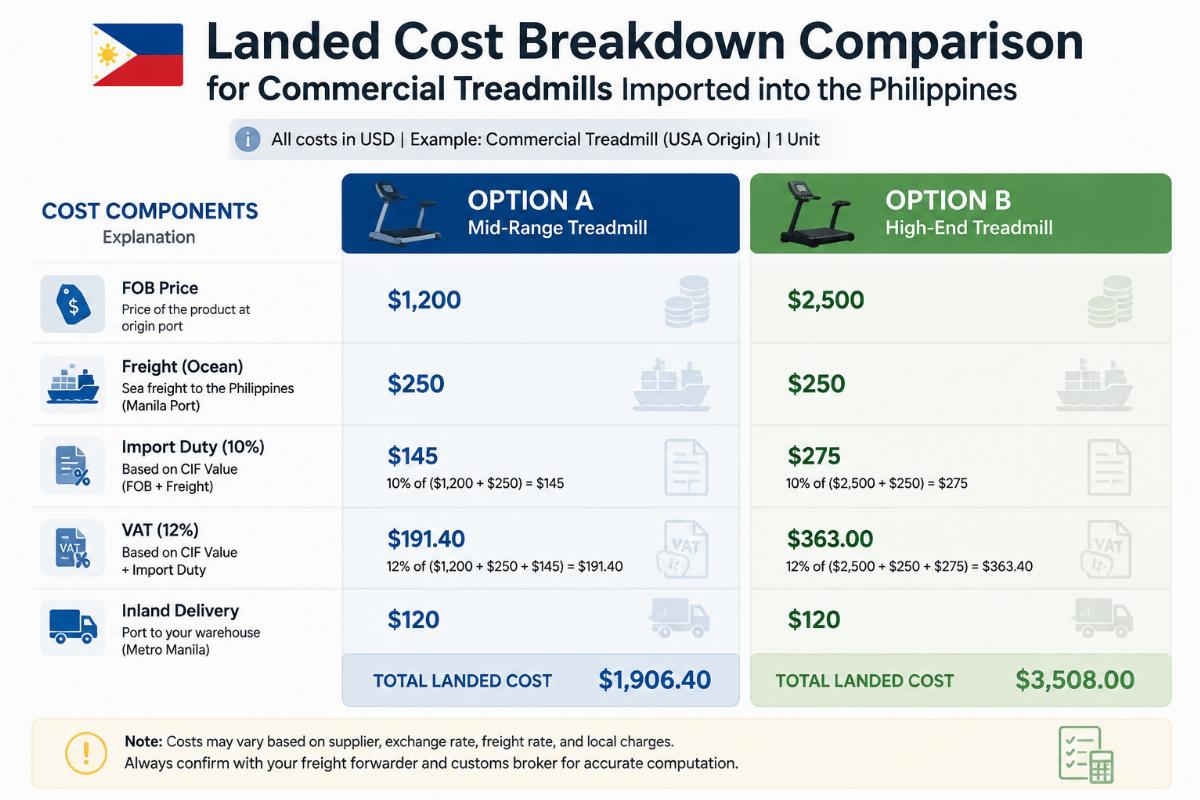
A budget-tier commercial treadmill in the Philippines typically costs between USD 800 and USD 1,500 per unit FOB, mid-range units sit between USD 1,500 and USD 3,000, and premium models run above USD 3,000. Once you add ocean freight, customs duty, VAT, and inland delivery, the landed cost per unit rises by a third to a half above the FOB figure. Buyers who only compare the unit price end up paying multiples of that difference in downtime, air-freighted spare parts, and premature replacements.
I still remember a container that arrived in Manila a few years ago. The buyer had gone with the lowest commercial treadmill price in Philippines they could find from a workshop that skipped load testing and had no CE paperwork on file. Within months, motors started burning out during peak evening hours. The replacement parts had to be air-freighted, and a technician had to fly in to sort out the wiring issues. The total rescue cost ended up eating most of the margin the buyer thought they had locked in. That container taught everyone involved a painful lesson: the cheapest commercial treadmill price in Philippines on paper almost always becomes the most expensive one in practice. [NEED_CITE: Philippines Bureau of Customs tariff classification for fitness equipment under AHTN code 9506.91]
Let me walk you through what actually determines the commercial treadmill price in Philippines in 2026, which specs separate a sound purchase from a costly mistake, and how to verify a supplier quote before you commit.
What Does a Commercial Treadmill Actually Cost in the Philippines in 2026?
The commercial treadmill price in Philippines falls into three clear tiers, and each tier tells you exactly what kind of ownership experience you are signing up for.
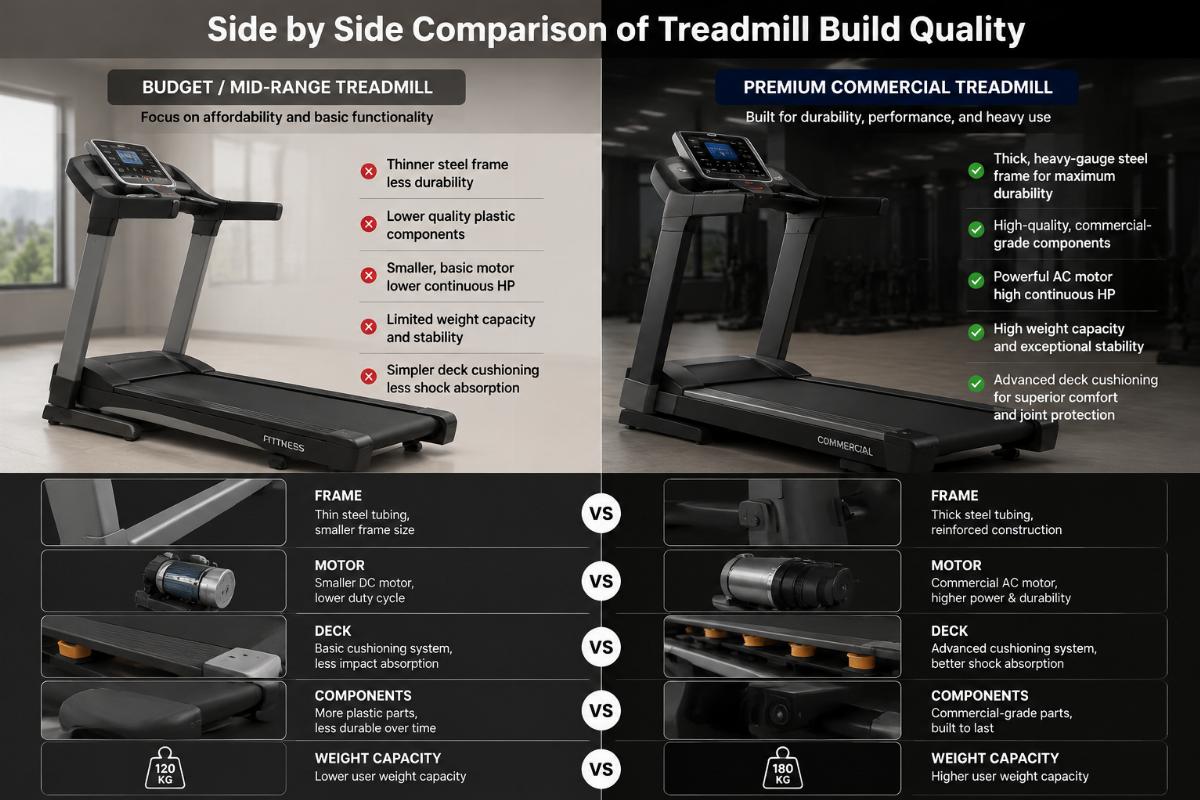
At the budget end, you are looking at machines built with lighter gauge frames, smaller continuous-duty motors, and basic electronics. These units are attractive on a spec sheet because the commercial treadmill price in Philippines looks exceptionally low. However, the frame tends to flex under repeated heavy use, the motor overheats during back-to-back sessions, and the deck wears through quickly. A gym chain in Metro Manila once filled an entire floor with this tier. Within a single year, they were dealing with motor replacements, deck swaps, and electronics failures on a weekly basis. The maintenance team practically lived in the cardio room.
The mid-range tier is where serious buyers usually land. These machines use heavier steel frames, properly rated AC motors with adequate cooling, and decks that hold up under continuous daily operation. A hotel fitness center in Cebu went with this tier and reported virtually zero motor-related shutdowns across multiple years of operation. Their annual maintenance spend stayed well below what they would have paid replacing budget units.
The premium tier includes machines with advanced cushioning systems, larger running surfaces, integrated entertainment options, and comprehensive warranty packages. These are the units you see in international hotel chains and high-end commercial gyms. The commercial treadmill price in Philippines at this level is significantly higher, but the total cost of ownership over a multi-year horizon often works out lower than mid-range because of extended component life and stronger warranty coverage.
| Price Tier | Frame Construction | Motor Type | Deck Durability | Typical Warranty |
|---|---|---|---|---|
| Budget | Light gauge, noticeable flex | Undersized continuous HP | Thin, wears quickly | Limited, parts often unavailable |
| Mid-Range | Heavy gauge, minimal flex | Properly rated AC motor | Commercial-grade thickness | Standard with accessible parts |
| Premium | Reinforced, zero flex | High-torque with enhanced cooling | Extended-life composite | Comprehensive with full parts support |
The key takeaway is that the commercial treadmill price in Philippines must be evaluated as a landed cost, not a factory price. [NEED_CITE: Philippines import duty rate schedule for gym and fitness equipment under Bureau of Customs]
Which Specs Determine Whether the Price Is Worth It?
The specs hidden inside a treadmill quote are what separate a machine that runs for years from one that becomes a money pit within months.
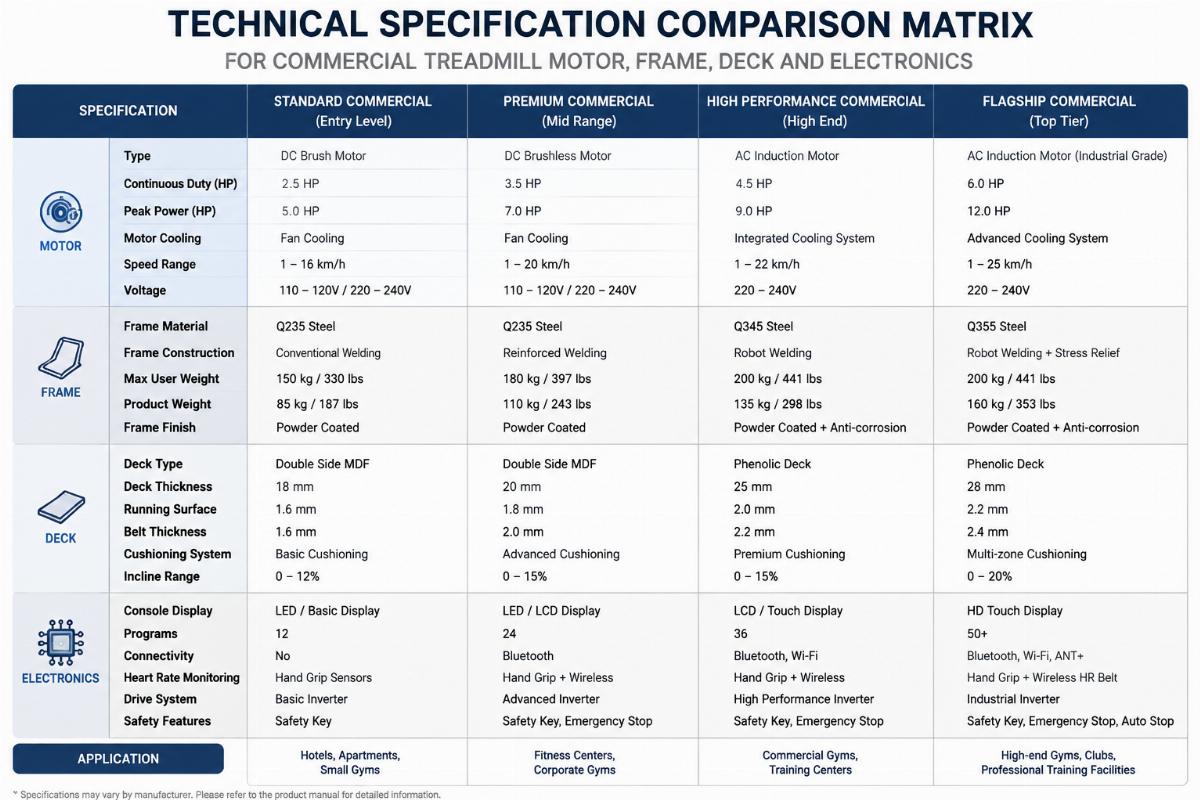
Motor rating is the single most important factor. Many budget suppliers quote peak horsepower, which is the number the motor can hit for a few seconds before overheating. What matters for commercial use is continuous horsepower — the rating the motor can sustain hour after hour without thermal shutdown. A mid-range commercial treadmill will list a continuous HP figure that matches the intended user weight range and daily usage hours. A budget unit will hide behind a peak HP number that looks impressive on paper but collapses under real gym conditions. [NEED_CITE: IEC 60335 safety standard requirements for continuous motor duty cycle in fitness equipment]
Frame weight and steel gauge tell you whether the machine will stay stable under a running user or start vibrating and walking across the floor. Heavier frames with thicker gauge steel absorb impact forces and keep the running platform steady. Lighter frames flex, which accelerates wear on the belt, deck, and motor bearings.
Deck thickness and material composition determine how long the running surface lasts before it needs replacement. A proper commercial deck uses multi-layer laminated board with a phenolic coating that reduces friction and heat buildup. Budget decks are thinner and lack adequate coating, which means they wear through faster and generate more heat that transfers directly to the motor.
Electronics and console quality matter more than most buyers realize. A well-designed control board protects the motor from voltage spikes, manages speed transitions smoothly, and provides accurate diagnostics when something goes wrong. Cheap control boards fail unpredictably, and finding replacement boards for unbranded machines is often impossible.
| Spec Category | Budget Tier | Mid-Range Tier | Premium Tier |
|---|---|---|---|
| Motor Rating | Peak HP only, unverified | Continuous HP, load-tested | Continuous HP with thermal protection |
| Frame Steel | Light gauge, flexes under load | Heavy gauge, stable | Reinforced, zero deflection |
| Deck | Thin, minimal coating | Multi-layer, phenolic coated | Extended-life composite |
| Electronics | Basic, no diagnostics | Protected board, error codes | Advanced diagnostics, remote monitoring |
| Certification | None or self-declared | CE certified, load test report | CE plus additional regional certifications |
A distributor in Davao once compared two quotes side by side. One supplier offered a lower commercial treadmill price in Philippines but could not provide a load test report or CE documentation. The other supplier’s price was slightly higher but came with a full certification package and verified continuous HP ratings. The distributor went with the second option. When a competing gym in the same city bought the cheaper machines, they faced compliance issues and motor failures within months. The distributor’s choice paid for itself many times over. [NEED_CITE: EN 957 international safety standard for stationary training equipment]
What Hidden Costs Do Cheap Treadmills Create After 6 Months?
The hidden costs of a cheap commercial treadmill do not show up on the invoice — they show up in the maintenance log, the downtime report, and the member complaint file.
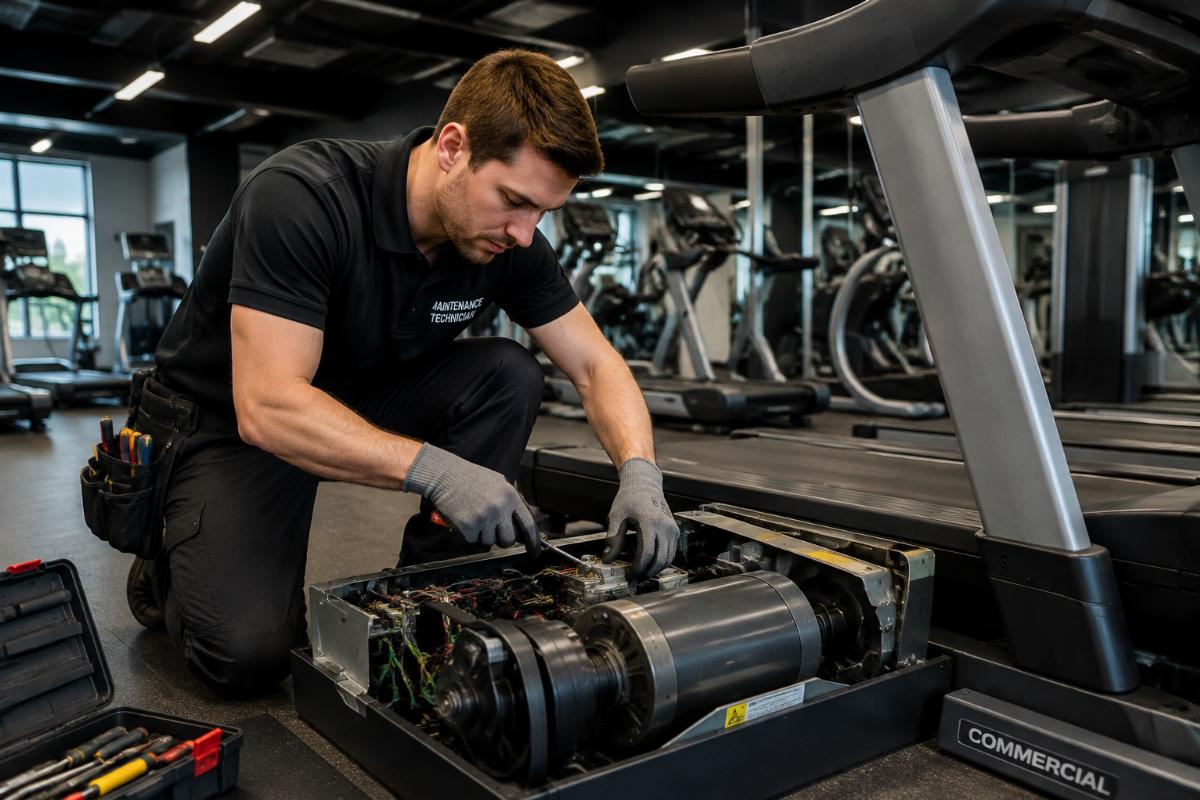
Motor burnout is the most common failure. When a motor is undersized for the expected usage pattern, it runs hot continuously. The insulation on the windings degrades, and eventually the motor shorts out. Replacing a commercial treadmill motor is not just a parts cost — it requires shipping the replacement, pulling the old unit, and paying a technician to install it. If the replacement has to be air-freighted because the gym cannot afford to keep the machine offline, the logistics cost alone can approach a significant fraction of what a new unit would have cost.
Frame flex creates a cascade of secondary problems. When the frame bends under load, the belt alignment shifts. Misaligned belts wear unevenly, which increases friction, which generates more heat, which stresses the motor further. The deck starts wearing on one side faster than the other. Electronics sensors give erratic readings. What started as a frame cost problem becomes a motor problem, a belt problem, a deck problem, and a console problem — all at once.
Parts unavailability is the silent killer of budget treadmills. Many low-cost machines use proprietary control boards, custom motor mounts, or non-standard belt sizes that are not available through any local distributor. When a component fails, the machine becomes a permanent paperweight. I have seen entire rows of treadmills in Southeast Asian gyms sitting idle for months because a single circuit board failed and the original workshop had gone out of business or refused to supply spare parts to a buyer who did not purchase directly from them.
A gym operator in the Visayas region once calculated the total cost of ownership for a batch of budget treadmills versus a mid-range alternative. The upfront price difference was noticeable. But once they added up motor replacements, deck swaps, belt changes, air-freight charges for urgent parts, and the revenue lost from machines being out of service, the budget option had cost substantially more within the first two years. The mid-range machines, by contrast, required only routine belt adjustments and occasional deck rotation.
| Failure Type | Direct Cost | Indirect Cost | Frequency in Budget Units |
|---|---|---|---|
| Motor burnout | Replacement unit plus shipping | Downtime, member complaints | Frequent |
| Frame flex damage | Belt and deck replacement | Cascading component wear | Common |
| Electronics failure | Control board replacement | Machine idle until part arrives | Occasional but catastrophic |
| Parts unavailability | Sourcing alternatives or scrapping | Permanent machine loss | High for unbranded units |
[NEED_CITE: fitness equipment maintenance cost benchmarks for commercial gym operations]
How Do Import Duties and Shipping Change the Final Price?
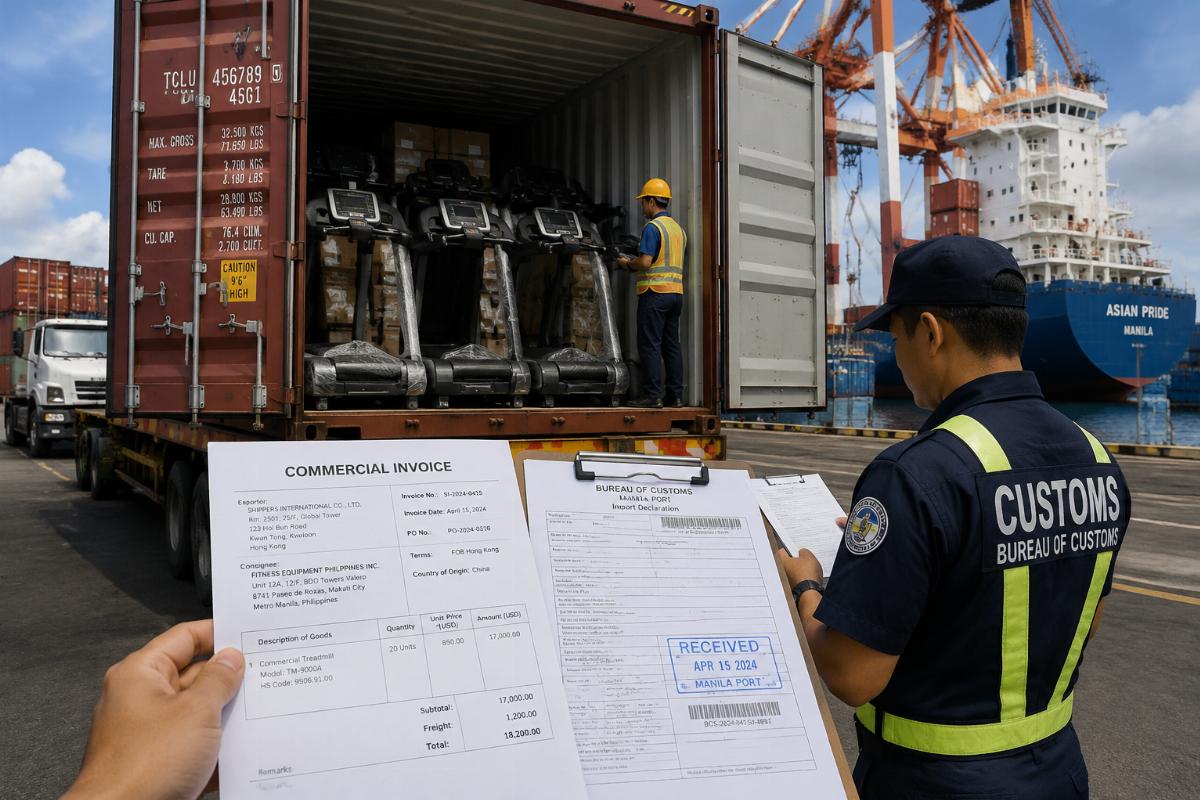
The commercial treadmill price in Philippines that lands in your warehouse is always higher than the number on the supplier’s proforma invoice, and the gap is wider than most first-time importers expect.
Ocean freight for a full container of treadmills from China to Manila varies by season and carrier availability. During peak shipping periods, rates climb noticeably. A single commercial treadmill takes up significant cubic volume, so container utilization matters. A well-planned container load that maximizes unit count per container brings the per-unit freight cost down meaningfully. Buyers who order partial containers or mix treadmills with irregularly shaped strength equipment often pay more per unit in freight than they anticipated.
Philippines customs duty on fitness equipment is applied based on the AHTN classification code. The duty rate, combined with the twelve percent value-added tax, adds a substantial layer to the landed cost. The duty is calculated on the CIF value — cost, insurance, and freight — not just the FOB price. This means the freight cost itself gets taxed. [NEED_CITE: Philippines Bureau of Customs AHTN code 9506.91 duty rate for fitness equipment]
Inland delivery from the port to the final location is another line item that buyers frequently underestimate. Manila port congestion can add days to the clearance process, and trucking rates from the port to a gym outside the metro area are not trivial. If the delivery location is on an island outside Luzon, inter-island shipping adds another layer of cost and complexity.
A distributor who imports full container loads of commercial fitness equipment into the Philippines shared their landed cost structure. The total landed cost per treadmill — including FOB price, ocean freight, customs duty, VAT, port handling fees, and inland delivery — came to roughly a third to a half above the original FOB figure. Any supplier quoting a commercial treadmill price in Philippines without accounting for these layers is either being misleading or does not understand the import process themselves.
| Cost Component | Basis of Calculation | Notes |
|---|---|---|
| FOB Price | Supplier invoice | Base manufacturing and packaging cost |
| Ocean Freight | Per container, varies by season | Maximize container utilization to reduce per-unit cost |
| Insurance | Percentage of CIF value | Typically minimal but mandatory |
| Customs Duty | Percentage of CIF value | Based on AHTN classification |
| VAT | Percentage of CIF plus duty | Applied on top of duty |
| Port Handling | Fixed fees per container | Includes arrastre and wharfage |
| Inland Delivery | Distance and location dependent | Higher for provinces and inter-island |
[NEED_CITE: Philippines customs valuation method based on CIF under the Customs Modernization and Tariff Act]
How to Verify a Supplier’s Price Quote Before You Commit?
A low commercial treadmill price in Philippines means nothing if the machine cannot pass customs, cannot handle daily gym use, and cannot be serviced when something breaks.
Start with certification documentation. A legitimate commercial treadmill for the Philippine market must carry CE certification at minimum. The CE mark should be backed by a test report from a recognized laboratory, not a self-declared certificate printed by the factory. Ask for the test report number and verify it. Suppliers who hesitate or provide vague answers here are hiding something. [NEED_CITE: CE marking requirements under European Directive 2006/42/EC for machinery including fitness equipment]
Request a load test report. A proper manufacturer runs every commercial treadmill model through a sustained load test that simulates real-world usage. The report should show the motor temperature profile, belt slip measurements, and frame deflection data under continuous operation. If a supplier cannot provide this, they are selling you a machine that has never been proven to hold up under commercial conditions.
Check spare parts availability. Ask specifically about motor replacement units, control boards, drive belts, and deck panels. A reliable supplier maintains a spare parts inventory and can ship replacements within a reasonable timeframe. If the supplier tells you parts are "available upon request" without specifying lead times, treat that as a warning sign.
Verify the warranty terms in writing. A meaningful commercial warranty covers the frame for multiple years, the motor for a substantial period, and parts and labor for at least the first year. More importantly, the warranty must be backed by actual service capability — either through the supplier’s own technical team or through a designated local service partner. A warranty that exists only on paper is worthless.
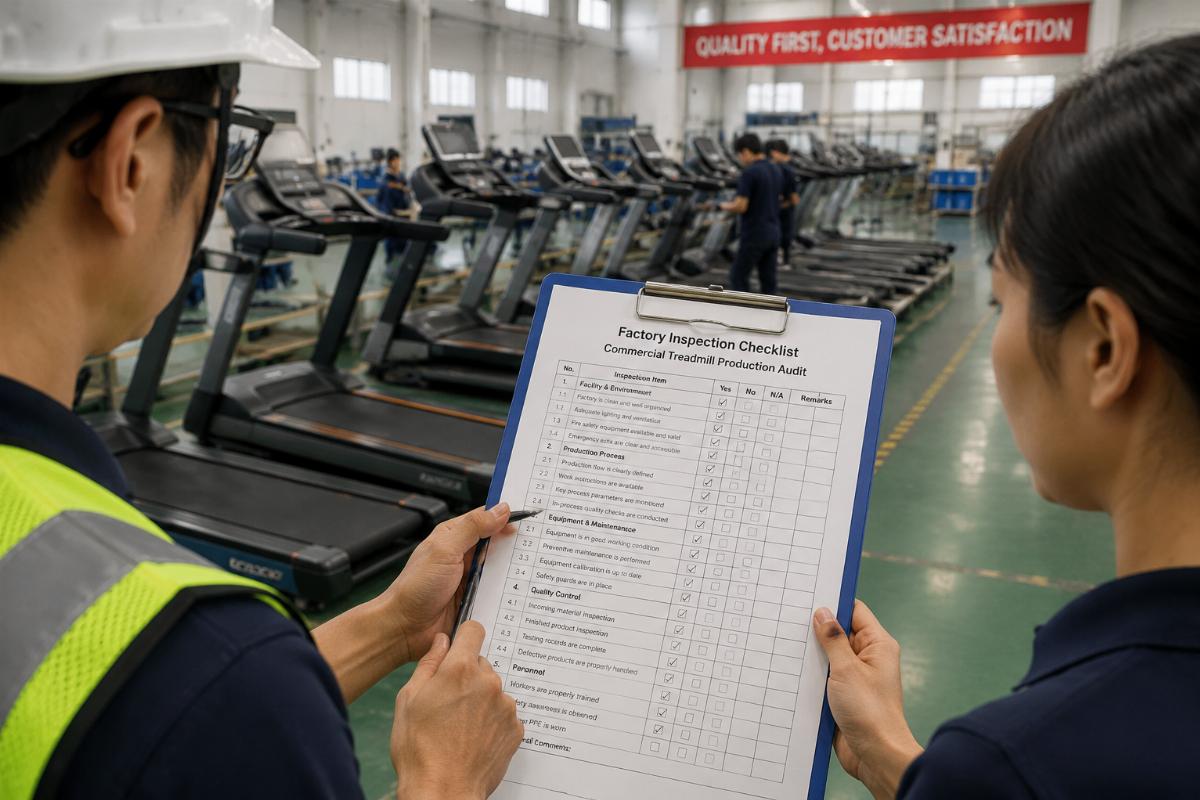
Consider a factory audit. If you are placing a large order, visiting the production facility or hiring a third-party inspection company to audit it is a small investment that prevents major headaches. A real factory will welcome the visit. A trading company posing as a manufacturer will make excuses.
A buyer in the Middle East once shared their verification checklist with me. They required every treadmill supplier to provide CE test reports, load test data, a spare parts catalog with lead times, and a written warranty with clear claim procedures. Suppliers who could not meet all four requirements were eliminated immediately. The buyer told me this process cut their shortlist from dozens of options down to a handful — but every machine they ultimately purchased ran without major issues for years.
| Verification Item | What to Request | Red Flag Response |
|---|---|---|
| CE Certification | Test report from recognized lab | Self-declared certificate only |
| Load Test Report | Motor temperature and frame deflection data | No report available |
| Spare Parts | Catalog with lead times | "Available upon request" with no specifics |
| Warranty | Written terms with service mechanism | Verbal assurance only |
| Factory Audit | On-site visit or third-party report | Excuses or refusal |
[NEED_CITE: third-party inspection standards for fitness equipment manufacturing facilities such as SGS or TÜV audit protocols]
Conclusion
The commercial treadmill price in Philippines is a layered figure that extends far beyond the factory gate, and understanding every layer is what separates a profitable purchase from an expensive lesson.
Buyers who focus only on the FOB number invite motor failures, parts shortages, and compliance headaches that multiply the real cost many times over. Evaluating continuous motor ratings, frame construction, certification documentation, and landed cost structure before placing an order ensures that the price you pay translates into years of reliable operation rather than months of frustrating downtime.


