
Commercial Treadmill Supplier for UK: China Factory Direct OEM
A CE sticker on the motor housing does not mean your shipment clears UK customs.
UK gym operators sourcing from a China-based commercial treadmill supplier can achieve substantial cost reductions versus European-branded equipment, but only when UKCA certification is verified separately from CE, spare parts agreements explicitly cover wear components, and landed cost calculations include port duties and VAT rather than stopping at FOB pricing.
Working the assembly floor in Shandong before moving to export sales, I watched a full container of commercial treadmills sit in a Tilbury bonded warehouse for nearly two months because the motor control boards failed on arrival and the buyer refused to release final payment. The contract referenced CE compliance, but nobody had specified which components fell under warranty versus which were classified as consumables. Flying over with replacement boards and troubleshooting videos eventually closed the case, but the storage fees and air-freight surcharges erased most of the original savings. That order reshaped how every quotation I write now handles certification scope and spare parts scheduling. [NEED_CITE: UK government guidance on UKCA marking post-Brexit transition periods]
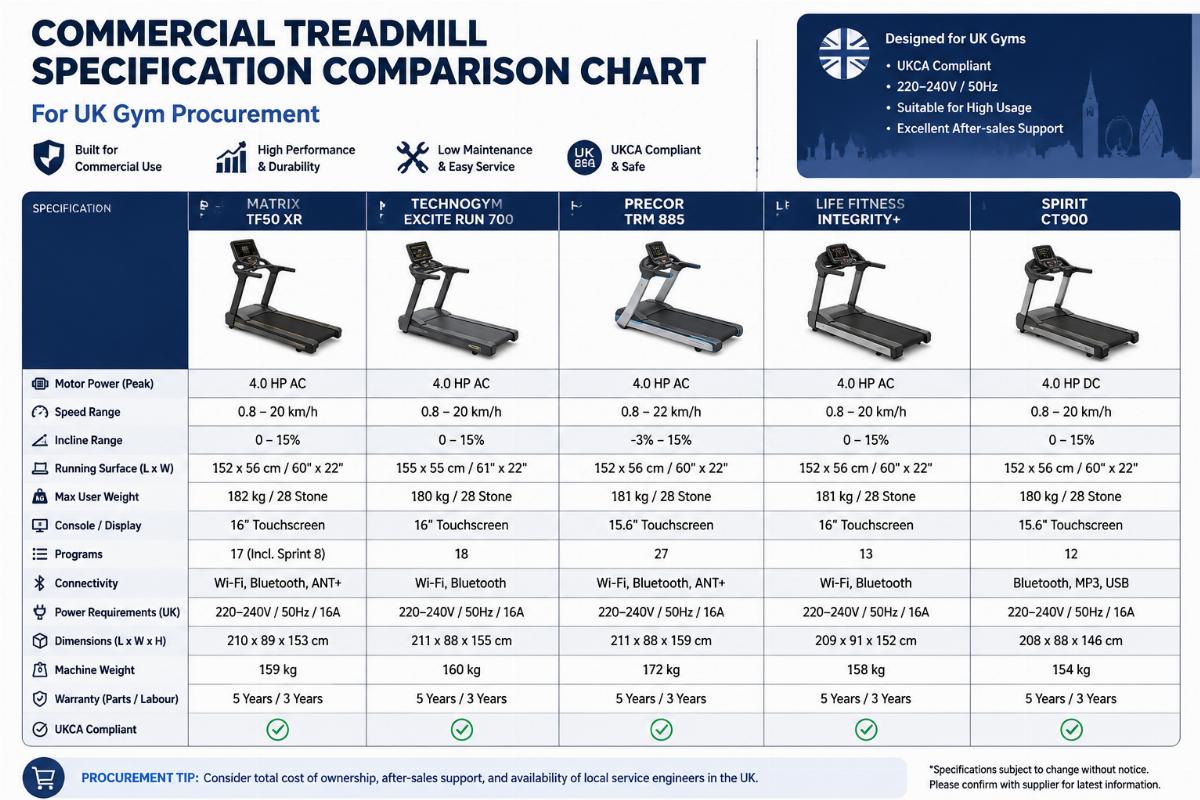
If you are comparing a China-direct commercial treadmill supplier against established European brands, the following sections break down specification thresholds, certification requirements, pricing structures, warranty terms, and logistics options based on real shipment experience to British ports.
What Specs Should UK Gyms Prioritize in Commercial Treadmills?
Running surface dimensions, continuous-duty motor rating, and maximum user weight capacity form the non-negotiable commercial baseline.
High-traffic gym environments place fundamentally different demands on treadmill components than hotel fitness corners or residential use. The table below outlines the specification tiers that separate genuine commercial machines from light-commercial or premium home units often mislabelled for gym use.
| Specification Parameter | Light Commercial / Premium Home | Genuine Commercial Grade |
|---|---|---|
| Running Surface Area | Compact / Standard | Extended length and width for full stride |
| Motor Duty Rating | Peak HP stated | Continuous-duty HP rated under load |
| Maximum User Weight | Moderate threshold | Heavy-duty frame and deck support |
| Deck Thickness | Single-layer or thin laminate | Multi-layer phenolic-coated deck |
| Speed Range | Standard ceiling | Extended upper range for sprint intervals |
| Incline Mechanism | Motorised or manual limited | High-range motorised incline |
| Frame Construction | Bolted light-gauge steel | Welded heavy-gauge commercial frame |
[NEED_CITE: international fitness equipment standards for commercial treadmill structural testing]
A UK-based fitness chain once requested quotes for a rollout across several locations. Their initial specification sheet listed peak motor horsepower rather than continuous-duty ratings. When we ran side-by-side thermal endurance tests, the peak-rated motors showed noticeable temperature escalation during sustained use, while continuous-duty rated units maintained stable operating temperatures across extended sessions. Switching the specification to continuous-duty ratings eliminated the overheating complaints they had experienced with previous equipment.
For any commercial treadmill supplier serving the UK market, the deck construction deserves particular attention. Phenolic-coated multi-layer decks substantially outlast single-layer alternatives in high-usage settings, reducing both replacement frequency and member complaints about belt slippage. The running surface should accommodate users with longer stride lengths without requiring them to adjust their natural gait, which directly affects retention in member-facing environments.

CE vs UKCA: Which Certification Does Your Shipment Actually Need?
Since the Brexit transition period ended, UKCA marking is the legally required conformity assessment for machinery entering Great Britain, and holding only a CE certificate creates genuine customs clearance risk.
Many overseas commercial treadmill supplier operations still assume that CE documentation satisfies British import requirements. This assumption was defensible during the extended transition window, but current enforcement reality means that Border Force officers at major ports can and do flag shipments lacking UKCA documentation for machinery categories. [NEED_CITE: UK legislation on UKCA marking recognition deadlines for machinery regulations]
The practical distinction matters because the technical standards referenced by CE and UKCA may diverge over time as British standards bodies update their own adopted versions of previously harmonised EU norms. A manufacturer holding CE certification under the Machinery Directive must undergo a separate conformity assessment process to obtain UKCA marking under the equivalent UK statutory instrument.
| Certification Aspect | CE Marking Only | UKCA Marking |
|---|---|---|
| Valid for GB Market Access | Time-limited / at risk | Currently recognised |
| Valid for NI Market Access | Recognised under Windsor Framework | Requires UKNI if placed by NI body |
| Technical Standards Basis | EU harmonised standards | UK designated standards |
| Responsible Authority | EU notified bodies | UK approved bodies |
A hotel fit-out project in southern England required compact commercial treadmills with full certification documentation for their insurance underwriter. The procurement team initially accepted a quotation listing CE compliance only. Their legal advisor flagged the UKCA requirement during contract review, and the supplier had to arrange third-party testing through a UK-approved body before the shipment could proceed. The delay added weeks to the project timeline and introduced additional testing costs that had not been budgeted.
When evaluating any commercial treadmill supplier, request explicit written confirmation that UKCA certification covers the complete machine including electrical components, not just the motor or the frame independently. Some manufacturers provide UKCA documentation for structural elements while leaving electronics under CE-only coverage, which creates gaps that trading standards officers can identify during market surveillance checks.

How Does China Factory-Direct Pricing Compare to Branded Equipment?
Factory-direct procurement from a Shandong-based commercial treadmill supplier typically delivers significant unit cost savings versus European and American branded equivalents at equivalent commercial specifications, but the true comparison requires calculating total landed cost rather than FOB price alone.
The headline per-unit price difference between Chinese factory-direct equipment and branded alternatives from established fitness manufacturers is substantial. However, the procurement decision requires layering in freight costs, port handling charges, import duty applicable to fitness equipment under the relevant commodity code, and UK VAT at the standard rate. Only after these components are aggregated does the real cost advantage become clear. [NEED_CITE: UK trade tariff commodity code for gymnasium exercise equipment]
| Cost Component | Branded European / American | China Factory Direct |
|---|---|---|
| Base Unit Price | Premium tier | Substantially lower at equivalent specs |
| Freight to UK Port | Often included in dealer pricing | Buyer-arranged or quoted separately |
| Import Duty | Paid by importer or embedded | Buyer responsibility |
| UK VAT | Charged on full landed value | Charged on full landed value |
| Spare Parts Pricing | Branded premium | Direct factory pricing |
| OEM Branding Cost | Not applicable | Moderate setup for private label |
A UK fitness equipment distributor importing their first full container worked through the cost structure carefully. Their initial comparison focused exclusively on per-unit FOB pricing, which showed dramatic savings. Once they added container shipping to Felixstowe, customs clearance fees, duty at the applicable rate for gym equipment, and VAT, the total landed cost remained meaningfully below their previous branded sourcing, but the gap had narrowed noticeably from the raw factory price comparison. Understanding this structure before placing orders prevents budget shortfalls at the port.
The OEM branding option available through direct factory sourcing adds another dimension. Distributors can apply their own branding, customise console interfaces, and specify colour schemes without the minimum order volumes that branded manufacturers typically require for private label programmes. This flexibility allows smaller distributors to build differentiated product lines rather than reselling identical equipment under multiple dealer names.
What Warranty and Spare Parts Terms Protect UK Buyers?
A warranty document that lists motor coverage without explicitly addressing wear components creates the conditions for post-delivery disputes, and UK buyers should insist on itemised spare parts schedules with defined supply timelines.
The motor gets the warranty headline, but in practice the components most likely to require replacement during the first years of commercial operation are the running belt, deck surface, drive key, and electronic control boards. If the warranty documentation states "motor covered" without clarifying whether the motor controller, drive board, and inverter fall under the same terms, the buyer discovers the gap only when a failure occurs and the supplier classifies the faulty board as a consumable.
| Warranty Element | Vague Coverage Risk | Explicit Coverage Standard |
|---|---|---|
| Motor | Stated generically | Frame, windings, and controller defined separately |
| Running Belt | Often excluded silently | Defined replacement schedule and cost |
| Deck Surface | Rarely mentioned | Wear threshold and replacement terms stated |
| Electronics / PCB | Ambiguous categorisation | Board-level coverage with response timeline |
| Spare Parts Supply | "Available on request" | Committed dispatch window from factory stock |
[NEED_CITE: fitness equipment industry guidelines on warranty component categorisation]
The Tilbury bonded warehouse situation I referenced earlier originated from exactly this ambiguity. Two motor control boards failed during the initial installation phase. The buyer considered them part of the motor system and expected warranty replacement. The factory classified them as electronic components subject to different terms. Neither party had acted in bad faith; the contract simply had not drawn the boundary clearly enough.
For any commercial treadmill supplier relationship, the productive approach is to attach a spare parts schedule to the purchase agreement listing every component that may require replacement within the first several years of operation, the factory’s committed dispatch timeline for each item, and whether replacement parts ship at cost or under warranty coverage. This document transforms warranty from a marketing statement into an operational planning tool.
Requesting a sample spare parts package with the initial shipment allows the buyer to stock critical items on-site rather than waiting for international shipping when a breakdown occurs. The cost of carrying a modest inventory of belts, drive keys, and a control board is minor compared to the revenue impact of a machine out of service during peak hours.

How to Structure Shipping from Shandong to UK Ports?
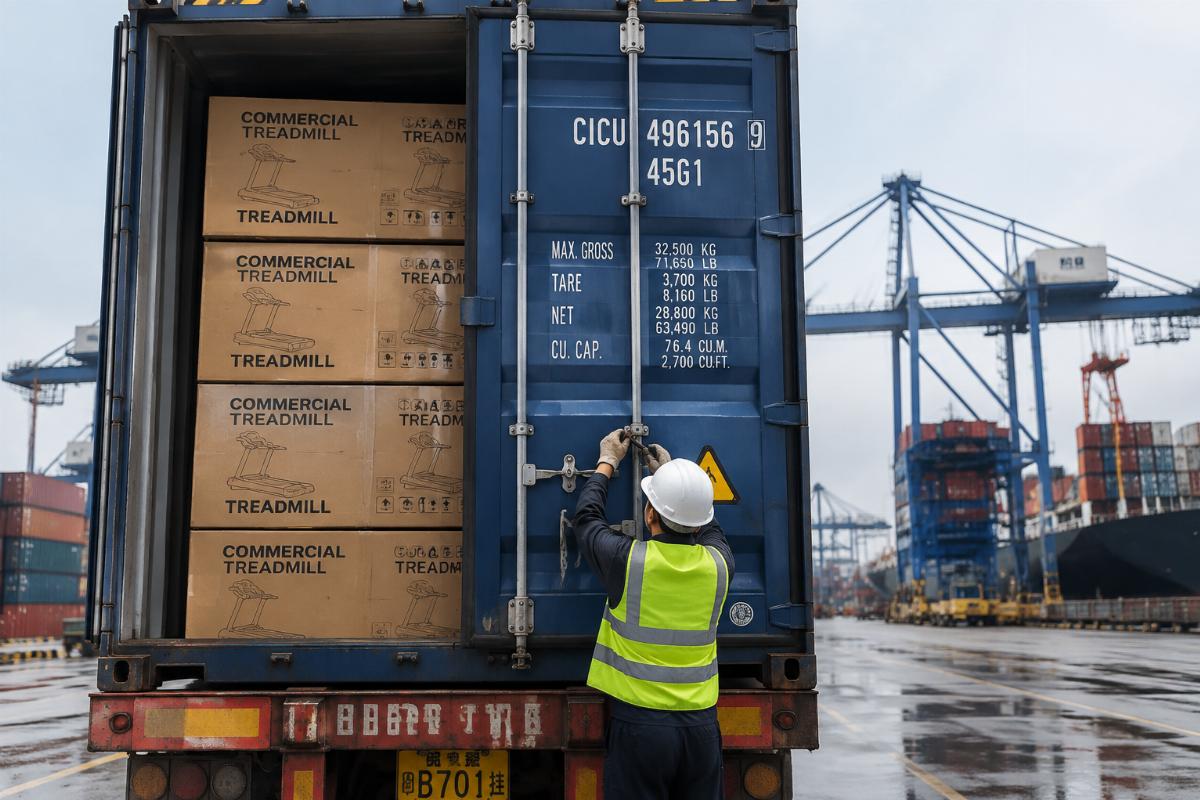
Full container loads to Tilbury or Felixstowe offer the most predictable per-unit freight cost, while less-than-container shipments require careful negotiation of destination deconsolidation charges and VAT payment timing.
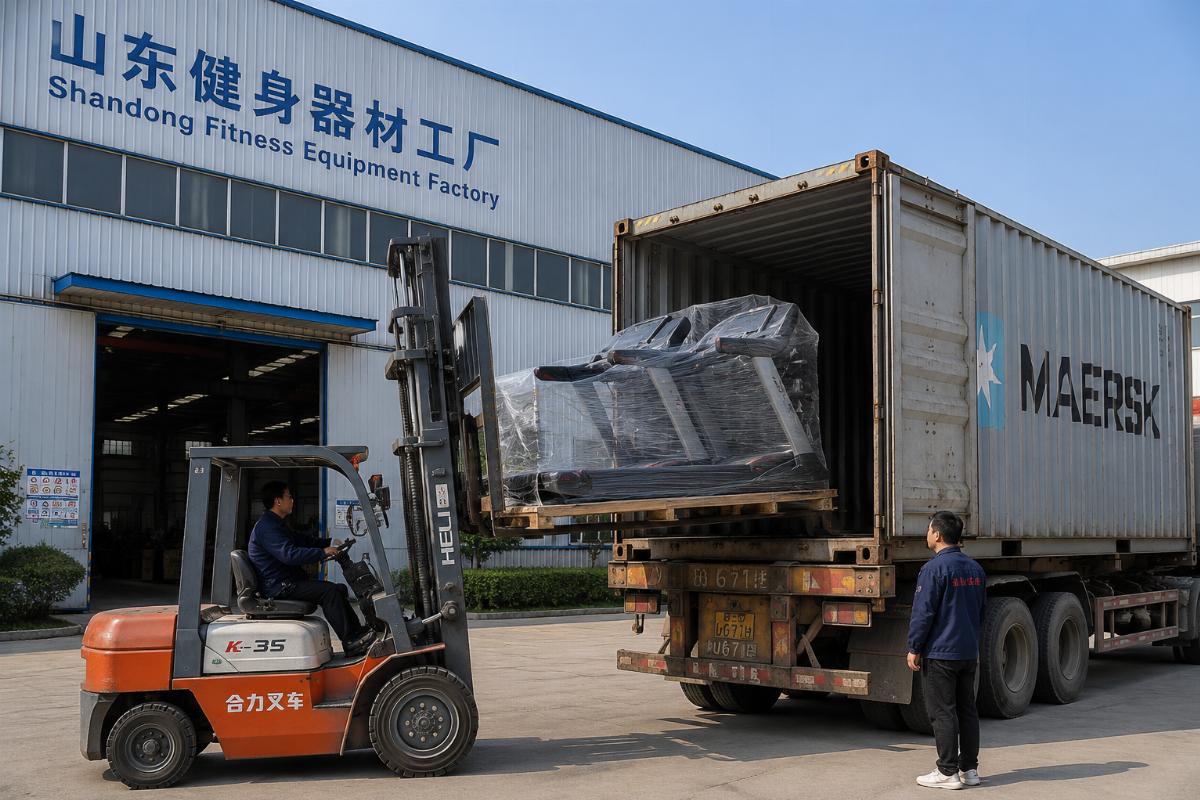
Shandong Province hosts a concentration of fitness equipment manufacturing facilities, and logistics routes to major UK ports are well established. The shipping structure decision depends on order volume, warehouse readiness at the destination, and cash flow timing around VAT payment.
| Shipping Method | Best Suited For | Key Cost Considerations |
|---|---|---|
| Full Container Load | Gym fit-outs, distributor stock orders | Predictable per-unit freight; buyer manages customs and inland transport |
| Less than Container Load | Trial orders, mixed equipment shipments | Destination port deconsolidation fees add to per-unit cost |
| Door-to-Door Arrangements | Buyers without import experience | Simplified process but reduced visibility on individual cost components |
[NEED_CITE: UK port authority guidance on container import procedures and charges]
A UK buyer placing their first order opted for a shared container arrangement with another importer to reduce individual commitment. The approach worked for the freight segment, but the destination port deconsolidation process introduced handling charges and timing uncertainty that neither party had fully anticipated. The per-unit landed cost remained competitive, but the administrative complexity was higher than a dedicated full container would have been.
For buyers planning multiple container shipments over a programme of gym openings or distribution centre stocking, establishing a forwarder relationship that handles both the origin-side documentation and the UK customs clearance under a single coordination structure reduces the risk of document mismatches delaying release. The commercial treadmill supplier’s export team typically prepares the commercial invoice, packing list, and certificate of origin, but the UK-side broker needs these documents to align precisely with the commodity code classification to avoid duty assessment disputes.
Timing matters for projects with fixed opening dates. Manufacturing lead times, container booking availability during peak shipping seasons, and UK port congestion patterns all influence the realistic delivery window. Building a buffer into project timelines rather than scheduling to the earliest possible arrival date protects against the kind of delays that cascade into fit-out contractor penalties.
Conclusion
Sourcing commercial treadmills directly from Chinese factories delivers real cost advantages for UK buyers who treat certification verification, spare parts documentation, and landed cost calculation as integral to the purchasing process rather than afterthoughts. The specification thresholds, UKCA requirements, warranty structures, and shipping arrangements outlined above reflect patterns observed across multiple shipment cycles to British ports. Buyers who engage their chosen commercial treadmill supplier on these terms with explicit written agreements before production begins position themselves to capture the genuine savings available while avoiding the disputes and delays that erode them.


