Container Loading Configuration for Leg Extension Machine Bulk Orders
Stuffing more machines into a 40HQ does not save money—it destroys frames. The correct container loading configuration for leg extension machine bulk orders requires calculating exact stacking layers based on disassembled dimensions, not assembled units, and using custom pallet support at load-bearing points to prevent structural deformation during ocean transit.
When I first imported leg extension machines for a chain of gyms in the Chicago area, three units arrived with bent main frames. The supplier had stacked six fully assembled machines directly on top of each other inside a single container—no pallets, no support blocks, no disassembly. The bottom units buckled under the weight of the upper layers during a rough Pacific crossing. We paid a mid-five-figure claim in freight insurance, missed the grand opening by weeks, and had to fly a technician out to assess the damage on-site. That single shipment taught me that every container loading configuration for leg extension machine bulk orders must be engineered before the purchase order is signed, not improvised at the factory loading dock. [NEED_CITE: ISTA 3A transport testing standards for packaged fitness equipment]
Let me walk you through the exact methodology we now use for every bulk shipment.
Why Do Leg Extension Machines Arrive Damaged?
Ninety percent of frame deformation in transit traces back to two mistakes: stacking assembled units without bottom support, and ignoring the load-bearing geometry of the base. The leg extension machine’s main frame is designed to handle dynamic user loads distributed across the seat rail and pivot points—not static vertical compression from stacked machines pressing directly on thin-gauge steel tubing.
The typical failure pattern looks like this: machines are loaded upright or laid flat without pallets, then stacked two or three high. During ocean transit, vessel rolling creates lateral shifting. Without pallets to lock position, the stack slides. The friction and point-loading bend the seat post brackets and warp the base plate. By the time the container reaches port, the damage is invisible from outside—the boxes look fine—but once unboxed, the leg adjustment rail binds and the weight stack guide rods misalign. [NEED_CITE: common transit damage modes for plate-loaded strength equipment per packaging engineering guidelines]
A distributor in the Middle East once received a full container of leg extension machines from a factory that used no pallets. The machines were wrapped in EPE foam and plastic film—adequate for scratch protection, useless for compression resistance. Seven out of twelve units required frame straightening before they could be installed. The repair cost exceeded the original ocean freight charges.
The root cause is almost never the machine’s structural weakness. It is the absence of a proper container loading configuration for leg extension machine bulk orders that accounts for:
- Base geometry: The footprint is not rectangular—it has cantilevered sections that cannot bear stacking weight.
- Pivot point vulnerability: The cam and lever assembly sits exposed and will crack if compressed.
- Seat rail sensitivity: Even minor bending renders the adjustment mechanism inoperable.
How to Calculate the Exact Loading Quantity for a 40HQ?
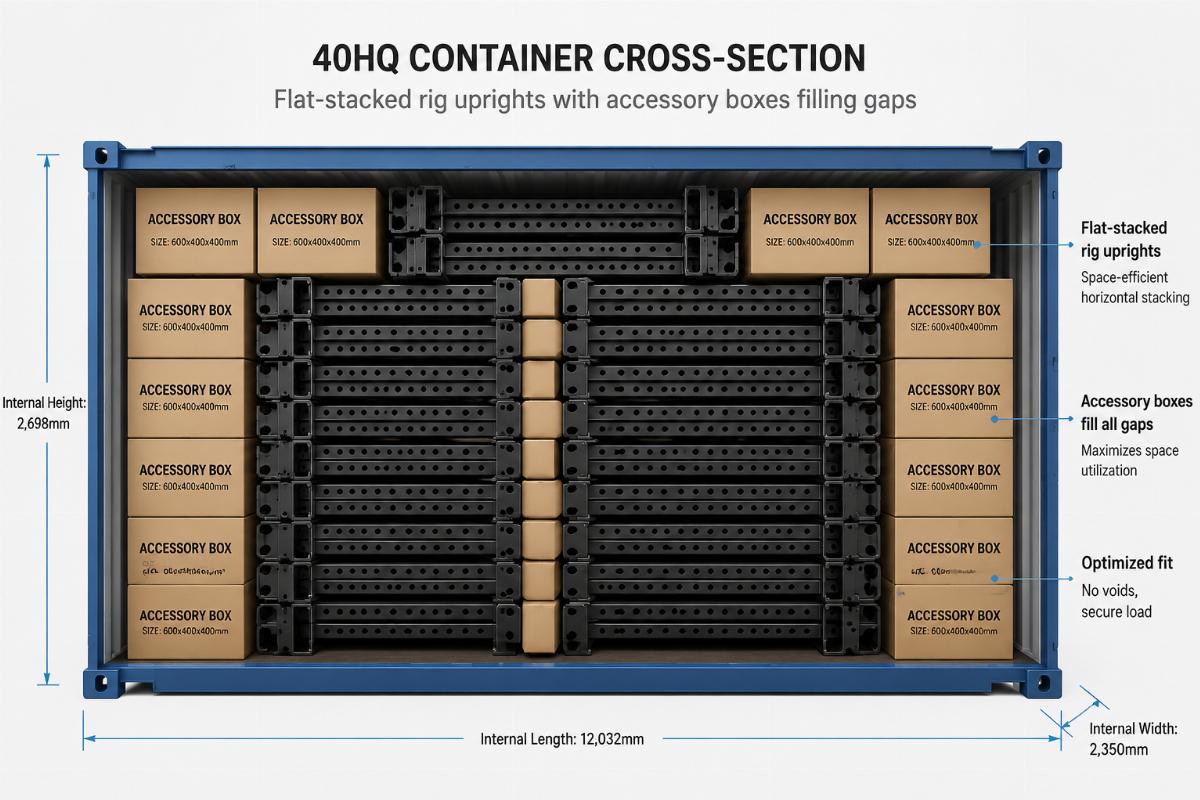
You must measure the machine in its disassembled state, not its assembled state, and then build a three-dimensional stacking model against the container’s internal dimensions. A standard 40HQ has an internal length of approximately 12 meters, width of 2.35 meters, and height of 2.69 meters. But usable space is always less—door corrugation, floor unevenness, and required ventilation gaps reduce effective volume. [NEED_CITE: ISO 668 standard dimensions for series 1 freight containers including internal clearances]
Here is the calculation workflow we follow:
Step 1: Disassemble and measure each component. Remove the seat back, armrests, weight stack guide rods (if applicable), and any protruding adjustment handles. Measure the length, width, and height of the main frame, the seat assembly, and the weight stack separately. Record the dimensions of each pallet position after packaging.
Step 2: Determine stackable orientation. The main frame can typically be laid flat or stood on its base. Laying flat usually yields better vertical utilization. Calculate how many layers can stack within the container height, accounting for pallet thickness and a safety clearance gap at the top.
Step 3: Map the floor plan. Using the disassembled footprint dimensions, calculate how many units fit side by side across the container width and lengthwise. Multiply by the number of stackable layers.
Step 4: Apply the disassembly multiplier. Removing armrests and seat backs typically reduces per-unit volume by a significant margin. In our experience, a fully assembled leg extension machine occupies roughly one-third more container space than its disassembled counterpart. This means a 40HQ that holds a certain number of assembled units can hold noticeably more when components are separated and nested.
Step 5: Validate with a loading diagram. Before confirming the order quantity, we generate a scaled loading plan showing every unit’s position, orientation, and layer. This diagram goes to the loading team and the buyer simultaneously—no ambiguity, no improvisation at the dock.
A commercial gym owner in Southeast Asia once ordered a quantity based on the supplier’s "assembled" loading estimate. When the container arrived, six machines were missing from the manifest. The factory had simply run out of space and loaded fewer units than quoted. The buyer paid freight on empty air. A proper container loading configuration for leg extension machine bulk orders eliminates this risk entirely.
What Are the Standard Packing Methods for Bulk Orders?
Custom wooden pallets at load-bearing points, combined with corner protectors and EPE foam wrapping, are non-negotiable for any ocean shipment of leg extension machines. Bare machines stacked directly on each other will suffer compression damage. Period.
At Bick Fitness, every bulk export order follows a standardized packing protocol developed over years of shipping to gyms across multiple continents:
1. Custom pallet base. Each machine’s main frame is secured to a wooden pallet sized to match the base footprint exactly. The pallet is positioned so that all four corners of the machine’s base plate rest on solid wood—not overhanging. This distributes stacking weight through the frame’s strongest structural points.
2. Load-bearing point reinforcement. We identify the two to four primary load-bearing points on the base frame—typically where the upright columns meet the floor plate. Custom wooden blocks are placed at these points to create a vertical load path. When machines are stacked, the weight transfers through these blocks directly to the pallet below, bypassing vulnerable mid-frame tubing.
3. Component separation and nesting. Armrests, seat backs, and adjustment levers are removed, wrapped individually in EPE foam, and placed in the void spaces between stacked main frames. This protects the components from scratching and utilizes otherwise wasted container volume.
4. Corner and edge protection. Hard cardboard or plastic corner guards are applied to all exposed frame edges. The seat adjustment rail—the most damage-prone component—is wrapped in additional foam sleeve protection.
5. Stretch film and strapping. Each palletized unit is stretch-wrapped to secure loose components. When stacked, the entire column is strapped to prevent lateral shifting during transit.
6. Loading diagram attachment. A printed loading plan is taped inside the container door so the stuffing team can verify placement in real time.
This is where factory-direct sourcing matters. When you order through a trading company, you rarely see the packing process. The factory may use minimal packaging to cut costs, and the trading company has no visibility until the container is already sealed. With direct manufacturer coordination, the container loading configuration for leg extension machine bulk orders is verified at every stage—from pallet construction to final strap tension.
How to Balance Loading Density and Safety?
Leaving intentional void spaces for bracing and weight distribution is more important than squeezing in one extra machine. Overstuffing a container creates two problems: it eliminates room for load-securing materials, and it pushes the total weight toward the container’s maximum payload limit, triggering port rejections or surcharges.
A 40HQ typically has a maximum payload capacity in the range of 26 to 28 metric tons, depending on the shipping line and route. Leg extension machines are dense—each unit carries a substantial weight stack and heavy-gauge steel frame. Miscalculating total weight is a common error.
Here is how we balance density and safety:
Weight calculation first. Before finalizing the loading plan, we calculate the total gross weight: machine weight times quantity, plus pallet weight, plus packaging materials. If the total approaches the container’s payload limit, we reduce the quantity by one or two units rather than risk overweight penalties.
Bracing space allocation. We reserve space along the container walls for wooden bracing beams and air bags. These prevent the stack from shifting laterally during rough seas. Without bracing, even a perfectly palletized stack can topple inward, crushing units against each other.
Center of gravity management. Heavier components—typically the main frames with weight stacks attached—are loaded on the bottom layers. Lighter disassembled components go on top. This keeps the container’s center of gravity low, reducing rollover risk during crane handling at transfer ports.
Door-end stability. The last row of machines nearest the container doors must be braced with a wooden bulkhead or cross-beam. If this row is not secured, opening the doors at destination can trigger an avalanche of falling equipment—a serious safety hazard for the receiving team.
A gym chain buyer in Latin America once insisted on maximizing unit count per container to reduce per-unit freight cost. The factory complied, loading the container to its absolute volumetric limit with no room for bracing. During transit through the Drake Passage, the stack shifted. Twelve machines were damaged, and the container doors buckled outward. The insurance claim was denied because the loading violated standard securing practices. The per-unit savings from that extra machine cost many times over in losses.
The correct container loading configuration for leg extension machine bulk orders always prioritizes arrival condition over theoretical maximum quantity. A slightly lower load count with proper bracing delivers more value than a stuffed container full of bent frames.
Conclusion
Every leg extension machine that arrives bent at destination was packed wrong at origin. Proper container loading configuration for leg extension machine bulk orders demands disassembled-dimension calculations, custom pallet support at load-bearing points, and intentional bracing space—never blind maximization of unit count. Get the loading plan right before the purchase order, and the machines arrive ready to bolt down and sell.