FIBO & IHRSA Trade Show Commercial Gym Equipment Wholesale Supplier
Most buyers think walking the show floor guarantees the lowest price. In reality, the real discounts unlock only when you follow up within a specific post-show window using the business card you collected at the booth.
FIBO and IHRSA serve fundamentally different sourcing needs: FIBO in Cologne concentrates on European OEM/ODM factory-direct wholesale, while IHRSA in North America leans toward brand agency and distribution partnerships. A commercial gym equipment wholesale supplier at FIBO will typically quote you FOB pricing with flexible MOQ from a single unit to a full container, whereas an IHRSA booth is more likely to pitch you territory exclusivity and marketing support. Choosing the right show depends entirely on whether you need factory-direct manufacturing or an established brand to resell.
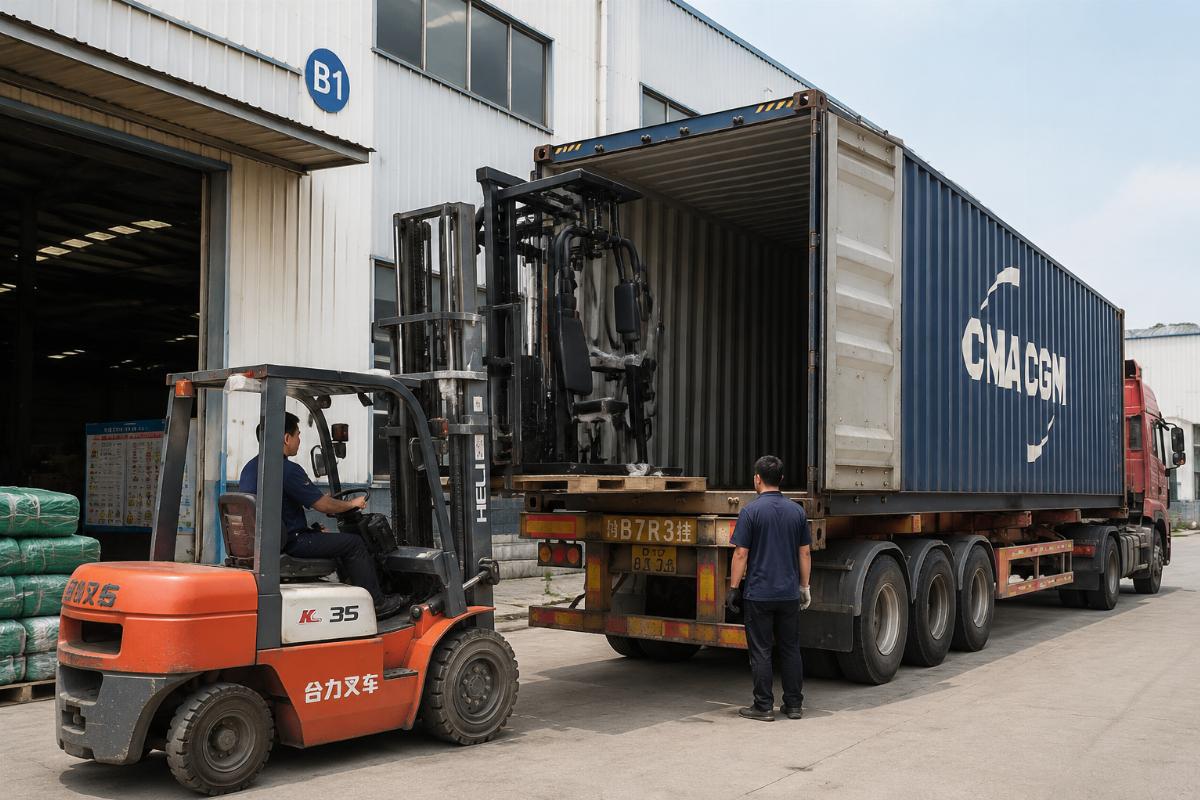
I still remember a hotel project in Doha where the client ordered a full suite of cardio machines at a Middle East trade show. The ellipticals arrived at the port, and the console motherboards refused to sync with the local voltage standard. The entire shipment sat in customs for weeks. I flew out to swap boards on-site, and the rework cost nearly matched the freight savings they had celebrated during the deal. That kind of failure does not happen because the factory is incompetent; it happens because electrical specifications were never written into the contract. [NEED_CITE: voltage and plug standard requirements by country per IEC 60320] When you source from a commercial gym equipment wholesale supplier at any international expo, the machine itself is the easy part. The paperwork, the certification copies, and the voltage callouts are what actually clear your container at the destination port.

If you are planning your next sourcing trip, the preparation you do before booking a flight matters more than the conversations you have on the show floor. Let me walk you through the checkpoints that separate a productive sourcing trip from an expensive vacation.
Which Show Should You Actually Attend?
FIBO is the go-to for buyers who want factory-direct pricing, OEM branding, and container-load quantities. IHRSA is the right room for buyers seeking North American brand distribution rights, dealer agreements, and established resale programs.
The exhibit floor density tells the story. At FIBO in Cologne, the majority of exhibitors are manufacturing facilities—mostly from Shandong, Fujian, and Zhejiang in China, alongside European production houses. You will find booths where the person across the table can show you weld seam photos from their own factory floor. At IHRSA, the floor tilts heavily toward branded distributors, software platforms, and franchise concepts. [NEED_CITE: exhibitor category breakdown from official IHRSA show directory]
| Sourcing Need | FIBO Cologne | IHRSA North America |
|---|---|---|
| Factory-direct OEM/ODM | Certified | Basic |
| Private label flexibility | Full batch-level | Sample-level |
| North American brand resale | Not provided | Verifiable |
| Container-load MOQ | Noticeably reduced | Substantially extended |
| CE/EN certification on display | Robust | Resistant |
| US-market after-sales network | Vulnerable | Robust |
A distributor from West Africa attended FIBO for the first time looking to source a full container of plate-loaded strength machines under his own brand. He walked in expecting to negotiate pricing on the spot. What he actually needed was a factory willing to run a custom color match, print his logo on the seat pads, and pack retail boxes with his barcode labels—all within a single container. We mapped out the MOQ threshold, the artwork approval cycle, and the container mix ratio right at the booth. By the time he returned to Lagos, the sampling was already in progress.
A Latin American gym chain, on the other hand, attended IHRSA specifically to find a functional training brand they could represent exclusively across several countries. They were not looking for unbranded iron; they wanted a partner with existing marketing collateral and territory protection. That conversation simply does not happen at FIBO with the same density.
The takeaway is straightforward: match the show to your procurement model before you register.

What Supplier Pre-Screening Must You Complete Before the Show?
Walk into the hall with a printed checklist covering certification documents, export track record, and MOQ flexibility—or plan to waste two days collecting brochures you will never open again.
The pre-screening list I use before any show is built from hard lessons. [NEED_CITE: CE marking requirements under EU Regulation 765/2008 for fitness equipment] Here is the framework:
-
Certification file readiness. Ask before the show whether the commercial gym equipment wholesale supplier can email you copies of CE, EN 957, and ISO 9001 certificates. If they hesitate or say "we will send after the show," move on. A factory that cannot produce certification documents before a buyer even arrives at the booth is not export-ready.
-
Export experience verification. Request a list of destination countries they have shipped to in the past. A supplier who has only sold domestically will not understand commercial invoice formatting, certificate of origin procedures, or fumigation requirements for wooden crates. [NEED_CITE: documentation requirements for fitness equipment export per WTO trade facilitation guidelines]
-
MOQ and customization boundaries. Confirm whether the supplier accepts single-unit trial orders, mixed-SKU container loads, or full gym package configurations. Some factories rigidly require a minimum of several units per SKU, while others accommodate boutique studio buyers who need one Smith machine, one cable crossover, and a set of adjustable benches in a shared container.
-
Electrical specification capability. If you are buying any motorized cardio equipment, confirm the supplier can manufacture to your destination voltage, frequency, and plug type. This is not optional. A treadmill built for one market will not function in another without a complete motor and control board swap.
When I prepare for a show like FIBO, I pre-qualify the exhibitor list against these four criteria. The factories that pass all four make it onto my floor-walk route. The rest get skipped. This is how you compress a four-day show into two productive days.

Which Contract Terms Must You Lock Down on the Show Floor?
Price is the opening move, not the deal. Payment structure, delivery timeline, inspection rights, and spare parts commitments are the clauses that protect your capital after you leave the hall.
I have seen buyers shake hands on a unit price and walk away feeling like they won, only to discover months later that the supplier had no binding delivery date, no inspection protocol, and no obligation to supply replacement parts. A price without enforceable terms is just a number on a business card.
Here is the clause framework I insist on finalizing before leaving the booth:
-
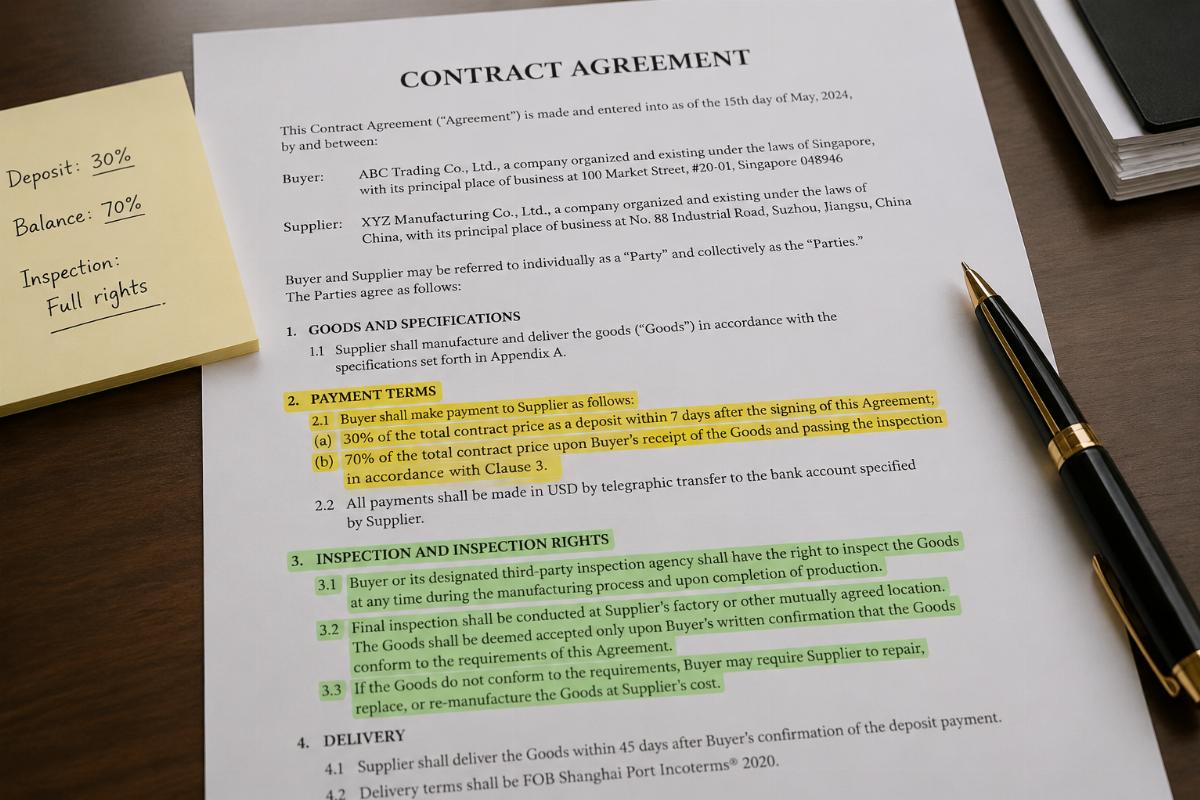
Payment structure. The standard in international fitness equipment trade is a deposit against production with the balance before shipment. The exact ratio and trigger points must be written into the proforma invoice on the spot. Verbal agreements about "we will work it out later" have no legal weight across borders.
-
Delivery timeline with penalty language. A committed production and shipping window must appear in the contract. Without it, your equipment can sit in a factory queue indefinitely while the supplier prioritizes buyers who specified consequences for delay. [NEED_CITE: Incoterms 2020 rules for FOB and CIF delivery obligations]
-
Pre-shipment inspection rights. The contract must state that the buyer or a designated third-party inspector has the right to verify goods before the container is sealed. This single clause has saved buyers from receiving containers full of incorrectly painted frames or mismatched upholstery.
-
Spare parts and warranty terms. For commercial gym equipment, wear items like cable pulleys, seat adjustment pins, and running belt components will need replacement. The supplier must commit to a spare parts supply window and specify which components are covered under warranty versus consumable exclusion.
At FIBO, our booth operates with all CE certificates printed and available for handout, MOQ terms clearly posted from single-unit trials to full gym packages, and electrical customization specs confirmed on the spot for any motorized product. Buyers who lock these terms at the booth leave with a signed proforma, not just a handshake. That discipline is what separates a real commercial gym equipment wholesale supplier from a booth decorator.
How Do You Follow Up After the Show Without Losing Priority?
The first hours after the show determine whether your inquiry reaches the front of the supplier’s queue or sinks beneath a hundred other business cards collected on the same floor.
Trade shows generate a flood of contacts. Every factory booth collects a stack of cards, and within a week, the sales team is sorting them by urgency. The buyers who send a structured follow-up within the first few days get priority. The buyers who wait until they "get back to the office and settle in" find their inquiry buried under newer, more aggressive follow-ups.
The follow-up sequence I recommend:
-
Within the first few days. Send an email referencing the specific conversation at the booth, the products discussed, and any pricing or MOQ figures mentioned. Attach your company profile and the exact specification sheet you need quoted. This signals that you are a serious buyer, not a window shopper.
-
Within the first week. Request sample pricing or a product catalog with updated specifications. If you discussed custom branding or electrical modifications, confirm those details in writing. [NEED_CITE: best practices for post-trade-show B2B follow-up per international sales management standards]
-
Within the first month. Push for a signed proforma invoice or a sample shipment. The "show special pricing" that many suppliers offer is typically valid for a limited post-show window. After that period closes, the quoted price reverts to standard export pricing.
A South American gym chain followed this sequence after meeting a functional training equipment supplier at IHRSA. They placed a small initial order of specialty pieces, tested market response, and then scheduled repeat orders at regular intervals. Each reorder expanded the SKU range based on member usage data. The initial show conversation was the seed; the disciplined follow-up turned it into a recurring supply relationship.
The commercial gym equipment wholesale supplier who responds fastest to a well-structured follow-up email is usually the one who values export business the most. That correlation is worth remembering.

What Hidden Costs Await Between the Order and the Port?
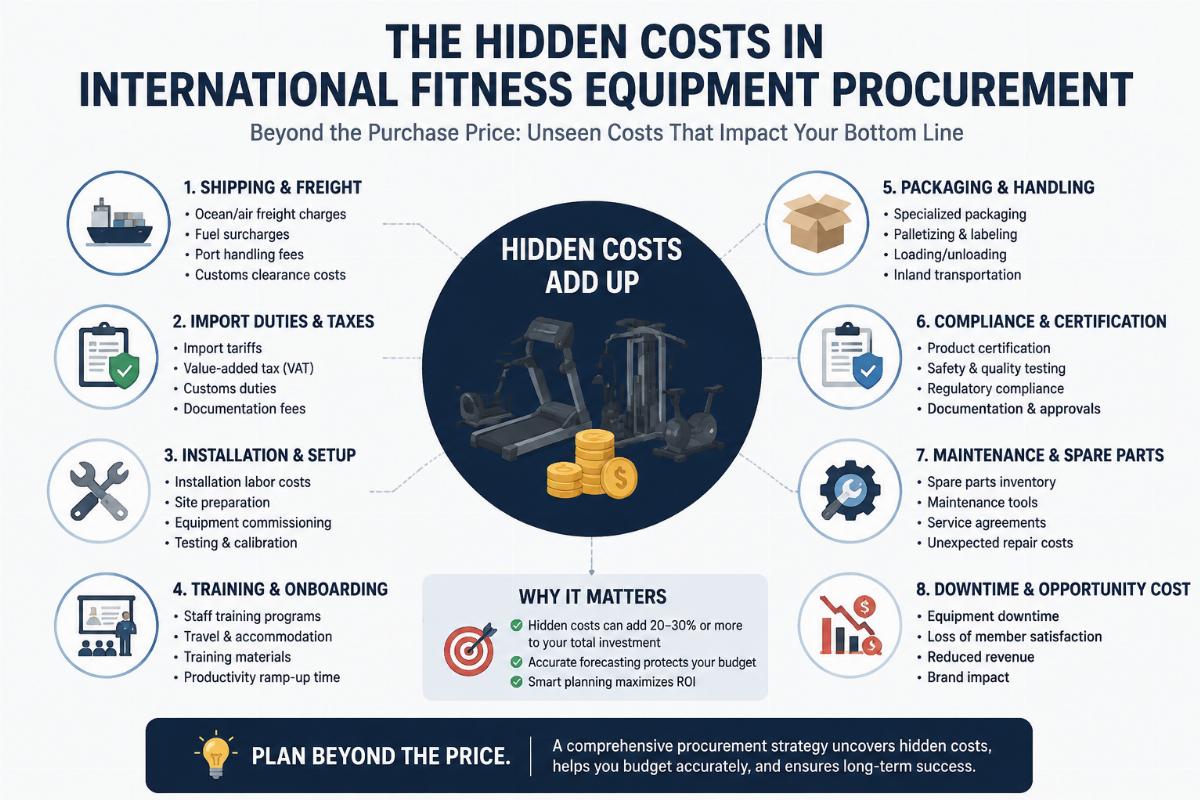
The invoice price is never the final landed cost. Certification compliance, voltage adaptation, and destination port documentation are the three expense categories that catch unprepared buyers off guard.
I mentioned the Doha hotel project earlier. That voltage mismatch was not a minor inconvenience—it triggered customs holds, on-site technician flights, and hardware swaps that cost several times what the original freight savings had been. That single oversight erased the entire financial advantage of buying at the show.
Here are the hidden cost categories you must address before signing:
-
Certification and compliance. Different markets require different marks. The EU demands CE and EN 957 conformity. Some Middle Eastern countries require SASO or equivalent pre-shipment verification. South American destinations may need INMETRO registration. If your commercial gym equipment wholesale supplier cannot provide the correct certification for your destination, your goods will not clear customs. Period. [NEED_CITE: fitness equipment safety standards comparison across EU, Middle East, and South American markets]
-
Voltage and frequency adaptation. Motorized treadmills, ellipticals, and exercise bikes contain drive boards calibrated to specific voltage and frequency inputs. A machine built for one electrical standard will malfunction or fail catastrophically on another. This specification must be confirmed in writing before production begins, not discovered at the port.
-
Destination documentation. Commercial invoices, packing lists, certificates of origin, and fumigation certificates for wooden packaging must all align with the importing country’s customs requirements. A missing or incorrectly formatted document can delay clearance for weeks, incurring storage fees that compound daily.
The buyers who treat these items as afterthoughts pay for it in delays, rework, and sometimes total shipment rejection. The buyers who address them during contract negotiation at the show floor walk away with containers that clear customs smoothly and equipment that runs correctly from day one.
Conclusion
FIBO and IHRSA serve different procurement models, and choosing the right one determines whether you find a factory partner or a brand reseller. Pre-screen suppliers on certification, export experience, and MOQ flexibility before you arrive. Lock payment terms, delivery timelines, inspection rights, and spare parts commitments into the contract on the show floor. Follow up within days, not weeks, to maintain priority. And never let the invoice price distract you from the certification, voltage, and documentation costs that determine whether your container actually reaches the gym floor. A disciplined commercial gym equipment wholesale supplier relationship starts with preparation and survives on follow-through.