Hack Squat Machine Landed Cost Kenya | Bick Wholesale Supplier
A lower FOB price often results in a higher final cost.
The true landed cost for importing commercial strength equipment into Kenya is not merely the sum of freight and factory price. It is determined by the accuracy of HS code classification under 9506.91, the precision of PVOC documentation matching the Bill of Lading, and strict adherence to the iCMS digital declaration system to avoid punitive demurrage fees.
I still remember the silence on the phone when a client in Nairobi realized their container of deep squat racks had been held at the Port of Mombasa. It was not a quality issue. The steel was solid, the welding was clean, and the CE marks were present. The problem was a single letter mismatch between the model number on the Pre-Export Verification of Conformity (PVOC) certificate and the commercial invoice. In the past, this might have been resolved with a quick phone call. Today, under the fully digital Integrated Customs Management System (iCMS), it triggered an automatic hold. The cargo sat for over forty days. The storage fees accumulated to an amount that exceeded the profit margin of the entire order. The client eventually refused the shipment, and we had to arrange for the units to be returned and dismantled for parts. That loss was not due to manufacturing error, but to administrative precision. This experience defines how I approach every shipment now. [NEED_CITE: KRA guidelines on iCMS data consistency requirements]
Understanding the full financial picture requires looking beyond the initial quote. When you search for a Landed Cost Calculator Kenya Fitness Equipment, you are likely trying to budget for a commercial gym setup without facing surprise penalties. The following breakdown details the critical components that determine your actual expenditure.
What Components Make Up the Landed Cost in Kenya?
The landed cost is a cumulative structure where each layer adds both value and potential risk.
Many buyers calculate their budget based on the Free On Board (FOB) price plus ocean freight. This is a dangerous oversimplification. For heavy commercial machinery like a hack squat machine or a multi-station selectorized unit, the post-arrival costs are significant and strictly regulated. The base calculation starts with the Cost, Insurance, and Freight (CIF) value. From there, the Kenya Revenue Authority (KRA) applies import duty and Value Added Tax (VAT). However, the hidden layers are often where budgets fail.
Before the goods even leave the factory, you must account for the Import Declaration Form (IDF) fee and the PVOC certification cost. These are mandatory for most regulated products, including fitness equipment. KEBS (Kenya Bureau of Standards) requires this pre-export verification to ensure safety and compliance. If you skip this or use an unverified agent, your goods will be rejected at the port. Upon arrival, port handling charges, railway surcharges if moving to Nairobi via SGR, and terminal fees apply.
| Cost Component | Nature of Charge | Risk Level if Mismanaged |
|---|---|---|
| Import Duty | Based on CIF Value | High (if HS code is wrong) |
| VAT | Standard Rate on CIF + Duty | Medium (Standardized) |
| PVOC/COO Fees | Pre-shipment Certification | Critical (Cargo Hold if missing) |
| IDF Fee | Digital Declaration Entry | Low (Administrative) |
| Port Handling | Terminal & Wharfage | Medium (Fixed but variable by volume) |
| Demurrage | Storage Penalty | Extreme (Daily compounding) |
[NEED_CITE: East African Community Common External Tariff structure for sports equipment]
The key is that these costs are not optional. They are structural. A Landed Cost Calculator Kenya Fitness Equipment must include these fixed regulatory fees to provide a realistic budget. Ignoring the PVOC cost or underestimating the port handling fees for heavy steel structures leads to immediate cash flow gaps.
How Does Correct HS Code Classification Impact Your Tax Liability?
Misclassifying strength machines as general steel structures can increase your duty rate significantly.
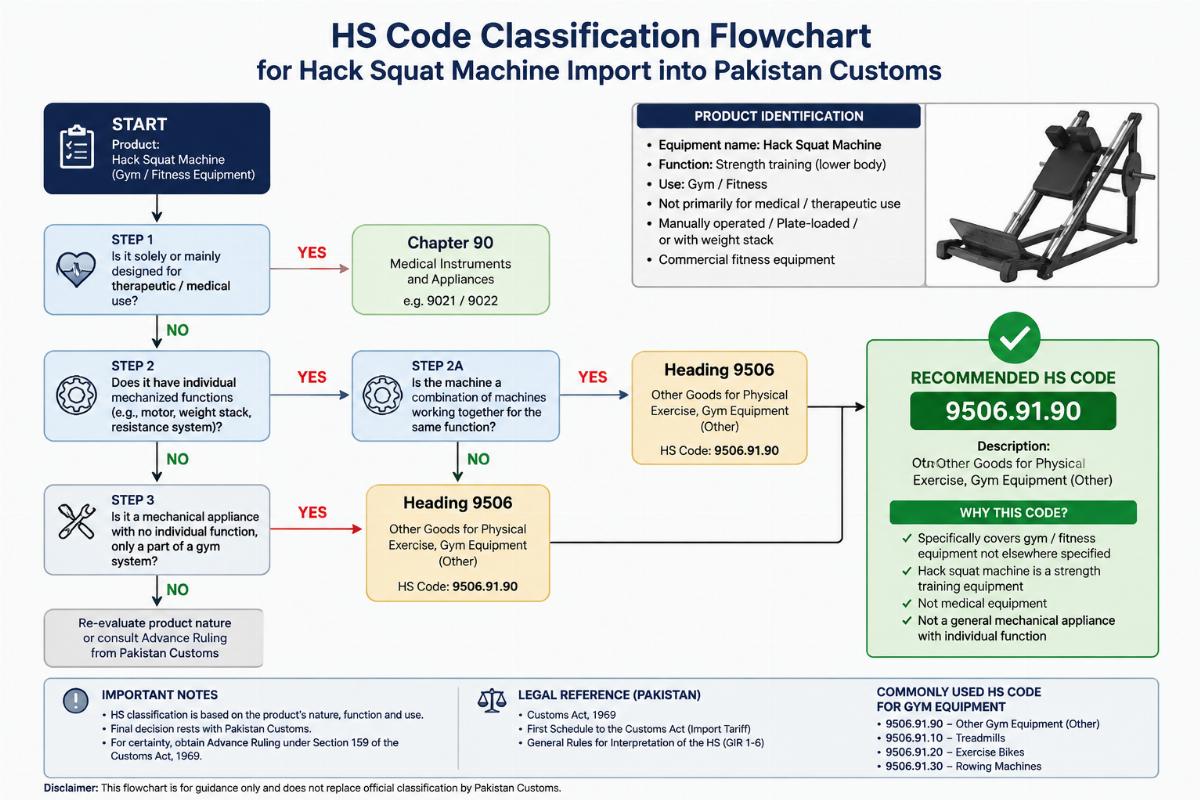
The Harmonized System (HS) code is the language of customs. For fitness equipment, the correct classification is typically under heading 9506.91, which covers articles and equipment for general physical exercise. However, some importers or clearing agents mistakenly classify heavy plate-loaded machines or smith machines under general metal structures or fabricated steel articles. This error is not trivial. The duty rate for general steel structures can be substantially higher than that for sports equipment.
When I review commercial invoices for a Landed Cost Calculator Kenya Fitness Equipment, I ensure the description matches the HS code precisely. A hack squat machine is not just "steel frame." It is "commercial strength training equipment." If the customs officer sees a generic description, they may apply a higher duty bracket or flag the shipment for a physical inspection, which delays clearance and increases costs.
Consider a recent case where a distributor imported a full gym setup. The clearing agent used a broad HS code for "metal furniture." The KRA system flagged the discrepancy because the weight and nature of the goods did not match typical furniture imports. The resulting audit delayed clearance by weeks. The correct classification under 9506.91 would have cleared the goods faster and at a lower duty rate. [NEED_CITE: KRA tariff classification guidelines for HS 9506]
Using the wrong code does not just affect duty. It affects the entire risk profile of the import. Accurate classification ensures that the Landed Cost Calculator Kenya Fitness Equipment reflects the true tax liability, preventing margin erosion after the goods have already arrived.
Why Are PVOC and COO Documents Non-Negotiable for Clearance?
KEBS mandates pre-export verification, and missing certificates trigger immediate cargo holds.
The Certificate of Conformity (CoC) issued under the PVOC program is your ticket into the Kenyan market. It proves that the goods meet Kenyan standards before they ship. Many buyers assume that having a CE mark is sufficient. While CE indicates European compliance, KEBS requires its own verification process. The technical file accompanying the CE mark must be available for review, but the PVOC certificate is the legal document required at the border.
The most common failure point is data consistency. The model numbers, quantities, and consignee details on the PVOC certificate must match the Commercial Invoice, Packing List, and Bill of Lading exactly. A typo in the model number, such as "HS-100" versus "HS-100A," is treated as a discrepancy. In the iCMS environment, this triggers a red flag.
I once handled a shipment where the PVOC agent listed the gross weight as 20,000 kg, but the Bill of Lading showed 20,500 kg due to additional wooden crating. The system rejected the entry. We had to apply for a correction, which took days. During those days, the container sat in the terminal. The cost of correcting the document was negligible, but the storage fees were not. This is why I insist on triple-checking all documents before the vessel departs. A Landed Cost Calculator Kenya Fitness Equipment should include a buffer for potential document correction fees, though the goal is to avoid them entirely.
Without a valid PVOC and Certificate of Origin (COO) for preferential tariff treatment if applicable, you cannot clear the goods. There is no workaround. The regulations are strict to protect local consumers from substandard imports. Ensuring these documents are perfect is the most effective way to control your landed cost.
How Can iCMS Digitalization Accelerate or Halt Your Shipment?
Digital precision is key; minor data discrepancies cause system rejections and costly demurrage.
The transition to the Integrated Customs Management System (iCMS) has transformed customs clearance in Kenya. It has reduced clearance times from weeks to days for compliant shipments. However, it has also eliminated tolerance for error. The system is automated. It checks data fields against each other. If the consignee name on the Bill of Lading does not match the IDF exactly, the system rejects the entry. There is no human officer to "overlook" a small mistake in the initial stage.
For a Landed Cost Calculator Kenya Fitness Equipment, this means that speed is a function of accuracy. A perfect submission clears quickly. A flawed submission enters a cycle of queries, corrections, and re-submissions. Each day spent in this cycle incurs demurrage charges from the shipping line and storage fees from the port authority. These fees are calculated daily and compound rapidly.
I advise my partners to treat the iCMS data entry as a critical manufacturing step. The commercial invoice, packing list, and bill of lading must be generated from the same data set. Any manual re-entry of data introduces the risk of typos. By ensuring that the digital footprint of the shipment is consistent across all platforms, you leverage the efficiency of iCMS. This efficiency directly lowers the landed cost by minimizing time-based penalties. [NEED_CITE: KRA press release on iCMS implementation benefits]
What Are the Hidden Risks of Underestimating Port Storage Fees?
Delays due to documentation errors incur daily storage charges that can exceed profit margins.
Port storage fees are the silent killer of import profitability. In Mombasa, free storage time is limited. Once this period expires, daily charges apply. These charges are not linear; they often increase after the first week. For a container of heavy fitness equipment, which may require special handling or inspection, the risk of delay is higher.
The scenario I mentioned earlier, where a single letter mismatch caused a forty-day hold, is not an outlier. It is a common consequence of administrative negligence. The storage fees for that period amounted to several times the savings achieved by choosing a lower-cost supplier. This is why the Landed Cost Calculator Kenya Fitness Equipment must include a risk assessment for demurrage.
To mitigate this, I ensure that all documentation is pre-verified before shipment. I work with clearing agents who understand the specifics of fitness equipment, such as the need for accurate weight declarations due to the dense nature of steel machines. By avoiding delays, you avoid these punitive fees. The goal is to have the goods cleared and moved to the final destination within the free storage period. This requires proactive management, not reactive problem-solving.
Conclusion
Accurate landed cost planning is about precision, not just price.
Importing commercial fitness equipment into Kenya requires a holistic view of costs, duties, and regulations. By focusing on correct HS classification, flawless PVOC documentation, and iCMS compliance, you protect your margins from hidden penalties. A reliable Landed Cost Calculator Kenya Fitness Equipment is only as good as the data entered into it. Ensure every detail is verified to turn a complex import process into a smooth, profitable operation.