HR-400 Half Rack Sub-Series Manufacturer & Supplier | OEM/ODM Factory Direct
Parameter sheets lie. Or at least, they omit the only variable that actually matters: who is going to use the rack, and how hard. The HR-400 half rack technical data sheet is not a spec list to be filed away—it is a procurement verification tool, and the numbers that decide whether a rack survives two years in a humid commercial gym or bends before the warranty expires are buried in tube gauge, load rating methodology, and footprint-to-usage matching logic.
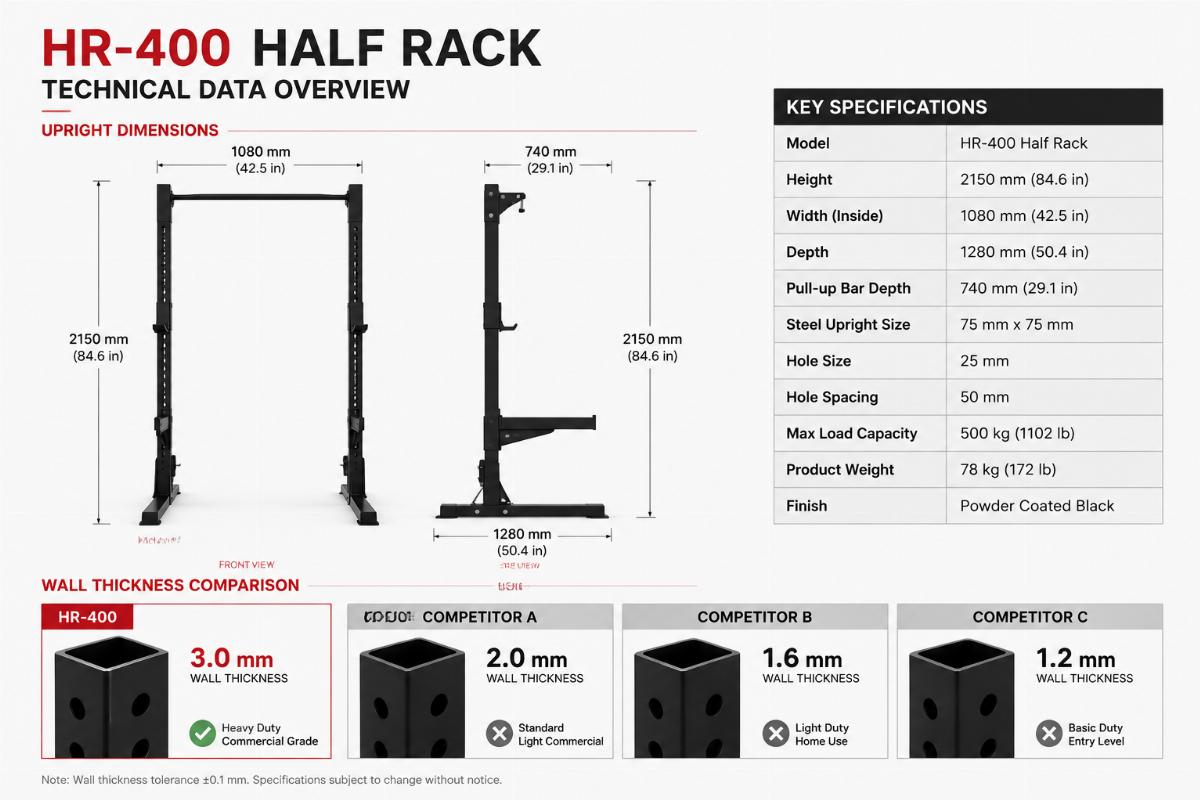
The core answer buyers search for: HR-400 half rack technical data covers main upright dimensions, wall thickness grades (light-duty vs. heavy-duty), static and dynamic load ratings, footprint dimensions, J-cup adjustment ranges, and attachment interface compatibility. The correct spec tier is determined not by the highest number on paper, but by matching tube gauge, load safety factor, and layout footprint to the actual user profile—commercial chain, hotel fitness center, or boutique studio.
I still remember standing in a gym in Ho Chi Minh City, caliper in hand, measuring the cross-member of a half rack that had been in service for less than two months. The beam was visibly sagging under repeated heavy squats. The owner had chosen the light-duty tier to save on per-unit cost, and the Southeast Asian heat and humidity had accelerated what was already a marginal structural decision. The tube wall thickness difference between the two tiers was a fraction of a millimeter—invisible on a spec sheet, obvious under load [NEED_CITE: influence of wall thickness on structural rigidity under cyclic loading per EN 20957]. The replacement shipment took weeks to arrive by sea, and the gym was losing revenue every day it sat half-empty.
That kind of field failure is what makes the HR-400 half rack technical data worth reading carefully, not just skimming for the load capacity number.
What Are the Core Structural Specs of HR-400 Half Rack?
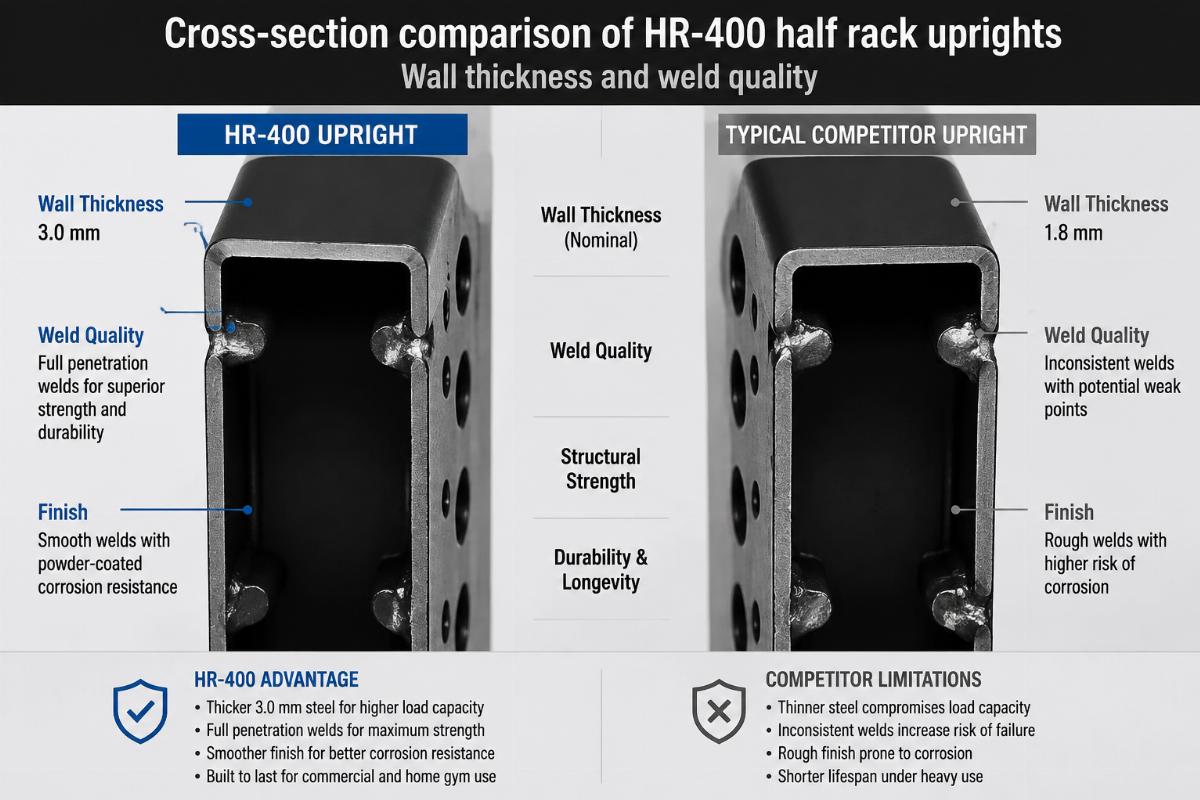
The structural backbone of any half rack is defined by three parameters: main upright cross-section size, wall thickness grade, and welding process quality. These three factors together determine the practical ceiling for load capacity, long-term fatigue resistance, and attachment stability.
The HR-400 series is offered in two structural tiers:
| Parameter | Light-Duty Tier | Heavy-Duty Tier |
|---|---|---|
| Upright cross-section | Standard commercial size | Enlarged commercial size |
| Wall thickness grade | Standard gauge | Reinforced gauge |
| Welding process | Standard MIG | Full-penetration continuous weld |
| Structural rigidity under cyclic load | Adequate for moderate use | Robust for high-frequency heavy use |
| Suitable environment | Climate-controlled, moderate traffic | High humidity, high traffic, heavy users |
The difference in wall thickness between the two tiers is small in absolute terms—less than a millimeter—but in structural engineering, that margin is the difference between a rack that holds up for a decade and one that starts showing deflection within a season [NEED_CITE: relationship between tube wall thickness and deflection under repeated loading in strength equipment].
Welding quality is equally critical and far harder to verify from a data sheet alone. A rack with thick uprights but incomplete weld penetration at the joint will fail at the joint before the tube itself yields. The heavy-duty tier uses full-penetration continuous welding at all structural joints, which is verifiable through visual inspection and, if needed, non-destructive testing [NEED_CITE: welding quality standards for fitness equipment per international safety norms].
A distributor in the Middle East once received a sample from a competing supplier that looked identical on paper. The upright dimensions matched. The rated load capacity matched. But when the sample was sectioned, the welds at the base plate joint showed clear porosity and incomplete fusion. That rack would never have survived a full container load of commercial gym deployment.
What Is the Actual Load Capacity vs. Rated Capacity?
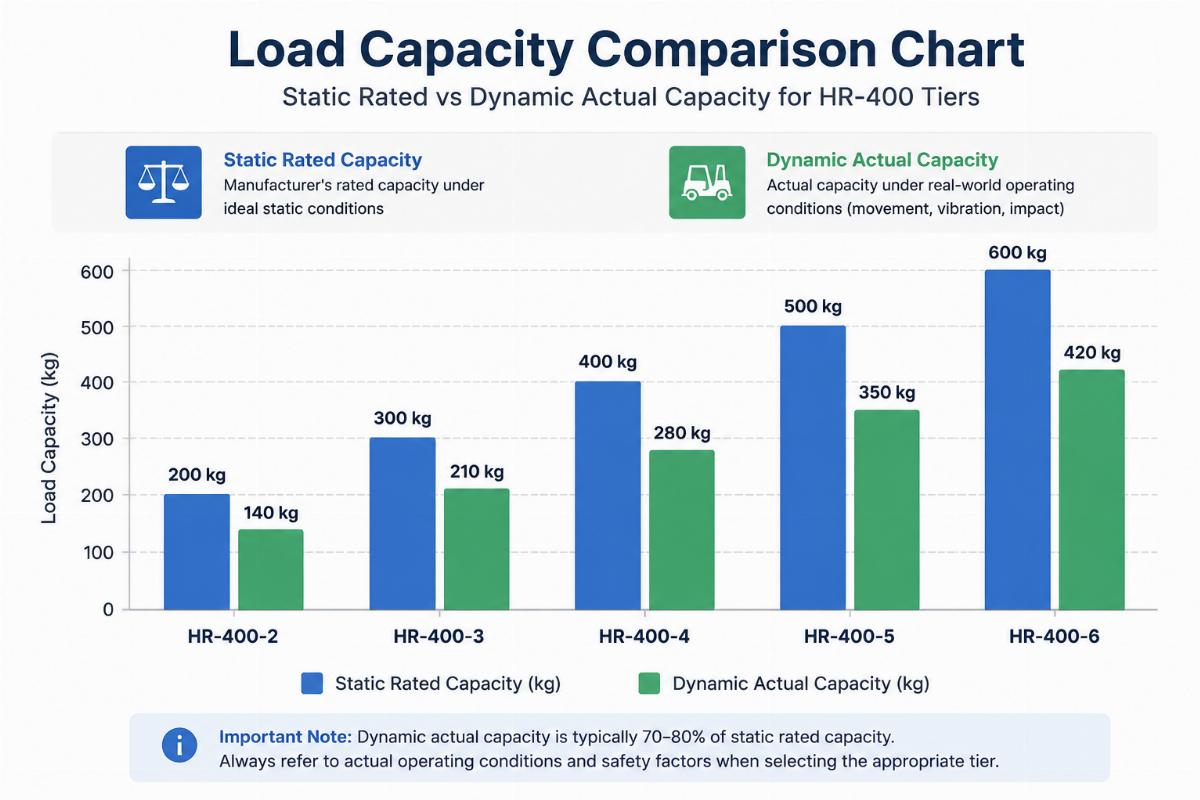
Static rated capacity and dynamic actual capacity are not the same number, and confusing them is the most common procurement mistake in the half rack category.
The rated load capacity listed in the HR-400 half rack technical data sheet is a static figure—measured under controlled laboratory conditions, with the load applied evenly and held stationary. In real-world gym use, the load is dynamic: barbells are dropped, jerked, and subjected to eccentric forces during lifts like cleans and snatches. The actual dynamic load on the rack can be substantially higher than the static weight of the plates on the bar.
Industry testing standards differentiate between static load ratings and dynamic load endurance, and reputable manufacturers apply a safety factor to bridge the gap [NEED_CITE: safety factor requirements for free-weight strength equipment per EN 20957 / ASTM standards]. The HR-400 heavy-duty tier is engineered with a higher safety factor, meaning the gap between rated static capacity and practical dynamic endurance is narrower and more reliable.
Consider a high-traffic commercial gym where the squat stations see continuous use throughout the day. Members loading heavy singles and doubles generate impact forces that a light-duty rack—rated for the same static number—would struggle to absorb over time. The light-duty tier is designed for environments where usage frequency is lower and user body weights are moderate, such as hotel fitness centers or personal training studios. The heavy-duty tier is built for the daily grind of a full commercial floor.
A gym operator in Southeast Asia ran a side-by-side comparison across two sites: one equipped with the light-duty tier, the other with the heavy-duty tier. Both sites had similar member profiles. Within the first year, the light-duty site showed visible deflection on the pull-up bar mounts and J-cup mounting holes showing elongation. The heavy-duty site showed no measurable change. The daily usage frequency was comparable, but the cumulative fatigue on the lighter structure was decisive [NEED_CITE: fatigue failure modes in tubular steel gym equipment under cyclic loading].
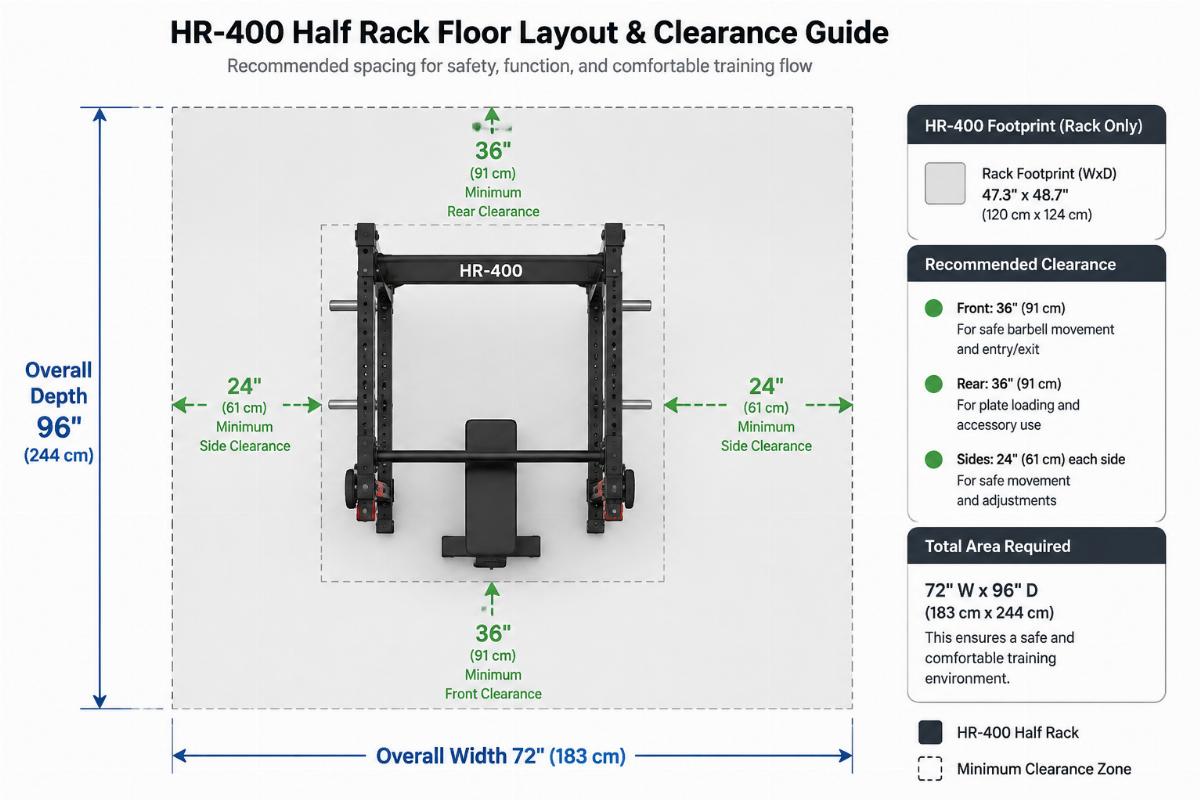
How Do Footprint Dimensions Affect Gym Layout?
The footprint of a half rack determines not just how many units fit on the floor, but how the entire training zone flows—and a miscalculation here is far more expensive than a per-unit price difference.
The HR-400 half rack technical data includes precise footprint dimensions, height specifications, and J-cup adjustment range. These numbers must be read in the context of the actual floor plan:
- Inter-unit spacing: Commercial gym standards require sufficient clearance between racks for safe barbell loading, plate storage access, and member movement. Cramping racks together to maximize unit count creates safety hazards and reduces usable floor space.
- Aisle and egress paths: Fire safety regulations and practical traffic flow demand clear aisles. The rack footprint must be planned alongside these paths, not around them.
- Container loading optimization: For importers ordering full container loads, the footprint dimensions directly determine how many units fit per container. A slight difference in rack depth can change the loading configuration from an awkward partial container to a clean full load, saving significantly on per-unit freight cost.
The HR-400 series footprint is designed to balance commercial-grade structural size with container-loading efficiency. The dimensions allow a practical number of units per standard high-cube container without requiring disassembly that complicates on-site installation [NEED_CITE: container loading optimization for commercial gym equipment based on footprint dimensions].
A hotel project in Latin America initially planned for a different rack model with a slightly larger depth. The revised layout showed that the extra depth would reduce the number of racks per container, pushing the project over budget on freight. Switching to the HR-400 footprint kept the container load intact and preserved the planned rack count on the gym floor.
How to Match HR-400 Specs to Your Customer Profile?
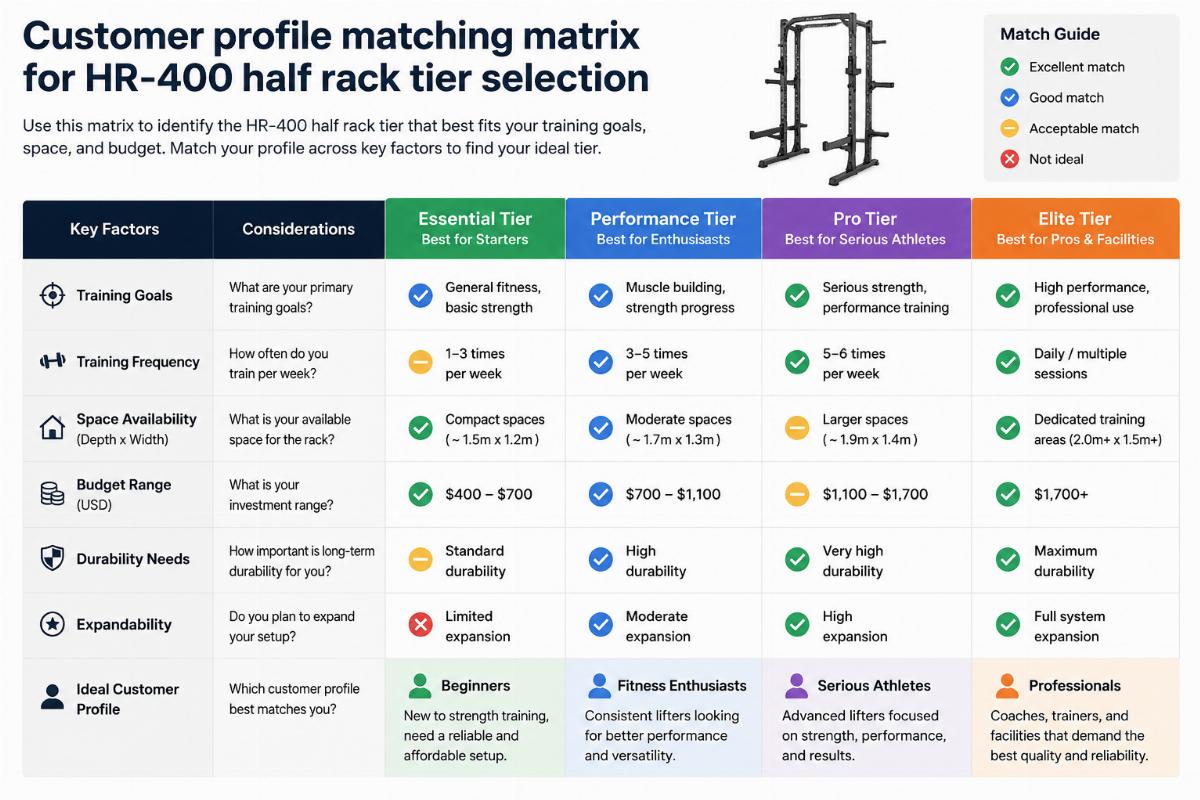
The spec sheet does not tell you which tier to buy. The customer profile does.
This is the part that most procurement guides skip, and it is the part that causes the most expensive mistakes. The HR-400 half rack technical data sheet lists both tiers with their respective specs. Choosing between them is not about which one is "better"—it is about which one matches the actual deployment scenario.
Commercial gym chains with high daily traffic and heavy member usage: The heavy-duty tier is the default choice. The reinforced gauge uprights and higher safety factor handle continuous loading cycles without deflection. The incremental per-unit cost is offset by the elimination of early structural failures and warranty claims.
Hotel and resort fitness centers: Usage frequency is typically lower, and member profiles tend toward moderate training intensity. The light-duty tier is often sufficient here, provided the environment is climate-controlled and the expected daily usage stays within moderate bounds. The lighter footprint also helps with layout flexibility in space-constrained hotel gyms.
Boutique studios and CrossFit boxes: These environments are deceptively demanding. Usage frequency may be lower than a big-box gym, but the training intensity—Olympic lifts, heavy deadlifts, high-rep WODs—generates dynamic forces that rival or exceed commercial gym levels. The heavy-duty tier is recommended here, particularly for the squat and pull-up stations.
Distributors building a product catalog for multiple markets: Offering both tiers allows matching the right product to each client segment. The HR-400 half rack technical data sheet provides the spec differentiation needed to position each tier correctly in the catalog, and the shared attachment compatibility across tiers simplifies inventory management.
A distributor in Africa initially ordered a full container of the light-duty tier for a chain of budget gyms. The gyms were in a hot, humid coastal city, and the members trained heavy. Within months, the distributor was fielding structural complaints. The next order was split: heavy-duty for the coastal locations, light-duty for the inland, climate-controlled sites. The return rate dropped to near zero.
What Attachments Are Compatible with HR-400?
Attachment compatibility is the difference between a rack that is just a rack and one that becomes the center of a functional training zone.
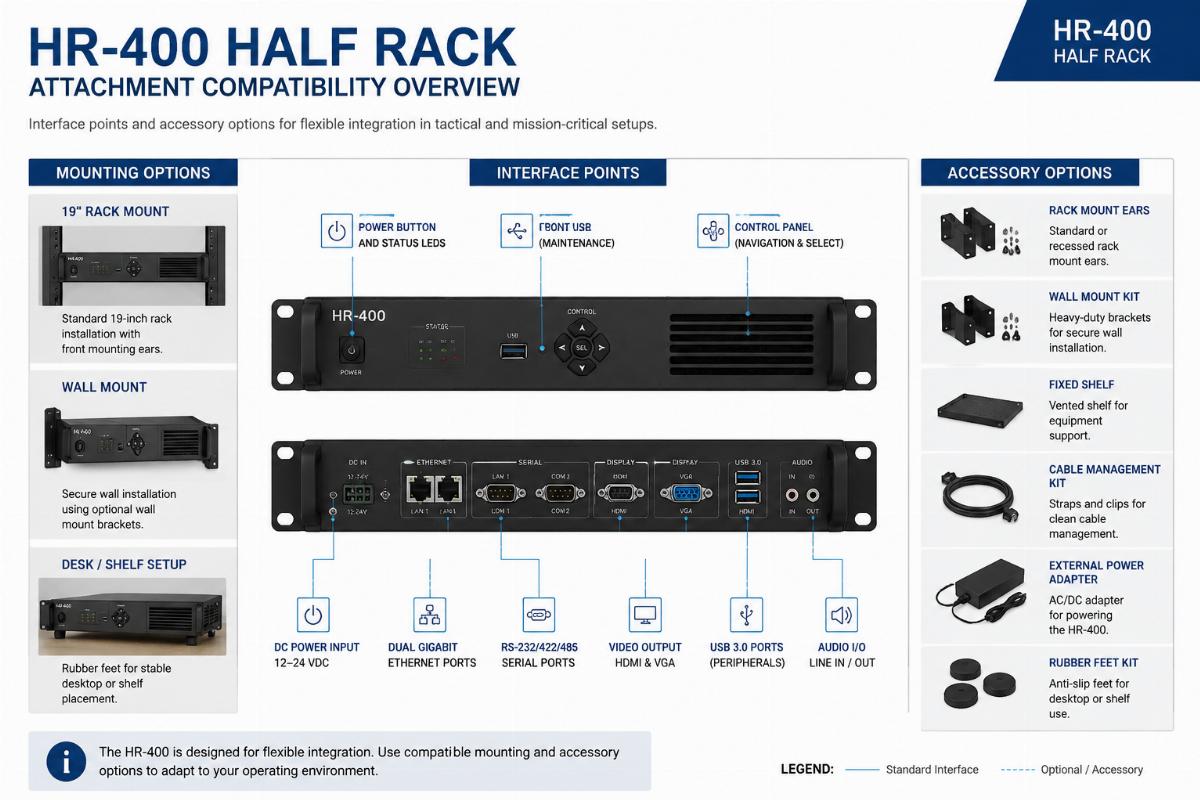
The HR-400 half rack technical data includes the interface specifications for attachments: hole diameter, hole spacing on the uprights, and mounting hardware type. These specifications determine which accessories can be added now and in the future, without requiring adapters or modifications.
Compatible attachments for the HR-400 series include:
- J-cups and safety straps: Adjustable across the full upright range, with spacing that allows precise barbell height setting for squats, bench press, and rack pulls.
- Pull-up bar variants: Multiple grip width options, mounted to the upright top section. The heavy-duty tier’s upright cross-section provides the rigidity needed for high-rep kipping pull-ups without flex.
- Dip attachments: Bolt-on or pin-in designs that mount to the upright face.
- Landmine and band pegs: Add-on accessories for rotational and resistance training.
- Storage horns: Plate storage pegs mounted to the rear or side of the uprights, keeping the training area clear.
The interface standardization across the HR-400 series means that attachments purchased for one tier will fit the other, simplifying procurement for buyers who deploy both tiers across different locations [NEED_CITE: attachment interface standardization across half rack product tiers].
A boutique studio operator in Europe started with a single heavy-duty HR-400 unit and added attachments incrementally as the training programs evolved. The initial investment in the heavy-duty tier paid off when the studio expanded to Olympic lifting workshops—the rack handled the dynamic loading without any upgrade needed, and the attachment ecosystem grew with the business.
Conclusion
The HR-400 half rack technical data sheet is a procurement decision tool, not a catalog page. Tube wall thickness, load rating methodology, footprint dimensions, and attachment compatibility are the variables that determine whether a rack installation succeeds or fails in the field. Matching those variables to the actual user profile—commercial chain, hotel gym, or boutique studio—is what separates a sound purchase from an expensive lesson.