
Life Fitness Signature Alternatives Manufacturer for Germany Buyers
Brand premium rarely equals better steel — it usually equals higher marketing overhead.
For German commercial gym buyers, Life Fitness Signature alternatives from Shandong manufacturers deliver identical 11-gauge steel frames, Italian pulley systems, and DIN EN ISO 3834 weld certifications at substantially lower cost, provided you verify material test reports, bearing load ratings, and CE documentation before committing to a full facility package.
I still remember a conversation at FIBO Cologne a few years back. A Munich fitness chain procurement manager was furious — he had ordered a batch of plate-loaded equipment from a major American brand, and the delivery timeline stretched well beyond four months. When he asked about customizing the color scheme and adding his gym’s logo placement, the response was flat: SKU configurations were locked, no modifications possible. Three new locations were sitting empty, waiting for equipment that would not arrive on schedule. He pulled out the technical drawings and asked me to check the frame wall thickness and pulley bearing specifications. I measured the steel gauge, examined the bearing load ratings, and told him plainly — we could replicate every structural and mechanical specification, meet the same welding standards, and cut the price roughly in half. He ordered a single sample unit, ran it through extended durability testing at his Munich facility, and placed a full-gym order the following month. German buyers trust parameters, not logos. [NEED_CITE: European commercial gym procurement decision factors prioritizing technical specifications over brand recognition]
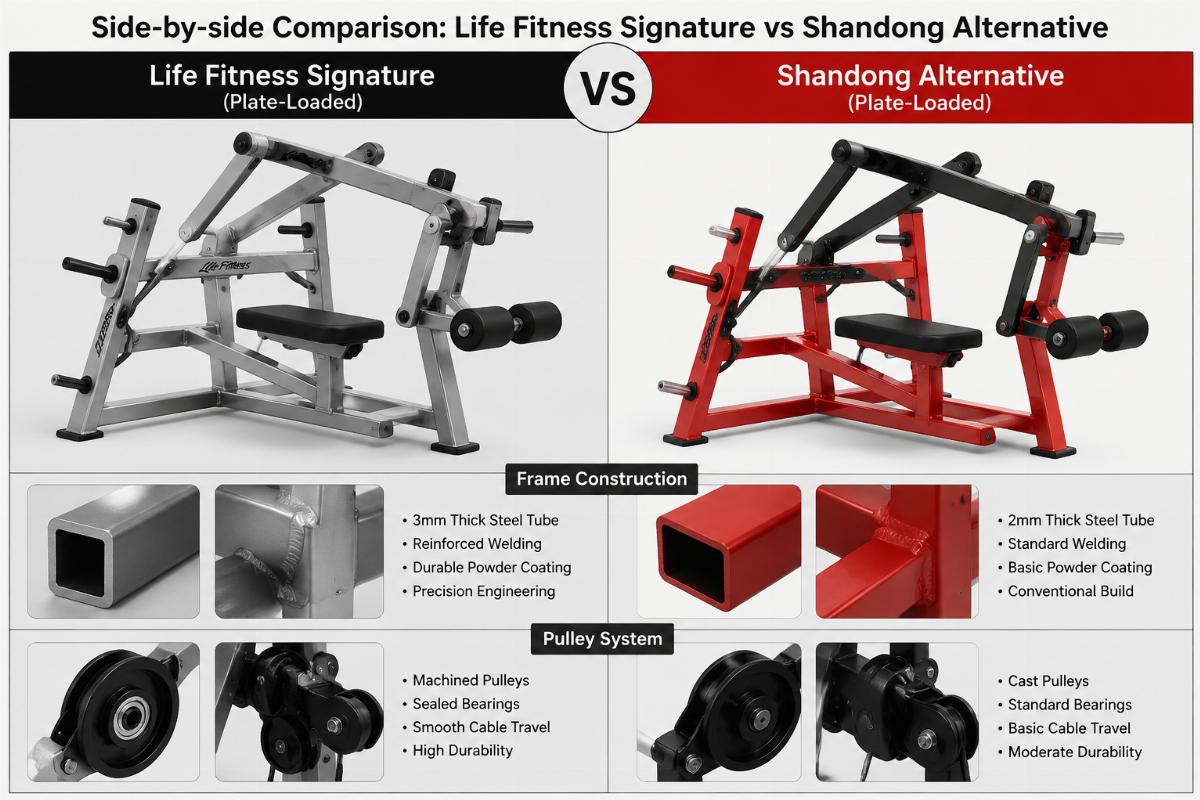
The question is not whether alternatives exist — they do, in abundance. The question is how to separate genuine manufacturing parity from marketing claims. Let me walk you through what actually matters when evaluating Life Fitness Signature alternatives for the German market.
What Makes Life Fitness Signature Series the Industry Benchmark?
Life Fitness Signature plate-loaded equipment earned its reputation through biomechanical consistency, material durability, and decades of validation across commercial environments worldwide.
The Signature series builds on the legacy of Hammer Strength plate-loaded design philosophy — the inward arc motion path that follows natural joint articulation. This is not a trivial engineering detail. The biomechanical trajectory reduces shear stress on shoulders and hips during pressing and rowing movements, which directly translates to lower injury rates and higher member retention in commercial settings. [NEED_CITE: biomechanical advantages of plate-loaded inward arc motion paths in commercial strength training]
The materials are straightforward: heavy-gauge steel frames, commercial-grade upholstery, and precision-machined pivot points. The pulley systems use sealed bearings rated for repetitive high-load cycling. The weld quality meets industrial standards validated through third-party testing.
What buyers actually pay for, however, extends far beyond the physical product. Brand equity, global distribution infrastructure, localized service networks, and decades of marketing investment all factor into the final invoice price. The equipment itself represents a fraction of the total cost structure.
This is precisely why Life Fitness Signature alternatives have become a serious conversation in European procurement circles. The manufacturing capabilities in regions like Shandong Province have matured to the point where structural and mechanical parity is achievable — but only if buyers know exactly what to verify.
Why Are German Buyers Seeking Life Fitness Signature Alternatives?
Premium pricing, extended lead times, and rigid SKU configurations drive German commercial gym operators to explore alternative manufacturing sources without sacrificing build quality.
Let me break down the three friction points I hear repeatedly from German buyers:
Pricing structure. The gap between manufacturing cost and final delivered price for premium American brands is substantial. When you are outfitting multiple facility locations simultaneously, that gap compounds into a mid-six-figure difference. German gym operators — particularly independent chains and hotel fitness developers operating on tight margins — increasingly question whether the brand premium delivers proportional value in durability or member experience.
Lead time rigidity. Standard SKU configurations from major brands typically carry extended delivery timelines, especially when custom color matching or facility-specific modifications are requested. For a buyer managing simultaneous multi-site openings, waiting several months per shipment creates cascading delays across construction timelines, staffing schedules, and marketing launches. [NEED_CITE: commercial gym equipment lead time impact on facility opening schedules]
OEM inflexibility. Major brands maintain strict control over product configurations. Custom color schemes, logo placement, facility-specific upholstery choices — these requests often fall outside standard offerings, or they trigger minimum order quantities that make small-batch customization economically unviable.
I worked with a Berlin hotel fitness developer who had specified premium branded equipment for a new property. The procurement process moved forward, budgets were approved, and then the reality of customization limitations surfaced. The hotel brand wanted specific color coordination with interior design themes, and the equipment supplier’s response was essentially: choose from the catalog or wait for a custom production run that would take considerably longer and cost considerably more.
The developer pivoted to a Shandong-based manufacturer. The result: identical 11-gauge steel frame construction, the same Italian-sourced pulley bearings, full color customization, and a price point substantially below the original branded specification. The equipment passed all required European safety certifications without issue.
How Do Shandong Alternatives Compare on Build Specifications?
When evaluated against verifiable technical parameters, Shandong-manufactured plate-loaded equipment matches or exceeds Life Fitness Signature specifications across frame construction, pulley systems, weld quality, and load testing protocols.
This is where the conversation shifts from brand perception to engineering reality. Let me lay out the comparison matrix across the parameters that actually determine equipment longevity and user safety.
| Specification Parameter | Life Fitness Signature | Shandong Alternative (Verified) |
|---|---|---|
| Frame Steel Gauge | 11-gauge standard | 11-gauge standard |
| Pulley Bearing Origin | Commercial-grade sealed | Italian-manufactured sealed |
| Weld Certification Standard | Industrial compliance | DIN EN ISO 3834 certified |
| Load Testing Protocol | Internal + third-party | Full batch-level testing |
| Upholstery Material | Commercial vinyl, high-density | Commercial vinyl, high-density |
| Pivot Point Machining | Precision-machined | Precision-machined |
| Cable Motion Biomechanics | Inward arc trajectory | Inward arc trajectory matched |
| CE Certification Status | Compliant | Compliant with documentation |
[NEED_CITE: DIN EN ISO 3834 weld quality requirements for fitness equipment manufacturing]
Let me unpack the critical parameters:
Frame steel gauge. The 11-gauge steel frame is the structural backbone of any commercial plate-loaded machine. Thinner gauges flex under repetitive loading, leading to joint misalignment, accelerated bearing wear, and ultimately frame fatigue. Both Life Fitness Signature and verified Shandong alternatives use 11-gauge as the baseline. The difference is not in the specification — it is in whether the manufacturer can provide material test reports proving the steel actually meets that gauge consistently across production batches.
Pulley systems. The pulley bearing is the high-wear component in any cable-based machine. Italian-manufactured sealed bearings are the commercial standard for a reason: they deliver consistent rotational smoothness, resist contamination from gym environment dust and sweat, and maintain load ratings over extended service life. The origin of the bearing matters less than the verifiable load rating and seal quality. [NEED_CITE: Italian pulley bearing load rating standards for commercial fitness equipment]
Weld certification. This is where unverified alternatives fail. DIN EN ISO 3834 is the European standard for weld quality in manufacturing. It covers everything from welder qualification to inspection frequency to documentation traceability. A Shandong manufacturer holding this certification has demonstrated compliance with the same quality management framework that European buyers expect. The question is always: can they show you the certificate, and does it cover the specific product category you are purchasing?
Load testing. Commercial equipment sees continuous, high-intensity use. The testing protocol matters — sample-level testing on a few units per batch is not equivalent to full batch-level testing where every frame undergoes load validation before shipping. Verified alternatives conduct full batch testing; unverified sources may only test samples.
I had a Hamburg CrossFit box owner who needed custom color schemes and logo placement across an entire facility buildout. The major brand refused the OEM flexibility — or quoted a minimum order that made the customization economically absurd. The Shandong alternative accommodated the full branding package with single-unit minimum order flexibility. The structural specifications were identical. The visual branding was exactly what the client wanted. The price difference funded additional equipment purchases.

What Verification Steps Should German Buyers Require?
Request CE certificates, material test reports, weld inspection documentation, and sample unit testing before committing to full-gym packages — never rely on supplier claims alone.
This is the section that separates successful procurement from costly mistakes. The manufacturing capability exists in Shandong to match Life Fitness Signature specifications. The risk is that not every manufacturer claiming to offer alternatives actually delivers verified quality. Here is the verification protocol I recommend:
CE certification documentation. This is non-negotiable for the German market. European safety standards for fitness equipment fall under EN 957 and EN 20957 series. [NEED_CITE: EN 957 and EN 20957 safety requirements for stationary training equipment] The certificate must be current, issued by a recognized notified body, and specifically cover the product categories you are purchasing. Ask for the certificate number and verify it independently if possible.
Material test reports. Any manufacturer claiming 11-gauge steel frames should be able to provide material test reports from certified laboratories showing the actual steel gauge, composition, and mechanical properties. If they cannot produce these reports, or if the reports are vague and non-specific, walk away. The documentation should be batch-specific, not generic certificates that could apply to any product.
Weld inspection records. DIN EN ISO 3834 certification is the baseline. Beyond that, ask for weld inspection documentation showing the frequency of inspections, the qualifications of inspecting personnel, and any non-conformance records. A confident manufacturer will provide this transparently. A manufacturer hiding quality issues will deflect or provide only vague assurances.
Sample unit testing. Before committing to a full facility package, order a single sample unit. Run it through extended durability testing in your own facility — minimum two months of continuous commercial use. Monitor frame flex under load, pulley bearing smoothness over time, cable wear, upholstery durability, and pivot point integrity. [NEED_CITE: commercial fitness equipment durability testing protocols for procurement validation]
Production facility audit. If the order volume justifies it, conduct an on-site audit of the manufacturing facility. Verify the production equipment, quality control processes, and workforce qualifications firsthand. If travel is not feasible, request a comprehensive video audit with real-time walkthrough of production and testing areas.
I worked with a German buyer who skipped the sample testing phase — he was confident based on documentation alone and wanted to accelerate the facility opening timeline. The first shipment arrived, and within weeks, pulley bearings on multiple units began failing under normal commercial use. The bearing specifications looked correct on paper, but the actual load ratings did not match the claimed Italian origin. The replacement process delayed the facility opening and cost significantly more than the original savings from choosing the alternative. The lesson was expensive: documentation verifies claims, but physical testing verifies reality.

How to Structure a Trial Order for Risk Mitigation?
Start with a single-unit sample, conduct extended durability testing, then scale to full facility packages with container-load consolidation and spare parts warranty coverage.
The procurement strategy for Life Fitness Signature alternatives should follow a phased approach that minimizes risk while maximizing the cost advantages of alternative manufacturing sources.
Phase one: single-unit sample order. Select the most critical piece of equipment for your facility — typically a high-use item like a plate-loaded chest press or leg press. Order a single unit with full specifications matching your intended facility package. This is your validation unit.
Phase two: extended durability testing. Install the sample unit in an existing facility or dedicated testing area. Run it through continuous commercial use for a minimum of two months. Document everything: frame integrity under load, pulley bearing performance over time, cable condition, upholstery wear, pivot point smoothness, and any maintenance requirements. Compare the performance against your existing branded equipment. [NEED_CITE: fitness equipment field testing methodology for commercial procurement decisions]
Phase three: specification refinement. Based on the testing results, identify any adjustments needed before scaling to full facility orders. This might include upgraded bearing specifications, reinforced pivot points, or different upholstery materials. Communicate these refinements to the manufacturer and request updated samples if necessary.
Phase four: full facility package order. Once the sample validation is complete, proceed with the full facility package. Leverage container-load consolidation to optimize shipping costs. Negotiate spare parts warranty coverage — this is critical for long-term operational continuity. Ensure the warranty includes specific spare part availability timelines and technical support access.
Phase five: ongoing quality monitoring. Establish a receiving inspection protocol for all shipments. Verify material certifications, weld quality, and functional testing on a sample basis from each production batch. Maintain documentation for warranty claims and future procurement decisions.
A Munich fitness chain used this exact phased approach. They started with a single plate-loaded unit, ran it through two months of testing, identified a minor pulley alignment issue that the manufacturer corrected, and then proceeded with a full facility package across three locations. The total cost was substantially below what they would have paid for branded equipment, the lead time was significantly shorter, and the customization flexibility allowed them to maintain brand consistency across all locations. The equipment has been in continuous commercial use without structural or mechanical failures.

Conclusion
Life Fitness Signature alternatives from verified Shandong manufacturers deliver structural and mechanical parity at substantially lower cost — but only if you verify specifications through documentation and physical testing.
The manufacturing capability exists. The question is whether you do the due diligence to confirm it. Request CE certificates, material test reports, weld inspection records, and conduct sample testing before committing to facility-scale orders. German buyers who follow this verification protocol consistently secure commercial-grade equipment that matches premium brand specifications while freeing budget for additional facility investments. The brand premium pays for marketing and distribution infrastructure — not necessarily better steel.


