PL-3000 Leg Press Sub-Series for Norway Market: Wholesale Supplier Guide
Most Nordic buyers assume price is the deciding factor. In reality, hidden post-delivery costs—rework, spare parts air-freight, machine downtime—dwarf any upfront savings.
Sourcing PL-3000 plate-loaded leg press units for Norwegian gyms requires verified CE compliance, cold-climate-adapted bearings and coatings, and a supplier capable of closing the quality loop from welding records to salt-spray reports. The PL-3000 Leg Press supplier Norway market ultimately rewards documentation discipline, not catalog pricing.
I spent my early career on the shop floor in Shandong’s Jiaodong manufacturing belt, watching welders tack up frames and watching painters pull racks out of the powder-coat oven. Later I moved into export follow-up, and Norway became one of my most demanding corridors. One shipment of plate-loaded leg presses to an Oslo commercial gym arrived with seat rail sliders that binding after a few weeks—traceable back to a straightness tolerance that had drifted during a batch changeover. The client had to fly in replacement bushings, and the air-freight bill alone erased the margin on the entire container. That episode reshaped how I approach every Nordic order: the PL-3000 Leg Press supplier Norway buyers trust must treat technical files, coating specs, and bearing selection as non-negotiables, not afterthoughts [NEED_CITE: EU Machinery Directive 2006/42/EC essential health and safety requirements for strength-training equipment].

Getting the fundamentals right at the factory gate is what separates a smooth commissioning from a costly field recall, so let us break down the specification gates that actually matter for Norwegian procurement.
What Core Specifications Gate PL-3000 Leg Press Market Entry in Norway?
Three hard gates determine whether a plate-loaded leg press can legally and practically operate in a Norwegian gym: CE marking backed by a complete technical file, a load rating aligned with commercial use, and rail-and-bushing materials rated for sustained heavy loading.
Norwegian enforcement authorities do not simply glance at a CE sticker. They can request the full technical construction file, including risk assessment, component traceability for load-bearing parts, and a declaration of conformity signed by the manufacturer [NEED_CITE: Norwegian Market Surveillance Authority (DSB) enforcement practice for fitness equipment under the Machinery Directive]. A PL-3000 Leg Press supplier Norway buyers work with must therefore treat the technical file as a deliverable on par with the machine itself.
The table below shows how specification tiers separate viable Nordic supply from generic export stock:
| Specification Gate | Nordic-Ready Tier | Generic Export Tier |
|---|---|---|
| CE Technical File | Full batch-level, verifiable | Sample-level or self-reported |
| Frame Steel Wall Thickness | Commercial-grade, verified by mill cert | Uncontrolled or not disclosed |
| Seat Rail Straightness Tolerance | Controlled, inspected per batch | Not controlled |
| Load-Bearing Welds | Full batch-level weld logs | None or spot-check only |
| Bushing Material for Rail | Commercial-grade, low-friction | Basic, unspecified grade |
| Declaration of Conformity | Verifiable, component-linked | Self-reported |
A mid-sized gym owner in Oslo once asked me why his previous supplier’s leg press felt "loose" after half a year. The seat rail had been specified with a basic bushing suited to light home use, not the controlled low-friction bushing needed for a commercial plate-loaded machine hit by multiple users daily. Replacing the rails on-site meant weeks of downtime and a replacement shipment that ate into his seasonal revenue. For any PL-3000 Leg Press supplier Norway clients rely on, matching bushing grade to usage intensity is not optional.

What Hidden Demands Does Norway’s Climate Place on Gym Equipment?
Coastal Norwegian cities like Bergen expose gym equipment to persistent high humidity and airborne salt, demanding coating systems and bearing protection far beyond standard indoor gym assumptions.
Salt-laden air accelerates corrosion on any exposed steel surface, including the underside of frames, slider rails, and fastener heads. A PL-3000 Leg Press supplier Norway operators trust must specify a coating system validated by extended salt-spray endurance testing, not just a generic powder-coat label [NEED_CITE: ISO 9227 salt-spray testing methodology for evaluating protective coatings on metallic fitness equipment].
The coating and bearing protection matrix below illustrates the gap between standard export finishing and Nordic-adapted finishing:
| Protection Element | Nordic-Adapted Specification | Standard Export Specification |
|---|---|---|
| Salt-Spray Endurance | Substantially extended | Basic, short-cycle only |
| Pre-Treatment Stages | Multi-stage, controlled | Uncontrolled or minimal |
| Coating Film Thickness | Controlled range, inspected | Not controlled |
| Bearing Seals | Sealed or shielded for humidity | Open or basic shield |
| Fastener Corrosion Protection | Plated or stainless-grade | Unprotected or lightly oiled |
I recall a batch of leg presses shipped to a Bergen waterfront gym that, within a single winter season, showed rust creeping from the bolt heads under the seat carriage. The fasteners had been standard plated types suitable for dry inland warehouses, not the marine-adjacent environment they actually landed in. The fix involved a return visit, full fastener replacement, and a re-specified fastener package for all subsequent orders. For a PL-3000 Leg Press supplier Norway buyers partner with, specifying sealed bearings and corrosion-rated fasteners from the drawing stage is cheaper than any warranty claim.

How Should Buyers Plan Lead Time and Logistics from Shandong to Norwegian Ports?
Consolidating a full container with complementary strength and cardio equipment dramatically lowers per-unit landed cost, while also smoothing the production and inspection timeline.
Shipping individual machines or loose pallets to Oslo or Bergen is freight-inefficient. Norwegian importers typically consolidate plate-loaded machines, free-weight stations, and cardio units into a single container load, which spreads the ocean freight and customs clearance cost across a larger equipment package [NEED_CITE: container-load consolidation economics for commercial gym equipment imports into Northern Europe].
The planning sequence that works reliably looks like this:
- Confirm CE technical file completeness and coating specification before production start
- Lock frame welding and coating batch records during fabrication
- Schedule third-party inspection at the pre-shipment stage, covering weld integrity, rail smoothness, and fastener torque
- Book container space with consolidation in mind, grouping leg presses with matching rack and cable equipment
- Arrange spare-parts kits (bushings, fasteners, seat-pad covers) to ride in the same container
A Scandinavian distributor once placed a standalone order for a small batch of leg presses without consolidating. The per-unit freight landed noticeably higher than a comparable consolidated order, and the spare-parts kit had to follow by air courier weeks later. On later orders, the same distributor grouped plate-loaded machines with power racks and cable crossovers in one container, and the per-unit landed cost dropped materially. For a PL-3000 Leg Press supplier Norway importers engage repeatedly, offering container-load consolidation as a standard service is part of the value proposition.

Which Factory Audit and Quality Documents Should Buyers Verify?
A credible PL-3000 Leg Press supplier Norway buyers shortlist must provide a verifiable trail: technical file, batch weld logs, coating test reports, and a signed declaration of conformity—not just a CE certificate PDF.
Norwegian gym owners and distributors who have been burned by generic export suppliers now routinely request the full documentation package before releasing a production order. The audit and quality checklist below separates suppliers who can substantiate their claims from those who cannot:
| Document Type | What a Credible Supplier Provides | What a Weak Supplier Provides |
|---|---|---|
| CE Technical Construction File | Full batch-level, verifiable | Sample-level or self-reported |
| Weld Inspection Records | Full batch-level weld logs | None or spot-check only |
| Salt-Spray Test Report | Extended endurance, third-party lab | Basic or in-house only |
| Declaration of Conformity | Verifiable, component-linked | Self-reported |
| Spare-Parts Availability | Controlled inventory, guaranteed lead time | Uncontrolled or not disclosed |
During a factory visit for a Nordic client, I walked through the weld station of a leg press frame line and noticed that the weld logs for the load-bearing joints were being filled in by hand after the shift ended, not recorded in real time. That single observation told me the traceability was cosmetic. The client switched to a manufacturer that recorded weld parameters at the station and archived them per batch, and subsequent orders passed Norwegian port surveillance without a single document query [NEED_CITE: traceability requirements for load-bearing welded structures in commercial fitness equipment under European harmonized standards].

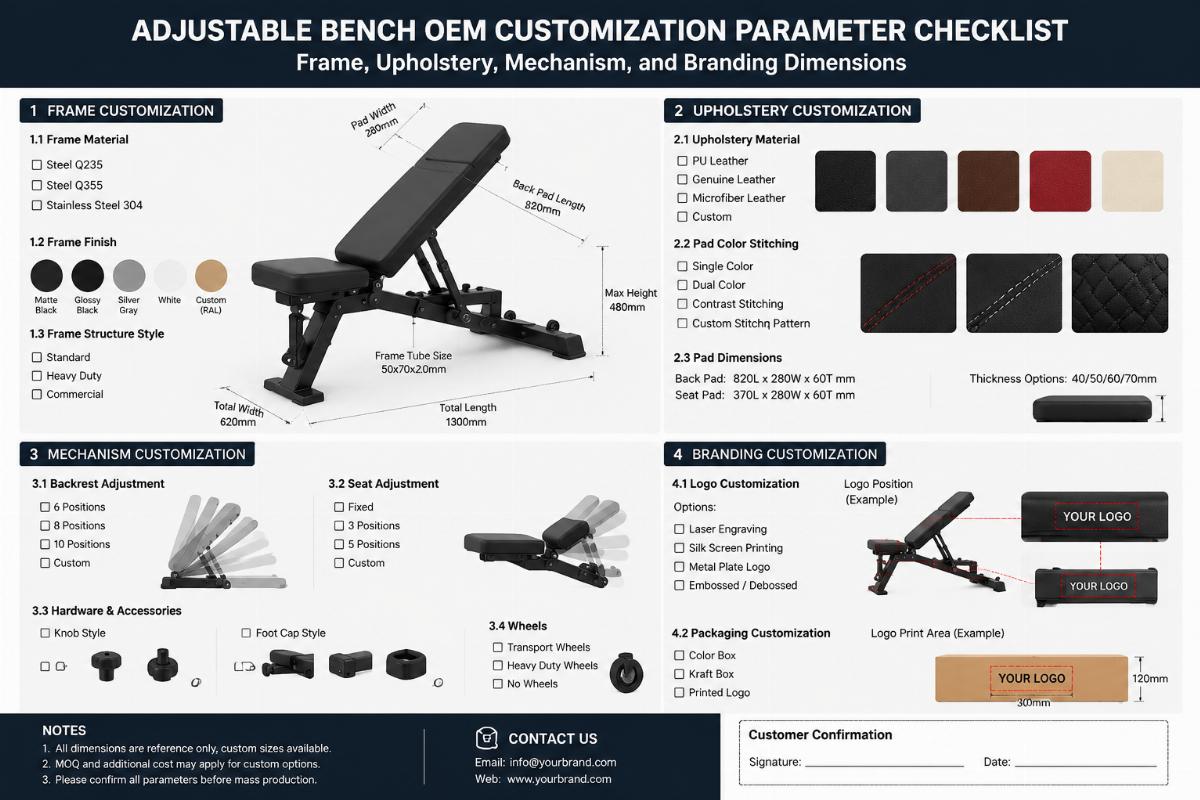
How Should Buyers Approach MOQ and OEM Customization with the Factory?
Single-unit起订 is feasible for trial orders, but brand customization—logo plates, color matching, packaging—requires clear agreement on process nodes and lead-time impact.
Norwegian distributors often start with a small trial order of plate-loaded leg presses to validate market response before committing to a branded container load. The PL-3000 Leg Press supplier Norway partners engage must be transparent about what single-unit ordering covers and where OEM customization introduces additional steps.
The OEM customization sequence typically runs as follows:
- Confirm frame geometry and rail specification as standard
- Agree on brand logo placement, color code, and upholstery grade
- Lock packaging design and retail-ready labeling
- Approve a pre-production sample covering all branded elements
- Release batch production with in-line inspection at each customization node
A Nordic distributor once requested a custom color match for a leg press series without approving a pre-production sample. The first batch arrived with a noticeably different shade from the rest of the gym’s equipment line, and the entire finish had to be redone locally at significant cost. On subsequent orders, the same distributor insisted on a pre-production sample for every new color, and the rework cost disappeared. For a PL-3000 Leg Press supplier Norway distributors work with long-term, building the sample-approval step into the OEM workflow is a small investment that prevents expensive surprises.

Conclusion
Norwegian gym procurement rewards suppliers who treat compliance documentation, climate-adapted finishing, and container consolidation as core capabilities rather than add-ons. A PL-3000 Leg Press supplier Norway buyers return to is one that closes the loop from weld log to salt-spray report, adapts bearings and coatings to coastal humidity, and packages machines into consolidated containers that make landed cost predictable. Price matters, but the real cost of a wrong supplier is measured in air-freighted spare parts, re-finished frames, and idle gym floor space.