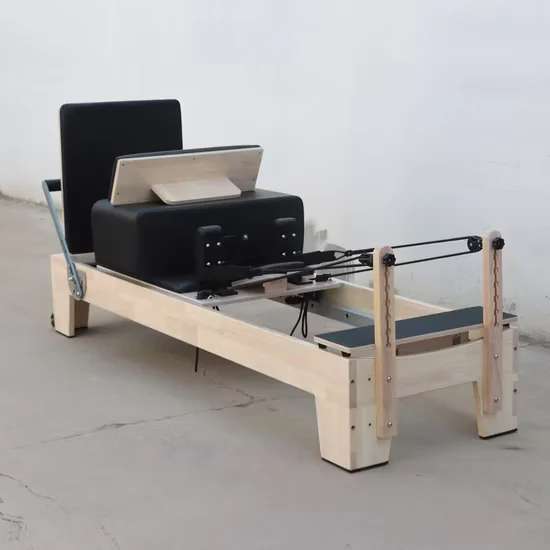
01 / Scenario
STUDIO
P
High-End Pilates Studios
Premium aesthetics meet quiet operation for boutique studio environments.

ISO
9001
CE
Certified
OEM
Available
10YR
Warranty
Aluminum Alloy Pilates Reformer, 2570×730mm Footprint, 90kg Net Weight — constructed with aluminum alloy frame and supplied with long box, jump board, and platform for full-range home and boutique studio use. Customization and private label options are available for branding requirements. Backed by a 3-year warranty with full OEM-ODM capability for tailored specifications.
// Spec Highlights
• Direct from Manufacturer · No Middlemen · Worldwide Shipping
01
// Material
Imported Solid Wood
Premium hardwood frames sourced for density and visual warmth.
02
// Hardware
Medical-Grade Silent
Whisper-quiet pulleys and springs for clinical environments.
03
// Customization
Appearance OEM
Color, upholstery, and branding tailored to your studio.
04
// Service
Layout Design
Free venue planning for studios and rehab institutions.
Every component is selected for longevity, performance, and aesthetic harmony - from imported hardwood frames to silent medical-grade accessories.
// Features
Aluminum Frame Integrity — Alloy extrusion with verified wall thickness resists rail deflection under daily carriage travel.
| Parameter | Value |
|---|---|
| Product Type | Pilates Reformer |
| Frame Material | Aluminium Alloy |
| Frame Color | White (customization available) |
| Product Dimensions | 2570 × 730 × 270 mm |
| Net Weight | 90 kg |
| Included Accessories | Long Box, Jump Board, Platform |
| Logo Customization | Available on request |
| Warranty | 3 Years |
| Facility Type | Typical Use |
|---|---|
| Home Pilates studio | Daily reformer practice in residential spaces where portability matters |
| Boutique Pilates facility | Small-group classes with frequent accessory swaps between sessions |
| Rehabilitation and physiotherapy center | Low-impact controlled movement for post-injury recovery programs |
The failure always starts at the rail-to-carriage interface, not the frame tube itself.
Most buyers compare Pilates reformers by upholstery color and spring count while ignoring the single component that determines whether the carriage still tracks straight after two years. I have pulled back reformers where the aluminum rail showed visible bowing under nothing more than repeated bodyweight loading — the alloy was too thin-walled, and the carriage wheels had worn a groove into the soft extrusion. An aluminum alloy Pilates reformer for home use lives or dies by its section modulus: the cross-sectional profile and wall thickness of the rail channel. [NEED_CITE: structural deflection criteria for aluminum extrusions under cyclic loading]
This reformer covers the full sagittal-plane repertoire — footwork, leg circles, short spine, and long stretch series — while the included jump board adds plyometric loading and the long box enables prone pulling and seated arm work. In a home studio or compact boutique space, a single aluminum alloy Pilates reformer for home replaces three or four pieces of isolated equipment. The platform attachment extends the working surface for standing balance drills. Users from approximately 155 cm to 190 cm can find comfortable range-of-motion limits within the 2570 mm bed length.
Every stroke of the carriage imposes a lateral moment on the rail channel, and over hundreds of cycles per week those micro-deflections accumulate at the mounting bolt lines. The carriage wheels press into the alloy track with each direction reversal, creating contact stress that depends entirely on the hardness and wall thickness of the extrusion. Sweat and cleaning agents introduce surface corrosion at the bolt heads and any exposed raw alloy edges. [NEED_CITE: fatigue behavior of aluminum alloy structures under repetitive low-amplitude loading]
The 90 kg net weight of this unit signals a substantial alloy section rather than a hollowed-out lightweight shell — lighter frames sacrifice wall thickness and introduce lateral play within the first year. The 2570 mm length provides full extension clearance for taller users without requiring a separate extension rail. The included long box, jump board, and platform share a common mounting interface with the main frame, which means the connection points must be machined to tight tolerances; any gap at the accessory joint translates directly into wobble during single-leg or standing exercises. Aluminum alloy extrusions hold those tolerances well when the die is properly maintained, and the white powder-coated finish seals the surface against oxidization in humid home environments.
Thinner alloy extrusions reduce shipping weight and material cost upfront, but they introduce rail deflection that makes the carriage drift off-center during unilateral exercises. Once the wheel track develops a wear groove, the carriage will never run smoothly again regardless of lubrication. Non-standard accessory mounts mean that a cracked long box bracket cannot be replaced without returning the entire unit. Low-density upholstery on the carriage pad compresses permanently within months of daily use, leaving the user pressing against the aluminum base plate. [NEED_CITE: wear progression in unlubricated aluminum-on-polymer sliding contacts]
The 2570 × 730 mm footprint fits comfortably within a residential spare room or a boutique studio bay, and the 90 kg aluminum alloy frame is light enough for one person to reposition when cleaning or reconfiguring the floor plan — no floor anchors required. The three-year warranty covers structural frame integrity, giving facility operators confidence for multi-year class schedules. Custom logo placement allows boutique studios to maintain brand consistency across equipment. OEM customization options let buyers specify frame finish and upholstery grade to match existing studio interiors.
Provide your studio floor dimensions and the number of reformer bays planned so that a 2D layout can confirm clearance and traffic flow between stations. Specify daily class frequency and average user bodyweight range to determine whether the standard carriage and spring configuration matches your load profile. Indicate any custom frame finish, upholstery color, or logo placement requirements at the time of inquiry to align production lead times.
Q: How does an aluminum alloy frame compare to a steel frame for home use?
A: Aluminum alloy offers a significant weight reduction that makes the reformer practical to move within a residential setting, while a steel frame provides higher absolute rigidity. For home environments where the unit may need to be repositioned for cleaning or space flexibility, the lighter alloy frame is functionally preferable as long as the extrusion wall thickness is sufficient to resist long-term rail deflection.
Q: What indicates that the rail system will hold up under regular use?
A: The key indicators are the aluminum alloy grade, the wall thickness of the rail extrusion, and the precision of the carriage wheel fit inside the channel. A properly specified alloy rail will show no visible lateral play when the carriage is pushed side-to-side by hand, and the wheel contact surface should remain smooth without grooving even after months of repeated directional reversals.
Q: Are the long box, jump board, and platform interchangeable with other reformers?
A: These accessories are designed to match the mounting interface on this specific frame. Cross-compatibility with other brands is not guaranteed because bolt hole spacing, bracket geometry, and connection tolerances vary between manufacturers. When ordering replacement accessories, confirm they are specified for this exact reformer model to avoid fitment gaps that cause wobble during use.
Q: What does routine maintenance look like for a home-based reformer?
A: Monthly inspection of carriage wheel surfaces, rail channel cleanliness, and spring attachment points covers the critical wear areas. The aluminum frame requires only wiping with a pH-neutral cleaner to prevent sweat corrosion. Fastener torque should be rechecked quarterly, and any lateral play in the carriage indicates that wheel or rail wear has progressed to the point where component replacement is needed.
Q: What happens when the upholstery on the carriage pad wears out?
A: The upholstery panel can be replaced independently of the carriage frame. When the pad no longer recovers its shape between sessions, contact the supplier for a replacement cover matched to the original density specification. Replacing the pad before it compresses fully prevents the user from pressing directly against the aluminum carriage base, which causes discomfort and accelerates fabric tearing at the mounting edges.
Premium aesthetics meet quiet operation for boutique studio environments.
Medical-grade silence and precision for sports & postpartum recovery.
Furniture-grade craftsmanship for premium residential installations.
Compact premium setups for one-on-one and small-group training.
Aesthetic Pilates integration for hybrid wellness studio programming.
Multi-unit deployment with instructor-grade reliability for certification programs.
Tell us about your project. Our team will respond within 24 hours with pricing, customization options, and shipping details.
// Sales Director
William
+86 132 2531 1800
// Export Manager
Bella
+86 198 5412 8032
william@bickfit.com