
01 / Scenario
STUDIO
P
High-End Pilates Studios
Premium aesthetics meet quiet operation for boutique studio environments.
ISO
9001
CE
Certified
OEM
Available
10YR
Warranty
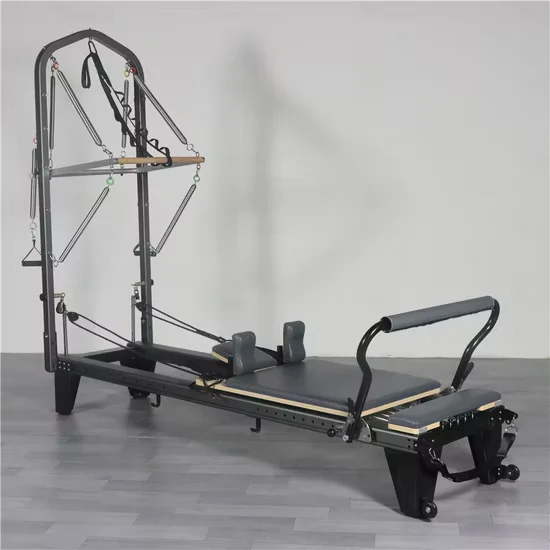
Commercial Pilates Reformer with Tower, Aluminium Alloy Frame, 2390×900×1960mm Dimensions — engineered for high-traffic studio environments with modular accessory integration including long box, jump board, and platform. The 120kg net weight and aluminium construction balance structural rigidity with manageable repositioning for multi-class facility layouts. Backed by a 3-year warranty and customizable branding options for studio identity alignment.
Every unit undergoes load verification testing prior to shipment, ensuring glide rail precision and spring tension consistency for demanding studio schedules.
// Spec Highlights
• Direct from Manufacturer · No Middlemen · Worldwide Shipping
01
// Material
Imported Solid Wood
Premium hardwood frames sourced for density and visual warmth.
02
// Hardware
Medical-Grade Silent
Whisper-quiet pulleys and springs for clinical environments.
03
// Customization
Appearance OEM
Color, upholstery, and branding tailored to your studio.
04
// Service
Layout Design
Free venue planning for studios and rehab institutions.
Every component is selected for longevity, performance, and aesthetic harmony - from imported hardwood frames to silent medical-grade accessories.
// Features
Mill-Traceable Aluminium — Every extrusion batch is tied to the alloy certificate, so you know exactly what is carrying your clients.
| Parameter | Value |
|---|---|
| Product Type | Pilates Reformer with Tower |
| Frame Material | Aluminium Alloy |
| Color | Black (custom color available on request) |
| Accessories Included | Long Box, Jump Board, Platform |
| Product Dimensions | 2390 × 900 × 1960 mm |
| Net Weight | 120 kg |
| Upholstery | Standard or high-density options available |
| Customization | Logo and color customization available |
| Production Capacity | 80 Pieces per Month |
| Warranty | 3 Years |
| Facility Type | Typical Use |
|---|---|
| Pilates studio | Daily group and private reformer sessions with tower-based resistance work |
| Boutique fitness studio | Hybrid classes combining reformer sequences with tower spring drills |
| Rehabilitation and physiotherapy center | Low-impact controlled resistance protocols under clinical supervision |
| Hotel and resort wellness facility | Guest-accessible reformer stations with supervised introductory sessions |
| Home studio | Private training environment with full tower attachment versatility |
The frame either holds tolerance or it does not — there is no middle ground once the carriage starts oscillating eight hours a day.
Many studios purchase reformers labelled "commercial grade" without ever seeing a wall-thickness spec or an alloy designation. Six months into heavy scheduling, the carriage develops lateral play, the rails show wear tracks, and the tower upright begins to deflect under spring tension. I have seen carbon steel rails in humid southern climates seize up in under half a year because the bearing seats were never sealed — pulleys grinding against corroded tracks while clients wonder why the movement feels rough [NEED_CITE: EN 957 structural requirements for stationary training equipment]. That failure mode is exactly why this commercial aluminium pilates reformer with tower uses an alloy frame with sealed bearing interfaces from the outset.
This reformer covers sagittal, frontal, and transverse plane work through the carriage and tower combination — spinal articulation, hip flexion and extension, rotational core control, and loaded lower-limb patterns. In a studio layout it pairs with mat zones and cadillac units to create a complete apparatus circuit without redundant floor space. The 2390 × 900 mm footprint fits standard studio bay widths while leaving lateral clearance for instructor access. It accommodates users across a wide height range thanks to adjustable spring anchor points and the long box platform. The commercial aluminium pilates reformer with tower is suited to studios running back-to-back classes where equipment turnover is constant and reconfiguration time must stay minimal.
Every carriage return generates an impact load at the end stop — multiply that by forty sessions a week and the fatigue cycle count climbs fast. The aluminium rail surface must resist micro-abrasion from the carriage wheels over thousands of travel cycles, and the tower upright must hold vertical alignment under asymmetric spring loading. Weld joints at the tower base are the critical stress concentration zone; any porosity there propagates under cyclic tension [NEED_CITE: weld classification and fatigue performance in structural aluminium]. The upholstery endures compressive cycling and shear from client contact, while cleaning chemicals and sweat residue attack the powder coating at every hand-contact point. Bearing seals face fine particulate ingress from studio flooring dust combined with moisture — an unsealed race degrades within months in this environment.
Aluminium alloy as a frame material offers a strength-to-weight ratio that keeps the net weight at 120 kg while preserving the structural rigidity needed for loaded tower exercises — the extrusion profile geometry matters as much as the alloy grade. The carriage rail interface determines whether the glide remains consistent or develops stick-slip behaviour after the first thousand cycles; precision-machined rail surfaces paired with sealed bearings eliminate that degradation path. Spring anchor configuration across multiple resistance levels allows instructors to scale load without swapping hardware between clients. Upholstery density and cover material dictate whether the padding compresses permanently under daily use or retains its profile through the warranty period. The three-year warranty reflects confidence in these structural decisions — it is a statement about fatigue life, not a marketing line.
Thin-wall aluminium extrusions deflect under tower spring tension, and the carriage develops a wandering travel path that clients feel immediately. Unsealed bearings in humid studio environments accumulate moisture and dust, turning smooth glide into audible grinding — and no amount of lubricant fixes a contaminated race. Low-density foam padding compresses permanently under repeated use, forcing studios to order replacement upholstery or live with visible deformation. Inadequate surface treatment on aluminium shows oxidation spots where cleaning agents pool at joints, and those marks are permanent. Non-standard hardware sizes mean replacement springs or pulleys are backordered indefinitely when a component wears out [NEED_CITE: fatigue and wear patterns in commercial fitness equipment components].
The aluminium extrusions are sourced with mill certification so the alloy composition and temper are documented, not guessed. Robotic MIG welding produces continuous weld lines at the tower base and frame joints — no spot-weld shortcuts that crack under cyclic loading. Every unit is load-tested before packing, not pulled from a batch sample. The 200μm industrial powder coating protects against sweat corrosion and cleaning chemical attack at contact points. The three-year structural warranty is backed by a manufacturing facility with seventeen years of equipment production history. Floor planning support includes 2D and 3D CAD layouts so the 2390 × 900 mm footprint is placed with correct instructor clearance and emergency egress spacing. OEM customization — logo, colour, upholstery — is handled in-house without third-party relabeling.
Provide your studio floor area and target apparatus count to receive a 2D or 3D layout showing clearance and traffic flow. Indicate your daily session volume so we can confirm whether the aluminium frame specification matches your usage intensity. Share your client demographic height and weight range to verify spring anchor positioning and long box travel coverage. State any custom colour, logo, or upholstery density requirements so those are quoted within the production lead time.
Q: How do I choose between an aluminium frame and a steel frame for a commercial reformer?
A: Aluminium offers corrosion resistance in humid studio environments and lower overall weight for repositioning, while maintaining rigidity through extrusion profile geometry. Steel frames are heavier and require protective coating to prevent rust. For studios with high humidity or frequent equipment reconfiguration, aluminium reduces long-term surface degradation. Request mill certificates for whichever material you evaluate to verify the alloy or steel grade before purchasing.
Q: What separates a commercial-grade reformer from a home-use model?
A: Commercial units use higher load-rated bearings, thicker frame extrusions, denser upholstery foam, and fatigue-tested spring sets designed for continuous daily cycling. Home models typically use unsealed bearings and lighter-gauge materials that degrade under class-schedule volume. Check bearing seal specification, frame wall thickness, and warranty terms — a commercial warranty covering structural components for multiple years signals engineered durability rather than marketing language.
Q: What maintenance does the rail and bearing system require?
A: Sealed bearings need no regular lubrication but should be inspected every six months for lateral play or grinding noise. Wipe rails with a dry cloth after each session to remove sweat residue and particulate buildup. Avoid solvent-based cleaners on rail surfaces — they strip protective coatings and accelerate wear. If carriage travel develops stick-slip behaviour, the bearing seals may be compromised and require replacement rather than adjustment.
Q: How should spring resistance be matched to different client levels?
A: The tower and carriage spring configuration offers multiple anchor points providing graduated resistance levels. Instructors select spring combinations based on client strength baseline and exercise objective — lighter springs for rehabilitation and motor control work, heavier springs for strength-focused sequences. Document spring settings per client in your studio management system so progressions are trackable across sessions without trial-and-error setup delays.
Q: What does the tower attachment add to standard reformer exercises?
A: The tower introduces vertical and angled resistance vectors that the carriage alone cannot produce — overhead pressing patterns, standing balance work, and assisted spinal decompression. It expands the exercise library significantly without requiring a separate apparatus. Verify that the tower upright is welded continuously at the base and that spring attachment points are reinforced, as these joints bear asymmetric loading during standing and kneeling exercises.
Premium aesthetics meet quiet operation for boutique studio environments.
Medical-grade silence and precision for sports & postpartum recovery.
Furniture-grade craftsmanship for premium residential installations.
Compact premium setups for one-on-one and small-group training.
Aesthetic Pilates integration for hybrid wellness studio programming.
Multi-unit deployment with instructor-grade reliability for certification programs.
Tell us about your project. Our team will respond within 24 hours with pricing, customization options, and shipping details.
// Sales Director
William
+86 132 2531 1800
// Export Manager
Bella
+86 198 5412 8032
william@bickfit.com


