01 / Scenario
STUDIO
P
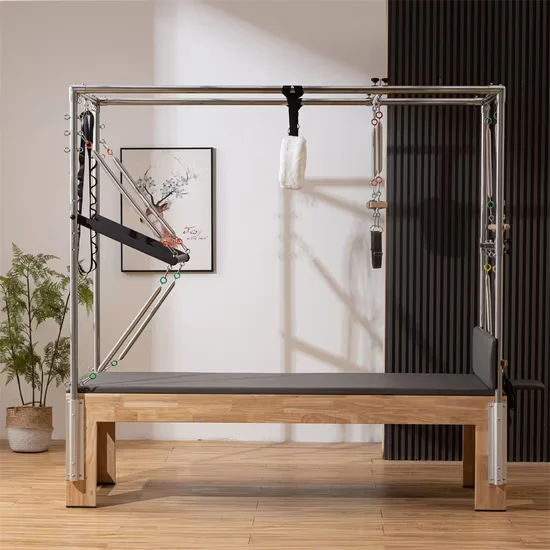
High-End Pilates Studios
Premium aesthetics meet quiet operation for boutique studio environments.

ISO
9001
CE
Certified
OEM
Available
10YR
Warranty
Aluminum Pilates Reformer, Aluminium Alloy Frame, 2570×730×270mm — precision-machined carriage rail system delivers zero lateral play across the 90kg-rated platform, with sealed bearings ensuring smooth linear travel under repeated spring-loaded cycles. Includes long box, jump board, and platform for full-spectrum studio programming. Every unit undergoes carriage rail flatness tolerance verification and spring fatigue cycle testing before shipment.
// Spec Highlights
• Direct from Manufacturer · No Middlemen · Worldwide Shipping
01
// Material
Imported Solid Wood
Premium hardwood frames sourced for density and visual warmth.
02
// Hardware
Medical-Grade Silent
Whisper-quiet pulleys and springs for clinical environments.
03
// Customization
Appearance OEM
Color, upholstery, and branding tailored to your studio.
04
// Service
Layout Design
Free venue planning for studios and rehab institutions.
Every component is selected for longevity, performance, and aesthetic harmony - from imported hardwood frames to silent medical-grade accessories.
// Features
Rust-Proof Alloy Rigidity — Mill-certified aluminum extrusion profiles resist corrosion and maintain carriage alignment under thousands of spring-loaded cycles.
| Parameter | Value |
|---|---|
| Product Type | Pilates Reformer |
| Material | Aluminium Alloy |
| Frame Construction | Extruded aluminium alloy profile |
| Color | White (custom color options available) |
| Product Dimensions | 2570 × 730 × 270 mm |
| Net Weight | 90 kg |
| Carriage System | Precision-machined rail with sealed bearing wheels |
| Spring Configuration | Multiple resistance springs with graduated tension |
| Included Accessories | Long Box, Jump Board, Platform |
| Customization | Available (logo, color, accessory configuration) |
| Age Group | Adult |
| Gender | Unisex |
| Warranty | 3 Years |
| Facility Type | Typical Use |
|---|---|
| Commercial Pilates studio | Group class reformer stations with high daily cycle counts |
| Boutique fitness facility | Premium member-facing equipment in design-forward spaces |
| Rehabilitation and physiotherapy center | Controlled loading for joint recovery and post-injury conditioning |
| Home fitness studio | Dedicated personal training space with commercial durability expectations |
Alloy grade and wall thickness determine whether a reformer frame stays true or warps under spring tension.
Many suppliers label their equipment as "aluminum frame" without disclosing the alloy series or extrusion profile dimensions. In a commercial Pilates studio running back-to-back classes, the carriage rail endures repeated eccentric loading from spring recoil and user impact during jump board work. Softer extrusions that lack proper temper designation will gradually deflect, causing the carriage to bind or develop lateral play. I have seen reformers pulled from studio floors after months of use because the rail geometry shifted enough to create uneven glide resistance [NEED_CITE: structural deflection thresholds in extruded aluminum fitness equipment frames]. The commercial aluminum pilates reformer you choose should come with mill documentation traceable to the extrusion batch.
The reformer addresses the full sagittal plane through supine, prone, and seated positions, targeting core stabilization, hip extension chains, and scapular control musculature. In a studio layout, it pairs with cadillacs and wunda chairs to create a complete apparatus circuit that moves clients through varying load orientations. A commercial aluminum pilates reformer occupies a rectangular footprint that requires clearance on at least two sides for instructor access and accessory deployment. The 2570 mm length accommodates users across a broad height range without requiring frame extensions.
The carriage rail experiences repeated axial loading as springs engage and release across hundreds of daily repetitions. Each cycle introduces micro-impact at the wheel contact point, particularly during controlled eccentric return phases where the spring pulls the carriage against the stopper. Sealed bearings in the carriage wheels resist contamination from studio dust and cleaning solution residue, while unsealed bushings gradually develop play as particulate matter enters the raceway [NEED_CITE: bearing contamination and service intervals in high-cycle linear motion systems]. The joint where the rail meets the frame end cap is a stress concentration zone where fastener loosening can alter rail parallelism. Sweat and chemical cleaners sprayed on the aluminum surface test the coating’s resistance to oxidation and staining over extended use.
The extruded aluminum alloy profile serves as both structural spine and carriage guide, meaning any dimensional inconsistency in the extrusion propagates directly into carriage travel quality. Profile wall thickness determines the frame’s resistance to bending under asymmetric loads — when a user applies unilateral force during single-leg work, the frame must resist torsional deflection to keep the carriage tracking straight. Sealed bearing wheels maintain consistent rolling resistance across the rail surface, whereas bushing-type wheels introduce friction variability as they wear. The spring attachment points must distribute load across a reinforced section of the frame rather than concentrating force at a single fastener. Platform and jump board mounting interfaces rely on rigid connection geometry; any flex at these joints creates instability during dynamic movements like plyometric jumps or standing balance work. The 90 kg net weight provides a stable base that resists frame shift during aggressive spring tension exercises without requiring permanent floor anchoring.
Thin-wall aluminum profiles save material expense upfront but introduce deflection problems once the frame experiences repeated spring loading in a commercial environment. Non-reinforced mounting points for accessories like jump boards can develop fatigue cracking where cyclic impact concentrates stress. Carriage wheels using bushings instead of sealed bearings require periodic replacement as they develop axial play, pulling the reformer out of service and generating maintenance labor costs [NEED_CITE: comparative maintenance frequency between sealed bearing and bushing carriage systems]. Frames that lack proper alloy temper designation may show visible bending or twisting under loads well within expected use parameters. Studios that cycle through multiple reformers due to frame failures face equipment replacement costs and client scheduling disruptions that dwarf initial savings.
The aluminum alloy used in this reformer comes with mill certification traceable to the extrusion batch, providing verification of material properties rather than relying on generic supplier claims. Robotic welding and precision-machined rail surfaces ensure the carriage travels with consistent resistance across the full stroke length. Each unit undergoes load testing before shipment to confirm structural performance under simulated use conditions. The 200μm industrial powder coating protects the aluminum surface from sweat corrosion and chemical cleaner damage in high-humidity studio environments. A three-year warranty covers frame and carriage components against manufacturing defects. Floor planning CAD support helps studios arrange reformer stations with proper instructor clearance and safe client circulation paths. OEM customization allows branding, color specification, and accessory configuration to match facility identity requirements.
Provide your studio floor dimensions and current apparatus list to receive a 2D-3D layout showing reformer placement with instructor access zones and client circulation paths. Specify daily class volume and expected usage intensity so we can confirm the structural grade matches your operational demands. Share your client height range demographics to verify the carriage travel length accommodates your user population without accessory modifications. Communicate any branding, color, or accessory configuration requirements for custom production planning.
Q: How do I verify the aluminum alloy grade rather than accepting a generic commercial-grade claim?
A: Request a mill test report that identifies the alloy series, temper designation, and extrusion batch number. This document traces the material back to the production run and confirms mechanical properties like yield strength and elongation. Suppliers who cannot provide batch-level documentation are typically sourcing unverified profiles. Always cross-reference the reported alloy against the structural demands of daily spring-loaded carriage cycles.
Q: What role does carriage rail precision play in long-term glide performance?
A: Rail flatness and parallelism determine whether the carriage maintains consistent contact pressure across all wheels. Deviations as small as fractions of a millimeter create uneven wear patterns that compound over thousands of cycles, eventually producing lateral play or binding. Precision-machined rails paired with sealed bearings preserve smooth travel far longer than extruded-only surfaces with bushing wheels. Ask for rail tolerance documentation per unit.
Q: How does spring configuration affect adaptability across different user strength levels?
A: Multiple springs with graduated resistance allow instructors to scale loading from rehabilitation-level tension to advanced athletic conditioning within the same apparatus. The attachment point geometry and spring anchor reinforcement must handle cumulative tension without frame deformation. Studios serving diverse populations benefit from configurations offering at least four to five distinct resistance increments to support progressive programming across beginner through advanced clients.
Q: What should I check regarding accessory mounting stability under dynamic loading?
A: Jump boards and platforms generate impact forces that transfer directly into the frame mounting interface. Verify that these connection points feature reinforced gussets or thickened wall sections rather than simple bolt-through joints. Pull-out strength testing and cyclic impact documentation confirm the mounting hardware resists loosening and fatigue cracking during plyometric and standing exercise sequences common in group class programming.
Premium aesthetics meet quiet operation for boutique studio environments.
Medical-grade silence and precision for sports & postpartum recovery.
Furniture-grade craftsmanship for premium residential installations.
Compact premium setups for one-on-one and small-group training.
Aesthetic Pilates integration for hybrid wellness studio programming.
Multi-unit deployment with instructor-grade reliability for certification programs.
Tell us about your project. Our team will respond within 24 hours with pricing, customization options, and shipping details.
// Sales Director
William
+86 132 2531 1800
// Export Manager
Bella
+86 198 5412 8032
william@bickfit.com