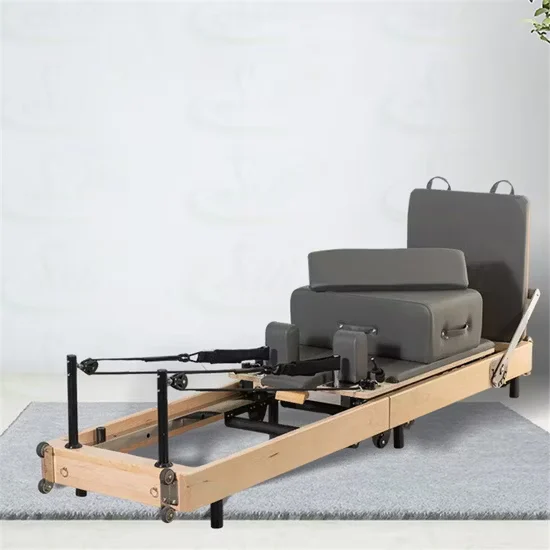
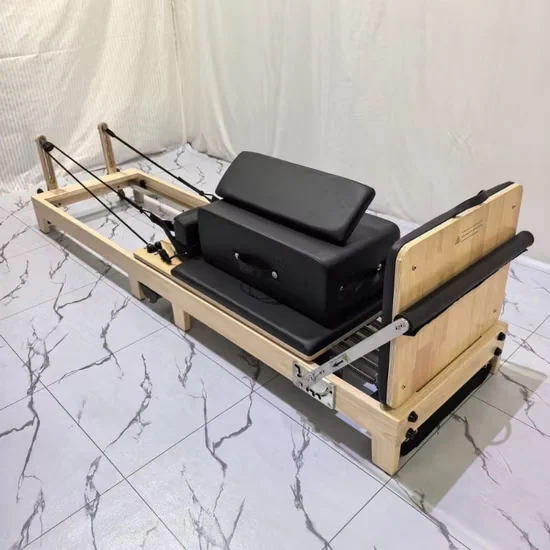
01 / Scenario
STUDIO
P
High-End Pilates Studios
Premium aesthetics meet quiet operation for boutique studio environments.

ISO
9001
CE
Certified
OEM
Available
10YR
Warranty
Aluminum Pilates Reformer, 2570×730×270mm, 90kg Net Weight — aircraft-grade aluminum frame resists corrosion and maintains rail alignment under cyclic spring tension in humid studio environments. Precision-machined carriage track ensures smooth glide without lateral play, paired with high-density foam upholstery rated for 8+ hour daily rotation. Integrated long box, jump board, and platform mount directly to rails for full-spectrum training. Backed by 3-year warranty and ISO 9001 certified production with 32-point inspection and 100% load testing before shipment.
// Spec Highlights
• Direct from Manufacturer · No Middlemen · Worldwide Shipping
01
// Material
Imported Solid Wood
Premium hardwood frames sourced for density and visual warmth.
02
// Hardware
Medical-Grade Silent
Whisper-quiet pulleys and springs for clinical environments.
03
// Customization
Appearance OEM
Color, upholstery, and branding tailored to your studio.
04
// Service
Layout Design
Free venue planning for studios and rehab institutions.
Every component is selected for longevity, performance, and aesthetic harmony - from imported hardwood frames to silent medical-grade accessories.
// Features
Precision-Machined Aluminum Carriage Track — Aircraft-grade aluminum frame maintains structural alignment under cyclic spring tension while resisting corrosion in humid studio environments.
| Parameter | Value |
|---|---|
| Product Type | Pilates Reformer |
| Frame Material | Aluminum alloy |
| Color | White (custom options available) |
| Carriage Rail | Precision-machined aluminum track |
| Accessories Included | Long box, jump board, platform |
| Product Dimensions | 2570 × 730 × 270 mm |
| Net Weight | 90 kg |
| Upholstery | High-density commercial foam |
| Logo | Custom branding available |
| Production Capacity | 80 pieces per month |
| Certification | ISO 9001 |
| Warranty | 3 Years |
| Facility Type | Typical Use |
|---|---|
| Pilates studio | Daily high-frequency group and private sessions across multiple instructors |
| Rehabilitation and conditioning facility | Controlled spring-resistance protocols for post-injury recovery and mobility restoration |
| Boutique fitness center | Premium reformer classes with elevated equipment aesthetic and structural durability |
| Hotel fitness room | Low-maintenance reformer station for guest self-service and supervised wellness sessions |
An aluminum frame eliminates the two most common reformer retirement triggers: corrosion from humid studio conditions and frame flex under repetitive spring tension.
Most reformers marketed as commercial grade still rely on steel frames. In a studio running six to eight classes per day with constant sweat exposure and humidifier output, steel frames begin surface oxidation at contact points within the first year. That corrosion migrates into carriage rail tolerances, creating lateral play that instructors notice before maintenance staff does. A commercial aluminum Pilates reformer sidesteps this entirely — aluminum alloy does not oxidize structurally in studio environments, and the carriage track maintains its machined flatness across thousands of spring-loading cycles. The frame rigidity under cyclic loading means the reformer does not develop the micro-shifts that cause carriage wobble in lighter-gauge steel competitors [NEED_CITE: EN 957 structural requirements for stationary training equipment].
This reformer addresses the full sagittal and transverse plane repertoire — footwork through long box work, jump board plyometrics, and platform-based standing sequences. In a studio layout, it pairs with mat stations and cadillacs to complete the classical and contemporary Pilates curriculum without requiring supplementary spring towers. The footprint accommodates high-density studio floors where reformer count directly determines class revenue capacity. The commercial aluminum Pilates reformer supports users across a wide anthropometric range through adjustable spring anchoring and carriage travel length, reducing the need for multiple frame sizes in a single facility.
The dominant stress on a reformer is not static weight — it is the repetitive eccentric loading as springs stretch and recoil through hundreds of cycles per class day. Each full spring extension generates torsional force at the frame-to-rail junction, and over months of studio rotation, this cyclic fatigue concentrates at bolt points and weld seams. The aluminum alloy frame resists this fatigue path because the material does not develop stress fractures the way thinner steel tubing can under identical cycle counts. The carriage rail interface bears the highest wear demand, and precision-machined tolerances prevent the lateral drift that accelerates wheel and bearing degradation [NEED_CITE: material fatigue performance under cyclic tensile loading in alloy frames].
The aluminum alloy frame specification matters because alloy grade determines both the yield threshold and the corrosion behavior — studio-grade reformers require structural aluminum that maintains dimensional stability under spring tension without galvanic reaction to cleaning agents. The integrated accessory mounting system eliminates the separate stands and clamp-on platforms that shift mid-session and require instructor intervention. Carriage rail flatness tolerance directly governs glide smoothness, and a precision-machined track ensures the carriage does not develop lateral play that compromises exercise alignment. High-density upholstery foam resists compression set, meaning the padding retains its profile and support through eight or more hours of daily client contact without developing the permanent depressions that signal replacement.
Substituting lower-grade aluminum or thinning the frame tube wall reduces the initial invoice but introduces frame deflection under heavy spring loads — instructors feel it as carriage hesitation at end range. Non-integrated accessories that clamp rather than bolt to the carriage rails create wobble during jump board sequences and require constant re-tightening between classes. Low-density foam upholstery compresses within months of studio rotation, forcing studios to re-pad or replace the carriage surface. Without documented spring tension calibration, the resistance profile drifts between units, making class choreography inconsistent across the studio floor [NEED_CITE: upholstery compression degradation under commercial cyclic loading].
The aluminum frame stock is traceable through material certification, so studios can verify alloy grade and structural rating against their insurance and compliance requirements. Every carriage rail is machined to documented flatness tolerances rather than batch-averaged. Each unit undergoes load testing before shipment — not sample-based QC from a production run. The powder-coated and anodized surfaces are specified to withstand studio-grade disinfectant exposure without surface breakdown. The three-year warranty covers structural frame and rail integrity under commercial use. Facility planning support includes CAD-compatible footprint files with recommended reformer spacing for safe client flow and instructor circulation paths, and OEM branding is available for studios building equipment identity into their interior design.
Provide your studio floor dimensions and target reformer count to receive a 2D layout with safe clearance zones mapped around each station. Specify average daily class frequency and client volume to confirm the structural specification matches your usage intensity. Indicate custom branding requirements — logo placement, frame color preference, and upholstery selection — to align equipment with your studio design language.
Q: How does an aluminum frame compare to steel for long-term studio use?
A: Aluminum eliminates corrosion risk in humid studio environments where steel frames develop surface oxidation at weld points and bolt junctions. It also maintains dimensional stability under cyclic spring tension, meaning the carriage rail does not develop the lateral play that plagues lighter-gauge steel reformers after extended high-frequency rotation. The weight reduction also simplifies repositioning during studio layout changes.
Q: How do I evaluate carriage glide quality and rail durability?
A: Request the carriage rail flatness tolerance specification from the manufacturer — precision-machined tracks hold tighter tolerances that prevent lateral drift. During inspection, apply off-center load to the carriage and check for any binding or hesitation along the full travel range. The wheel material and bearing specification determine how long smooth glide persists under daily commercial cycles.
Q: Are the long box, jump board, and platform included or sold separately?
A: All three accessories are included with the reformer and mount directly to the carriage rails using integrated attachment points. This eliminates the separate stands and clamp-on hardware that shift during use and require adjustment between clients. Replacement parts are available through the manufacturer for accessory components that experience wear.
Q: What is the spring replacement cycle and can tension be customized?
A: Each unit ships with a spring tension calibration sheet documenting resistance values at standard extension lengths. Springs should be inspected quarterly for tension drift and replaced when measured resistance falls outside the documented tolerance range. Custom spring sets with different resistance profiles can be specified at order for studios with specialized programming requirements.
Q: How should reformer spacing be planned for a commercial studio?
A: Each station requires the reformer footprint plus clearance for full carriage extension and instructor circulation on at least two sides. CAD layout support is available to map safe spacing around your specific floor dimensions, accounting for storage zones, entry flow, and emergency egress paths that comply with local occupancy codes.
Premium aesthetics meet quiet operation for boutique studio environments.
Medical-grade silence and precision for sports & postpartum recovery.
Furniture-grade craftsmanship for premium residential installations.
Compact premium setups for one-on-one and small-group training.
Aesthetic Pilates integration for hybrid wellness studio programming.
Multi-unit deployment with instructor-grade reliability for certification programs.
Tell us about your project. Our team will respond within 24 hours with pricing, customization options, and shipping details.
// Sales Director
William
+86 132 2531 1800
// Export Manager
Bella
+86 198 5412 8032
william@bickfit.com