
01 / Scenario
STUDIO
P
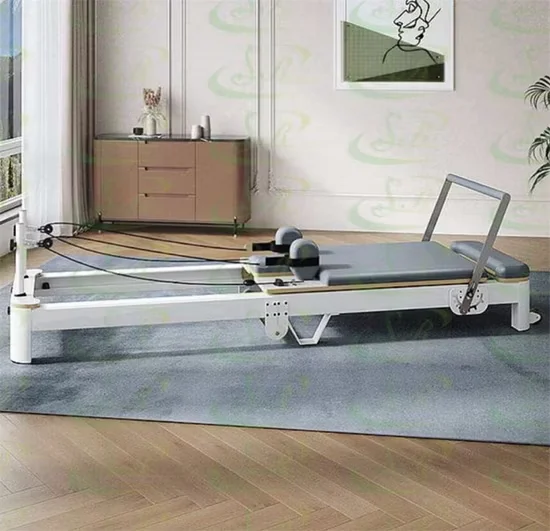
High-End Pilates Studios
Premium aesthetics meet quiet operation for boutique studio environments.
ISO
9001
CE
Certified
OEM
Available
10YR
Warranty
Folding Aluminum Alloy Pilates Reformer, 2570×730mm Frame, 90kg Net Weight — precision-machined folding hinge maintains carriage rail parallelism after repeated cycles, while the aluminum alloy construction reduces weight for studio repositioning without sacrificing rigidity under spring-loaded movement. Includes Long Box, Jump Board, and Platform with reinforced mounting interfaces. Backed by a 3-year warranty and ISO 9001-certified manufacturing for commercial studio and rehabilitation environments.
// Spec Highlights
• Direct from Manufacturer · No Middlemen · Worldwide Shipping
01
// Material
Imported Solid Wood
Premium hardwood frames sourced for density and visual warmth.
02
// Hardware
Medical-Grade Silent
Whisper-quiet pulleys and springs for clinical environments.
03
// Customization
Appearance OEM
Color, upholstery, and branding tailored to your studio.
04
// Service
Layout Design
Free venue planning for studios and rehab institutions.
Every component is selected for longevity, performance, and aesthetic harmony - from imported hardwood frames to silent medical-grade accessories.
// Features
Weld Integrity Under Repeated Folding Cycles — Every hinge joint is stress-mapped for fatigue resistance, ensuring rail alignment holds after thousands of fold and unfold sequences in studio environments.
| Parameter | Value |
|---|---|
| Product Type | Pilates Reformer |
| Model NO. | SRY-12A |
| Frame Material | Aluminum Alloy |
| Product Dimensions | 2570×730×270mm |
| Net Weight | 90kgs |
| Folding Mechanism | Yes |
| Accessories Included | Long Box / Jump Board / Platform |
| Color Options | White (standard), custom finishes available |
| Logo | Customized |
| Certification | ISO 9001 |
| Warranty | 3 Years |
| Facility Type | Typical Use |
|---|---|
| Commercial Pilates Studio | Daily group reformer classes with high-frequency carriage cycling |
| Boutique Fitness Center | Hybrid sessions blending reformer work with mat-based programming |
| Rehabilitation Clinic | Controlled resistance movements for post-injury and post-surgical recovery |
| Hotel Wellness Facility | Guest-access equipment requiring compact storage between uses |
| Home Fitness | Dedicated personal practice space with floor-area constraints |
Precision-machined hinge points keep the carriage rail parallel through every deployment cycle.
Pilates reformers built for occasional home use often fold well enough initially, but the joint clearances that feel tight on day one open up under daily studio schedules. Once the hinge develops play, the carriage no longer tracks straight — users feel the drift as uneven spring resistance, and instructors spend class time compensating for equipment behavior instead of coaching movement [NEED_CITE: EN 957 structural requirements for stationary training equipment]. The commercial folding aluminum alloy Pilates reformer SRY-12A addresses this by locking rail alignment into the hinge geometry itself, so repeated folding does not degrade the glide path.
This reformer covers the full spectrum of supine, prone, seated, and standing spring-loaded movements, targeting core stabilization, hip and shoulder articulation, and spinal mobility. In a multi-apparatus studio, it pairs naturally with cadillacs and chair units, filling the high-repetition foundational work that those larger units cannot deliver at class pace. The 2570mm rail length accommodates adult users across a broad height range without compromising end-stop clearance. For facilities running back-to-back reformer classes, the folding capability lets staff reclaim floor space for mat work or functional sessions between scheduling blocks. The commercial folding aluminum alloy Pilates reformer serves studios that need durability matched with spatial flexibility.
The carriage system endures repetitive eccentric loading — springs pull against the user’s controlled release, generating cyclic stress at every wheel-to-rail contact point. In a studio running six classes daily, each carriage completes hundreds of full-stroke cycles per week. The folding hinge bears a different load profile: static weight during storage, then a dynamic shock at deployment. Weld zones near hinge plates and rail anchors are where fatigue cracks originate in under-engineered frames [NEED_CITE: weld classification and fatigue performance in structural aluminum alloys]. The aluminum alloy frame must manage both corrosion from sweat exposure and micro-movement abrasion at bolted joints, which is why alloy grade and wall thickness matter as much as the folding design itself.
The aluminum alloy frame reduces overall unit weight for repositioning while maintaining rigidity along the carriage rail axis — a balance that thin-wall steel tubing fails to achieve once corrosion begins. At 90kgs net weight, the unit is heavy enough to resist walking during vigorous jump board work yet light enough for a single technician to fold and store. The 2570×730mm footprint defines operational clearance: studios need at least 600mm between deployed units for instructor access, and the folded depth determines wall-clearance requirements for storage zones. Accessory mounting points for the long box, jump board, and platform must be reinforced at the interface — these attachments introduce cantilevered loads that flex a poorly braced frame. The three-year warranty scope signals how the manufacturer allocates confidence between the static frame and the moving carriage components.
Thin-wall aluminum extrusions save weight and material cost upfront but deform under sustained spring tension, warping the rail enough to create carriage binding. Non-sealed wheel bearings accumulate chalk dust and sweat residue, developing audible grinding within the first year of commercial use — and replacement bearings for proprietary sizes are often unavailable from the original supplier. Hinge mechanisms that rely on friction-fit pins rather than positive-lock engagements develop lateral play, and once that tolerance opens, no field adjustment recovers the original rail alignment [NEED_CITE: bearing degradation and maintenance intervals in fitness equipment]. Low-density foam on the carriage pad compresses permanently within months of daily use, forcing studios to re-upholster or replace pads at their own expense.
The aluminum alloy frame specification is traceable to the mill, meaning the grade and wall thickness can be verified against the purchase order — not left to a generic "commercial grade" label. Robotic MIG welding on aluminum requires controlled heat input to prevent porosity, and continuous weld lines at hinge plates eliminate the spot-weld failures that appear under cyclic loading. Every unit undergoes load testing before shipment, catching carriage tracking issues and hinge play before the equipment reaches the studio floor. The powder-coated finish resists the alkaline cleaning agents used in commercial environments, and the three-year warranty covers frame and moving parts under documented commercial use. Two-dimensional and three-dimensional CAD layout support helps studio operators plan operational clearances around this reformer’s folded and deployed footprints, avoiding the unsafe spacing that forces instructors to squeeze between active carriages.
Provide your studio floor plan and class schedule density to receive a 2D or 3D layout showing operational clearances, storage zones, and instructor circulation paths around this reformer. Specify your target user demographic so the rail length and accessory configuration can be confirmed against your members’ body-size range. Detail any custom color, logo, or upholstery requirements early in the procurement cycle to align finish options with your studio’s design standard.
Q: How does an aluminum alloy frame compare to steel for daily commercial reformer use?
A: Aluminum alloy delivers meaningful weight reduction for repositioning and storage while resisting the corrosion that sweat and cleaning agents cause on uncoated steel. The trade-off is that aluminum requires precise wall thickness and alloy selection to match steel’s load-bearing rigidity, particularly at carriage rail anchors and folding hinge zones. Properly specified, aluminum holds alignment longer in humid studio environments.
Q: What should I verify about the folding mechanism before committing to a purchase?
A: Request the hinge cycle fatigue report and confirm that rail parallelism is measured after repeated fold and unfold sequences, not just on a fresh unit. Check whether the locking engagement is a positive mechanical catch or a friction-fit pin — positive locks maintain alignment as wear accumulates. Verify that replacement hinge components are stocked and available separately.
Q: What determines carriage glide smoothness over years of studio use?
A: Wheel material, bearing type, and rail surface finish together govern long-term glide quality. Sealed bearings resist chalk dust and moisture ingress far better than open bushings, extending maintenance intervals. The aluminum rail surface must maintain its finish without pitting from sweat exposure, since even minor surface degradation transfers directly into carriage vibration.
Q: Are the included accessories mounted with standard or proprietary hardware?
A: The long box, jump board, and platform attach at reinforced interface points on the frame. Confirm whether these mounting systems use standard fasteners available from industrial suppliers or proprietary fittings that require the original manufacturer as sole source. Standard hardware simplifies replacement and keeps the studio operational if an attachment needs servicing.
Q: How should I plan floor space around this reformer in a multi-unit studio?
A: The deployed footprint of 2570×730mm defines the active zone, but you need lateral instructor clearance and end-of-rail access for spring changes. The folded depth determines how many units can be stored against a wall between classes. Provide your room dimensions for a CAD layout that accounts for both operational and storage configurations.
Premium aesthetics meet quiet operation for boutique studio environments.
Medical-grade silence and precision for sports & postpartum recovery.
Furniture-grade craftsmanship for premium residential installations.
Compact premium setups for one-on-one and small-group training.
Aesthetic Pilates integration for hybrid wellness studio programming.
Multi-unit deployment with instructor-grade reliability for certification programs.
Tell us about your project. Our team will respond within 24 hours with pricing, customization options, and shipping details.
// Sales Director
William
+86 132 2531 1800
// Export Manager
Bella
+86 198 5412 8032
william@bickfit.com


