01 / Scenario
STUDIO
P
High-End Pilates Studios
Premium aesthetics meet quiet operation for boutique studio environments.
ISO
9001
CE
Certified
OEM
Available
10YR
Warranty
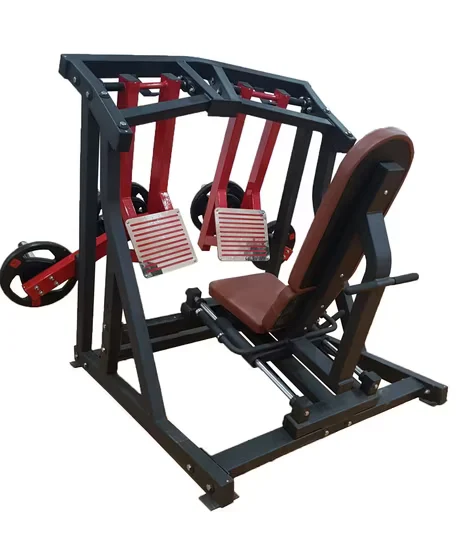
Plate Loaded ISO-Lateral Leg Press Machine, 1989×1771×1545mm, 148kg Net Weight — engineered for high-traffic commercial strength zones with plate-loaded resistance for independent leg training. Frame steel gauge and welding method require verification against mill-certified specifications before procurement. Every unit undergoes load testing prior to shipment, backed by a 10-year frame warranty and factory-direct floor planning support.
// Spec Highlights
• Direct from Manufacturer · No Middlemen · Worldwide Shipping
01
// Material
Imported Solid Wood
Premium hardwood frames sourced for density and visual warmth.
02
// Hardware
Medical-Grade Silent
Whisper-quiet pulleys and springs for clinical environments.
03
// Customization
Appearance OEM
Color, upholstery, and branding tailored to your studio.
04
// Service
Layout Design
Free venue planning for studios and rehab institutions.
Every component is selected for longevity, performance, and aesthetic harmony - from imported hardwood frames to silent medical-grade accessories.
// Features
Traceable 11-Gauge Steel — Mill-certified Q235/Q345 coil origin documented for every frame tube in this commercial plate loaded iso-lateral leg press machine.
| Parameter | Value |
|---|---|
| Product Type | Plate Loaded Leg Press Machine |
| Loading Type | Plate loaded |
| Product Dimensions | 1989×1771×1545mm |
| Net Weight | 148kg |
| Exercise Part | Leg |
| Certification | ISO 9001, SGS |
| Facility Type | Typical Use |
|---|---|
| Commercial gym strength floor | High-traffic bilateral leg pressing station |
| University strength and conditioning room | Athlete lower-body development |
| Hotel and resort fitness center | Guest-accessible leg training |
| Rehabilitation and performance center | Controlled unilateral or bilateral leg loading |
Many suppliers label frames "commercial grade" without disclosing actual steel gauge or wall thickness — under repeated multi-hundred-kilogram leg press loads, this ambiguity leads to measurable frame deflection and accelerated weld fatigue.
11-gauge steel with mill certification provides a verifiable deformation threshold for plate loaded iso-lateral leg press operations.
When a leg press frame is built from unverified thin-wall tubing, the lateral arms and pivot housings deflect under eccentric loading, shifting the movement arc and placing unintended shear on the user’s knees. Over months of high-traffic use, this deflection concentrates stress at welded joints, where spot welds — often used to cut costs — develop micro-cracks long before visual inspection reveals them. [NEED_CITE: structural steel gauge requirements for stationary strength equipment]
This plate loaded iso-lateral leg press machine occupies the primary bilateral pressing plane in a commercial strength zone, complementing hack squats, lunges, and functional rigs that address unilateral and hip-dominant patterns. The iso-lateral arm design allows independent limb loading, making it suitable for facilities serving both general population members and athletes requiring asymmetry correction. Its footprint accommodates high-density floor plans where traffic flow demands clear egress on both sides of the station.
Leg press stations experience a distinct combination of static hold, concentric push, and eccentric return loads — each cycle introduces tensile and compressive stress across the frame’s main uprights and pivot brackets. In commercial environments running 8+ hours daily, these cycles accumulate rapidly, testing weld continuity at every joint and bearing seals at every pivot point. Unsealed bearings allow sweat and rubber dust to infiltrate, creating abrasive wear that develops play within the first year. The powder coating at foot plate contact points faces repeated impact and chemical exposure from cleaning agents, demanding adequate thickness and pre-treatment to resist chipping. [NEED_CITE: weld classification and fatigue performance in cyclic loading applications]
The 3×3 inch frame tube with 11-gauge wall thickness establishes the baseline resistance to bending under load — thicker walls raise the moment of inertia, directly reducing deflection at the pivot housing. Robotic MIG welding produces continuous fillet welds along all structural joints, eliminating the cold joints and incomplete fusion typical of manual spot welding. Continuous welds distribute stress across the entire joint length rather than concentrating it at discrete points, extending fatigue life under the repeated loading patterns of commercial leg press use. Sealed industrial bearings at the iso-lateral pivot resist contamination from gym floor debris and sweat, maintaining smooth rotation without the play that develops in open bushings. The 200μm powder coating applied over sandblasted steel provides a durable barrier against impact, sweat corrosion, and cleaning chemical exposure at high-contact zones.
Thin-wall frames deflect visibly under heavy loads, altering the movement arc and accelerating user fatigue while increasing joint stress. Spot welds that pass visual QC crack under cyclic loading, creating sudden structural failure risk and potential liability exposure. Non-sealed bearings develop play within months in high-traffic environments, requiring frequent replacement and generating downtime. Low-density upholstery compresses permanently under daily use, splitting at seam points within the first year and demanding full replacement rather than simple cover swaps. Inadequate powder coating chips at contact points, exposing bare steel to sweat corrosion that spreads beneath the surrounding finish.
Every frame tube in this commercial plate loaded iso-lateral leg press machine traces back to mill-certified Q235 or Q345 coil, with documentation available for procurement verification. Robotic MIG welding ensures continuous weld lines on all structural joints, with no spot-weld weak points. Each unit undergoes load testing before shipment — not sample-based inspection — confirming structural integrity at the rated capacity. The 200μm industrial powder coating over sandblasted steel resists chipping and corrosion at high-contact loading points. A 10-year frame warranty backs the structural investment. 2D-3D floor planning CAD support ensures the 1989×1771×1545mm footprint integrates with safe clearance zones around adjacent stations.
Provide your strength zone dimensions and equipment list to receive a 2D-3D layout confirming safe clearance around this plate loaded iso-lateral leg press machine. Specify daily user volume to match the structural grade to your traffic model. Indicate target user height and limb length ranges to verify iso-lateral arm reach compatibility. Custom color, logo, and upholstery options are available for facility branding alignment.
Q: How do I verify that a leg press frame meets true commercial structural standards?
A: Request mill-certified steel documentation showing gauge, tube dimensions, and steel grade with traceable coil origin. Confirm robotic MIG continuous welding on all structural joints rather than spot welds. Verify that load testing is performed on every unit before shipment, not on a sample basis. These three elements together establish whether the frame will resist deflection and fatigue under repeated heavy loading in a high-traffic environment.
Q: What frame steel gauge is appropriate for a plate loaded leg press in a commercial gym?
A: 11-gauge steel with a 3×3 inch tube cross-section provides the deformation resistance needed for multi-hundred-kilogram leg press loads in commercial settings. Thinner gauges or smaller tube profiles deflect under load, altering the movement arc and concentrating stress at welded joints. The combination of adequate wall thickness and proper tube geometry ensures the frame maintains structural alignment over years of cyclic loading without visible flex or weld fatigue.
Q: How does plate loaded compare to selectorized for a leg press in high-traffic facilities?
A: Plate loaded leg press machines offer greater maximum load capacity and simpler maintenance, as there are no weight stack guide rods to bind under off-center loading and no selectorized pin mechanisms to wear. For facilities where users regularly exceed 150kg of resistance or where equipment runs 8+ hours daily, plate loaded configurations reduce downtime and maintenance frequency. Selectorized stations suit facilities prioritizing quick weight changes for circuit-style programming over maximum load potential.
Q: What clearance and floor planning considerations apply to this leg press footprint?
A: The 1989×1771×1545mm dimensions require additional clearance on all sides for safe user mounting, plate loading, and egress. Minimum recommended clearance allows full range of motion without adjacent equipment interference and provides space for plate storage access. A 2D-3D floor planning CAD layout confirms safe spacing between this station and adjacent equipment, accounting for traffic flow patterns and emergency egress requirements in your specific facility dimensions.
Premium aesthetics meet quiet operation for boutique studio environments.
Medical-grade silence and precision for sports & postpartum recovery.
Furniture-grade craftsmanship for premium residential installations.
Compact premium setups for one-on-one and small-group training.
Aesthetic Pilates integration for hybrid wellness studio programming.
Multi-unit deployment with instructor-grade reliability for certification programs.
Tell us about your project. Our team will respond within 24 hours with pricing, customization options, and shipping details.
// Sales Director
William
+86 132 2531 1800
// Export Manager
Bella
+86 198 5412 8032
william@bickfit.com