
01 / Scenario
STUDIO
P
High-End Pilates Studios
Premium aesthetics meet quiet operation for boutique studio environments.
ISO
9001
CE
Certified
OEM
Available
10YR
Warranty
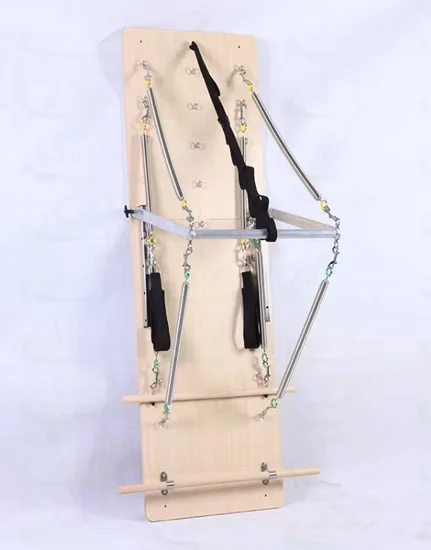
Pilates Wall Unit Spring Board Reformer, 1850×560×75 mm, 35 kg — engineered with a reinforced wall-mounted frame and precision-calibrated spring resistance system for consistent tension across sessions. Includes long box, jump board, and platform with zero-play mounting points for repeatable alignment. Backed by 3-year warranty and unit-level load testing before shipment.
// Spec Highlights
• Direct from Manufacturer · No Middlemen · Worldwide Shipping
01
// Material
Imported Solid Wood
Premium hardwood frames sourced for density and visual warmth.
02
// Hardware
Medical-Grade Silent
Whisper-quiet pulleys and springs for clinical environments.
03
// Customization
Appearance OEM
Color, upholstery, and branding tailored to your studio.
04
// Service
Layout Design
Free venue planning for studios and rehab institutions.
Every component is selected for longevity, performance, and aesthetic harmony - from imported hardwood frames to silent medical-grade accessories.
// Features
Traceable Frame Steel — mill-certified Q235/Q345 tubing from coil to finished Pilates wall unit, every structural member verifiable to its heat number.
| Parameter | Value |
|---|---|
| Product Type | Pilates Wall Unit |
| Model | SRY-09 |
| Specification | 1850 × 560 × 75 mm |
| Net Weight | 35 kg |
| Spring System | Calibrated tension springs with sealed housings |
| Accessory Compatibility | Long Box / Jump Board / Platform |
| Color Options | Solid Color options available |
| Frame Finish | Industrial powder coating, 200μm scratch-resistant |
| Welding Method | Robotic MIG continuous weld |
| Logo | Customized |
| Production Capacity | 800 Pieces / Month |
| Warranty | 3 Years |
| Certification | ISO 9001:2015, CE European Conformity |
| Facility Type | Typical Use |
|---|---|
| Commercial Pilates Studio | Wall-mounted reformer stations for group and private sessions |
| Boutique Fitness Center | Mind-body training zone with spring board resistance work |
| Rehabilitation and Physiotherapy Clinic | Controlled resistance exercises for post-injury recovery protocols |
| Hotel and Resort Wellness Floor | Space-efficient reformer training in compact wellness areas |
| University Athletic Training Room | Supplemental flexibility and core conditioning for student athletes |
Frame rigidity is the single variable that determines whether a commercial Pilates wall unit spring board reformer stays precise or degrades into noise and misalignment.
Most wall-mounted Pilates equipment on the market uses thin-gauge tubing that looks adequate on paper but flexes visibly when springs reach mid-range tension. Over months of studio-level repetition — dozens of sessions per day, hundreds of spring cycles per station — that micro-deflection accumulates into permanent frame distortion. Mounting rails shift, spring housings develop angular play, and the reformer carriage no longer tracks true. Instructors start compensating by adjusting client positioning rather than trusting the equipment. [NEED_CITE: EN 957 structural requirements for stationary training equipment]
The failure rarely happens catastrophically. It arrives as a slow drift: a rattle during footwork, a spring that does not return to neutral, a long box that no longer seats flush against its mounting point. By the time studio owners notice, the frame has already yielded past its elastic limit and replacement is the only option.
A wall-mounted Pilates reformer occupies a unique niche in studio layout: it delivers full reformer functionality while consuming only wall-side depth rather than the footprint of a standalone unit. This makes it the density solution for studios running high class volumes where floor-space-per-client directly affects revenue per square meter.
The spring board configuration covers the sagittal and frontal planes through pushing, pulling, and rotational spring-resisted movements. It pairs naturally with mat stations for warm-up sequences and with standalone reformers for advanced repertoire that requires full carriage travel. The included long box and jump board extend the movement vocabulary into spinal articulation and plyometric conditioning.
For facility operators, the commercial Pilates wall unit spring board reformer fits studios running six or more sessions daily per station, serving client body weights across the typical adult range without requiring manual spring reconfiguration between users.
Spring-loaded wall units face a distinctive loading profile: cyclic tension from springs pulling against the wall anchor, combined with dynamic impact when jump boards are in use. Each spring engagement sends a force vector through the mounting rail, into the weld joints, and ultimately into the wall fasteners. In a busy studio, this cycle repeats thousands of times per week. [NEED_CITE: weld classification and fatigue performance in structural steel]
The critical stress points concentrate at the spring housing brackets and the lower rail anchoring zone. Continuous robotic MIG welding distributes load across the full joint length rather than concentrating it at discrete spot-weld nodes. Sealed spring housings prevent chalk dust and humidity ingress that would otherwise corrode internal spring surfaces and alter tension calibration over time.
Powder coating at 200μm thickness protects high-contact zones — mounting rails, spring attachment points, and accessory docking surfaces — from the combination of sweat acidity and cleaning chemicals that commercial studios apply between sessions.
Frame tube dimensions and steel grade determine how much load the wall unit can absorb before elastic deformation becomes permanent. A 75 mm depth profile must resist bending moments generated by fully extended springs plus user body weight acting at the carriage interface. Heavier-gauge steel with mill certification traceable to the source coil provides verifiable assurance that the tube will perform consistently across production batches.
Welding continuity matters more than weld appearance. Spot welds may pass visual inspection but create discrete stress risers where fatigue cracks initiate under repeated loading. Continuous MIG welds spread stress along the entire joint, which is particularly important at the junction where spring housings meet the main frame tube.
Accessory mounting points — for the long box, jump board, and platform — must be machined to tight tolerances. Play at these interfaces introduces imprecise movement paths and accelerates wear on both the accessory hardware and the receiving slots on the main frame. Industrial powder coating applied after sandblast pre-treatment bonds to the steel substrate at a thickness that survives repeated accessory installation and removal cycles without exposing bare metal.
Thin-wall tubing saves material cost upfront but bends under sustained spring tension, forcing the entire unit out of square alignment. Once the frame distorts, spring housings bind, accessories no longer dock correctly, and the station becomes unreliable for precision-based Pilates instruction.
Spot-welded joints at mounting brackets crack without visible warning. A bracket failure under full spring extension releases stored energy unpredictably — a liability no studio operator should carry. Non-sealed spring housings accumulate debris that alters resistance curves, meaning instructors cannot trust that a given spring setting delivers consistent load across different stations. [NEED_CITE: spring fatigue and failure modes in cyclic loading applications]
Low-thickness powder coating chips at contact points within months, exposing steel to studio humidity and accelerating corrosion at the exact locations where structural integrity matters most. When accessory mounting hardware uses non-standard fasteners, replacement parts become unavailable once the original supplier stops responding to service requests.
Every frame tube is sourced from Q235 and Q345 industrial steel with mill certification that traces back to the originating coil — no unverified material enters production. Robotic MIG welding produces continuous weld lines at every structural joint on the Pilates wall unit, eliminating the spot-weld weak points that fail under spring-tension cycling.
Each unit undergoes load testing before shipment, verifying that the wall-mounting frame and spring system perform under forces exceeding normal studio use. The 200μm industrial powder coating, applied over sandblast pre-treatment, protects high-wear contact surfaces from chipping and corrosion across years of daily use. A structural warranty backs the frame for long-term commercial deployment.
For facility planning, the 1850 × 560 mm footprint and wall-mounted configuration allow tight spacing between stations while maintaining safe clearance for full-range spring board movements and jump board exercises. OEM customization — including color, logo application, and accessory configuration — allows operators to match the unit to their studio identity and training methodology.
Provide your studio floor dimensions and existing equipment list to receive a 2D or 3D layout showing optimal wall unit placement with safe clearance zones. Specify your average daily session count per station so we can confirm the structural grade matches your traffic volume. Share your target client demographic and any custom requirements — color matching, logo placement, or accessory selection — to receive a configuration proposal built around your operational needs.
Q: How do I distinguish commercial-grade from light-commercial Pilates wall units?
A: Commercial-grade units use thicker frame steel with mill certifications, continuous welding at structural joints, and sealed spring housings designed for high daily cycle counts. Light-commercial versions typically use thinner tubing, spot welding, and open spring systems that develop play under sustained studio traffic. Request weld method documentation and steel specification sheets to verify the difference.
Q: What frame specifications ensure long-term rigidity under spring loading?
A: Frame tube gauge, steel grade, and welding continuity together determine rigidity. Heavier-gauge industrial steel with continuous MIG welds prevents frame deflection when springs reach full tension. Mill-certified material traceable to the source coil provides assurance that every tube meets stated specifications rather than relying on unverified supplier claims.
Q: How do sealed spring housings affect maintenance intervals?
A: Sealed housings prevent chalk dust, humidity, and debris from entering the spring chamber, which maintains consistent tension calibration and prevents internal corrosion. Open housings require more frequent inspection and spring replacement as accumulated contamination alters resistance curves and accelerates metal fatigue within the coil structure.
Q: What wall structural requirements apply to safe installation?
A: The wall must support the combined load of the unit weight plus maximum spring tension forces plus dynamic user loading. Concrete walls require chemical or mechanical anchors rated for the calculated pull-out force. Steel stud walls need through-bolts into structural members. A professional structural assessment of the wall is recommended before installation.
Q: How often should springs and accessory mounting hardware be inspected?
A: Springs should be inspected quarterly for visible coil gap changes, corrosion, or tension inconsistency across the set. Accessory mounting points — long box slots, jump board brackets, platform docks — need checking for play or fastener loosening every quarter. Replace any spring showing deformation and retorque all accessory hardware to specified values during each inspection cycle.
Premium aesthetics meet quiet operation for boutique studio environments.
Medical-grade silence and precision for sports & postpartum recovery.
Furniture-grade craftsmanship for premium residential installations.
Compact premium setups for one-on-one and small-group training.
Aesthetic Pilates integration for hybrid wellness studio programming.
Multi-unit deployment with instructor-grade reliability for certification programs.
Tell us about your project. Our team will respond within 24 hours with pricing, customization options, and shipping details.
// Sales Director
William
+86 132 2531 1800
// Export Manager
Bella
+86 198 5412 8032
william@bickfit.com


